
Verwandte Artikel zu Faking Liberties: Religious Freedom in American-Occupied...
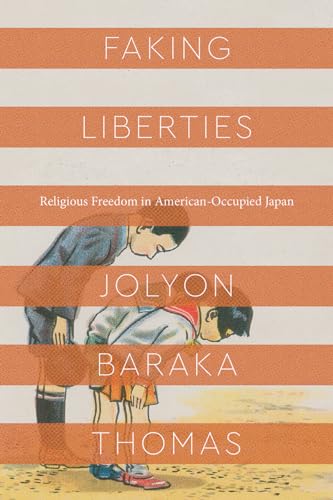
Faking Liberties: Religious Freedom in American-Occupied Japan (Class 200: New Studies in Religion) - Softcover
Inhaltsangabe
Religious freedom is a founding tenet of the United States, and it has frequently been used to justify policies towards other nations. Such was the case in 1945 when Americans occupied Japan following World War II. Though the Japanese constitution had guaranteed freedom of religion since 1889, the United States declared that protection faulty, and when the occupation ended in 1952, they claimed to have successfully replaced it with “real” religious freedom.
Through a fresh analysis of pre-war Japanese law, Jolyon Baraka Thomas demonstrates that the occupiers’ triumphant narrative obscured salient Japanese political debates about religious freedom. Indeed, Thomas reveals that American occupiers also vehemently disagreed about the topic. By reconstructing these vibrant debates, Faking Liberties unsettles any notion of American authorship and imposition of religious freedom. Instead, Thomas shows that, during the Occupation, a dialogue about freedom of religion ensued that constructed a new global set of political norms that continue to form policies today.
Die Inhaltsangabe kann sich auf eine andere Ausgabe dieses Titels beziehen.
Über die Autorin bzw. den Autor
Jolyon Baraka Thomas is an assistant professor of religious studies at the University of Pennsylvania.
Auszug. © Genehmigter Nachdruck. Alle Rechte vorbehalten.
Faking Liberties
Religious Freedom in American-Occupied Japan
By Jolyon Baraka ThomasThe University of Chicago Press
Copyright © 2019 The University of Chicago
All rights reserved.
ISBN: 978-0-226-61882-1All rights reserved.
Contents
Prologue: The Drums of War,
Conventions,
Introduction: The Universal Particularity of Religious Freedom,
A PREOCCUPATION WITH RELIGIOUS FREEDOM,
1 The Meiji Constitutional Regime as a Secularist System,
2 Who Needs Religious Freedom?,
3 Domestic Problems, Diplomatic Solutions,
4 In the Absence of Religious Freedom,
THE OCCUPATION OF RELIGIOUS STUDIES,
5 State Shinto as a Heretical Secularism,
6 Who Wants Religious Freedom?,
7 Universal Rights, Unique Circumstances,
8 Out of the Spiritual Vacuum,
Conclusion: The Bellicose Pacifism of Religious Freedom,
Epilogue: Songs of Freedom,
Acknowledgments,
Abbreviations,
Notes,
References,
Index,
CHAPTER 1
THE MEIJI CONSTITUTIONAL REGIME AS A SECULARIST SYSTEM
If the "Shinto" of the proponents [of making Shinto the national religion] indicates the Great Divine Way [kannagara no daido], then it is neither a national religion [kokkyo] nor a popular religion [minkyo]. As long as one is a Japanese citizen, it [the Great Divine Way] is one's conviction, the object of one's respect, and the inexhaustible article of faith. However, what we must understand is that the Great Divine Way is not a religion. If it was a religion, because belief is free [under the constitution], then that article of faith and that respect [characteristic of the Great Divine Way] would be circumscribed. The general meaning of the Great Divine Way is different; it is the supreme directive to Japanese people. More than a supreme directive, it is the same as [being] "Japanese." From the moment we are born, it suffuses the bodies and spirits of us Japanese. In contrast to this, Sect Shinto, Buddhism, and Christianity are religions. Because they are religions, according to the point established by the constitution, "Japanese subjects shall, within limits not prejudicial to peace and order, and not antagonistic to their duties as subjects, enjoy freedom of religious belief." Therefore the arguments for national and popular religions enter into the problem of constitutional revision, and should not be taken lightly.
Ando Masazumi (1942)
In an 1872 open letter penned in English and submitted to Japanese prime minister Sanjo Saneyoshi (1837–91), famed statesman Mori Arinori (1847–89) wrote the following:
Among many important human concerns, the one respecting our religious faith appears to be the most vital. In all the enlightened nations of the earth, the liberty of conscience, especially in matters of religious faith, is sacredly regarded as not only an inherent right of man, but also as a most fundamental element to advance all human interests.
It is a strange and grievous fact that we fail to find in the whole history of the long and glorious continuance of our intelligent race, a trace of the recognition in any form of this sacred right. It is even more remarkable, amid the wonderful progress we now behold, that our people are not as yet quite earnest and thorough in their consideration of this important subject.
Mori went on to propose that the Japanese government establish proper laws "by which all the proper rights of man shall be recognized and protected from violence," and that it establish an educational system "by which the whole condition of our people shall be so elevated that their moral strength will sufficiently protect their rights, even without the additional dry and unsatisfactory shield of the written law of the state."
The problem that Mori aimed to address was epistemological as much as it was legal. To think of religious freedom as a right that needed to be protected, one needed the modern concept of religion: exclusivist, private, belief-centric, a universal genus of which there were many competing species. To think of religious freedom as an "inherent right of man," one needed to think of rights as inalienable (even as one also thought of them as endangered). As Japan's first ambassador to the United States, Mori was keenly aware of these issues. He knew that solving some of Japan's most pressing diplomatic concerns, such as revising unequal treaties, hinged on them (hence the simultaneous publication of his missive in both English and Japanese).
By the time Japanese oligarchs promulgated the Meiji Constitution in the name of the emperor in February 1889, Mori and his colleague Ito Hirobumi (1841–1909) had successfully made the case that incorporating a provision for religious freedom in the national charter would definitively mark Japan as one of the few "civilized" nations of the world. But Mori was stabbed on the very day that the new constitution was promulgated, and he died the following day. The assassination of one of Japan's foremost champions of religious freedom at the hands of an ultranationalist who was purportedly enraged by Mori's alleged disrespectful comportment at the Ise Shrines could easily seem to presage the demise of religious freedom in Japan.
Indeed, although the Meiji Constitution incorporated a clause guaranteeing freedom of religious belief that was similar in wording and scope to the constitutions of many contemporaneous European constitutional monarchies, scholars writing in the postwar period have frequently suggested that the Japanese clause was inherently flawed. Some have argued that the architects of the Meiji state failed to understand "real" religious freedom and therefore unnecessarily circumscribed this crucial civil liberty through the language of civic duties. They also claim that the constitutional clause proved to be ineffective at protecting the rights of marginal groups such as Christians or members of the many religious confraternities, sects, and movements that flourished in the late nineteenth and early twentieth centuries. Many have also argued that the small degree of religious freedom the constitution guaranteed was attenuated, and then wholly abandoned, in the years following its promulgation.
For example, the "clash of education and religion" debates that followed the Christian educator Uchimura Kanzo's (1861–1930) principled refusal to bow before the imperial portrait in 1891 revealed significant disagreements about how to balance the "duties of subjects" with the provision for religious liberty. Subsequent police crackdowns on marginal movements such as Renmonkyo (late 1890s) and Omotokyo (1921 and 1935) seemed to confirm that "real" religious liberty in Japan breathed its last breath along with its former champion Mori in 1889. When Japan lost the Pacific War and the Allied Occupation began, the occupiers in charge of religions policy repeatedly claimed that Japan had no genuine tradition of religious freedom. Japanese modernizers made similar claims in support of their own reformist projects. In these postwar accounts, Japanese religious freedom was born with Mori's 1872 missive and died with him the day after the Meiji Constitution was promulgated. Religious freedom, the story goes, only returned to life when the benevolent American occupiers swooped in to Japan at the close of the war, liberating Japan's citizens from their oppressive and theocratic government.
There are very good reasons to question this pat narrative, particularly because it clearly served the political purpose of justifying Occupation...
„Über diesen Titel“ kann sich auf eine andere Ausgabe dieses Titels beziehen.
Suchergebnisse für Faking Liberties: Religious Freedom in American-Occupied...

Beispielbild für diese ISBN
Faking Liberties
Anbieter: PBShop.store US, Wood Dale, IL, USA
Verkäuferbewertung 5 von 5 Sternen

PAP. Zustand: New. New Book. Shipped from UK. Established seller since 2000. Artikel-Nr. FW-9780226618821
Beispielbild für diese ISBN
Faking Liberties
Anbieter: PBShop.store UK, Fairford, GLOS, Vereinigtes Königreich
Verkäuferbewertung 5 von 5 Sternen
PAP. Zustand: New. New Book. Shipped from UK. Established seller since 2000. Artikel-Nr. FW-9780226618821
Neu kaufen
EUR 38,64
EUR 5,92 Versand
Versand von Vereinigtes Königreich nach USA
Versand von Vereinigtes Königreich nach USA
Anzahl: 15 verfügbar
Beispielbild für diese ISBN
Faking Liberties: Religious Freedom in American-Occupied Japan (Class 200: New Studies in Religion)
Anbieter: Majestic Books, Hounslow, Vereinigtes Königreich
Verkäuferbewertung 4 von 5 Sternen

Zustand: New. pp. 336. Artikel-Nr. 382803236
Neu kaufen
EUR 42,30
EUR 7,67 Versand
Versand von Vereinigtes Königreich nach USA
Versand von Vereinigtes Königreich nach USA
Anzahl: 3 verfügbar
Beispielbild für diese ISBN
Faking Liberties Religious Freedom in AmericanOccupied Japan
Anbieter: Revaluation Books, Exeter, Vereinigtes Königreich
Verkäuferbewertung 5 von 5 Sternen
Paperback. Zustand: Brand New. 356 pages. 8.75x6.00x0.75 inches. In Stock. Artikel-Nr. __022661882X
Neu kaufen
EUR 35,48
EUR 14,75 Versand
Versand von Vereinigtes Königreich nach USA
Versand von Vereinigtes Königreich nach USA
Anzahl: 2 verfügbar
Beispielbild für diese ISBN
Faking Liberties: Religious Freedom in American-Occupied Japan (Class 200: New Studies in Religion)
Anbieter: Kennys Bookstore, Olney, MD, USA
Verkäuferbewertung 5 von 5 Sternen
Zustand: New. 2019. Paperback. . . . . . Books ship from the US and Ireland. Artikel-Nr. V9780226618821
Neu kaufen
EUR 42,60
EUR 9,37 Versand
Versand innerhalb von USA
Versand innerhalb von USA
Anzahl: Mehr als 20 verfügbar
Beispielbild für diese ISBN
Faking Liberties: Religious Freedom in American-Occupied Japan (Class 200: New Studies in Religion)
Anbieter: Ria Christie Collections, Uxbridge, Vereinigtes Königreich
Verkäuferbewertung 5 von 5 Sternen
Zustand: New. In English. Artikel-Nr. ria9780226618821_new
Neu kaufen
EUR 42,29
EUR 13,32 Versand
Versand von Vereinigtes Königreich nach USA
Versand von Vereinigtes Königreich nach USA
Anzahl: Mehr als 20 verfügbar