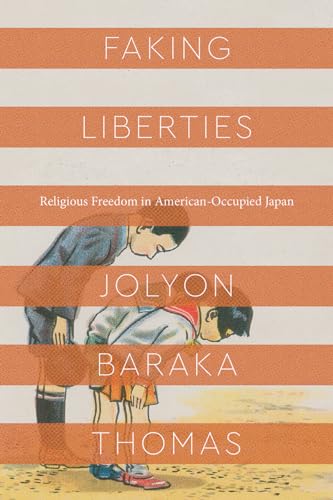
Faking Liberties: Religious Freedom in American-Occupied Japan (Class 200: New Studies in Religion) - Softcover
Inhaltsangabe
Religious freedom is a founding tenet of the United States, and it has frequently been used to justify policies towards other nations. Such was the case in 1945 when Americans occupied Japan following World War II. Though the Japanese constitution had guaranteed freedom of religion since 1889, the United States declared that protection faulty, and when the occupation ended in 1952, they claimed to have successfully replaced it with “real” religious freedom.
Through a fresh analysis of pre-war Japanese law, Jolyon Baraka Thomas demonstrates that the occupiers’ triumphant narrative obscured salient Japanese political debates about religious freedom. Indeed, Thomas reveals that American occupiers also vehemently disagreed about the topic. By reconstructing these vibrant debates, Faking Liberties unsettles any notion of American authorship and imposition of religious freedom. Instead, Thomas shows that, during the Occupation, a dialogue about freedom of religion ensued that constructed a new global set of political norms that continue to form policies today.
Die Inhaltsangabe kann sich auf eine andere Ausgabe dieses Titels beziehen.
Über die Autorin bzw. den Autor
Jolyon Baraka Thomas is an assistant professor of religious studies at the University of Pennsylvania.
Auszug. © Genehmigter Nachdruck. Alle Rechte vorbehalten.
Faking Liberties
Religious Freedom in American-Occupied Japan
By Jolyon Baraka ThomasThe University of Chicago Press
Copyright © 2019 The University of Chicago
All rights reserved.
ISBN: 978-0-226-61882-1All rights reserved.
Contents
Prologue: The Drums of War,
Conventions,
Introduction: The Universal Particularity of Religious Freedom,
A PREOCCUPATION WITH RELIGIOUS FREEDOM,
1 The Meiji Constitutional Regime as a Secularist System,
2 Who Needs Religious Freedom?,
3 Domestic Problems, Diplomatic Solutions,
4 In the Absence of Religious Freedom,
THE OCCUPATION OF RELIGIOUS STUDIES,
5 State Shinto as a Heretical Secularism,
6 Who Wants Religious Freedom?,
7 Universal Rights, Unique Circumstances,
8 Out of the Spiritual Vacuum,
Conclusion: The Bellicose Pacifism of Religious Freedom,
Epilogue: Songs of Freedom,
Acknowledgments,
Abbreviations,
Notes,
References,
Index,
CHAPTER 1
THE MEIJI CONSTITUTIONAL REGIME AS A SECULARIST SYSTEM
If the "Shinto" of the proponents [of making Shinto the national religion] indicates the Great Divine Way [kannagara no daido], then it is neither a national religion [kokkyo] nor a popular religion [minkyo]. As long as one is a Japanese citizen, it [the Great Divine Way] is one's conviction, the object of one's respect, and the inexhaustible article of faith. However, what we must understand is that the Great Divine Way is not a religion. If it was a religion, because belief is free [under the constitution], then that article of faith and that respect [characteristic of the Great Divine Way] would be circumscribed. The general meaning of the Great Divine Way is different; it is the supreme directive to Japanese people. More than a supreme directive, it is the same as [being] "Japanese." From the moment we are born, it suffuses the bodies and spirits of us Japanese. In contrast to this, Sect Shinto, Buddhism, and Christianity are religions. Because they are religions, according to the point established by the constitution, "Japanese subjects shall, within limits not prejudicial to peace and order, and not antagonistic to their duties as subjects, enjoy freedom of religious belief." Therefore the arguments for national and popular religions enter into the problem of constitutional revision, and should not be taken lightly.
Ando Masazumi (1942)
In an 1872 open letter penned in English and submitted to Japanese prime minister Sanjo Saneyoshi (1837–91), famed statesman Mori Arinori (1847–89) wrote the following:
Among many important human concerns, the one respecting our religious faith appears to be the most vital. In all the enlightened nations of the earth, the liberty of conscience, especially in matters of religious faith, is sacredly regarded as not only an inherent right of man, but also as a most fundamental element to advance all human interests.
It is a strange and grievous fact that we fail to find in the whole history of the long and glorious continuance of our intelligent race, a trace of the recognition in any form of this sacred right. It is even more remarkable, amid the wonderful progress we now behold, that our people are not as yet quite earnest and thorough in their consideration of this important subject.
Mori went on to propose that the Japanese government establish proper laws "by which all the proper rights of man shall be recognized and protected from violence," and that it establish an educational system "by which the whole condition of our people shall be so elevated that their moral strength will sufficiently protect their rights, even without the additional dry and unsatisfactory shield of the written law of the state."
The problem that Mori aimed to address was epistemological as much as it was legal. To think of religious freedom as a right that needed to be protected, one needed the modern concept of religion: exclusivist, private, belief-centric, a universal genus of which there were many competing species. To think of religious freedom as an "inherent right of man," one needed to think of rights as inalienable (even as one also thought of them as endangered). As Japan's first ambassador to the United States, Mori was keenly aware of these issues. He knew that solving some of Japan's most pressing diplomatic concerns, such as revising unequal treaties, hinged on them (hence the simultaneous publication of his missive in both English and Japanese).
By the time Japanese oligarchs promulgated the Meiji Constitution in the name of the emperor in February 1889, Mori and his colleague Ito Hirobumi (1841–1909) had successfully made the case that incorporating a provision for religious freedom in the national charter would definitively mark Japan as one of the few "civilized" nations of the world. But Mori was stabbed on the very day that the new constitution was promulgated, and he died the following day. The assassination of one of Japan's foremost champions of religious freedom at the hands of an ultranationalist who was purportedly enraged by Mori's alleged disrespectful comportment at the Ise Shrines could easily seem to presage the demise of religious freedom in Japan.
Indeed, although the Meiji Constitution incorporated a clause guaranteeing freedom of religious belief that was similar in wording and scope to the constitutions of many contemporaneous European constitutional monarchies, scholars writing in the postwar period have frequently suggested that the Japanese clause was inherently flawed. Some have argued that the architects of the Meiji state failed to understand "real" religious freedom and therefore unnecessarily circumscribed this crucial civil liberty through the language of civic duties. They also claim that the constitutional clause proved to be ineffective at protecting the rights of marginal groups such as Christians or members of the many religious confraternities, sects, and movements that flourished in the late nineteenth and early twentieth centuries. Many have also argued that the small degree of religious freedom the constitution guaranteed was attenuated, and then wholly abandoned, in the years following its promulgation.
For example, the "clash of education and religion" debates that followed the Christian educator Uchimura Kanzo's (1861–1930) principled refusal to bow before the imperial portrait in 1891 revealed significant disagreements about how to balance the "duties of subjects" with the provision for religious liberty. Subsequent police crackdowns on marginal movements such as Renmonkyo (late 1890s) and Omotokyo (1921 and 1935) seemed to confirm that "real" religious liberty in Japan breathed its last breath along with its former champion Mori in 1889. When Japan lost the Pacific War and the Allied Occupation began, the occupiers in charge of religions policy repeatedly claimed that Japan had no genuine tradition of religious freedom. Japanese modernizers made similar claims in support of their own reformist projects. In these postwar accounts, Japanese religious freedom was born with Mori's 1872 missive and died with him the day after the Meiji Constitution was promulgated. Religious freedom, the story goes, only returned to life when the benevolent American occupiers swooped in to Japan at the close of the war, liberating Japan's citizens from their oppressive and theocratic government.
There are very good reasons to question this pat narrative, particularly because it clearly served the political purpose of justifying Occupation reforms related to religion. If we only look at historical sources generated during the Occupation and in the first several decades after it, then Japan during what I will call the Meiji constitutional period appears wholly bereft of religious freedom. If, however, we examine sources from the Meiji constitutional period itself, we find instead a surfeit of discussion about religious freedom and ideal religion-state relations. Japanese people were not ignorant of religious freedom. In fact, they were deeply concerned about it and were constantly trying to figure out how to make it work. Because they had adopted the category of "religion" in their diplomatic relations and because they had formally separated religion from politics in constitutional law, Japanese people had to distinguish religion from not-religion. The problem was that not everyone agreed on where to draw the line. The religion/not-religion distinction established in Japanese constitutional law prompted ongoing anxiety about how to separate religion from other aspects of social and political life. This uncertainty prompted a range of stakeholders to weigh in on the vexing question of whether compulsory participation in shrine rites constituted infringement on the right to religious liberty.
This background chapter tracks the ebbs and flows of this contentious discourse in broad strokes by focusing on how debates about religious freedom revealed the shifting and diverse religion/not-religion distinctions that undergirded the Meiji constitutional regime. Subsequent chapters of part 1 focus on particular legal debates in which specific interest groups defined and defended religious freedom as they understood it. I show that religious freedom is not simply a matter of constitutional law or national policy, but is rather determined at subnational scales in response to disputes over property, privileges, and precedent. I also show that Japan's relationship with religious freedom was not aberrant in comparison to global norms. Japanese interest groups tactically imported and adapted interpretations of religious freedom based on their interpretations of what worked for "civilized" North American and European nations. In chapter 3, I show through examples of Japanese immigrant experiences in the United States that American perspectives on religious freedom were just as incoherent as Japanese practices were. Collectively, the chapters of part 1 thoroughly undermine the occupiers' claim that they understood religious freedom and that their Japanese counterparts did not.
To make this claim stick, I first have to prove that prewar and wartime Japan was repressive not because it was dominated by a state religion, as has commonly been assumed, but rather because the religion/not-religion arrangement adopted in the Meiji Constitution allowed politicians, policy makers, priests, and police to designate certain practices as deserving of protection and others as inimical to peace and order. It was the act of discriminating between religion and not-religion that allowed for draconian crackdowns on particular movements and apparent infringements on religious liberty, not the dominance of what scholars before me have called "State Shinto." Put differently, what we know today as State Shinto was a symptom of a deeper conceptual arrangement, not the cause of illiberal practices of governance. As Yijiang Zhong has stated, the modern Japanese state "should not be understood as a peculiar case in which an irrational and religious form of divine authority was mobilized to justify an authoritarian modern state." Instead, "the formation of the ambivalent political authority in Meiji Japan was a process galvanized by the imperative to devise and institute the mutually constituting categories of the religious and the secular, in order to construct the formally secular, public, political authority of the modern nation-state."
Japanese secularity was not weird. It was normal. It is the normalcy of the Japanese religion/not-religion distinction that should disturb us, not the peculiar qualities of theocratic State Shinto. There is no doubt whatsoever that the prewar and wartime Japanese state was unjust. Police surveilled and suppressed religious groups. Religious leaders died in prison. But our diagnosis of why this state of affairs was even possible has been deeply flawed.
DEMARCATING THE MEIJI CONSTITUTIONAL PERIOD
The common claim that the Occupation introduced religious freedom where there previously was none is ideologically driven more than it is factually correct. It overlooks a mountain of historical evidence that indisputably demonstrates that Japanese people argued vociferously throughout the time the Meiji Constitution was in effect about what religious freedom meant and how it could best be secured. In addition to debating the meaning of the words "religion" and "freedom" and what it meant to juxtapose them, stakeholders attempted to define a constellation of related terms such as superstition, morality, tradition, and civic ritual. While Article 28 of the Meiji Constitution clearly circumscribed the guarantee of religious freedom offered to Japanese imperial subjects through its references to "duties" and "peace and order," it did not deny them that freedom outright, nor was its language particularly strict in comparison with other constitutions of the time.
To my knowledge few have systematically examined this period when Japan's first constitutional guarantee of religious freedom was in effect as a discrete historical era, but there are compelling reasons to do so. The period from 1890 to 1945 was bookended by interactions with the United States (especially) and European nations in which the concept of religious freedom played a major role. It opened with the Japanese government's overt attempt to appeal to the international community by providing a constitutional guarantee of religious freedom as one mark of Japan's entry into the ranks of "civilized" nations. It closed when the occupiers suspended the Meiji Constitution at the formal onset of the Occupation.
The subsequent promulgation of the American-drafted "Peace Constitution" in November 1946 was designed to replace the previous Japanese system of religion-state relations with a new democratic system characterized by what the occupiers understood as "real religious freedom." Understandably, this watershed legal-historical moment has attracted considerable academic attention and remains a hotly contested point in contemporary Japanese politics. I take up the ramifications of the American reforms in the second half of this book, but my unconventional periodization in the first half focuses attention on the broad characteristics of the legal regime that preceded this stunning Occupation intervention into Japanese political life.
My periodization also serves as a corrective for the fact that many studies of modern Japanese religions have focused on the Meiji era (1868–1912) at the expense of sustained engagement with broader time spans. Conversely, some scholars specializing in the history of Shinto and its relationship with the state have treated the entirety of the period from 1868 to 1945 as a single historical period, often making the inaccurate assertion that Shinto served as Japan's national religion throughout that time. The former approach artificially divides up history according to imperial reign dates and therefore obscures legal and political continuities across different eras of imperial rule. The latter approach articulates history according to two drastic political transitions (the "restoration" of direct rule to the emperor in 1868; the "democratization" of Japan in 1945), but it obscures significant conceptual, legal, and political shifts that took place both during and across the Meiji (1868–1912), Taisho (1912–26), and early Showa (1926–89) eras. Many of these shifts were associated with major changes in the position of religion in Japanese society, law, and politics. Here I will trace a few of the main dynamics that contributed to the prevailing understandings of religion and law in the period under question, providing a brief overview of the prehistory of the Meiji Constitution before I discuss the impact of the formal establishment of religious freedom in constitutional law.
The Prehistory of the Meiji Constitutional Religious Freedom Clause
The 1889 provision of a constitutional religious freedom clause represented a major change from the Japanese government's earlier attempts to establish a single "national teaching." Historically, the tradition we now call Shinto had only recently come into its own as a discrete religion distinct from Buddhism, with a series of purifying moves beginning in the fourteenth century culminating in the forceful separation of Shinto and Buddhism following the political revolution of 1868. After the political transition "restoring" the emperor to direct rule in 1868, a brief period of anti-Buddhist violence known as haibutsu kishaku ("destroy the buddhas; expel Sakyamuni") ensued. During this time, proponents of making Shinto the national religion advocated the utter rejection of Buddhism as a foreign creed unsuitable to the Japanese national character.
By the time the anti-Buddhist fervor died down in the early 1870s, the architects of the modern Japanese state began experimenting with religion and education as methods for fostering a new sense of national identity. This effort characterized the Great Promulgation Campaign (Taikyo senpu undo) that took place between 1872 and 1884, when the state enrolled Shinto priests, Buddhist clerics, and popular entertainers in the project of disseminating a vague "national teaching" to the populace through standardized lectures on the three basic doctrines of "revering the gods and loving the country," "following the principle of heaven and the way of humanity," and "dedicating oneself to the emperor and honoring and protecting the court."
The project was fraught from the outset. In the wake of the anti-Buddhist persecution of the late 1860s, Buddhist commitment to the new "national teaching" campaign was understandably muted. The Japanese state had also intervened in Buddhist affairs by bypassing clerical authority in matters of marriage and diet. The nikujiki saitai edict of 1872 gave priests permission to eat meat and to marry, effectively annulling a long-standing legal arrangement in which Buddhist clerics were regarded as separate from ordinary citizens due to their ascetic commitments. Buddhists resented state intrusion into what they saw as their traditional jurisdictions and the perquisites that accompanied clerical status. Controversial land reforms in the 1870s and 1880s exacerbated these tensions when the state expropriated public lands that had previously been leased to Buddhist organizations in a long-term arrangement with the Tokugawa government. Governmental interference in shrines' and temples' customary rights to land and property would recur during the Meiji constitutional period (see chapter 4) and under the Occupation (see chapter 6). A new governmental policy of tolerating Christianity after centuries of prohibition further complicated the tense relationship between Buddhist and Shinto priests, spurring battles over customary rights and over the proper definition of "religion."
(Continues...)
Excerpted from Faking Liberties by Jolyon Baraka Thomas. Copyright © 2019 The University of Chicago. Excerpted by permission of The University of Chicago Press.
All rights reserved. No part of this excerpt may be reproduced or reprinted without permission in writing from the publisher.
Excerpts are provided by Dial-A-Book Inc. solely for the personal use of visitors to this web site.
„Über diesen Titel“ kann sich auf eine andere Ausgabe dieses Titels beziehen.
Weitere beliebte Ausgaben desselben Titels

Suchergebnisse für Faking Liberties: Religious Freedom in American-Occupied...

Beispielbild für diese ISBN
Faking Liberties
Anbieter: PBShop.store US, Wood Dale, IL, USA
Verkäuferbewertung 5 von 5 Sternen

PAP. Zustand: New. New Book. Shipped from UK. Established seller since 2000. Artikel-Nr. FW-9780226618821
Beispielbild für diese ISBN
Faking Liberties
Anbieter: PBShop.store UK, Fairford, GLOS, Vereinigtes Königreich
Verkäuferbewertung 5 von 5 Sternen
PAP. Zustand: New. New Book. Shipped from UK. Established seller since 2000. Artikel-Nr. FW-9780226618821
Neu kaufen
EUR 36,47
EUR 5,72 shipping
Versand von Vereinigtes Königreich nach USA
Versand von Vereinigtes Königreich nach USA
Anzahl: 15 verfügbar
Beispielbild für diese ISBN
Faking Liberties: Religious Freedom in American-Occupied Japan (Class 200: New Studies in Religion)
Anbieter: Majestic Books, Hounslow, Vereinigtes Königreich
Verkäuferbewertung 4 von 5 Sternen

Zustand: New. pp. 336. Artikel-Nr. 382803236
Neu kaufen
EUR 41,63
EUR 7,40 shipping
Versand von Vereinigtes Königreich nach USA
Versand von Vereinigtes Königreich nach USA
Anzahl: 3 verfügbar
Beispielbild für diese ISBN
Faking Liberties Religious Freedom in AmericanOccupied Japan
Anbieter: Revaluation Books, Exeter, Vereinigtes Königreich
Verkäuferbewertung 5 von 5 Sternen
Paperback. Zustand: Brand New. 356 pages. 8.75x6.00x0.75 inches. In Stock. Artikel-Nr. __022661882X
Neu kaufen
EUR 38,76
EUR 14,24 shipping
Versand von Vereinigtes Königreich nach USA
Versand von Vereinigtes Königreich nach USA
Anzahl: 2 verfügbar
Foto des Verkäufers
Faking Liberties: Religious Freedom in American-Occupied Japan
Verlag:
The University of Chicago Press, 2019
ISBN 10: 022661882X
ISBN 13: 9780226618821
Neu
Softcover
Anbieter: moluna, Greven, Deutschland
Verkäuferbewertung 4 von 5 Sternen
Zustand: New. Artikel-Nr. 257176411
Neu kaufen
EUR 43,93
EUR 48,99 shipping
Versand von Deutschland nach USA
Versand von Deutschland nach USA
Anzahl: Mehr als 20 verfügbar
Foto des Verkäufers
Faking Liberties
Verlag:
University Of Chicago Press Apr 2019, 2019
ISBN 10: 022661882X
ISBN 13: 9780226618821
Neu
Taschenbuch
Anbieter: AHA-BUCH GmbH, Einbeck, Deutschland
Verkäuferbewertung 5 von 5 Sternen
Taschenbuch. Zustand: Neu. Neuware. Artikel-Nr. 9780226618821
Neu kaufen
EUR 54,50
EUR 62,60 shipping
Versand von Deutschland nach USA
Versand von Deutschland nach USA
Anzahl: 2 verfügbar