
Verwandte Artikel zu The View from Somewhere: Undoing the Myth of Journalistic...
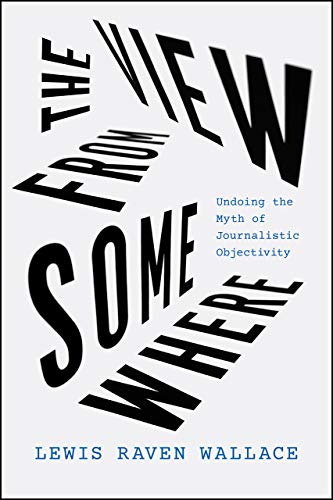
Inhaltsangabe
A look at the history and myth of the objective journalist and how this ideal has been used to silence marginalized voices.
In The View from Somewhere, Lewis Raven Wallace dives deep into the history of “objectivity” in journalism and how its been used to gatekeep and silence marginalized writers as far back as Ida B. Wells. At its core, this is a book about fierce journalists who have pursued truth and transparency and sometimes been punished for it—not just by tyrannical governments but by journalistic institutions themselves. He highlights the stories of journalists who question “objectivity” with sensitivity and passion: Desmond Cole of the Toronto Star; New York Times reporter Linda Greenhouse; Pulitzer Prize-winner Rachel Kaadzi Ghansah; Peabody-winning podcaster John Biewen; Guardian correspondent Gary Younge; former Buzzfeed reporter Meredith Talusan; and many others. Wallace also shares his own experiences as a midwestern transgender journalist and activist who was fired from his job as a national reporter for public radio for speaking out against “objectivity” in coverage of Trump and white supremacy.
With insightful steps through history, Wallace stresses that journalists have never been mere passive observers. Using historical and contemporary examples—from lynching in the nineteenth century to transgender issues in the twenty-first—Wallace offers a definitive critique of “objectivity” as a catchall for accurate journalism. He calls for the dismissal of this damaging mythology in order to confront the realities of institutional power, racism, and other forms of oppression and exploitation in the news industry.
The View from Somewhere is a compelling rallying cry against journalist neutrality and for the validity of news told from distinctly subjective voices.
In The View from Somewhere, Lewis Raven Wallace dives deep into the history of “objectivity” in journalism and how its been used to gatekeep and silence marginalized writers as far back as Ida B. Wells. At its core, this is a book about fierce journalists who have pursued truth and transparency and sometimes been punished for it—not just by tyrannical governments but by journalistic institutions themselves. He highlights the stories of journalists who question “objectivity” with sensitivity and passion: Desmond Cole of the Toronto Star; New York Times reporter Linda Greenhouse; Pulitzer Prize-winner Rachel Kaadzi Ghansah; Peabody-winning podcaster John Biewen; Guardian correspondent Gary Younge; former Buzzfeed reporter Meredith Talusan; and many others. Wallace also shares his own experiences as a midwestern transgender journalist and activist who was fired from his job as a national reporter for public radio for speaking out against “objectivity” in coverage of Trump and white supremacy.
With insightful steps through history, Wallace stresses that journalists have never been mere passive observers. Using historical and contemporary examples—from lynching in the nineteenth century to transgender issues in the twenty-first—Wallace offers a definitive critique of “objectivity” as a catchall for accurate journalism. He calls for the dismissal of this damaging mythology in order to confront the realities of institutional power, racism, and other forms of oppression and exploitation in the news industry.
The View from Somewhere is a compelling rallying cry against journalist neutrality and for the validity of news told from distinctly subjective voices.
Die Inhaltsangabe kann sich auf eine andere Ausgabe dieses Titels beziehen.
Über die Autorin bzw. den Autor
Lewis Raven Wallace is an independent journalist, a co-founder of Press On, a southern movement journalism collective, and the host of The View from Somewhere podcast. He previously worked in public radio and is a longtime activist engaged in prison abolition, racial justice, and queer and trans liberation. He is a white transgender person from the Midwest and is now based in North Carolina.
Auszug. © Genehmigter Nachdruck. Alle Rechte vorbehalten.
The View From Somewhere
Undoing the Myth of Journalistic Objectivity
By Lewis Raven WallaceThe University of Chicago Press
Copyright © 2019 Lewis Wallace
All rights reserved.
ISBN: 978-0-226-58917-6All rights reserved.
Contents
Introduction, 1,
1 How Black Lives Matter Made the News,
2 The Deviants: Race, Lynching, and the Origins of "Objectivity",
3 The Agitators: Journalists as Labor Leaders,
4 Drowning in Facts: "Objectivity," Ambiguity, and Vietnam,
5 "Public Radio Voice",
6 Straight News, Gay Media, and the AIDS Crisis,
7 Journalism's Purity Ritual,
8 "Can't You Find Any More Women to Attack?": What Happens When Facts Don't Matter,
9 Truth and the Lost Cause,
10 The "Assault on Reality": Trans People and Subjectivity,
11 The View from Somewhere,
Conclusion: The End of Journalism,
Acknowledgments,
Further Reading,
Index,
CHAPTER 1
HOW BLACK LIVES MAT TER MADE THE NEWS
It was barely August, and I was doing early morning shifts as a radio host. That meant getting up right around sunrise and biking a few blocks through thick summer shadows to WYSO, the small radio station on the campus of Antioch College. Our newsroom was bare bones. A clunky PC glowed from one of the two desks, wire copy popping up on the screen in a steady stream. It was still called wire copy, as if it comes to us through an old telegraph wire, but it was actually the Associated Press sending dispatches over the internet. Every morning I'd sit in the dark, drink coffee, and run my eyes over tornados and fires and kidnappings and infanticides and voter turnout and political play-by-plays, the occasional "human interest" story. Once in a while there'd be some bit of humor or joy, usually on a slow news day.
On this particular morning shift, the story that jumped out at me was a police story, or rather a story about a man and the police, a quick AP dispatch about an event in Beavercreek, Ohio, a suburb ten miles from where I was sitting in the air-conditioned dark, with my face lit by the virtual wire. It opened something like this:
A man in a southwest Ohio Wal-Mart store waved a rifle at customers, including children, and was fatally shot by police when he wouldn't drop the weapon, according to police and a recorded 911 call from a witness.
Authorities say a customer also died after suffering a medical problem during the evacuation of the store Tuesday. Police identified her as Angela Williams, 37, of Fairborn.
Police identified the man shot Tuesday night at a Wal-Mart in the Dayton suburb of Beavercreek as 22-year-old John Crawford of Cincinnati. He died at a hospital.
He waved a rifle. He wouldn't drop the weapon. Did I revise the wording, knowing even then to be skeptical of police narratives? I might have added another "police say" to qualify, aware that a man who is dead cannot tell his side of the story. I had, after all, been an activist around this stuff for years; before I was a journalist, I co-created and ran a website full of young people of color's stories about harassment and violence at the hands of police in Chicago. Growing up, my dad, an attorney, had told me, "Cops always lie." So I knew enough to know that a police statement does not a true story make. What I didn't know was that this was the beginning of the end of my faith in the whole system of news-making into which I'd been trained. That August, everything was about to change — the way the news covered policing, the way I thought about the news, and the relationship between activism and the news. It was a tipping point, but I couldn't see that yet.
Of course I couldn't. It was 5:30 a.m.; I was alone in the so-called newsroom, rushed because I was prepping for a 6 a.m. hard start, when I'd have to be ready with a four-minute newscast, the weather for today and this week, and traffic updates, saying all this into a mic while operating the soundboard and not making mistakes of any kind, or at least not making the kind of mistakes people catch: a mispronunciation, a wrong name, a verbal stumble, running over my time. With an audience of several thousand even that early, people notice when you mess up.
So that morning, in a mix of other sad stories, I read the copy about that death in Beavercreek and didn't think too much of it — another shitty news day. Beavercreek is an almost-entirely white suburb of Dayton, Ohio. I didn't think much about who the man might be who'd been killed, but I pictured some wacked-out white dude, waving that gun at some kids. Incidents with white dudes and guns seemed to happen every day somewhere, so, sure as I was that journalists shouldn't trust police, I figured they'd stopped some shit from going down that could have been national news, could have dominated my day: "Shooter kills four children in Ohio Walmart," Lewis Wallace reports from Dayton. Instead it was just a "police-involved shooting," a blip. One life, which can begin to seem like nothing when you're reading out death every day. This is horrible, but I'm saying it because it's true and it can become part of how you think when you're doing daily news.
There are lots of true stories in the world. Daily news is where they are first pared down, selected out in a process called "news judgment": the split-second decisions about what is a story, and just how big and new that story is, how much airtime or word count it deserves. The decisions about which truths get told can have a ripple effect — sometimes a protest that gets news coverage becomes a larger protest; an act of violence or terrorism gains imitators and followers; a radical ideology propagates in the mainstream in part because it's been talked about on the news. I was astounded and humbled most days by the fact that I had this kind of power to choose what would become news. There I was, a weird transgender punk, alone in a dark room with my cup of coffee, making decisions that would, in small or large ways, shape what people believed their world was made up of, what was important and possible. I was also acutely aware of the stories that didn't get told, the dispatches that came through the wire and went nowhere. At the time, it was rare that a story about a police shooting got told in much depth. These deaths were covered like poverty or cancer: a thing that happens, too routine to highlight every time in a headline.
If you were one of the people reading newswires in the morning, it was obvious what stories and events were being left out. But for the people listening, it was like they never happened.
The day brightened. People came in and filled up the cheerful old gray-carpeted science building that the radio station was now housed in, after years in a moldy basement under the student center. WYSO was the NPR station for the cities of Dayton and Springfield, but still remained in its founding spot on a college campus, and a strange college campus at that. Antioch is known for its anarchist leanings and frequent closures due to budget problems. Even with the closures, the station had been thriving there consistently since the 1950s, and it had become a mainstay. We had a membership who trusted us, a relatively diverse staff, a robust community outreach program. We were proud that we aired voices from all over the region talking about the problems that affected our listening area, like the still-lingering recession and water pollution and abandoned homes, gas prices and troubled charter schools and closed-up strip malls. We covered immigration, welfare, health care, and the sprawling US Air...
„Über diesen Titel“ kann sich auf eine andere Ausgabe dieses Titels beziehen.
Suchergebnisse für The View from Somewhere: Undoing the Myth of Journalistic...

Beispielbild für diese ISBN
The View from Somewhere Undoi
Verlag:
University of Chicago Press, 2019
ISBN 10: 022658917X
ISBN 13: 9780226589176
Gebraucht
Hardcover
Anbieter: World of Books (was SecondSale), Montgomery, IL, USA
Verkäuferbewertung 5 von 5 Sternen

Zustand: Good. Item in good condition. Textbooks may not include supplemental items i.e. CDs, access codes etc. Artikel-Nr. 00110437211
Gebraucht kaufen
EUR 5,44
Versand gratis
Versand innerhalb von USA
Versand innerhalb von USA
Anzahl: 1 verfügbar
Beispielbild für diese ISBN
The View from Somewhere: Undoing the Myth of Journalistic Objectivity
Verlag:
University of Chicago Press, 2019
ISBN 10: 022658917X
ISBN 13: 9780226589176
Gebraucht
Hardcover
Anbieter: ThriftBooks-Atlanta, AUSTELL, GA, USA
Verkäuferbewertung 5 von 5 Sternen
Hardcover. Zustand: Very Good. No Jacket. Missing dust jacket; May have limited writing in cover pages. Pages are unmarked. ~ ThriftBooks: Read More, Spend Less. Artikel-Nr. G022658917XI4N01
Gebraucht kaufen
EUR 5,96
Versand gratis
Versand innerhalb von USA
Versand innerhalb von USA
Anzahl: 1 verfügbar
Beispielbild für diese ISBN
The View from Somewhere: Undoing the Myth of Journalistic Objectivity
Verlag:
University of Chicago Press, 2019
ISBN 10: 022658917X
ISBN 13: 9780226589176
Gebraucht
Hardcover
Anbieter: ThriftBooks-Dallas, Dallas, TX, USA
Verkäuferbewertung 5 von 5 Sternen
Hardcover. Zustand: Good. No Jacket. Pages can have notes/highlighting. Spine may show signs of wear. ~ ThriftBooks: Read More, Spend Less. Artikel-Nr. G022658917XI3N00
Gebraucht kaufen
EUR 5,96
Versand gratis
Versand innerhalb von USA
Versand innerhalb von USA
Anzahl: 1 verfügbar
Beispielbild für diese ISBN
The View from Somewhere: Undoing the Myth of Journalistic Objectivity
Verlag:
University of Chicago Press, 2019
ISBN 10: 022658917X
ISBN 13: 9780226589176
Gebraucht
Hardcover
Anbieter: ThriftBooks-Atlanta, AUSTELL, GA, USA
Verkäuferbewertung 5 von 5 Sternen
Hardcover. Zustand: Very Good. No Jacket. Former library book; May have limited writing in cover pages. Pages are unmarked. ~ ThriftBooks: Read More, Spend Less. Artikel-Nr. G022658917XI4N10
Gebraucht kaufen
EUR 5,96
Versand gratis
Versand innerhalb von USA
Versand innerhalb von USA
Anzahl: 1 verfügbar
Beispielbild für diese ISBN
The View from Somewhere : Undoing the Myth of Journalistic Objectivity
Verlag:
University of Chicago Press, 2019
ISBN 10: 022658917X
ISBN 13: 9780226589176
Gebraucht
Hardcover
Anbieter: Better World Books: West, Reno, NV, USA
Verkäuferbewertung 5 von 5 Sternen
Zustand: Good. Former library copy. Pages intact with minimal writing/highlighting. The binding may be loose and creased. Dust jackets/supplements are not included. Includes library markings. Stock photo provided. Product includes identifying sticker. Better World Books: Buy Books. Do Good. Artikel-Nr. 42646111-6
Gebraucht kaufen
EUR 7,30
Versand gratis
Versand innerhalb von USA
Versand innerhalb von USA
Anzahl: 1 verfügbar