
Verwandte Artikel zu Does Science Need a Global Language?: English and the...
Inhaltsangabe
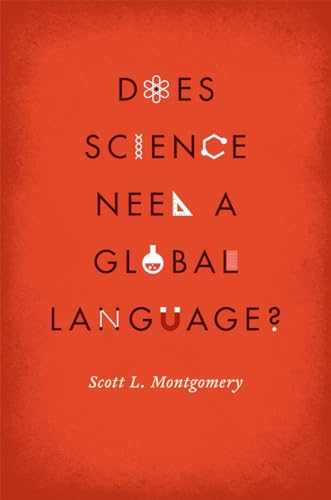
In early 2012, the global scientific community erupted with news that the elusive Higgs boson had likely been found, providing potent validation for the Standard Model of how the universe works. Scientists from more than one hundred countries contributed to this discovery—proving, beyond any doubt, that a new era in science had arrived, an era of multinationalism and cooperative reach. Globalization, the Internet, and digital technology all play a role in making this new era possible, but something more fundamental is also at work. In all scientific endeavors lies the ancient drive for sharing ideas and knowledge, and now this can be accomplished in a single tongue— English. But is this a good thing?
In Does Science Need a Global Language?, Scott L. Montgomery seeks to answer this question by investigating the phenomenon of global English in science, how and why it came about, the forms in which it appears, what advantages and disadvantages it brings, and what its future might be. He also examines the consequences of a global tongue, considering especially emerging and developing nations, where research is still at a relatively early stage and English is not yet firmly established.
Throughout the book, he includes important insights from a broad range of perspectives in linguistics, history, education, geopolitics, and more. Each chapter includes striking and revealing anecdotes from the front-line experiences of today’s scientists, some of whom have struggled with the reality of global scientific English. He explores topics such as student mobility, publication trends, world Englishes, language endangerment, and second language learning, among many others. What he uncovers will challenge readers to rethink their assumptions about the direction of contemporary science, as well as its future.
Die Inhaltsangabe kann sich auf eine andere Ausgabe dieses Titels beziehen.
Über die Autorin bzw. den Autor
Scott L. Montgomery is a consulting geologist and university lecturer. He is the author of The Chicago Guide to Communicating Science, The Powers That Be: Global Energy for the Twenty-First Century and Beyond, and several books on the history of science and scientific language, including Science in Translation: Movements of Knowledge through Cultures and Time.
Auszug. © Genehmigter Nachdruck. Alle Rechte vorbehalten.
DOES SCIENCE NEED A GLOBAL LANGUAGE?
English and the Future of Research
By Scott L. MontgomeryTHE UNIVERSITY OF CHICAGO PRESS
Copyright © 2013 Scott L. Montgomery
All rights reserved.
ISBN: 978-0-226-53503-6All rights reserved.
Contents
| Foreword by David Crystal.................................................. | ix |
| Preface.................................................................... | xi |
| (1) A New Era.............................................................. | 1 |
| (2) Global English Realities, Geopolitics, Issues......................... | 24 |
| (3) English and Science The Current Landscape............................. | 68 |
| (4) Impacts A Discussion of Limitations and Issues for a Global Language.. | 102 |
| (5) Past and Future What Do Former Lingua Francas of Science Tell Us?..... | 132 |
| (6) Does Science Need a Global Language?................................... | 166 |
| Notes...................................................................... | 189 |
| Index...................................................................... | 215 |
Excerpt
CHAPTER 1
A New Era
To peep at such a world—to see the stirOf the great Babel ...
WILLIAM COWPER, "The Task"
When I first met Ben, I thought he must be in customer service, so friendlyand practiced was his smile. In fact, he is a biochemist from Uganda.Very dark-skinned and always neatly dressed with a touch of elegance,he speaks fluent and natural English that bubbles with an East Africanaccent. His eyes have a sharp intelligence that can penetrate solid objects.We were forced colleagues, our boys playing on the same sports team,and so I decided to ask how he became a chemist. Every researcher hasa story; his was something more.
"I am lucky to be a scientist," Ben began, "but my luck was no accident."Born in 1958, four years before Uganda's independence from Britain,Ben spent his early years near Mubende, a town northwest of Kampala,where Bantu is spoken. He attended a local district school like most otherchildren and was taught English. His father had worked in the colonialbureaucracy and often spoke the language at home with his son. "He hadhigh hopes for me," Ben said, without further explanation. "He savedenough to send me to a private academy, where a British man taught."This man, an expatriate engineer of Indian descent, quickly recognizedin Ben an aptitude for math. With the father's permission, he gave theboy private lessons and much encouragement. "He was a mentor," Bennoted, "and a lifeline."
In 1972, the new dictator, Idi Amin, ordered all Asians to leave thecountry within ninety days. The teacher was forced to flee and never returned.In the face of mounting chaos and murders caused by the regime,Ben's father sent his son to an uncle in Tanzania and then, with help fromother family members, to San Francisco, where a relative owned a smallrestaurant. Ben was granted refugee status and attended school whileworking part time in the restaurant; since his English was both excellentand polite, he helped conduct business with suppliers. With his earnings,he eventually enrolled in a community college. Ben's parents toldhim he must remain in the United States, so he eventually transferred tothe University of Oregon, where a scholarship helped him earn a BS inmathematics and an MS in biochemistry. Chemistry drew him, he said,because of its powers of transformation. "I know this is the ancient view,of the alchemists. But it is true; in chemistry I found a kind of hope."He studied the biochemistry of plants for his PhD, then took a job witha firm in Chicago.
Since 1990, Ben has specialized in food-related research. When I askedwhy, he replied, "Because this is what the world needs most." He has hadprofessional assignments in Brazil, India, Japan, Norway, and elsewhere,and has presented papers at many scientific meetings. He enjoys thesemeetings a great deal and attends several every year, as he almost alwayscomes away with new research ideas and collaborations. Yet he said hehad been thinking about returning to Uganda to teach. When I expressedsurprise at this desire to end a successful career, he looked at me withoutsmiling. "I feel science must be shared," he said. "It is not mine to keep.I can speak to my countrymen in a language that will not take sides withany group."
Science, Globally Speaking
In a globalizing world, language is power. The more human beings andinstitutions with which we can communicate, the more access to the offeringsand agents of the larger world we gain. This may seem merely amatter of numbers, but far more is involved. Language has a role in theoldest dream for a better world: the dream of a universal language thatallows people everywhere to commune and work together. It is the visionof a unified humanity, harmony on a planetary scale. In the West, we knowthis dream through the image of its loss: the biblical story of the Tower ofBabel, a great structure erected to reach the heavens, designed no doubtby engineers and scientists of the time, but left incomplete when a jealousGod shattered the once-universal language into thousands of tongues thatcould not understand one another.
What if, after a significant pause, a new chapter and verse might beadded to the tale? What if, in our own time, a worthy alternative to Babelhas emerged, lacking in arrogance, extending not merely to the empyrealrealm but deep into the atom and as far as the distant galaxies? Such questionshave already been answered. For the first time in history, science—humanity'sgreat tower of knowledge—has a global tongue. In truth, itis a global language for numerous domains, with science being one caseamong many. It is a special case, to be sure, but one whose meaning can'tbe probed without an understanding of this larger reality.
Today, close to 2 billion people in over 120 nations speak English atsome level of proficiency. This extraordinary number includes a broadspectrum of ability, without any doubt. Yet it testifies to the global drawthis language now commands. For the natural sciences, medicine, andlarge areas of engineering, English utterly dominates in internationalcommunication. This does not mean that it rules in every circumstance, inevery country. Its dominance has definite limits, being confined mainly tosituations with an international or, especially, a global dimension. Yet thisis crucial, as we will see, since science has itself entered a new, globalizingera. English, in short, is the global tongue for this era of globalization.
By the late 2000s, nearly all forms of written output, whether in printor online, whether in person or in video, whether in professional or informalsettings, had already come to depend on this one tongue whenthe intended audience is the larger world community of researchers inany field. Scientists everywhere now recognize this. They would find itnecessary to also stress that the global role of this language isn't at allconfined to publication. English has become the speech of internationalscientific conferences, symposia, conventions, colloquia, visiting lectures,workshops, interviews, and more—the oral dimension to global science.When Ben goes to Brazil or Japan to give a three-week minicourse onprotein synthesis in dwarf wheat, or when he is hired as a consultant bya German agricultural firm to examine its operations in Southeast...
„Über diesen Titel“ kann sich auf eine andere Ausgabe dieses Titels beziehen.
Suchergebnisse für Does Science Need a Global Language?: English and the...

Beispielbild für diese ISBN
Does Science Need a Global Lan
Verlag:
University Of Chicago Press, 2013
ISBN 10: 0226535037
ISBN 13: 9780226535036
Gebraucht
Hardcover
Anbieter: World of Books (was SecondSale), Montgomery, IL, USA
Verkäuferbewertung 5 von 5 Sternen

Zustand: Good. Item in good condition. Textbooks may not include supplemental items i.e. CDs, access codes etc. Artikel-Nr. 00105729950
Gebraucht kaufen
EUR 4,39
Versand gratis
Versand innerhalb von USA
Versand innerhalb von USA
Anzahl: 2 verfügbar
Beispielbild für diese ISBN
Does Science Need a Global Language?: English and the Future of Research
Verlag:
University of Chicago Press, 2013
ISBN 10: 0226535037
ISBN 13: 9780226535036
Gebraucht
Hardcover
Anbieter: Wonder Book, Frederick, MD, USA
Verkäuferbewertung 5 von 5 Sternen
Zustand: As New. Like New condition. Like New dust jacket. A near perfect copy that may have very minor cosmetic defects. Artikel-Nr. P09Q-00503
Gebraucht kaufen
EUR 6,21
Versand gratis
Versand innerhalb von USA
Versand innerhalb von USA
Anzahl: 1 verfügbar
Beispielbild für diese ISBN
Does Science Need a Global Language? : English and the Future of Research
Verlag:
University of Chicago Press, 2013
ISBN 10: 0226535037
ISBN 13: 9780226535036
Gebraucht
Hardcover
Anbieter: Better World Books, Mishawaka, IN, USA
Verkäuferbewertung 5 von 5 Sternen
Zustand: Very Good. Former library copy. Pages intact with possible writing/highlighting. Binding strong with minor wear. Dust jackets/supplements may not be included. Includes library markings. Stock photo provided. Product includes identifying sticker. Better World Books: Buy Books. Do Good. Artikel-Nr. 51279082-75
Gebraucht kaufen
EUR 6,35
Versand gratis
Versand innerhalb von USA
Versand innerhalb von USA
Anzahl: 2 verfügbar
Beispielbild für diese ISBN
Does Science Need a Global Language? ? English and the Future of Research
Verlag:
University of Chicago Press -, 2013
ISBN 10: 0226535037
ISBN 13: 9780226535036
Gebraucht
Hardcover
Anbieter: Bahamut Media, Reading, Vereinigtes Königreich
Verkäuferbewertung 5 von 5 Sternen
hardcover. Zustand: Very Good. Shipped within 24 hours from our UK warehouse. Clean, undamaged book with no damage to pages and minimal wear to the cover. Spine still tight, in very good condition. Remember if you are not happy, you are covered by our 100% money back guarantee. Artikel-Nr. 6545-9780226535036
Gebraucht kaufen
EUR 11,99
EUR 8,14 Versand
Versand von Vereinigtes Königreich nach USA
Versand von Vereinigtes Königreich nach USA
Anzahl: 1 verfügbar
Beispielbild für diese ISBN
Does Science Need a Global Language?: English and the Future of Research
Anbieter: AwesomeBooks, Wallingford, Vereinigtes Königreich
Verkäuferbewertung 5 von 5 Sternen
Hardcover. Zustand: Very Good. Does Science Need a Global Language?: English and the Future of Research This book is in very good condition and will be shipped within 24 hours of ordering. The cover may have some limited signs of wear but the pages are clean, intact and the spine remains undamaged. This book has clearly been well maintained and looked after thus far. Money back guarantee if you are not satisfied. See all our books here, order more than 1 book and get discounted shipping. Artikel-Nr. 7719-9780226535036
Gebraucht kaufen
EUR 17,52
EUR 4,81 Versand
Versand von Vereinigtes Königreich nach USA
Versand von Vereinigtes Königreich nach USA
Anzahl: 2 verfügbar
Beispielbild für diese ISBN
Does Science Need a Global Language? English and the Future of Research
Anbieter: Revaluation Books, Exeter, Vereinigtes Königreich
Verkäuferbewertung 5 von 5 Sternen
Hardcover. Zustand: Brand New. 216 pages. 9.10x6.10x1.00 inches. In Stock. Artikel-Nr. 0226535037
Neu kaufen
EUR 41,56
EUR 11,67 Versand
Versand von Vereinigtes Königreich nach USA
Versand von Vereinigtes Königreich nach USA
Anzahl: 1 verfügbar
Beispielbild für diese ISBN
Does Science Need a Global Language?
Verlag:
The University of Chicago Press, 2013
ISBN 10: 0226535037
ISBN 13: 9780226535036
Neu
Hardcover
Anbieter: Kennys Bookstore, Olney, MD, USA
Verkäuferbewertung 5 von 5 Sternen
Zustand: New. In all scientific endeavors lies the ancient drive for sharing ideas and knowledge, and now this can be accomplished in a single tongue - English. But is this a good thing? This author answers this question by investigating the phenomenon of English in science, how and why it came about, the forms in which it appears, and what is its future. Num Pages: 216 pages, 1 halftone, 7 line drawings, 1 table. BIC Classification: 2AB; CFG; PD. Category: (G) General (US: Trade). Dimension: 236 x 164 x 20. Weight in Grams: 470. . 2013. Hardcover. . . . . Books ship from the US and Ireland. Artikel-Nr. V9780226535036
Neu kaufen
EUR 45,19
EUR 9,06 Versand
Versand innerhalb von USA
Versand innerhalb von USA
Anzahl: 15 verfügbar