
Verwandte Artikel zu Seasick: Ocean Change and the Extinction of Life on...
Inhaltsangabe
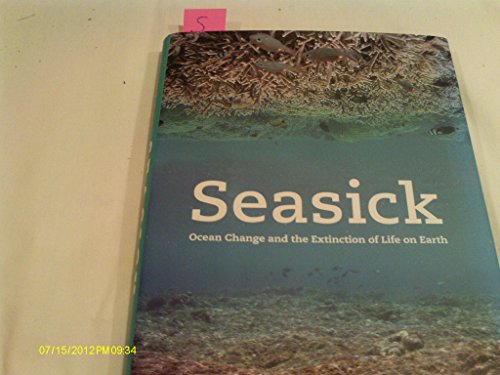
We have long lorded over the ocean. But only recently have we become aware of the myriad life-forms beneath its waves. We now know that this delicate ecosystem is our life-support system; it regulates the earth’s temperatures and climate and comprises 99 percent of living space on earth. So when we change the chemistry of the whole ocean system, as we are now, life as we know it is threatened.
In Seasick, veteran science journalist Alanna Mitchell dives beneath the surface of the world’s oceans to give readers a sense of how this watery realm can be managed and preserved, and with it life on earth. Each chapter features a different group of researchers who introduce readers to the importance of ocean currents, the building of coral structures, or the effects of acidification. With Mitchell at the helm, readers submerge 3,000 feet to gather sea sponges that may contribute to cancer care, see firsthand the lava lamp–like dead zone covering 17,000 square kilometers in the Gulf of Mexico, and witness the simultaneous spawning of corals under a full moon in Panama.
The first book to look at the planetary environmental crisis through the lens of the global ocean, Seasick takes the reader on an emotional journey through a hidden realm of the planet and urges conservation and reverence for the fount from which all life on earth sprang.
Die Inhaltsangabe kann sich auf eine andere Ausgabe dieses Titels beziehen.
Über die Autorin bzw. den Autor
Alanna Mitchell spent fourteen years as a writer covering science and the environment at the Globe and Mail. She is the author of Dancing at the Dead Sea: Tracking the World’s Environmental Hotspots, also published by the University of Chicago Press. In 2010, Mitchell received the Grantham Prize for Excellence in Reporting on the Environment for Seasick. She is the first book author to win the Grantham Prize, and the first Canadian.
Auszug. © Genehmigter Nachdruck. Alle Rechte vorbehalten.
Seasick
Ocean Change and the Extinction of Life on EarthBy Alanna MitchellUniversity of Chicago Press
Copyright © 2009 Alanna MitchellAll right reserved.
ISBN: 978-0-226-53258-5
Chapter One
The last best place on earth
GREAT BARRIER REEF
If all life on land were to vanish tomorrow, creatures in the ocean would flourish. If the opposite happened-if the ocean's life perished-then the creatures on land would die too. Life, if it went on, would have to start over.
For the vast majority of the earth's 4.5-billion-year history, there was no life outside the ocean. The planet's first creatures-bacteria-like organisms stewing in a primordial soup-appeared in the ocean more than 3 billion years ago. The first life forms on land, plants such as ferns and mosses, came into being only about 400 million years ago. Animals capable of living on land came even later.
It's hard for humans to grasp. Throughout much of our species' short time on earth-perhaps 200,000 years-we have spun stories that assure us that the world is ours to use as we see fit. Biologically, though, humans are here at the sufferance of the ocean. It gives us life, and it keeps us alive. The global ocean controls the planet's carbon cycle, determines its climate, and, through the work of phytoplankton, provides every second breath of oxygen we take.
That is not, however, how we've viewed the sea. We've tended instead to see it as the source of other things: an endless supply of food, a route to distant places. We have learned that the sea is useful, but we have not understood until the last few generations that it makes up 99 percent of the living space on earth and is also our main life-support system.
But until very recently it hasn't mattered what humans think or don't think or what stories we tell. Even what we do, or don't do, has been inconsequential in the grand scheme of things-not, perhaps, for individual humans but for the planet as a whole, and certainly for the global ocean. The planet's resilience, its vastness, has compensated for whatever we might do.
Now, though, it does matter. After millennia of insignificance, human actions and belief systems-what we do and how we think-have effected change on a scale that is damaging the ocean. Our actions are dangerous to us and to millions of other living things. We are altering not just bits of the sea with dreadful oil spills or eroding shores or vast extinctions of fish, but the whole, interconnected global system that is the ocean, the main medium of life on earth.
As goes the ocean, so goes life. This is the axiom that, in our hubris, we have refused to acknowledge. We have regarded the ocean's mysteries as elemental, immutable. Now, though, we must understand its mechanisms. Only then will we be equipped to alter our actions and stop the damage, to stand back and let the sea heal if it can. This is, in the view of many scientists, our only hope for survival.
* * *
One of the best places to see how the ocean should work is the Great Barrier Reef, which runs down the east coast of Australia, and that's why I'm on a lurching catamaran with a few dozen seasick tourists, braving high winds and roiling waves. To me this is the mother ecosystem, a modern proxy for where life must have begun, one piece of the ocean that is still gloriously intact. I have traveled around the world to savor it, as if it were a watery Paradise before the Fall, the last best place on earth.
Considered one of the seven natural wonders of the world, the Great Barrier Reef is by far the largest coral reef, an intertwined collection of more than 2,900 smaller reefs, including some of the oldest coral colonies on the planet. They make up a long, bony structure so substantial it can be seen from space.
It is a biological gold mine, more productive even than tropical rainforests. Within earth's most important medium for life, the Great Barrier Reef is arguably the most important part. It is the marine equivalent of the biggest city in the world, a vast maternity ward, the lushest, most productive, and probably most complex biological system on the planet. Innumerable different types of plants and animals live here. It is an engine of evolution.
How does it work?
The ocean is impossibly complicated, interconnected, turbulent, and nonlinear, and it touches every part of life. Humans can grasp its import only in terms of far simpler, smaller-scale phenomena: Every tear you cry, for example, ends up back in the ocean system. Every third molecule of carbon dioxide you exhale is absorbed into the ocean. Every second breath you take comes from the oxygen produced by plankton.
Think of a jigsaw puzzle whose pieces interlock in five or six dimensions instead of just two. Take the fierce winds today off the coast of Australia. They have kept every single tourist boat along the reef at dock, except this massive, fast catamaran. As we boarded this morning, the crew issued stern warnings about how rough the seas would be and insisted that everyone take seasickness pills-either Dramamine or ginger tablets-for the hour-long journey.
To humans these high winds are an annoyance or a danger. One woman is crying as the catamaran heaves, clutching a white paper bag in case she throws up. A young man vanishes to the rear of the ship, a slight sweat on his upper lip. Looking at the horizon is supposed to calm a seasick stomach, but for him and many other passengers on this boat, the trick is decidedly not working. Even the crew members are sighing deeply and trying to remain cheerful.
* * *
Throughout the ocean, the winds drive currents on the surface. Together these air and water currents circulate the sun's energy-its heat-making the planet habitable. Some of that heat moves in great, snaking submarine rivers through the ocean basins. In the north, for example, when the warm water, heavy with salt, loses enough of its heat close to the pole, it falls to the abyss, and then meanders back toward the Antarctic in a massive hemispheric conveyor belt. This is a major way that the sun's energy-the source of all life-is distributed throughout the planet.
It's a system in perpetual motion. In any bucket of water you collect at the seashore, there may be molecules that originated near the south pole-where the planet's deep, cold waters are mixed as if in a huge bowl-at the equator, or anywhere else in the vast ocean system.
Like the blood in your body, the ocean waters are constantly on the move. You have no blood that is only of the brain or only of the thumb. Nor is there sea water that is only of the Pacific or only of the Indian Ocean. There is only one ocean and it is a single system, chemically, physically, and biologically.
While the ocean has different surface temperatures at different latitudes, and therefore supports distinct groupings of creatures, each collection of life supports all the others. For example, and in simplified terms, phytoplankton (plant plankton) like the cold waters of the high latitudes. They reproduce more abundantly there. But the creatures they feed, such as larger zooplankton (animal plankton), are food for krill and other little crustaceans, and these are food for little fish, which in turn nourish the long-distance swimmers of the ocean, such as tuna, marlin, and sharks.
Moreover, at any given latitude, the surface of the ocean and its lower levels are at different temperatures and so support different creatures. Here again the winds are crucial. Powerful...
„Über diesen Titel“ kann sich auf eine andere Ausgabe dieses Titels beziehen.
Suchergebnisse für Seasick: Ocean Change and the Extinction of Life on...

Beispielbild für diese ISBN
Seasick: Ocean Change and the Extinction of Life on Earth
Verlag:
University of Chicago Press (edition 1), 2009
ISBN 10: 0226532585
ISBN 13: 9780226532585
Gebraucht
Hardcover
Anbieter: BooksRun, Philadelphia, PA, USA
Verkäuferbewertung 5 von 5 Sternen

Hardcover. Zustand: Fair. 1. The item might be beaten up but readable. May contain markings or highlighting, as well as stains, bent corners, or any other major defect, but the text is not obscured in any way. Artikel-Nr. 0226532585-7-1
Gebraucht kaufen
EUR 6,00
Versand gratis
Versand innerhalb von USA
Versand innerhalb von USA
Anzahl: 1 verfügbar
Beispielbild für diese ISBN
Seasick : Ocean Change and the Extinction of Life on Earth
Verlag:
University of Chicago Press, 2009
ISBN 10: 0226532585
ISBN 13: 9780226532585
Gebraucht
Hardcover
Erstausgabe
Anbieter: Better World Books, Mishawaka, IN, USA
Verkäuferbewertung 5 von 5 Sternen
Zustand: Very Good. 1st Edition. Former library copy. Pages intact with possible writing/highlighting. Binding strong with minor wear. Dust jackets/supplements may not be included. Includes library markings. Stock photo provided. Product includes identifying sticker. Better World Books: Buy Books. Do Good. Artikel-Nr. 348105-6
Gebraucht kaufen
EUR 6,58
Versand gratis
Versand innerhalb von USA
Versand innerhalb von USA
Anzahl: 2 verfügbar
Beispielbild für diese ISBN
Seasick: Ocean Change and the Extinction of Life on Earth
Verlag:
University of Chicago Press, Chicago, IL, 2009
ISBN 10: 0226532585
ISBN 13: 9780226532585
Gebraucht
Hardcover
Anbieter: Xochi's Bookstore & Gallery, Truth or consequences, NM, USA
Verkäuferbewertung 1 von 5 Sternen

Hardcover. Zustand: Fine. Zustand des Schutzumschlags: Fine. 1st. 161pp.incl.index; HB quarter-bound; bluegreen&blue w/silver; fine condition w/clean,tight pgs. DJ blue&green w/white; fine. "The first book to look at the planetary environmental crisis through the lens of the global ocean. ". Artikel-Nr. 030548
Gebraucht kaufen
EUR 16,58
EUR 4,47 Versand
Versand innerhalb von USA
Versand innerhalb von USA
Anzahl: 1 verfügbar
Beispielbild für diese ISBN
Seasick: Ocean Change and the Extinction of Life on Earth
Anbieter: Kennys Bookstore, Olney, MD, USA
Verkäuferbewertung 5 von 5 Sternen
Zustand: New. 2009. Hardcover. . . . . . Books ship from the US and Ireland. Artikel-Nr. V9780226532585
Neu kaufen
EUR 55,94
EUR 9,39 Versand
Versand innerhalb von USA
Versand innerhalb von USA
Anzahl: 15 verfügbar