
Verwandte Artikel zu Inside the Presidential Debates: Their Improbable Past...
Inhaltsangabe
Newton Minow’s long engagement with the world of television began nearly fifty years ago when President Kennedy appointed him chairman of the Federal Communications Commission. As its head, Minow would famously dub TV a “vast wasteland,” thus inaugurating a career dedicated to reforming television to better serve the public interest. Since then, he has been chairman of PBS and on the board of CBS and elsewhere, but his most lasting contribution remains his leadership on televised presidential debates. He was assistant counsel to Illinois governor Adlai Stevenson when Stevenson first proposed the idea of the debates in 1960; he served as cochair of the presidential debates in 1976 and 1980; and he helped create and is currently vice chairman of the Commission on Presidential Debates, which has organized the debates for the last two decades.
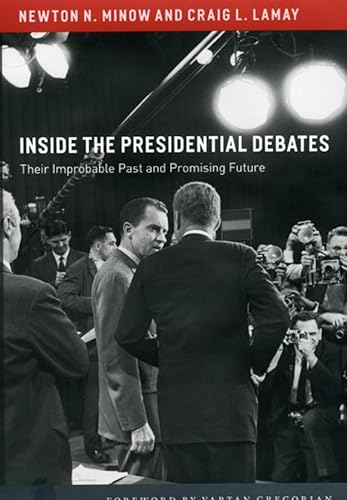
Written with longtime collaborator Craig LaMay, this fascinating history offers readers for the first time a genuinely inside look into the origins of the presidential debates and the many battles—both legal and personal—that have determined who has been allowed to debate and under what circumstances. The authors do not dismiss the criticism of the presidential debates in recent years but do come down solidly in favor of them, arguing that they are one of the great accomplishments of modern American electoral politics. As they remind us, the debates were once unique in the democratic world, are now emulated across the globe, and they offer the public the only real chance to see the candidates speak in direct response to one another in a discussion of major social, economic, and foreign policy issues.
Looking to the challenges posed by third-party candidates and the emergence of new media such as YouTube, Minow and LaMay ultimately make recommendations for the future, calling for the debates to become less formal, with candidates allowed to question each other and citizens allowed to question candidates directly. They also explore the many ways in which the Internet might serve to broaden the debates’ appeal and informative power. Whether it’s Clinton or Obama vs. McCain, Inside the Presidential Debates will be welcomed in 2008 by anyone interested in where this crucial part of our democracy is headed—and how it got there.
Die Inhaltsangabe kann sich auf eine andere Ausgabe dieses Titels beziehen.
Über die Autorin bzw. den Autor
Newton N. Minow is senior counsel of Sidley Austin LLP, where he has practiced law since 1965, and is the Walter Annenberg Professor Emeritus of communications and law at Northwestern University. Craig L. LaMay is associate professor of journalism at Northwestern University’s Medill School of Journalism. They are the authors and editors of numerous works and the coauthors of Abandoned in the Wasteland: Children, Television, and the First Amendment.
Auszug. © Genehmigter Nachdruck. Alle Rechte vorbehalten.
Inside the Presidential Debates
THEIR IMPROBABLE PAST AND PROMISING FUTUREBy Newton N. Minow Craig L. LaMayThe University of Chicago Press
Copyright © 2008 Newton N. Minow and Craig L. LaMayAll right reserved.
ISBN: 978-0-226-53041-3
Contents
FOREWORD by Vartan Gregorian...........................................................................................ixACKNOWLEDGMENTS........................................................................................................xvINTRODUCTION...........................................................................................................11 How Adlai Stevenson Put John F. Kennedy in the White House...........................................................172 Presidential Debates and "Equal Opportunity".........................................................................293 "If You're Thirty-two Points Behind, What Else Are You Going to Do?".................................................434 The Commission on Presidential Debates and Its Critics...............................................................615 The Dilemma: Who Debates?............................................................................................816 How to Improve the Presidential Debates..............................................................................101AppendixesA Memorandum of Understanding between the Bush and Kerry Campaigns, 2004...............................................123B Negotiated Agreements between the League of Women Voters and the Ford and Carter Campaigns, 1976.....................137C Section 312 of the Communications Act: "Reasonable Access" for Candidates for Federal Office.........................139D Challenges to the CPD under Federal Election and Tax Law.............................................................141E Broadcast Debates and the First Amendment............................................................................145F The Televised Presidential Debates, 1960-2004........................................................................153NOTES..................................................................................................................165INDEX..................................................................................................................203
Chapter One
How Adlai Stevenson Put John F. Kennedy in the White HouseWhat I am proposing now is ... the establishment of what I hope will become a national institution, a great debate for the Presidency. ADLAI E. STEVENSON, March 1960
Let's begin by addressing the questions posed by Admiral James Stockdale, the distinguished and straightforward U.S. Navy veteran who appeared in the 1992 vice presidential debate representing Ross Perot's Reform Party: "Who am I? And why am I here?"
My involvement with presidential debates began with heart attacks that in 1955 struck two of the most powerful men in the country, President Dwight D. Eisenhower and Senate Majority Leader Lyndon Baines Johnson. At the time I was a young law partner of former Illinois governor Adlai E. Stevenson, and in the fall of that year I was with Stevenson when he gave a speech at the University of Texas. The governor and I were invited to spend that night at Johnson's Stonewall, Texas, ranch, where LBJ was recovering from his illness. After Adlai's speech in Austin, we drove to the ranch with Texas congressman Sam Rayburn, the powerful speaker of the House. We arrived in Stonewall late at night, but LBJ was waiting up for us (much to the dismay of his wife Lady Bird, as his doctors had told him to get more rest). Johnson announced that it would be unseemly to have the top three Democrats in the country appear to be conspiring to take over the government while President Eisenhower was recovering from his own heart attack, so we would be out all the next day, meeting in the open where the press could see us.
Afterward Adlai and I flew back to Chicago, and in the course of the plane ride Adlai said, "Lyndon and Sam say that if I want the nomination next year, I will have to fight for it in the primaries. What do you think?"
I said, "They're right. If President Eisenhower does not run for reelection, the Democratic nomination will be very appealing. There will be a lot of candidates who want it. On the other hand, if President Eisenhower does run again, he's going to be reelected and you should forget about it. But if you want the nomination, you're going to have to campaign for it."
Adlai said, "I'm not going to do that. I'm not going to run around to shopping centers shaking hands like I'm running for sheriff."
Eventually, of course, President Eisenhower did decide to run again in 1956, and Adlai did enter the primaries, did run around shaking hands at shopping centers, and won his party's nomination. The two electoral contests between Eisenhower and Stevenson were a turning point in presidential campaigns. Both traveled the country meeting voters, but the Republicans made extensive use of television, too. The last true whistle-stop campaign in American presidential politics had occurred in 1948, with President Truman's train swing across the nation. That year there were only twenty-nine television stations operating in the United States, broadcasting to only about 1 million television sets, less than 9 percent of the nation's homes. Two years later there were 108 stations on the air around the country broadcasting to 10 million sets. By 1952 television penetration had jumped to nearly 40 percent of American homes, and that year both the Republican and Democratic presidential nominating conventions were broadcast to national audiences for the first time. Both parties made use of television advertisements, each with different objectives. General Eisenhower was already widely popular, so his campaign needed only to shore up support in key areas of the country. It hired six different advertising firms to produce more than a dozen twenty- and sixty-second commercials featuring the general answering recorded questions read by nonprofessional performers. The Democrats' advertising strategy was to make Adlai into more of a national figure, and it bought five-minute segments at the end of popular entertainment programs to give their candidate exposure. The Republicans eventually did the same.
As the presidential campaign of that year wore on, it seemed to me that the combination of countrywide barnstorming and spot television advertising was physically exhausting for the candidates and made very little sense as a way to explain their views on important issues to the voters. I wrote a memo to Adlai proposing an alternative. Modern technology would enable voters to have a much better understanding of the candidates through radio and television, I argued, and because President Eisenhower's health was still not fully restored, Adlai should propose a series of televised nationwide joint discussions instead of traveling across the country shaking hands at rallies. Stevenson's advisers debated the idea, and though some of them agreed with me, they eventually rejected it. A few thought the idea would be perceived as a gimmick. Others thought Adlai would not do well in such a face-to-face debate. My guess is Eisenhower would have rejected the idea, too.
Then, very near the end of the campaign, a major international crisis erupted. On October 31, war broke out between Egypt and an alliance of Israel, France, and Britain over control of the Suez...
„Über diesen Titel“ kann sich auf eine andere Ausgabe dieses Titels beziehen.
Suchergebnisse für Inside the Presidential Debates: Their Improbable Past...

Beispielbild für diese ISBN
Inside the Presidential Debates: Their Improbable Past and Promising Future
Verlag:
The University of Chicago Press, 2008
ISBN 10: 0226530418
ISBN 13: 9780226530413
Gebraucht
Hardcover
Anbieter: World of Books (was SecondSale), Montgomery, IL, USA
Verkäuferbewertung 5 von 5 Sternen

Hardback. Zustand: Good. Offers readers a look into the origins of the presidential debates and the many battles - both legal and personal - that have determined who has been allowed to debate and under what circumstances. This book explores the many ways in which the Internet might serve to broaden the debates' appeal and informative power. Artikel-Nr. 00107325948
Gebraucht kaufen
EUR 4,57
Versand gratis
Versand innerhalb von USA
Versand innerhalb von USA
Anzahl: 1 verfügbar
Beispielbild für diese ISBN
Inside the Presidential Debates : Their Improbable Past and Promising Future
Verlag:
University of Chicago Press, 2008
ISBN 10: 0226530418
ISBN 13: 9780226530413
Gebraucht
Hardcover
Anbieter: Better World Books, Mishawaka, IN, USA
Verkäuferbewertung 5 von 5 Sternen
Zustand: Good. Former library copy. Pages intact with minimal writing/highlighting. The binding may be loose and creased. Dust jackets/supplements are not included. Includes library markings. Stock photo provided. Product includes identifying sticker. Better World Books: Buy Books. Do Good. Artikel-Nr. GRP102627151
Gebraucht kaufen
EUR 6,16
Versand gratis
Versand innerhalb von USA
Versand innerhalb von USA
Anzahl: 1 verfügbar
Beispielbild für diese ISBN
Inside the Presidential Debates : Their Improbable Past and Promising Future
Verlag:
University of Chicago Press, 2008
ISBN 10: 0226530418
ISBN 13: 9780226530413
Gebraucht
Hardcover
Anbieter: Better World Books: West, Reno, NV, USA
Verkäuferbewertung 5 von 5 Sternen
Zustand: Good. Former library copy. Pages intact with minimal writing/highlighting. The binding may be loose and creased. Dust jackets/supplements are not included. Includes library markings. Stock photo provided. Product includes identifying sticker. Better World Books: Buy Books. Do Good. Artikel-Nr. GRP102627151
Gebraucht kaufen
EUR 6,16
Versand gratis
Versand innerhalb von USA
Versand innerhalb von USA
Anzahl: 1 verfügbar
Beispielbild für diese ISBN
Inside the Presidential Debates: Their Improbable Past and Promising Future
Verlag:
University of Chicago Press, 2008
ISBN 10: 0226530418
ISBN 13: 9780226530413
Gebraucht
Hardcover
Anbieter: Wonder Book, Frederick, MD, USA
Verkäuferbewertung 5 von 5 Sternen
Zustand: As New. Like New condition. Like New dust jacket. A near perfect copy that may have very minor cosmetic defects. Artikel-Nr. M14C-00678
Gebraucht kaufen
EUR 6,40
Versand gratis
Versand innerhalb von USA
Versand innerhalb von USA
Anzahl: 1 verfügbar
Beispielbild für diese ISBN
Inside the Presidential Debates : Their Improbable Past and Promising Future
Verlag:
University of Chicago Press, 2008
ISBN 10: 0226530418
ISBN 13: 9780226530413
Gebraucht
Hardcover
Anbieter: Better World Books Ltd, Dunfermline, Vereinigtes Königreich
Verkäuferbewertung 5 von 5 Sternen
Zustand: Good. Pages intact with minimal writing/highlighting. The binding may be loose and creased. Dust jackets/supplements are not included. Stock photo provided. Product includes identifying sticker. Better World Books: Buy Books. Do Good. Artikel-Nr. 7673785-6
Gebraucht kaufen
EUR 5,97
EUR 5,89 Versand
Versand von Vereinigtes Königreich nach USA
Versand von Vereinigtes Königreich nach USA
Anzahl: 1 verfügbar
Beispielbild für diese ISBN
Inside the Presidential Debates
Anbieter: Majestic Books, Hounslow, Vereinigtes Königreich
Verkäuferbewertung 4 von 5 Sternen

Zustand: New. pp. xvii + 219. Artikel-Nr. 8246200
Neu kaufen
EUR 19,79
EUR 7,66 Versand
Versand von Vereinigtes Königreich nach USA
Versand von Vereinigtes Königreich nach USA
Anzahl: 1 verfügbar
Beispielbild für diese ISBN
Inside the Presidential Debates Their Improbable Past and Promising Future
Anbieter: Revaluation Books, Exeter, Vereinigtes Königreich
Verkäuferbewertung 5 von 5 Sternen
Hardcover. Zustand: Brand New. 240 pages. 9.25x6.25x0.75 inches. In Stock. Artikel-Nr. 0226530418
Neu kaufen
EUR 48,01
EUR 11,79 Versand
Versand von Vereinigtes Königreich nach USA
Versand von Vereinigtes Königreich nach USA
Anzahl: 1 verfügbar