
Verwandte Artikel zu The Submerged State: How Invisible Government Policies...
The Submerged State: How Invisible Government Policies Undermine American Democracy (Chicago Studies in American Politics) - Softcover
Buch 57 von 65: Chicago Studies in American Politics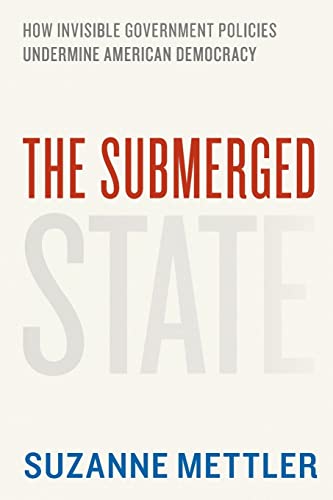
Inhaltsangabe
“Keep your government hands off my Medicare!” Such comments spotlight a central question animating Suzanne Mettler’s provocative and timely book: why are many Americans unaware of government social benefits and so hostile to them in principle, even though they receive them? The Obama administration has been roundly criticized for its inability to convey how much it has accomplished for ordinary citizens. Mettler argues that this difficulty is not merely a failure of communication; rather it is endemic to the formidable presence of the “submerged state.”
In recent decades, federal policymakers have increasingly shunned the outright disbursing of benefits to individuals and families and favored instead less visible and more indirect incentives and subsidies, from tax breaks to payments for services to private companies. These submerged policies, Mettler shows, obscure the role of government and exaggerate that of the market. As a result, citizens are unaware not only of the benefits they receive, but of the massive advantages given to powerful interests, such as insurance companies and the financial industry. Neither do they realize that the policies of the submerged state shower their largest benefits on the most affluent Americans, exacerbating inequality. Mettler analyzes three Obama reforms—student aid, tax relief, and health care—to reveal the submerged state and its consequences, demonstrating how structurally difficult it is to enact policy reforms and even to obtain public recognition for achieving them. She concludes with recommendations for reform to help make hidden policies more visible and governance more comprehensible to all Americans.
The sad truth is that many American citizens do not know how major social programs work—or even whether they benefit from them. Suzanne Mettler’s important new book will bring government policies back to the surface and encourage citizens to reclaim their voice in the political process.
Die Inhaltsangabe kann sich auf eine andere Ausgabe dieses Titels beziehen.
Über die Autorin bzw. den Autor
Suzanne Mettler is the Clinton Rossiter Professor of American Institutions at Cornell University. Her most recent book is Soldiers to Citizens: The G.I. Bill and the Making of the Greatest Generation.
Auszug. © Genehmigter Nachdruck. Alle Rechte vorbehalten.
THE SUBMERGED STATE
HOW INVISIBLE GOVERNMENT POLICIES UNDERMINE AMERICAN DEMOCRACYBy SUZANNE METTLERThe University of Chicago Press
Copyright © 2011 The University of ChicagoAll right reserved.
ISBN: 978-0-226-52165-7
Contents
Introduction Confronting the Submerged State.........................................................11 Governance Unseen..................................................................................82 The Politics of the Submerged State................................................................313 From Nudge to Reveal with MATT GUARDINO............................................................484 Scaling Back the Submerged State The Victory for Student Aid.......................................695 Sustaining and Expanding the Submerged State Tax Policy and Health Care Reform.....................886 Toward Visible and Vibrant Democracy...............................................................110Appendix Text and Graphics for Additional Experimental Questions and Treatments......................125Acknowledgments......................................................................................127Notes................................................................................................131Index................................................................................................153
Chapter One
GOVERNANCE UNSEEN
When Senator Mary Landrieu held a town hall meeting in Louisiana in the summer of 2009 in order to hear her constituents' views on health care reform, she encountered a boisterous crowd. One man stood up, waving a copy of the U.S. Constitution, and asked, "Where does the federal government get any right to stick its hands anywhere in the health care system?" Members of Congress heard similar sentiments expressed at such meetings across the nation. Meanwhile, letters to the editor in newspapers throughout the country contained protestations like that voiced by Ohio resident Ray Brown, who wrote to the Columbia Dispatch: "There are no circumstances on this Earth under which we should let our government have anything at all to do with our excellent health-care system." In each case, opponents of reform implied that the U.S. health care system as we know it was borne and persists sui generis, a natural development that has been nurtured only by the market economy.
Such characterizations are, quite simply, wrong. As Senator Landrieu explained patiently to the man who questioned her, "Some aspects of our system are nationalized," noting that government programs such as Medicare and Medicaid cover a significant portion of the population, nearly one in three people. She could have explained, further, that the so-called "private" insurance plans provided by employers, through which 59 percent of Americans under age sixty- five receive insurance, are subsidized by government, which privileges them with tax- exempt status. She might have added that the construction of vast numbers of the nation's hospitals was funded by a federal policy enacted in 1948, signed into law by President Harry Truman. Or that a significant portion of students in the nation's medical and nursing schools are funded by federal scholarships.
In fact, the health care system experienced by Americans of the early twenty-first century has been fostered by public policy and highly subsidized by government spending for three- quarters of a century. It is fairly well known that the United States spends more per capita on health care than any other nation; in 2009 this amounted to $2.5 trillion, or 17.6 percent of GDP. Less commonly known is the fact that government itself foots most of the bill—some estimate 56 percent, amounting to more than in any other country. Remarkably, however, many Americans have been largely unaware of government's substantial role in health care, and therefore reform legislation in 2009–10 appeared to them to be a startling new and foreign intervention into a system that belonged mostly if not entirely to the private sector.
The misunderstanding that many people possess about health care policy is unsurprising, however, because much of it—like other areas of contemporary social provision—is embedded within the submerged state. When most people think of government programs, they likely envision cavernous, austere buildings located in the vicinity of Washington, D.C., filled with bureaucrats sitting in cubicles who directly oversee the delivery of goods and services to citizens, as exemplified by Social Security. Many would also acknowledge that states and local governments oft en play the role of "supporting actors," carrying out much of the day-to-day work of the federal government by following its mandates and dispensing its funds, for example, in unemployment insurance or welfare offices. But, in fact, much of the activity financed by the federal government today fits neither of those standard descriptions. Rather, it disguises or subverts government's role, making the real actors appear to be those in the market or private sector—whether individuals, households, organizations, or businesses. The mechanisms or tools through which such activities occur have proliferated to include a great variety, such as loans subsidized and guaranteed by government but offered through private banks and government-sponsored enterprises; social benefits in the form of tax incentives and tax breaks for those engaging in activities that government wishes to reward; and benefits and services provided by nonprofits and private third-party organizations that are subsidized or "contracted out" by government.
Take student loans, for example. Several years ago, while teaching an undergraduate course on public policy, I included student loans among a list of government social programs. One student objected, saying, "But student loans shouldn't be called a social program! I'm paying for my tuition with student loans and I got them through a bank—not a government agency. And I have to pay them back after I graduate, with interest." Another student quickly countered the first, saying, "But if any of us just went to a bank ourselves and applied for a regular loan—not a student loan guaranteed by government—they probably wouldn't be willing to lend to us. At our age, we don't look like very safe bets for paying back what we borrow. And even if they did lend to us, the loan would cost us a good deal more than it does with government's help." A lively discussion ensued, reflecting different understandings of how student loans operate and different views of the characteristics that define public policies.
These disparities in perceptions owe to the fact that student loans, like much of U.S. health care policy, have long operated primarily by subsidizing private actors to provide social benefits. In the 1960s, policymakers sought means to make college affordable for more students. Banks were typically reluctant to loan to students, considering them a bad risk, and when they did, they imposed high interest rates, typically ranging from 11 to 14 percent and above. The Higher Education Act of 1965, signed into law by Johnson, established the Guaranteed Student Loan Program, giving banks incentives to lend to students at lower rates of interest. It did so by offering that the federal government would pay half the interest on such loans and would guarantee them, promising to repay them entirely if a borrower defaulted. In 1972 policymakers provided further impetus to student lending by creating the Student...
„Über diesen Titel“ kann sich auf eine andere Ausgabe dieses Titels beziehen.
Suchergebnisse für The Submerged State: How Invisible Government Policies...

Foto des Verkäufers
The Submerged State: How Invisible Government Policies Undermine American Democracy (Chicago Studies in American Politics)
Verlag:
University of Chicago Press, 2011
ISBN 10: 0226521656
ISBN 13: 9780226521657
Gebraucht
Softcover
Anbieter: Dream Books Co., Denver, CO, USA
Verkäuferbewertung 5 von 5 Sternen

Zustand: good. Gently used with minimal wear on the corners and cover. A few pages may contain light highlighting or writing, but the text remains fully legible. Dust jacket may be missing, and supplemental materials like CDs or codes may not be included. May be ex-library with library markings. Ships promptly! Artikel-Nr. DBV.0226521656.G
Gebraucht kaufen
EUR 5,08
Versand gratis
Versand innerhalb von USA
Versand innerhalb von USA
Anzahl: 1 verfügbar
Beispielbild für diese ISBN
The Submerged State: How Invisible Government Policies Undermine American Democracy
Verlag:
University of Chicago Press, 2011
ISBN 10: 0226521656
ISBN 13: 9780226521657
Gebraucht
Paperback
Anbieter: ThriftBooks-Atlanta, AUSTELL, GA, USA
Verkäuferbewertung 5 von 5 Sternen
Paperback. Zustand: Fair. No Jacket. Readable copy. Pages may have considerable notes/highlighting. ~ ThriftBooks: Read More, Spend Less. Artikel-Nr. G0226521656I5N00
Gebraucht kaufen
EUR 6,22
Versand gratis
Versand innerhalb von USA
Versand innerhalb von USA
Anzahl: 1 verfügbar
Beispielbild für diese ISBN
The Submerged State : How Invisible Government Policies Undermine American Democracy
Verlag:
University of Chicago Press, 2011
ISBN 10: 0226521656
ISBN 13: 9780226521657
Gebraucht
Softcover
Anbieter: Better World Books, Mishawaka, IN, USA
Verkäuferbewertung 5 von 5 Sternen
Zustand: Good. Pages intact with minimal writing/highlighting. The binding may be loose and creased. Dust jackets/supplements are not included. Stock photo provided. Product includes identifying sticker. Better World Books: Buy Books. Do Good. Artikel-Nr. 7826429-6
Gebraucht kaufen
EUR 6,55
Versand gratis
Versand innerhalb von USA
Versand innerhalb von USA
Anzahl: 4 verfügbar
Beispielbild für diese ISBN
The Submerged State: How Invisible Government Policies Undermine American Democracy
Verlag:
The University of Chicago Press, 2011
ISBN 10: 0226521656
ISBN 13: 9780226521657
Gebraucht
Paperback
Anbieter: World of Books (was SecondSale), Montgomery, IL, USA
Verkäuferbewertung 5 von 5 Sternen
Paperback. Zustand: Fair. The Obama administration has been criticized for its inability to convey how much it has accomplished for ordinary citizens. This title argues that this difficulty is not merely a failure of communication; rather it is endemic to the formidable presence of the 'submerged state.'. Artikel-Nr. 00108489352
Gebraucht kaufen
EUR 7,76
Versand gratis
Versand innerhalb von USA
Versand innerhalb von USA
Anzahl: 1 verfügbar
Beispielbild für diese ISBN
The Submerged State: How Invisible Government Policies Undermine American Democracy (Chicago Studies in American Politics)
Anbieter: AwesomeBooks, Wallingford, Vereinigtes Königreich
Verkäuferbewertung 5 von 5 Sternen
paperback. Zustand: Very Good. The Submerged State: How Invisible Government Policies Undermine American Democracy (Chicago Studies in American Politics) This book is in very good condition and will be shipped within 24 hours of ordering. The cover may have some limited signs of wear but the pages are clean, intact and the spine remains undamaged. This book has clearly been well maintained and looked after thus far. Money back guarantee if you are not satisfied. See all our books here, order more than 1 book and get discounted shipping. Artikel-Nr. 7719-9780226521657
Gebraucht kaufen
EUR 15,04
EUR 4,91 Versand
Versand von Vereinigtes Königreich nach USA
Versand von Vereinigtes Königreich nach USA
Anzahl: 2 verfügbar
Beispielbild für diese ISBN
The Submerged State
Anbieter: PBShop.store US, Wood Dale, IL, USA
Verkäuferbewertung 5 von 5 Sternen
PAP. Zustand: New. New Book. Shipped from UK. Established seller since 2000. Artikel-Nr. FW-9780226521657
Beispielbild für diese ISBN
The Submerged State
Anbieter: PBShop.store UK, Fairford, GLOS, Vereinigtes Königreich
Verkäuferbewertung 5 von 5 Sternen
PAP. Zustand: New. New Book. Shipped from UK. Established seller since 2000. Artikel-Nr. FW-9780226521657
Neu kaufen
EUR 24,08
EUR 4,96 Versand
Versand von Vereinigtes Königreich nach USA
Versand von Vereinigtes Königreich nach USA
Anzahl: 15 verfügbar
Beispielbild für diese ISBN
The Submerged State: How Invisible Government Policies Undermine American Democracy (Chicago Studies in American Politics).
Verlag:
Chicago / London, University of Chicago Press., 2011
ISBN 10: 0226521656
ISBN 13: 9780226521657
Gebraucht
Paperback.
Anbieter: Antiquariat Thomas Haker GmbH & Co. KG, Berlin, Deutschland
Verkäuferbewertung 5 von 5 Sternen
Paperback. Zustand: Gut. 163 p. Guter Zustand. Sprache: Englisch Gewicht in Gramm: 325. Artikel-Nr. 882315
Gebraucht kaufen
EUR 14,40
EUR 15,00 Versand
Versand von Deutschland nach USA
Versand von Deutschland nach USA
Anzahl: 1 verfügbar
Beispielbild für diese ISBN
The Submerged State: How Invisible Government Policies Undermine American Democracy (Chicago Studies in American Politics)
Verlag:
University of Chicago Press, 2011
ISBN 10: 0226521656
ISBN 13: 9780226521657
Gebraucht
Softcover
Anbieter: Phatpocket Limited, Waltham Abbey, HERTS, Vereinigtes Königreich
Verkäuferbewertung 5 von 5 Sternen
Zustand: Good. Your purchase helps support Sri Lankan Children's Charity 'The Rainbow Centre'. Ex-library, so some stamps and wear, but in good overall condition. Our donations to The Rainbow Centre have helped provide an education and a safe haven to hundreds of children who live in appalling conditions. Artikel-Nr. Z1-R-036-02093
Gebraucht kaufen
EUR 17,68
EUR 12,69 Versand
Versand von Vereinigtes Königreich nach USA
Versand von Vereinigtes Königreich nach USA
Anzahl: 1 verfügbar
Beispielbild für diese ISBN
The Submerged State: How Invisible Government Policies Undermine American Democracy (Chicago Studies in American Politics)
Verlag:
University of Chicago Press -, 2011
ISBN 10: 0226521656
ISBN 13: 9780226521657
Gebraucht
paperback
Anbieter: Bahamut Media, Reading, Vereinigtes Königreich
Verkäuferbewertung 4 von 5 Sternen

paperback. Zustand: Very Good. Shipped within 24 hours from our UK warehouse. Clean, undamaged book with no damage to pages and minimal wear to the cover. Spine still tight, in very good condition. Remember if you are not happy, you are covered by our 100% money back guarantee. Artikel-Nr. 6545-9780226521657
Gebraucht kaufen
EUR 22,50
EUR 8,32 Versand
Versand von Vereinigtes Königreich nach USA
Versand von Vereinigtes Königreich nach USA
Anzahl: 1 verfügbar