
Verwandte Artikel zu The Norman Maclean Reader (Emersion: Emergent Village...
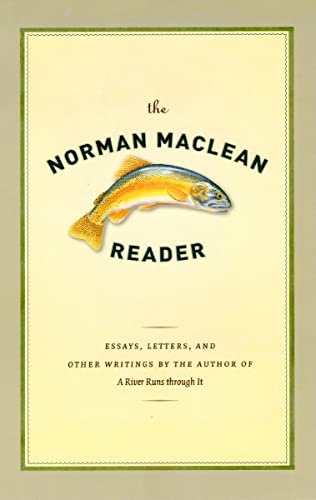
The Norman Maclean Reader (Emersion: Emergent Village resources for communities of faith) - Hardcover
Inhaltsangabe
In his eighty-seven years, Norman Maclean played many parts: fisherman, logger, firefighter, scholar, teacher. But it was a role he took up late in life, that of writer, that won him enduring fame and critical acclaim—as well as the devotion of readers worldwide. Though the 1976 collection A River Runs Through It and Other Stories was the only book Maclean published in his lifetime, it was an unexpected success, and the moving family tragedy of the title novella—based largely on Maclean’s memories of his childhood home in Montana—has proved to be one of the most enduring American stories ever written.
The Norman Maclean Reader is a wonderful addition to Maclean’s celebrated oeuvre. Bringing together previously unpublished materials with incidental writings and selections from his more famous works, the Reader will serve as the perfect introduction for readers new to Maclean, while offering longtime fans new insight into his life and career.
In this evocative collection, Maclean as both a writer and a man becomes evident. Perceptive, intimate essays deal with his career as a teacher and a literary scholar, as well as the wealth of family stories for which Maclean is famous. Complete with a generous selection of letters, as well as excerpts from a 1986 interview, The Norman Maclean Reader provides a fully fleshed-out portrait of this much admired author, showing us a writer fully aware of the nuances of his craft, and a man as at home in the academic environment of the University of Chicago as in the quiet mountains of his beloved Montana.
Various and moving, the works collected in The Norman Maclean Reader serve as both a summation and a celebration, giving readers a chance once again to hear one of American literature’s most distinctive voices.
Die Inhaltsangabe kann sich auf eine andere Ausgabe dieses Titels beziehen.
Über die Autorin bzw. den Autor
Norman Maclean (1902–90), woodsman, scholar, teacher, and storyteller, grew up in the western Rocky Mountains of Montana and worked for many years in logging camps and for the United States Forestry Service before beginning his academic career. He was the William Rainey Harper Professor of English at the University of Chicago until 1973. O. Alan Weltzien is professor of English at the University of Montana Western, in Dillon, Montana. He is the author of A Father and an Island: Reflections on Loss, a memoir; To Kilimanjaro and Back, a book of poems; Exceptional Mountains, a cultural history of Pacific Northwest volcanoes; coeditor of Coming into McPhee Country: John McPhee and the Art of Literary Nonfiction; and editor of The Literary Art and Activism of Rick Bass.
Auszug. © Genehmigter Nachdruck. Alle Rechte vorbehalten.
The Norman Maclean Reader
The University of Chicago Press
Copyright © 2008 The University of ChicagoAll right reserved.
ISBN: 978-0-226-50026-3
Contents
Introduction, by O. Alan Weltzien......................................................................viiTHE CUSTER WRITINGSEdward S. Luce: Commanding General (Retired), Department of the Little Bighorn.........................3From the Unfinished Custer Manuscript..................................................................9Chapter 1: The Hill....................................................................................11Chapter 2: The Sioux...................................................................................26Chapter 3: The Cheyennes...............................................................................40Chapter 4: In Business.................................................................................55Last Chapter: Shrine to Defeat.........................................................................62A MACLEAN SAMPLER"This Quarter I Am Taking McKeon": A Few Remarks on the Art of Teaching................................69"Billiards Is a Good Game": Gamesmanship and America's First Nobel Prize Scientist.....................78Retrievers Good and Bad................................................................................93Logging and Pimping and "Your Pal, Jim"................................................................101An Incident............................................................................................116The Woods, Books, and Truant Officers..................................................................130The Pure and the Good: On Baseball and Backpacking.....................................................136Black Ghost............................................................................................141From Young Men and Fire................................................................................150Interview with Norman Maclean..........................................................................166SELECTED LETTERSLetters to Robert M. Utley, 1955-1979..................................................................183Letters to Marie Borroff, 1949-1986....................................................................212Letters to Nick Lyons, 1976-1981.......................................................................234Letters to Lois Jansson, 1979-1981.....................................................................246Acknowledgments........................................................................................257Suggestions for Further Reading........................................................................A gallery of photographs appears following page 104.
Chapter One
The Hill
Every battle has something of a personality and a personal after-life. But it is true of battles as of men-only some have a deep personal life of their own with the capacity to affect permanently the lives of those associated with them and to be known everywhere by those who know almost nothing about them. The battle of the Little Bighorn, which from the ordinary historical point of view lacks any great significance, has been an immense personal force altering the feelings, beliefs, daily routines and larger destinies of those who survived it or were related to the dead. It has given a structure to their lives, however harsh the outlines, for (it seems that) the dead who continue to live become abstracted into patterns and are transformed and transform others, as it were, into a kind of geometry.
To the large world outside, the Battle has many personal traits that attract a wide diversity of personalities. It has the power of an endless argument, one of the world's battles destined to be fought forever. More has been written about it than about any American battle excepting possibly the Battle of Gettysburg, and at times with as much fury and general confusion as darkened Custer Hill late in the afternoon of June 25, 1876. Some of its power, undoubtedly, is in its artistry. It is almost a ready-made plot with ready-made characters for that large class of writers who lack the power to invent plots and characters of their own. To painters of similar abilities, it is close to a finished composition-a hilltop in a big sky; repeating the circle of the hilltop, a circle of kneeling men in blue; within the embattled circle a central standing figure highlighted by blond hair; and, surrounding the circle of blue, larger circles of contrasting redskins. The Battle has also had the power to promote business, draw customers and sell beer. And it has had two powers perhaps deeper than all others-the power of horror and of jest. It shocked the nation as nothing had since the death of Lincoln, leaving permanent marks upon the individuals, families and tribes connected with it. Recently-but only recently-we have become enough at ease with it to make it into a joke. The joke has many variants, some of them dirty and all of them grim, but essentially it is one joke and underneath the many variants is a kindly undertone, as if some joke had been played upon the bluffs of the Little Bighorn for which there should be universal forbearance, on the chance that the joke played there is played some time on all of us. Clearly, our dead are delivered from oblivion when they become a joke on us.
The history of the personality and personal after-life of an event is not history of any commonly recognized kind, and this one, for lack of a classification, may be called the biography of a battle. That the Battle still lives and grows, however, is a fact demonstrable by the ordinary kinds of historical and even statistical evidence-by the number of books written about it, the number of times it appears visually in paintings or on the screen or TV, the number of times it is heard in such common sayings as "so-and-so made his last stand" or "too damn many Indians." But a reality of a somewhat different order has to be explored for the sources of its life, and observations about this reality cannot always be documented with footnotes, since life-after-death, at least in this life, depends upon patterns and geometrical extensions and may of course depend upon much more. Yet what lives beyond its natural self is clearly structured for remembrance. The patterns are partly in the natural thing which must have had a higher sense of form than that of most of the living matter surrounding it. The patterns are also partly superimposed and come from us, who strive or at least feel at times that we should strive to make something structural out of our own lives. The history of this life-after-death, however, involves much more than the matching of two sets of fixed patterns. As there is no life in fixities, so each who achieves immortality must retain something of his past and yet take on new meanings with the passing of time. Unless capable of such organic growth, even immortality dies.
The ground itself upon which the Battle was fought has its own history of death and transfiguration, and it seems right to begin with the reality of the earth and to trace first how this isolated piece of it soon after the Battle became known to the whole world and eventually was transformed into a National Monument. On the Hill itself, which is somewhat symmetrical, there are also lines to be traced. The lines are of white-stone markers and they correspond roughly to the Hill's contours and converge near its top. Each stone is indeed an abstraction of what was found there.
1. THE NEWS
News of the Battle was spread first by mysterious smoke...
„Über diesen Titel“ kann sich auf eine andere Ausgabe dieses Titels beziehen.
Suchergebnisse für The Norman Maclean Reader (Emersion: Emergent Village...

Beispielbild für diese ISBN
The Norman Maclean Reader
Verlag:
The University of Chicago Press, 2008
ISBN 10: 0226500268
ISBN 13: 9780226500263
Gebraucht
Hardcover
Anbieter: World of Books (was SecondSale), Montgomery, IL, USA
Verkäuferbewertung 5 von 5 Sternen

Hardback. Zustand: Good. In his 88 years, Norman Maclean (1902-90) played many parts: fisherman, logger, firefighter, scholar, teacher. But it was a role he took up late in life, that of writer, which won him enduring fame and critical acclaim. This reader offers an introduction Norman Maclean and provides insight into his life and career. Artikel-Nr. 00110486178
Gebraucht kaufen
EUR 9,33
Versand gratis
Versand innerhalb von USA
Versand innerhalb von USA
Anzahl: 1 verfügbar
Beispielbild für diese ISBN
The Norman Maclean Reader
Verlag:
University of Chicago Press, 2008
ISBN 10: 0226500268
ISBN 13: 9780226500263
Gebraucht
Hardcover
Erstausgabe
Anbieter: Better World Books, Mishawaka, IN, USA
Verkäuferbewertung 5 von 5 Sternen
Zustand: Good. 1st Edition. Pages intact with minimal writing/highlighting. The binding may be loose and creased. Dust jackets/supplements are not included. Stock photo provided. Product includes identifying sticker. Better World Books: Buy Books. Do Good. Artikel-Nr. 7779402-6
Gebraucht kaufen
EUR 11,87
Versand gratis
Versand innerhalb von USA
Versand innerhalb von USA
Anzahl: 1 verfügbar
Beispielbild für diese ISBN
The Norman Maclean Reader
Verlag:
University of Chicago Press, 2008
ISBN 10: 0226500268
ISBN 13: 9780226500263
Gebraucht
Hardcover
Erstausgabe
Anbieter: Better World Books, Mishawaka, IN, USA
Verkäuferbewertung 5 von 5 Sternen
Zustand: Fine. 1st Edition. Used book that is in almost brand-new condition. May contain a remainder mark. Better World Books: Buy Books. Do Good. Artikel-Nr. 18511027-6
Gebraucht kaufen
EUR 11,87
Versand gratis
Versand innerhalb von USA
Versand innerhalb von USA
Anzahl: 1 verfügbar
Beispielbild für diese ISBN
The Norman MacLean Reader
Verlag:
University of Chicago Press, 2008
ISBN 10: 0226500268
ISBN 13: 9780226500263
Gebraucht
Hardcover
Anbieter: ThriftBooks-Dallas, Dallas, TX, USA
Verkäuferbewertung 5 von 5 Sternen
Hardcover. Zustand: Very Good. No Jacket. May have limited writing in cover pages. Pages are unmarked. ~ ThriftBooks: Read More, Spend Less. Artikel-Nr. G0226500268I4N00
Gebraucht kaufen
EUR 12,96
Versand gratis
Versand innerhalb von USA
Versand innerhalb von USA
Anzahl: 1 verfügbar
Foto des Verkäufers
The Norman Maclean Reader (Emersion: Emergent Village resources for communities of faith)
Verlag:
University of Chicago Press, 2008
ISBN 10: 0226500268
ISBN 13: 9780226500263
Gebraucht
Hardcover
Anbieter: WeBuyBooks, Rossendale, LANCS, Vereinigtes Königreich
Verkäuferbewertung 5 von 5 Sternen
hardcover. Zustand: Very Good. Most items will be dispatched the same or the next working day. A copy that has been read, but is in excellent condition. Pages are intact and not marred by notes or highlighting. The spine remains undamaged. Artikel-Nr. rev1403918954
Gebraucht kaufen
EUR 19,28
EUR 8,34 Versand
Versand von Vereinigtes Königreich nach USA
Versand von Vereinigtes Königreich nach USA
Anzahl: 1 verfügbar
Foto des Verkäufers
The Norman Maclean Reader (Emersion: Emergent Village resources for communities of faith)
Verlag:
University of Chicago Press, 2008
ISBN 10: 0226500268
ISBN 13: 9780226500263
Gebraucht
Hardcover
Anbieter: WeBuyBooks, Rossendale, LANCS, Vereinigtes Königreich
Verkäuferbewertung 5 von 5 Sternen
hardcover. Zustand: Like New. Most items will be dispatched the same or the next working day. An apparently unread copy in perfect condition. Dust cover is intact with no nicks or tears. Spine has no signs of creasing. Pages are clean and not marred by notes or folds of any kind. Artikel-Nr. rev4685899165
Gebraucht kaufen
EUR 19,28
EUR 8,34 Versand
Versand von Vereinigtes Königreich nach USA
Versand von Vereinigtes Königreich nach USA
Anzahl: 1 verfügbar
Beispielbild für diese ISBN
The Norman Maclean Reader
Anbieter: PBShop.store US, Wood Dale, IL, USA
Verkäuferbewertung 5 von 5 Sternen
HRD. Zustand: New. New Book. Shipped from UK. Established seller since 2000. Artikel-Nr. FW-9780226500263
Beispielbild für diese ISBN
The Norman Maclean Reader
Anbieter: PBShop.store UK, Fairford, GLOS, Vereinigtes Königreich
Verkäuferbewertung 5 von 5 Sternen
HRD. Zustand: New. New Book. Shipped from UK. Established seller since 2000. Artikel-Nr. FW-9780226500263
Neu kaufen
EUR 39,92
EUR 5,84 Versand
Versand von Vereinigtes Königreich nach USA
Versand von Vereinigtes Königreich nach USA
Anzahl: 3 verfügbar
Beispielbild für diese ISBN
The Norman Maclean Reader
Verlag:
The University of Chicago Press, 2008
ISBN 10: 0226500268
ISBN 13: 9780226500263
Neu
Hardcover
Anbieter: Kennys Bookstore, Olney, MD, USA
Verkäuferbewertung 5 von 5 Sternen
Zustand: New. In his 88 years, Norman Maclean (1902-90) played many parts: fisherman, logger, firefighter, scholar, teacher. But it was a role he took up late in life, that of writer, which won him enduring fame and critical acclaim. This reader offers an introduction Norman Maclean and provides insight into his life and career. Editor(s): Weltzien, O. Alan. Num Pages: 352 pages, 19 halftones. BIC Classification: DNF; DSK. Category: (G) General (US: Trade). Dimension: 238 x 163 x 23. Weight in Grams: 562. . 2008. 1st Edition. Hardcover. . . . . Books ship from the US and Ireland. Artikel-Nr. V9780226500263
Neu kaufen
EUR 40,53
EUR 9,22 Versand
Versand innerhalb von USA
Versand innerhalb von USA
Anzahl: 1 verfügbar
Foto des Verkäufers
The Norman MacLean Reader
Verlag:
The University of Chicago Press, Chicago, IL, 2008
ISBN 10: 0226500268
ISBN 13: 9780226500263
Gebraucht
Hardcover
Erstausgabe
Anbieter: Jeff Hirsch Books, ABAA, Wadsworth, IL, USA
Verkäuferbewertung 5 von 5 Sternen
Zustand des Schutzumschlags: dj. First Edition. First edition and first printing. Hardcover. 260 pages. Anthology of writings from the author of the classic "A River Runs Through It." Edited and with an introduction by O. Alan Weltzien. Includes previous unpublished materials, numerous letters from him, the text of a 1986 interview, some photographs, and excerpts from his two published books. A fine copy in cloth boards and in a very near fine dust jacket. Artikel-Nr. 202226
Gebraucht kaufen
EUR 45,21
EUR 6,15 Versand
Versand innerhalb von USA
Versand innerhalb von USA
Anzahl: 1 verfügbar