
Verwandte Artikel zu Science on the Air: Popularizers and Personalities...
Inhaltsangabe
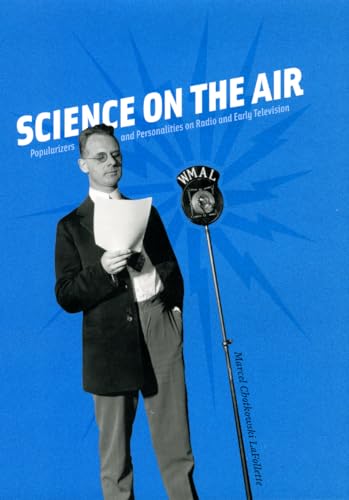
Mr. Wizard’s World. Bill Nye the Science Guy. NPR’s Science Friday. These popular television and radio programs broadcast science into the homes of millions of viewers and listeners. But these modern series owe much of their success to the pioneering efforts of early-twentieth-century science shows like Adventures in Science and “Our Friend the Atom.” Science on the Air is the fascinating history of the evolution of popular science in the first decades of the broadcasting era.
Marcel Chotkowski LaFollette transports readers to the early days of radio, when the new medium allowed innovative and optimistic scientists the opportunity to broadcast serious and dignified presentations over the airwaves. But the exponential growth of listenership in the 1920s, from thousands to millions, and the networks’ recognition that each listener represented a potential consumer, turned science on the radio into an opportunity to entertain, not just educate.
Science on the Air chronicles the efforts of science popularizers, from 1923 until the mid-1950s, as they negotiated topic, content, and tone in order to gain precious time on the air. Offering a new perspective on the collision between science’s idealistic and elitist view of public communication and the unbending economics of broadcasting, LaFollette rewrites the history of the public reception of science in the twentieth century and the role that scientists and their institutions have played in both encouraging and inhibiting popularization. By looking at the broadcasting of the past, Science on the Air raises issues of concern to all those who seek to cultivate a scientifically literate society today.
Marcel Chotkowski LaFollette transports readers to the early days of radio, when the new medium allowed innovative and optimistic scientists the opportunity to broadcast serious and dignified presentations over the airwaves. But the exponential growth of listenership in the 1920s, from thousands to millions, and the networks’ recognition that each listener represented a potential consumer, turned science on the radio into an opportunity to entertain, not just educate.
Science on the Air chronicles the efforts of science popularizers, from 1923 until the mid-1950s, as they negotiated topic, content, and tone in order to gain precious time on the air. Offering a new perspective on the collision between science’s idealistic and elitist view of public communication and the unbending economics of broadcasting, LaFollette rewrites the history of the public reception of science in the twentieth century and the role that scientists and their institutions have played in both encouraging and inhibiting popularization. By looking at the broadcasting of the past, Science on the Air raises issues of concern to all those who seek to cultivate a scientifically literate society today.
Die Inhaltsangabe kann sich auf eine andere Ausgabe dieses Titels beziehen.
Über die Autorin bzw. den Autor
Marcel Chotkowski LaFollette is an independent historian who has taught at the Johns Hopkins University, the George Washington University, and the Massachusetts Institute of Technology. She is the author of several books, including Making Science Our Own: Public Images of Science, 1910–1955, also published by the University of Chicago Press, and Reframing Scopes: Journalists, Scientists, and Lost Photographs from the Trial of the Century.
Auszug. © Genehmigter Nachdruck. Alle Rechte vorbehalten.
Science on the Air
Popularizers and Personalities on Radio and Early TelevisionBy Marcel Chotkowski LaFolletteThe University of Chicago Press
Copyright © 2008 The University of ChicagoAll right reserved.
ISBN: 978-0-226-46759-7
Contents
List of Figures..........................................ixPrologue.................................................11 Tuxedos and Microphones................................72 The Radio Nature League................................273 Syndicating Science....................................454 Cooperative Ventures...................................655 Shifting Ground........................................876 A Twist of the Dial....................................1137 Facts and Fictionalizations............................1338 Adventuring with Scientists............................1579 Broadcasting the Voice of the Atom.....................17910 Illusions of Actuality................................211Epilogue: Entertaining Lessons...........................239Notes....................................................247Bibliography.............................................281Acknowledgments..........................................295Index....................................................299
Chapter One
Tuxedos and Microphones
This is merely a matter of salesmanship. The station acquires a higher appreciation of science if science appears in tuxedos than if it appears in soft shirts and patched clothes.... Filtering down to a part of our audience, it has an elevating influence on them. AUSTIN HOBART CLARK, 1925
ON October 3, 1923, the head of the Smithsonian Institution had just returned from fieldwork in the Canadian Rockies when his clerk took a telephone message from the manager of a new Washington, D.C., radio station. "Radio Corporation of America desires the Secretary to speak for broadcasting some time between the 20th and 30th of this month, from 8 to 10 o'clock in the evening on any subject," the clerk's note read. Had Charles D. Walcott accepted the invitation, his appearance would probably have been a onetime event. The geoscientist was neither a dynamic nor a comfortable public speaker. After many months away, he had work to do in the "Castle," the redbrick Victorian-era headquarters for the museum complex. It was easy to bump this invitation down the line.
"I do not feel that I could undertake this personally, as my voice is not adapted to it," Secretary Walcott wrote to Austin Hobart Clark, a middle-aged curator in the Smithsonian's U.S. National Museum, "but it occurred to me that perhaps you might be willing to give a short talk and to make the necessary arrangements with the Company as to time, place, etc." Clark was very willing. Here, finally, might be an opportunity to make his mark.
If the request had been handed off to some other Smithsonian scientist, the result might have been less eventful. Clark, an expert on marine invertebrates like starfish and sea urchins, knew little about radio broadcasting, but he was smart, ambitious, and exuberantly confident in his intellectual agility. He also had an authoritative and patrician New England accent-an authentic version of radio's stereotypical voice of the 1920s. After his first successful appearance, Clark began, at the encouragement and invitation of the station, to arrange more "Smithsonian Radio Talks," inviting speakers from within his institution's various bureaus.
Those first programs now seem stark and unsophisticated. Succinct fifteen-minute talks delivered by ichthyologists, astronomers, and entomologists. No jokes, no banter, no clever sound effects. Clark's broadcasts found an audience, however, and they represent one of the first sustained efforts in the United States to use radio to reach the public with science, the first wave in steadily expanding popularization efforts. The circumstances surrounding these pioneering broadcasts illuminate an important moment in the history of science and of American life. From the 1920s through the 1940s, the scientific community became more concerned about scripting its public image for the sake of increased funding and political support, and therefore became more engaged in popularization. The extent to which prestigious researchers in the United States cooperated in and supported ventures involving radio-a medium they regarded as intrinsically sensationalistic-demonstrated begrudging acceptance of the need for popularization.
This preoccupation with image coincided with increasing audience interest in science. After World War I, provocative changes were occurring in "the patterns and channels and beaten ruts" of conventional thought. As each scientific insight or discovery reshaped the intellectual landscape, it also wiggled the lens of public understanding. From theories of relativity to theories about human psychology, from animal physiology to plant pathology to Tutankhamen's tomb, excitement surrounded popular discussion of science. Ordinary Americans were eager to learn more about scientists' accomplishments, about exotic aspects of the natural world revealed during expeditions, and about the science underpinning consumer technologies like radio. Topics "which in previous generations would have got into print only in the form of treatises that would have reposed on the shelves," historian Mark Sullivan observed about his own times, "were now among the books most in demand at public libraries." Newspapers and popular magazines like Collier's Weekly and the Saturday Evening Post played critical roles in satisfying the public's desire for quick and comprehensible explanations. In 1923 radio offered another tantalizing outlet for communicating about science.
Using radio to reach that potential audience proved to be as challenging as it was tempting. Within two years, Clark was declaring:
One never knows, of course, how long this will last. But all of those who have talked over the radio ... have acquired a wholly new concept of popular science, and the training they have received will not soon be forgotten.
What was that "new concept"? What did scientists like Clark believe they were accomplishing when they cooperated with commercial broadcasters? And did they succeed? As communications analyst Anthony Smith emphasizes, the "essence" of broadcasting is that editorial power over content is "fused with the ownership of the means of disseminating the product." This innate condition placed scientists-accustomed to controlling their own communications-at a disadvantage, especially when power over all aspects of broadcasting, from scheduling to scripts to access, became consolidated in the United States within a few corporations that owned the national networks. The dream of reaching enormous audiences was alluring. For the scientists and their organizations, the question eventually became whether they were willing to pay the price.
BIG DREAMS
In the fall of 1923, radio dangled in the public imagination like a shiny new toy. Wireless transmission of sound to mass, undifferentiated audiences represented an astonishing prospect, one that frequently prompted predictions of national unity, universal education, and international cooperation. As one commentator observed, radio's success stimulated the dream that society "shall wake up one bright morning with an international consciousness ... and the dawn of mutual understanding and world peace will have come." To...
„Über diesen Titel“ kann sich auf eine andere Ausgabe dieses Titels beziehen.
Suchergebnisse für Science on the Air: Popularizers and Personalities...

Beispielbild für diese ISBN
Science on the Air : Popularizers and Personalities on Radio and Early Television
Verlag:
University of Chicago Press, 2008
ISBN 10: 0226467597
ISBN 13: 9780226467597
Gebraucht
Hardcover
Anbieter: Better World Books, Mishawaka, IN, USA
Verkäuferbewertung 5 von 5 Sternen

Zustand: Good. Former library copy. Pages intact with minimal writing/highlighting. The binding may be loose and creased. Dust jackets/supplements are not included. Includes library markings. Stock photo provided. Product includes identifying sticker. Better World Books: Buy Books. Do Good. Artikel-Nr. 2006548-6
Gebraucht kaufen
EUR 6,75
Versand gratis
Versand innerhalb von USA
Versand innerhalb von USA
Anzahl: 2 verfügbar
Beispielbild für diese ISBN
Science on the Air: Popularizers and Personalities on Radio and Early Television
Verlag:
University of Chicago Press, 2008
ISBN 10: 0226467597
ISBN 13: 9780226467597
Gebraucht
Hardcover
Anbieter: ThriftBooks-Dallas, Dallas, TX, USA
Verkäuferbewertung 5 von 5 Sternen
Hardcover. Zustand: Very Good. No Jacket. Former library book; May have limited writing in cover pages. Pages are unmarked. ~ ThriftBooks: Read More, Spend Less. Artikel-Nr. G0226467597I4N10
Gebraucht kaufen
EUR 6,90
Versand gratis
Versand innerhalb von USA
Versand innerhalb von USA
Anzahl: 1 verfügbar
Beispielbild für diese ISBN
Science on the Air Popularizers and Personalities on Radio and Early Television
Anbieter: Revaluation Books, Exeter, Vereinigtes Königreich
Verkäuferbewertung 5 von 5 Sternen
Hardcover. Zustand: Brand New. illustrated edition. 324 pages. 9.00x6.25x1.25 inches. In Stock. Artikel-Nr. 0226467597
Neu kaufen
EUR 30,89
EUR 14,75 Versand
Versand von Vereinigtes Königreich nach USA
Versand von Vereinigtes Königreich nach USA
Anzahl: 1 verfügbar
Beispielbild für diese ISBN
Science on the Air
Verlag:
The University of Chicago Press, 2008
ISBN 10: 0226467597
ISBN 13: 9780226467597
Neu
Hardcover
Anbieter: Kennys Bookstore, Olney, MD, USA
Verkäuferbewertung 5 von 5 Sternen
Zustand: New. Presents history of the evolution of popular science in the first decades of the broadcasting era. This title transports readers to the early days of radio, when the new medium allowed innovative and optimistic scientists the opportunity to broadcast serious and dignified presentations over the airwaves. Num Pages: 288 pages, 22 halftones. BIC Classification: 1KBB; 3JJG; 3JJH; 3JJPG; APT; APW; PDZ. Category: (G) General (US: Trade). Dimension: 237 x 171 x 26. Weight in Grams: 594. . 2008. Hardback. . . . . Books ship from the US and Ireland. Artikel-Nr. V9780226467597
Neu kaufen
EUR 57,38
EUR 9,37 Versand
Versand innerhalb von USA
Versand innerhalb von USA
Anzahl: 15 verfügbar