
Verwandte Artikel zu Piracy: The Intellectual Property Wars from Gutenberg...
Inhaltsangabe
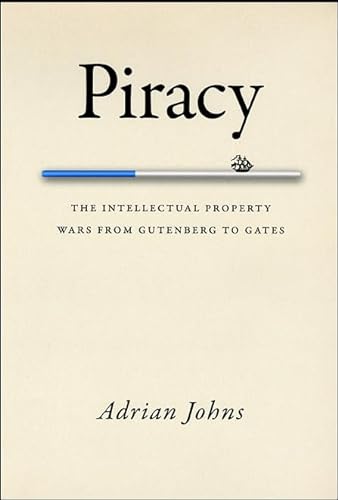
Since the rise of Napster and other file sharing services in its wake, most of us have assumed that intellectual piracy is a product of the digital age and that it threatens creative expression as never before. The Motion Picture Association of America, for instance, claimed that in 2005 the film industry lost $2.3 billion in revenue to piracy online. But here Adrian Johns shows that piracy has a much longer and more vital history than we have realized - one that has been largely forgotten and is little understood. "Piracy" explores the intellectual property wars from the advent of print culture in the fifteenth century to the reign of the Internet in the twenty-first. Written with a historian's flair for narrative and sparkling detail, the book swarms throughout with characters of genius, principle, cunning, and outright criminal intent. In the wars over piracy, it is the victims - from Charles Dickens to Bob Dylan - who have always been the best known, but the principal players - the pirates themselves - have long languished in obscurity, and it is their stories especially that Johns brings to life in these vivid pages. Brimming with broader implications for today's debates over open access, fair use, free culture, and the like, Johns' book ultimately argues that piracy has always stood at the center of our attempts to reconcile creativity and commerce - and that piracy has been an engine of social, technological, and intellectual innovations as often as it has been their adversary. From Cervantes to Sonny Bono, from Maria Callas to Microsoft, from Grub Street to Google, no chapter in the story of piracy evades Johns' graceful analysis in what will be the definitive history of the subject for years to come.
Die Inhaltsangabe kann sich auf eine andere Ausgabe dieses Titels beziehen.
Über die Autorin bzw. den Autor
Adrian Johns is professor of history and chair of the Committee on Conceptual and Historical Studies of Science at the University of Chicago. He is the author of The Nature of the Book: Print and Knowledge in the Making, also published by the University of Chicago Press.
Auszug. © Genehmigter Nachdruck. Alle Rechte vorbehalten.
Piracy
THE INTELLECTUAL PROPERTY WARS FROM GUTENBERG TO GATESBy Adrian JohnsTHE UNIVERSITY OF CHICAGO PRESS
Copyright © 2009 Adrian JohnsAll right reserved.
ISBN: 978-0-226-40118-8
Contents
1 A General History of the Pirates...............................................12 The Invention of Piracy........................................................173 The Piratical Enlightenment....................................................414 Experimenting with Print.......................................................575 Pharmaceutical Piracy and the Origins of Medical Patenting.....................836 Of Epics and Orreries..........................................................1097 The Land without Property......................................................1458 Making a Nation................................................................1799 The Printing Counterrevolution.................................................21310 Inventors, Schemers, and Men of Science.......................................24711 International Copyright and the Science of Civilization.......................29112 The First Pirate Hunters......................................................32713 The Great Oscillation War.....................................................35714 Intellectual Property and the Nature of Science...............................40115 The Pirate at Home and at Large...............................................43116 From Phreaking to Fudding.....................................................46317 Past, Present, and Future.....................................................497Acknowledgments..................................................................519Notes............................................................................523Index............................................................................593
Chapter One
A General History of the Pirates
In mid-2004, executives at the Tokyo headquarters of the huge electronics multinational NEC began to hear reports that its products were being counterfeited and sold in Chinese stores. Nobody was at all surprised. Reports of this kind were routine for any corporation of NEC's size and reach, and in this case they initially seemed to concern small stuff—blank DVDs and the like. The company nevertheless moved swiftly to put into action its standard response in such cases, hiring a firm called International Risk to look into the matter. There was no reason to suspect that this would prove to be anything more than yet another incident like all the others—irritating, no doubt, but impossible to suppress entirely. Piracy of this kind was the unavoidable price of doing business on a global scale.
Two years, half a dozen countries, and several continents later, what International Risk had unveiled shocked even the most jaded experts in today's industrial shenanigans. They revealed not just a few streetwise DVD pirates, but an entire parallel NEC organization. As the real company's senior vice president ruefully remarked, the pirates had "attempted to completely assume the NEC brand." Their version, like the original, was multinational and highly professional. Its agents carried business cards. They were even recruited publicly by what looked like legitimate advertising. The piratical firm had not only replicated existing NEC goods, but actively invested in research and development to devise its own. Over time, it had produced an entire range of consumer products, from MP3 players to lavish home theater systems. These goods were of high quality, with warranties emulating NEC's own (in fact, the conspiracy came to light only when users tried to exercise their warranty rights by contacting NEC). To manufacture them the impostor multinational had signed royalty arrangements with more than fifty businesses scattered through China, Hong Kong, and Taiwan, at least some of which seemed to believe they were working for the real NEC. And it had developed its own sophisticated distribution networks, allowing its products to reach a global market extending at least as far as Africa and Europe. If this was indeed, as the international press called it, the "next step in pirating," then it was a very dramatic and impressive step indeed.
When news of the pirate NEC broke in mid-2006, the story quickly winged its way across the Internet. Readers and commentators in the blogosphere reproduced the original press reports many times over. They expressed dismay at the implications. But their dismay was often accompanied by a drop of schadenfreude. Now, they realized, none of them could really be confident that the "NEC" disk drives, chips, screens, or keyboards on which they were doing their blogging were what they claimed to be. Some found this ominous, because of what it implied about knowledge in general in the networked world. Others acknowledged those implications but were only too happy to profess that they found them appealing: here was a gigantic corporation coming a cropper at the hands of unbranded outlaws who had proved themselves faster, nimbler, smarter. The Net's echo-chamber amplified the incident into a symbol of every cultural fear, epistemic doubt, and libertarian dream suggested by the digital age. Here, it seemed, was a glimpse of where everyday menaces like phishing and identity theft were inexorably leading.
This case of a doppelgänger multinational does indeed seem to mark some kind of culmination. It is hard to imagine a more spectacular act of piracy, unless perhaps one could conjure up a fake World Intellectual Property Organization. And in fact the venture came to light almost exactly on cue, just as impersonation of this kind had been identified as a growing piratical trend, set to succeed hacking and pharming as the mode of digital banditry du jour. "Brandjacking," it was called. It had even been singled out as a looming problem by the CEO of International Risk—who, not coincidentally, was a longtime veteran of the Hong Kong police experienced in tackling human kidnappings. Such piracy, he had cautioned in public speeches, was fast becoming a fact of life for the electronics and pharmaceuticals industries, with a recognizable modus operandi. An episode generally began when a legitimate company licensed a factory to manufacture its goods; the brandjackers who stood behind the factory would then take the documentation involved in the license, duplicate it, and redeploy it in order to recruit other plants. These other operations often remained blissfully unaware that they were dealing with impostors. After all, the outlaws helped themselves to the very devices—affidavits, bills, forms, contracts—that are supposed to guarantee legitimacy in modern capitalism. Especially hard to fight were brandjackers who operated across national boundaries, particularly the strait separating Taiwan from mainland China. The authorities in the People's Republic might well prove reluctant to prosecute local businesses that could plausibly claim to be acting in innocence. All of these vulnerabilities were exploited to the full by NEC's evil twin.
NEC's discomfiting experience throws into sharp relief the sheer range of phenomena that fall under the term "piracy" as it is nowadays used. They extend far beyond the piecemeal purloining of intellectual property. They reach, in fact, to the defining elements of modern culture itself: to science and technology; to authorship, authenticity, and credibility; to policing and politics; to the premises on which economic activity and...
„Über diesen Titel“ kann sich auf eine andere Ausgabe dieses Titels beziehen.
Suchergebnisse für Piracy: The Intellectual Property Wars from Gutenberg...

Beispielbild für diese ISBN
Piracy: The Intellectual Property Wars from Gutenberg to Gates
Verlag:
University of Chicago Press, 2010
ISBN 10: 0226401189
ISBN 13: 9780226401188
Gebraucht
Hardcover
Anbieter: ThriftBooks-Atlanta, AUSTELL, GA, USA
Verkäuferbewertung 5 von 5 Sternen

Hardcover. Zustand: Fair. No Jacket. Readable copy. Pages may have considerable notes/highlighting. ~ ThriftBooks: Read More, Spend Less. Artikel-Nr. G0226401189I5N00
Gebraucht kaufen
EUR 6,77
Versand gratis
Versand innerhalb von USA
Versand innerhalb von USA
Anzahl: 1 verfügbar
Beispielbild für diese ISBN
Piracy: The Intellectual Property Wars from Gutenberg to Gates
Verlag:
University of Chicago Press, 2010
ISBN 10: 0226401189
ISBN 13: 9780226401188
Gebraucht
Hardcover
Anbieter: ThriftBooks-Atlanta, AUSTELL, GA, USA
Verkäuferbewertung 5 von 5 Sternen
Hardcover. Zustand: Very Good. No Jacket. May have limited writing in cover pages. Pages are unmarked. ~ ThriftBooks: Read More, Spend Less. Artikel-Nr. G0226401189I4N00
Gebraucht kaufen
EUR 6,77
Versand gratis
Versand innerhalb von USA
Versand innerhalb von USA
Anzahl: 1 verfügbar
Beispielbild für diese ISBN
Piracy: The Intellectual Property Wars from Gutenberg to Gates
Verlag:
University of Chicago Press, 2010
ISBN 10: 0226401189
ISBN 13: 9780226401188
Gebraucht
Hardcover
Anbieter: ThriftBooks-Atlanta, AUSTELL, GA, USA
Verkäuferbewertung 5 von 5 Sternen
Hardcover. Zustand: Good. No Jacket. Former library book; Pages can have notes/highlighting. Spine may show signs of wear. ~ ThriftBooks: Read More, Spend Less. Artikel-Nr. G0226401189I3N10
Gebraucht kaufen
EUR 6,77
Versand gratis
Versand innerhalb von USA
Versand innerhalb von USA
Anzahl: 1 verfügbar
Beispielbild für diese ISBN
Piracy: The Intellectual Property Wars from Gutenberg to Gates
Verlag:
University of Chicago Press, 2010
ISBN 10: 0226401189
ISBN 13: 9780226401188
Gebraucht
Hardcover
Anbieter: ThriftBooks-Dallas, Dallas, TX, USA
Verkäuferbewertung 5 von 5 Sternen
Hardcover. Zustand: Good. No Jacket. Pages can have notes/highlighting. Spine may show signs of wear. ~ ThriftBooks: Read More, Spend Less. Artikel-Nr. G0226401189I3N00
Gebraucht kaufen
EUR 6,77
Versand gratis
Versand innerhalb von USA
Versand innerhalb von USA
Anzahl: 1 verfügbar
Beispielbild für diese ISBN
Piracy: The Intellectual Property Wars from Gutenberg to Gates
Verlag:
University of Chicago Press, 2010
ISBN 10: 0226401189
ISBN 13: 9780226401188
Gebraucht
Hardcover
Anbieter: ThriftBooks-Dallas, Dallas, TX, USA
Verkäuferbewertung 5 von 5 Sternen
Hardcover. Zustand: Very Good. No Jacket. Missing dust jacket; May have limited writing in cover pages. Pages are unmarked. ~ ThriftBooks: Read More, Spend Less. Artikel-Nr. G0226401189I4N01
Gebraucht kaufen
EUR 6,77
Versand gratis
Versand innerhalb von USA
Versand innerhalb von USA
Anzahl: 1 verfügbar
Beispielbild für diese ISBN
Piracy : The Intellectual Property Wars from Gutenberg to Gates
Verlag:
University of Chicago Press, 2010
ISBN 10: 0226401189
ISBN 13: 9780226401188
Gebraucht
Hardcover
Erstausgabe
Anbieter: Better World Books, Mishawaka, IN, USA
Verkäuferbewertung 5 von 5 Sternen
Zustand: Good. 1st Edition. Pages intact with minimal writing/highlighting. The binding may be loose and creased. Dust jackets/supplements are not included. Stock photo provided. Product includes identifying sticker. Better World Books: Buy Books. Do Good. Artikel-Nr. 6466303-6
Gebraucht kaufen
EUR 7,09
Versand gratis
Versand innerhalb von USA
Versand innerhalb von USA
Anzahl: 2 verfügbar
Beispielbild für diese ISBN
Piracy : The Intellectual Property Wars from Gutenberg to Gates
Verlag:
University of Chicago Press, 2010
ISBN 10: 0226401189
ISBN 13: 9780226401188
Gebraucht
Hardcover
Erstausgabe
Anbieter: Better World Books, Mishawaka, IN, USA
Verkäuferbewertung 5 von 5 Sternen
Zustand: Good. 1st Edition. Former library copy. Pages intact with minimal writing/highlighting. The binding may be loose and creased. Dust jackets/supplements are not included. Includes library markings. Stock photo provided. Product includes identifying sticker. Better World Books: Buy Books. Do Good. Artikel-Nr. 346999-6
Gebraucht kaufen
EUR 7,09
Versand gratis
Versand innerhalb von USA
Versand innerhalb von USA
Anzahl: 1 verfügbar
Beispielbild für diese ISBN
Piracy: The Intellectual Property Wars from Gutenberg to Gates
Verlag:
University of Chicago Press, 2010
ISBN 10: 0226401189
ISBN 13: 9780226401188
Gebraucht
Hardcover
Anbieter: Books From California, Simi Valley, CA, USA
Verkäuferbewertung 4 von 5 Sternen

hardcover. Zustand: Good. Artikel-Nr. mon0003382052
Gebraucht kaufen
EUR 4,67
EUR 4,44 Versand
Versand innerhalb von USA
Versand innerhalb von USA
Anzahl: 1 verfügbar
Beispielbild für diese ISBN
Piracy: The Intellectual Property Wars from Gutenberg to Gates
Verlag:
University of Chicago Press, 2010
ISBN 10: 0226401189
ISBN 13: 9780226401188
Gebraucht
Hardcover
Erstausgabe
Anbieter: Books End Bookshop, Syracuse, NY, USA
Verkäuferbewertung 4 von 5 Sternen
Hardcover. Zustand: Very Good+. Zustand des Schutzumschlags: Very Good+. First Edition; First Printing. Review material laid in. Stamped Withdrawn from Syracuse University Library- uncirculated, no other library markings. ; 8.90 X 5.90 X 1.80 inches fmc2%262D. Artikel-Nr. 316999
Gebraucht kaufen
EUR 7,34
EUR 5,34 Versand
Versand innerhalb von USA
Versand innerhalb von USA
Anzahl: 1 verfügbar
Beispielbild für diese ISBN
Piracy : The Intellectual Property Wars from Gutenberg to Gates
Verlag:
University of Chicago Press, 2010
ISBN 10: 0226401189
ISBN 13: 9780226401188
Gebraucht
Hardcover
Erstausgabe
Anbieter: Better World Books Ltd, Dunfermline, Vereinigtes Königreich
Verkäuferbewertung 5 von 5 Sternen
Zustand: Good. 1st Edition. Pages intact with minimal writing/highlighting. The binding may be loose and creased. Dust jackets/supplements are not included. Stock photo provided. Product includes identifying sticker. Better World Books: Buy Books. Do Good. Artikel-Nr. 6466303-6
Gebraucht kaufen
EUR 6,76
EUR 5,96 Versand
Versand von Vereinigtes Königreich nach USA
Versand von Vereinigtes Königreich nach USA
Anzahl: 1 verfügbar