
Verwandte Artikel zu Why the Wheel is Round: Muscles, Technology, and How...
Inhaltsangabe
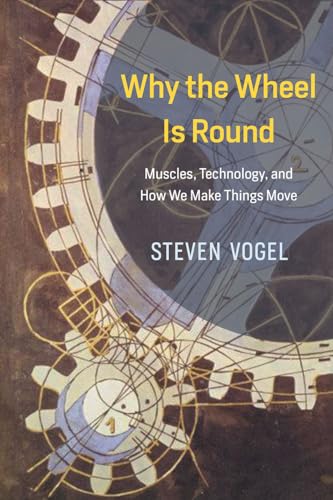
There is no part of our bodies that fully rotates - be it a wrist or ankle or arm in a shoulder socket, we are made to twist only so far. And yet, there is no more fundamental human invention than the wheel - a rotational mechanism that accomplishes what our physical form cannot. Throughout history, humans have developed technologies powered by human strength, complementing the physical abilities we have while overcoming our weaknesses. Providing a unique history of the wheel and other rotational devices, like cranks, cranes, carts, and capstans, Why the Wheel Is Round examines the contraptions and tricks we have devised in order to more efficiently move - and move through - the physical world. Steven Vogel combines his engineering expertise with his remarkable curiosity about how things work to explore how wheels and other mechanisms were, until very recently, powered by the push and pull of the muscles and skeletal systems of humans and other animals. Why the Wheel Is Round explores all manner of treadwheels, hand-spikes, gears, and more, as well as how these technologies diversified into such things as hand-held drills and hurdy-gurdies. Surprisingly, a number of these devices can be built out of everyday components and materials, and Vogel's accessible and expansive book includes instructions and models so that inspired readers can even attempt to make their own muscle-powered technologies, like trebuchets and ballista. Appealing to anyone fascinated by the history of mechanics and technology as well as to hobbyists with home workshops, Why the Wheel Is Round offers a captivating exploration of our common technological heritage based on the simple concept of rotation. From our leg muscles powering the gears of a bicycle to our hands manipulating a mouse on a roller ball, it will be impossible to overlook the amazing feats of innovation behind our daily devices.
Die Inhaltsangabe kann sich auf eine andere Ausgabe dieses Titels beziehen.
Über die Autorin bzw. den Autor
Steven Vogel (1940–2015) was James B. Duke Professor Emeritus of biology at Duke University. His books include Cats’ Paws and Catapults, Glimpses of Creatures in Their Physical Worlds, and The Life of a Leaf, the latter also published by the University of Chicago Press.
Auszug. © Genehmigter Nachdruck. Alle Rechte vorbehalten.
Why the Wheel Is Round
Muscles, Technology, and How We Make Things Move
By Steven VogelThe University of Chicago Press
Copyright © 2016 Steven Vogel
All rights reserved.
ISBN: 978-0-226-38103-9All rights reserved.
Contents
Preface,
1 Circling Bodies,
2 Wheels and Wagons,
3 Turning Points — and Pots,
4 Going in Circles,
5 Or Being Encircled,
6 Grabbing Again and Again,
7 Turning and Unturning,
8 The True Crank,
9 Spinning Fibers,
10 A Few More Turns,
11 Rolling Back Rotation,
Appendix: Making Models,
Notes,
References,
CHAPTER 1
Circling Bodies
First — don't be shy — try a few motions with your own body. Twist an extended arm as far as you can one way and then twist it the other way. Your wrist (mainly) can't even do a full 360-degree rotation. Twist your neck — your head won't rotate even as far as your hand did. Your lower back's mobility limits how far your torso can rotate just as severely, and feet (mainly ankles) feel still greater rotational constraint. All sorts of limbering and muscle-strengthening exercises depend on rotation — "curls" just put the matter more explicitly. After all, appendages hook on to us at pivot points around which they swing. But they swing through limited arcs, with varying degrees of constraint. Thus arms move around shoulders more freely; legs around hips less so, with flexibility evidently traded against stability and reliability. No picture need be provided; doing it yourself should be persuasive.
Continuous rotation, as with a proper wheel? For better or worse, no animal joint has ever managed that trick. Yes, we humans can rotate continuously — but only if we do it as a whole-body activity — as do somersaulting or rolling children. Almost all other creatures that rotate live within that general limitation as well. We're looking at tumbleweeds, a shrimp that rolls back to the water when washed up on a beach, a caterpillar that rotates head over heels, so to speak, and the helicopter-like seeds (really fruits, technically samaras) of trees such as maples. More about these systems in a few pages.
Then look around. Sure, we've created a host of devices that may turn but also face (by design) much the same limitation on rotation — most hinges, door handles, light switches, latches, staplers, scissors, pliers ... But playing a far more central role in our technology are things that rotate without limit as parts of otherwise non-turners, things that go around and around as long as they're driven and perhaps a little longer. I mean devices based on that marvelous invention, the wheel and axle. That includes almost all of our motors and their associated shafts, pulleys, gears, and so forth. It includes our diverse wheeled and propeller-driven vehicles. Plus all manner of hand tools, from eggbeaters to socket wrenches. Long ago that meant wagons and potter's wheels, and the diversity of our rotational contraptions has been on the increase throughout our history. No doubt at all — mechanisms that rotate as parts of otherwise non-rotating contrivances form the very core of our mechanical technology.
We thus glimpse a paradoxical problem. Through most of human history (and prehistory, if you prefer the distinction), muscle has been the main motor of our technology, whether we work our own personal meat or persuade that of our domesticated animals to do our jobs. Muscle can only pull, and it must remain attached at both its ends. How can a non-rotating engine drive truly rotational machinery? This book explores the diverse ways that humans have faced up to and managed to deal with that most basic of dilemmas. In essence, it explores one facet of the biomechanics behind history.
Your immediate rejoinder might be that the difficulty yields to a trivially simple fix. Specifically, just add a crank, a lever extending radially outward from the rotating shaft with a slip fitting on a sideways extension of that lever. No need for an illustration — we make such things all the time, from hand-operated household gear such as pencil sharpeners, eggbeaters, and meat grinders to the engines of our cars, in which pistons moving (for most cars) up and down crank and thereby turn drive shafts. That slip fitting might be nothing more than a greasy hand or a loosely fitting outer handle of wood or plastic. It seems reasonable that this obvious trick should have been particularly appropriate for ancient devices, with their slow rotation rates. Oddly enough, cranks remained unknown (or nearly so) until about a thousand years ago. Think of it — for all their sophistication, the classical Mediterranean civilizations made no significant use of this simple and now ubiquitous arrangement. Punning subtly, one might ask, where's the rub?
Muscle-powered rotational machinery obviously has a much longer history than cranks — think again about all those wagons, chariots, and potter's wheels. How, then, were they persuaded to rotate? And have these more ancient fixes persisted, even gained in importance, with the further proliferation of rotational devices? No surprise — one question leads to another.
First, then, what are the options for making shafts and wheels turn? If nothing else, its peculiar modernity tells us that a crank isn't the only thing that will work. Consider some other possibilities, put as a series that I don't assert is chronological, fully complete, or mutually exclusive — and at the expense of suspense ...
• Roll the top of a cylinder by pushing something across it while the bottom then rolls (at half the speed) along the ground — rolling a log or barrel, as in figure 1.1. Of course, sooner or later (more likely sooner), the propelling roller on top leaves the driven roller behind. So you can't cover much distance without fairly often moving the roller left behind from rear to front. Even with a series of driven rollers, creating a new front one with a rear reject remains required. The simpler French-style or rod-type rolling pin works this way; its task doesn't ask that it roll very far and allows easy lifting and repositioning
• Pull or push on the axis of a wheel while a part of its circumference contacts the ground with enough friction so it rotates rather than just sliding along — as a horse pulls a cart and as in figure 1.2; or as you use a conventional rolling pin, one with a rotating handle at each end, by pushing or pulling the handles. The rolling pin then rotates as it presses the pie crust, although the handles do not. Proper bearings aren't absolutely necessary — a person can pull along a bagel-shaped (toroidal) water tank, hauling on a rope that loops through its center hole.
• Make an animal (perhaps a person) walk while pushing or pulling in monotonous circles around a vertical shaft or drum from which a radial lever protrudes — for example, turning a large posthole digger (auger), as in figure 1.3. The motor itself then rotates at just the same speed as the shaft or drum, so no bearing need be supplied — at least between the two. (Of course, that shaft or drum will typically turn around its own bearing.) Years ago, playgrounds had small merry-go-rounds driven by one or more children as others sat on the deck and made encouraging noises.
• Grab the handle of a tool, turn it through an arc, then release it, grab it again after turning one's arm or body some ways opposite the direction of the tool's rotation, and turn it again, as in figure...
„Über diesen Titel“ kann sich auf eine andere Ausgabe dieses Titels beziehen.
Suchergebnisse für Why the Wheel is Round: Muscles, Technology, and How...

Beispielbild für diese ISBN
Why the Wheel Is Round: Muscles, Technology, and How We Make Things Move
Verlag:
The University of Chicago Press, 2016
ISBN 10: 022638103X
ISBN 13: 9780226381039
Gebraucht
Hardcover
Anbieter: World of Books (was SecondSale), Montgomery, IL, USA
Verkäuferbewertung 5 von 5 Sternen

Hardback. Zustand: Good. There is no part of our bodies that fully rotates be it a wrist or ankle or arm in a shoulder socket, we are made to twist only so far. And yet, there is no more fundamental human invention than the wheel a rotational mechanism that accomplishes what our physical form cannot. Throughout history, humans have developed technologies powered by human strength, complementing the physical abilities we have while overcoming our weaknesses. Providing a unique history of the wheel and other rotational devices, like cranks, cranes, carts, and capstans, Why the Wheel Is Round examines the contraptions and tricks we have devised in order to more efficiently move and move through the physical world. Steven Vogel combines his engineering expertise with his remarkable curiosity about how things work to explore how wheels and other mechanisms were, until very recently, powered by the push and pull of the muscles and skeletal systems of humans and other animals. Why the Wheel Is Round explores all manner of treadwheels, hand-spikes, gears, and more, as well as how these technologies diversified into such things as hand-held drills and hurdy-gurdies. Surprisingly, a number of these devices can be built out of everyday components and materials, and Vogel's accessible and expansive book includes instructions and models so that inspired readers can even attempt to make their own muscle-powered technologies, like trebuchets and ballista. Appealing to anyone fascinated by the history of mechanics and technology as well as to hobbyists with home workshops, Why the Wheel Is Round offers a captivating exploration of our common technological heritage based on the simple concept of rotation. From our leg muscles powering the gears of a bicycle to our hands manipulating a mouse on a roller ball, it will be impossible to overlook the amazing feats of innovation behind our daily devices. Artikel-Nr. 00099238653
Gebraucht kaufen
EUR 5,08
Versand gratis
Versand innerhalb von USA
Versand innerhalb von USA
Anzahl: 1 verfügbar
Beispielbild für diese ISBN
Why the Wheel Is Round: Muscles, Technology, and How We Make Things Move
Verlag:
University of Chicago Press (edition Illustrated), 2016
ISBN 10: 022638103X
ISBN 13: 9780226381039
Gebraucht
Hardcover
Anbieter: BooksRun, Philadelphia, PA, USA
Verkäuferbewertung 5 von 5 Sternen
Hardcover. Zustand: Very Good. Illustrated. With dust jacket. It's a well-cared-for item that has seen limited use. The item may show minor signs of wear. All the text is legible, with all pages included. It may have slight markings and/or highlighting. Artikel-Nr. 022638103X-11-1-29
Gebraucht kaufen
EUR 5,09
Versand gratis
Versand innerhalb von USA
Versand innerhalb von USA
Anzahl: 1 verfügbar
Beispielbild für diese ISBN
Why the Wheel Is Round: Muscles, Technology, and How We Make Things Move
Verlag:
University of Chicago Press, 2016
ISBN 10: 022638103X
ISBN 13: 9780226381039
Gebraucht
Hardcover
Anbieter: ThriftBooks-Phoenix, Phoenix, AZ, USA
Verkäuferbewertung 5 von 5 Sternen
Hardcover. Zustand: Very Good. No Jacket. May have limited writing in cover pages. Pages are unmarked. ~ ThriftBooks: Read More, Spend Less. Artikel-Nr. G022638103XI4N00
Gebraucht kaufen
EUR 5,94
Versand gratis
Versand innerhalb von USA
Versand innerhalb von USA
Anzahl: 1 verfügbar
Beispielbild für diese ISBN
Why the Wheel Is Round: Muscles, Technology, and How We Make Things Move
Verlag:
University of Chicago Press, 2016
ISBN 10: 022638103X
ISBN 13: 9780226381039
Gebraucht
Hardcover
Anbieter: ThriftBooks-Dallas, Dallas, TX, USA
Verkäuferbewertung 5 von 5 Sternen
Hardcover. Zustand: Good. No Jacket. Former library book; Pages can have notes/highlighting. Spine may show signs of wear. ~ ThriftBooks: Read More, Spend Less. Artikel-Nr. G022638103XI3N10
Gebraucht kaufen
EUR 5,94
Versand gratis
Versand innerhalb von USA
Versand innerhalb von USA
Anzahl: 1 verfügbar
Beispielbild für diese ISBN
Why the Wheel Is Round: Muscles, Technology, and How We Make Things Move
Verlag:
University of Chicago Press, 2016
ISBN 10: 022638103X
ISBN 13: 9780226381039
Gebraucht
Hardcover
Anbieter: ThriftBooks-Atlanta, AUSTELL, GA, USA
Verkäuferbewertung 5 von 5 Sternen
Hardcover. Zustand: Good. No Jacket. Pages can have notes/highlighting. Spine may show signs of wear. ~ ThriftBooks: Read More, Spend Less. Artikel-Nr. G022638103XI3N00
Gebraucht kaufen
EUR 5,94
Versand gratis
Versand innerhalb von USA
Versand innerhalb von USA
Anzahl: 1 verfügbar
Beispielbild für diese ISBN
Why the Wheel Is Round: Muscles, Technology, and How We Make Things Move
Verlag:
University of Chicago Press, 2016
ISBN 10: 022638103X
ISBN 13: 9780226381039
Gebraucht
Hardcover
Anbieter: ThriftBooks-Atlanta, AUSTELL, GA, USA
Verkäuferbewertung 5 von 5 Sternen
Hardcover. Zustand: Fair. No Jacket. Former library book; Readable copy. Pages may have considerable notes/highlighting. ~ ThriftBooks: Read More, Spend Less. Artikel-Nr. G022638103XI5N10
Gebraucht kaufen
EUR 5,94
Versand gratis
Versand innerhalb von USA
Versand innerhalb von USA
Anzahl: 1 verfügbar
Beispielbild für diese ISBN
Why the Wheel Is Round: Muscles, Technology, and How We Make Things Move
Verlag:
University of Chicago Press, 2016
ISBN 10: 022638103X
ISBN 13: 9780226381039
Gebraucht
Hardcover
Anbieter: ThriftBooks-Dallas, Dallas, TX, USA
Verkäuferbewertung 5 von 5 Sternen
Hardcover. Zustand: Very Good. No Jacket. Former library book; May have limited writing in cover pages. Pages are unmarked. ~ ThriftBooks: Read More, Spend Less. Artikel-Nr. G022638103XI4N10
Gebraucht kaufen
EUR 5,94
Versand gratis
Versand innerhalb von USA
Versand innerhalb von USA
Anzahl: 1 verfügbar
Beispielbild für diese ISBN
Why the Wheel Is Round: Muscles, Technology, and How We Make Things Move
Verlag:
University of Chicago Press, 2016
ISBN 10: 022638103X
ISBN 13: 9780226381039
Gebraucht
Hardcover
Anbieter: ThriftBooks-Atlanta, AUSTELL, GA, USA
Verkäuferbewertung 5 von 5 Sternen
Hardcover. Zustand: Good. No Jacket. Former library book; Pages can have notes/highlighting. Spine may show signs of wear. ~ ThriftBooks: Read More, Spend Less. Artikel-Nr. G022638103XI3N10
Gebraucht kaufen
EUR 5,94
Versand gratis
Versand innerhalb von USA
Versand innerhalb von USA
Anzahl: 1 verfügbar
Beispielbild für diese ISBN
Why the Wheel Is Round: Muscles, Technology, and How We Make Things Move
Verlag:
University of Chicago Press, 2016
ISBN 10: 022638103X
ISBN 13: 9780226381039
Gebraucht
Hardcover
Anbieter: ThriftBooks-Dallas, Dallas, TX, USA
Verkäuferbewertung 5 von 5 Sternen
Hardcover. Zustand: Good. No Jacket. Pages can have notes/highlighting. Spine may show signs of wear. ~ ThriftBooks: Read More, Spend Less. Artikel-Nr. G022638103XI3N00
Gebraucht kaufen
EUR 5,94
Versand gratis
Versand innerhalb von USA
Versand innerhalb von USA
Anzahl: 1 verfügbar
Beispielbild für diese ISBN
Why the Wheel Is Round: Muscles, Technology, and How We Make Things Move
Verlag:
University of Chicago Press, 2016
ISBN 10: 022638103X
ISBN 13: 9780226381039
Gebraucht
Hardcover
Anbieter: ThriftBooks-Reno, Reno, NV, USA
Verkäuferbewertung 5 von 5 Sternen
Hardcover. Zustand: Very Good. No Jacket. May have limited writing in cover pages. Pages are unmarked. ~ ThriftBooks: Read More, Spend Less. Artikel-Nr. G022638103XI4N00
Gebraucht kaufen
EUR 5,94
Versand gratis
Versand innerhalb von USA
Versand innerhalb von USA
Anzahl: 1 verfügbar