
Verwandte Artikel zu A Long Saturday: Conversations
Inhaltsangabe
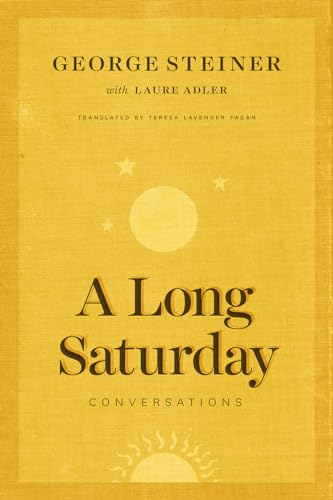
George Steiner is one of the preeminent intellectuals of our time. The Washington Post has declared that no one else “writing on literature can match him as polymath and polyglot, and few can equal the verve and eloquence of his writing,” while the New York Times says of his works that “the erudition is almost as extraordinary as the prose: dense, knowing, allusive.” Reading in many languages, celebrating the survival of high culture in the face of modern barbarisms, Steiner probes the ethics of language and literature with unparalleled grace and authority. A Long Saturday offers intimate insight into the questions that have absorbed him throughout his career.
In a stimulating series of conversations, Steiner and journalist Laure Adler discuss a range of topics, including Steiner’s boyhood in Vienna and Paris, his education at the University of Chicago and Harvard, and his early years in academia. Books are a touchstone throughout, but Steiner and Adler’s conversations also range over music, chess, psychoanalysis, the place of Israel in Jewish life, and beyond. Blending thoughts on subjects of broad interest in the humanities—the issue of honoring Richard Wagner and Martin Heidegger in spite of their politics, or Virginia Woolf’s awareness of the novel as a multivocal form, for example—with personal reflections on life and family, Steiner demonstrates why he is considered one of today’s greatest minds. Revealing and exhilarating, A Long Saturday invites readers to pull up a chair and listen in on a conversation with a master.
In a stimulating series of conversations, Steiner and journalist Laure Adler discuss a range of topics, including Steiner’s boyhood in Vienna and Paris, his education at the University of Chicago and Harvard, and his early years in academia. Books are a touchstone throughout, but Steiner and Adler’s conversations also range over music, chess, psychoanalysis, the place of Israel in Jewish life, and beyond. Blending thoughts on subjects of broad interest in the humanities—the issue of honoring Richard Wagner and Martin Heidegger in spite of their politics, or Virginia Woolf’s awareness of the novel as a multivocal form, for example—with personal reflections on life and family, Steiner demonstrates why he is considered one of today’s greatest minds. Revealing and exhilarating, A Long Saturday invites readers to pull up a chair and listen in on a conversation with a master.
Die Inhaltsangabe kann sich auf eine andere Ausgabe dieses Titels beziehen.
Über die Autorin bzw. den Autor
George Steiner is extraordinary fellow at Churchill College at the University of Cambridge. He is the author of many books, including Martin Heidegger, Real Presences, and The Portage to San Cristobal of A. H., all also published by the University of Chicago Press. Laure Adler is a journalist and the author of several books. Teresa Lavender Fagan is a freelance translator living in Chicago.
Auszug. © Genehmigter Nachdruck. Alle Rechte vorbehalten.
A Long Saturday
Conversations
By George Steiner, Laure Adler, Teresa Lavender FaganThe University of Chicago Press
Copyright © 2017 The University of Chicago
All rights reserved.
ISBN: 978-0-226-35038-7All rights reserved.
Contents
Translator's Note,
Interviewer's Note,
An Unsentimental Education: From Exile to the Institute,
To Be a Guest on Earth: Reflections on Judaism,
"Every Language Opens a Window onto a New World",
"God Is Kafka's Uncle": From the Book to Books,
The Humanities Can Make Us Inhuman: The Twentieth Century Has Morally Weakened Humanity,
Epilogue: Learning How to Die,
CHAPTER 1
An Unsentimental Education
FROM EXILE TO THE INSTITUTE
LAURE ADLER There's something, George Steiner, that your friend Alexis Philonenko mentions in Cahiers de L'Herne: your arm, the deformity, that physical challenge. He talks about it, and suggests it might have been a source of suffering for you all your life. Yet you never talk about it.
GEORGE STEINER It's very difficult for me to look at it objectively, of course. The decisive factor in my life was my mother's genius — she was a great Viennese woman. She spoke several languages: French, Hungarian, Italian, English; she was fiercely proud, but in a completely private way; and she had marvelous self-assurance.
I must have been around three or four — I can't remember exactly, but the moment was life altering. The first few years of my life were very difficult because my arm was more or less attached to my body; the treatments were very painful; I went from one hospital to the next to have it corrected. My mother said to me, "You are so lucky! You'll never have to do your military service!" What she said changed my life. "You are so lucky!" It was amazing that she could say that. And she was right. I was able to go to graduate school two or three years before my peers who had to do their military service.
Imagine: being able to say that to her son! I hate today's therapeutic culture, which uses euphemisms to describe the handicapped: "We're going to deal with this as a social advantage," and so on. That's wrong: it's very difficult, it's a serious problem, but it can also be beneficial. I was raised at a time when we weren't given aspirin or candy. There were shoes with zippers — very easy to put on. "No," my mother said, "you're going to learn how to tie your laces." I can tell you, it was hard. Anyone with two good hands doesn't even think about it, but it's an incredible achievement to be able to tie shoe laces. I yelled, I cried, and after six or seven months I managed to tie my shoes. And my mother said, "You can write with your left hand." I refused. Then she held my other hand behind my back, "You're going to learn to write with your bad hand — yes, you are." And she taught me how. I was able to draw pictures and sketch with my left hand. It was a metaphysics of effort. It was a metaphysics of will, discipline, and especially happiness to see all that as a great privilege; and it continued throughout my life.
I think it also enabled me to understand certain conditions, certain problems, that must be confronted by those with infirmities, problems that human Apollos, those fortunate to have a magnificent body and marvelous health, find difficult to grasp. What are the connections between physical and mental suffering and intellectual effort? We still don't understand this very well. Let's never forget that Beethoven was deaf, Nietzsche had terrible migraines, and Socrates was ugly. It's fascinating to find out what another person has had to overcome. I always ask myself this question when I meet someone: What has that person experienced? What has been his or her victory — or major defeat?
L.A. In Errata you tell how your father, who was born in Vienna and understood very quickly that Nazism was on the rise, left Vienna and moved to Paris with his family. And so you were born in Paris, and one day when you were very young, you witnessed a demonstration where people were shouting, "Kill the Jews!"
G.S. Yes, that was known as the Stavisky affair. It was an obscure scandal but is remembered because the extreme right in France keeps bringing it up. One of the marchers was a Colonel de La Rocque. Today he seems like a rather sinister clown, but he was taken very seriously at the time. I was quite close to the march, near the Lycée Janson-de-Sailly, and was running home up rue de la Pompe with my nanny because a small group of demonstrators of the extreme Right was approaching, led by Colonel de La Rocque. "Kill the Jews!" A phrase that would become "Better Hitler than Communism." This was happening in a neighborhood (rue de la Pompe, avenue Paul-Doumer) where there was a large population of Jewish bourgeois. My mother, not because she was afraid, but rather out of respect for old-fashioned conventions, said to my nanny and me, "Oh! lower the blinds." In came my father, who exclaimed, "Raise the blinds." He led me onto our little balcony. I remember the scene vividly: "Kill the Jews! Kill the Jews!" He said to me very calmly, "This is called history, and you must never be afraid." For a child of six, those words were transformative. Since that time, I know what to call history, and if I'm afraid, I'm ashamed; and I try not to be afraid.
It was an enormous advantage for me to know very early on who Hitler was, and that knowledge provided me with me an "unsentimental" education. From the year of my birth, in 1929, my father had predicted with absolute clarity — I have his journals — what was going to happen. Nothing surprised him.
L.A. So your father, who had foreseen what was going to happen in a Europe inflamed by Nazism, then decided to move his family to the United States. How did that come about?
G.S. The French prime minister, Paul Reynaud, had decided at the last minute that the country desperately needed fighter planes, Grummans. My father was sent to New York with some other financial bigwigs to negotiate the purchase of fighter planes for France. When he arrived in New York, something incredible happened. We sometimes forget that New York was a neutral city, completely neutral, with a lot of Nazis there on business, the Swastika pinned on their collars, as well as Nazi bankers also on buying trips or there for financial negotiations. At a Wall Street club a German who had been a close friend of my father's — this man ran the large Siemens company, which still exists — noticed him at a table and had a message sent over to him. My father tore up the note in front of everyone and didn't even acknowledge his friend. He didn't want to listen to him or see him. But his friend waited for him in the men's room, took him by the shoulders, and said, "Listen to me. This very year we're going to go through France like a hot knife through butter. Get your family out of there whatever the cost!" This took place before the fateful Wannsee conference, but already the big German bankers and CEOs knew what was happening from Polish accounts, as well as reports from the Wehrmacht in Poland; they knew that Jews would all be killed. Not how, or by what method, but they knew in principle: the Jews were going to be massacred.
This was 1940, right before the German invasion. Fortunately, my father took the warning very seriously. He asked Paul Reynaud permission for his family — my mother, my sister and me — to join him in the U.S., and Reynaud granted it. But my mother refused:...
„Über diesen Titel“ kann sich auf eine andere Ausgabe dieses Titels beziehen.
Suchergebnisse für A Long Saturday: Conversations

Beispielbild für diese ISBN
A Long Saturday: Conversations
Verlag:
University of Chicago Press, 2017
ISBN 10: 022635038X
ISBN 13: 9780226350387
Gebraucht
Hardcover
Anbieter: ThriftBooks-Atlanta, AUSTELL, GA, USA
Verkäuferbewertung 5 von 5 Sternen

Hardcover. Zustand: Very Good. No Jacket. May have limited writing in cover pages. Pages are unmarked. ~ ThriftBooks: Read More, Spend Less. Artikel-Nr. G022635038XI4N00
Gebraucht kaufen
EUR 11,59
Versand gratis
Versand innerhalb von USA
Versand innerhalb von USA
Anzahl: 1 verfügbar
Beispielbild für diese ISBN
A Long Saturday: Conversations
Verlag:
University of Chicago Press, 2017
ISBN 10: 022635038X
ISBN 13: 9780226350387
Gebraucht
Hardcover
Anbieter: ThriftBooks-Dallas, Dallas, TX, USA
Verkäuferbewertung 5 von 5 Sternen
Hardcover. Zustand: Very Good. No Jacket. May have limited writing in cover pages. Pages are unmarked. ~ ThriftBooks: Read More, Spend Less. Artikel-Nr. G022635038XI4N00
Gebraucht kaufen
EUR 11,61
Versand gratis
Versand innerhalb von USA
Versand innerhalb von USA
Anzahl: 1 verfügbar
Beispielbild für diese ISBN
A Long Saturday : Conversations
Verlag:
University of Chicago Press, 2017
ISBN 10: 022635038X
ISBN 13: 9780226350387
Gebraucht
Hardcover
Anbieter: Better World Books, Mishawaka, IN, USA
Verkäuferbewertung 5 von 5 Sternen
Zustand: Very Good. Pages intact with possible writing/highlighting. Binding strong with minor wear. Dust jackets/supplements may not be included. Stock photo provided. Product includes identifying sticker. Better World Books: Buy Books. Do Good. Artikel-Nr. 12955670-6
Gebraucht kaufen
EUR 13,80
Versand gratis
Versand innerhalb von USA
Versand innerhalb von USA
Anzahl: 1 verfügbar
Beispielbild für diese ISBN
Long Saturday â" Conversations
Verlag:
University of Chicago Press, 2017
ISBN 10: 022635038X
ISBN 13: 9780226350387
Gebraucht
Paperback
Anbieter: WorldofBooks, Goring-By-Sea, WS, Vereinigtes Königreich
Verkäuferbewertung 5 von 5 Sternen
Paperback. Zustand: Very Good. The book has been read, but is in excellent condition. Pages are intact and not marred by notes or highlighting. The spine remains undamaged. Artikel-Nr. GOR011214848
Gebraucht kaufen
EUR 13,11
EUR 6,51 Versand
Versand von Vereinigtes Königreich nach USA
Versand von Vereinigtes Königreich nach USA
Anzahl: 1 verfügbar
Beispielbild für diese ISBN
A Long Saturday: Conversations
Verlag:
University of Chicago Press, 2017
ISBN 10: 022635038X
ISBN 13: 9780226350387
Gebraucht
Hardcover
Anbieter: Saint Georges English Bookshop, Berlin, Deutschland
Verkäuferbewertung 4 von 5 Sternen

Hardcover. Zustand: Very Good. Zustand des Schutzumschlags: Very Good. Excellent used condition, unmarked text, unclipped jacket, some edge wear, Ships from Berlin Bookshop Bxn05082026. Artikel-Nr. 195157183
Gebraucht kaufen
EUR 20,00
EUR 16,00 Versand
Versand von Deutschland nach USA
Versand von Deutschland nach USA
Anzahl: 1 verfügbar