
Verwandte Artikel zu The Last Hurrah: A Novel
Inhaltsangabe
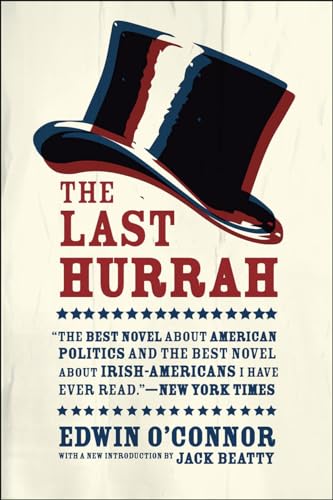
“We’re living in a sensitive age, Cuke, and I’m not altogether sure you’re fully attuned to it.” So says Irish-American politician Frank Skeffington—a cynical, corrupt 1950s mayor, and also an old-school gentleman who looks after the constituents of his New England city and enjoys their unwavering loyalty in return. But in our age of dynasties, mercurial social sensitivities, and politicians making love to the camera, Skeffington might as well be talking to us.
Not quite a roman á clef of notorious Boston mayor James Michael Curley, The Last Hurrah tells the story of Skeffington’s final campaign as witnessed through the eyes of his nephew, who learns a great deal about politics as he follows his uncle to fundraisers, wakes, and into smoke-filled rooms, ultimately coming—almost against his will—to admire the man. Adapted into a 1958 film starring Spencer Tracy and directed by John Ford (and which Curley tried to keep from being made), Edwin O’Connor’s opus reveals politics as it really is, and big cities as they really were. An expansive, humorous novel offering deep insight into the Irish-American experience and the ever-changing nature of the political machine, The Last Hurrah reveals political truths still true today: what the cameras capture is just the smiling face of the sometimes sordid business of giving the people what they want.
Die Inhaltsangabe kann sich auf eine andere Ausgabe dieses Titels beziehen.
Über die Autorin bzw. den Autor
Edwin O’Connor (1918-68) was an American radio personality, journalist, and novelist. Among his many books are The Edge of Sadness, winner of the Pulitzer Prize for fiction, and I Was Dancing.
Auszug. © Genehmigter Nachdruck. Alle Rechte vorbehalten.
The Last Hurrah
A Novel
By Edwin O'ConnorThe University of Chicago Press
Copyright © 2016 Jack Beatty
All rights reserved.
ISBN: 978-0-226-32141-7All rights reserved.
CHAPTER 1
IT was early in August when Frank Skeffington decided — or rather, announced his decision, which actually had been arrived at some months before — to run for re-election as mayor of the city. This was a matter about which there had been public speculation for a good while: for, in fact, four years, ever since he had been inaugurated for what his opponents had fondly hoped was the last time. Since the beginning of the current year, however, the speculation had increased, not alone because the deadline was drawing nearer, but also because there were no other elections of importance coming up — the municipal elections took place in off years politically and so did not have to share the spotlight with national or state contests. Thus interest had mounted, and as it had, so had the hopes of Skeffington's opponents. For while he was admittedly among the most durable of politicians, he was just as admittedly getting older, and in recent speeches and press conferences he had expressed little interest in continuing his long political career. On one memorable occasion he had gone so far as to speak with a certain dreaminess of the joys of retirement, of the quiet time of withdrawal which would follow a lifetime spent in the service of the public.
"Far from the madding crowd," he had said, gazing at the reporters expressionlessly. "The declining years spent in solitude and contemplation. Possibly in some rustic retreat."
This hint had not been received without a measure of cynicism; one reporter from the chief opposition paper had led the questioning which followed.
"Tell us, Governor," he had said (for, as Skeffington had twice been governor of the state, the courtesy title lingered long after the office itself had been lost), "just how would you propose to adjust yourself to this rustic life? Wouldn't it be pretty quiet? What would you do?"
"Read," Skeffington had replied promptly. "And reflect." At this his pale blue eyes had closed, and an expression of extraordinary benignity crossed the full, faintly veined and rather handsome face; the long, heavy head inclined perceptibly forward, and the reporters found themselves looking at the silver crown of his hair. It was almost as if, in anticipation, he were paying pious tribute to the time of ultimate retreat.
The reporter had coughed. "We know you've always been a great reader, Governor," he had said, a trifle sardonically. "Any idea of the kind of books you'd take with you?"
Skeffington's reply, made with eyes still closed, had been characteristically elusive. "The great books," he had said.
The reporter had been persistent. "Which great books, Governor?"
Skeffington's eyes had opened, the silver head had lifted, and once more the reporters met the deadpan look. "I don't know whether you'd know them or not," he had said thoughtfully. "The Bible, which is a book composed of two parts, commonly called the Old and the New Testaments. The poems and plays of Shakespeare, an Englishman. And during the winter months I would also take the paper which you represent."
The reporter had said warily, "Thanks for the compliment, Governor. I suppose there's some special reason?"
Skeffington had nodded. "During the long winter months a glowing fire might be welcome," he had said, "and I have found from long experience that your paper burns very well. Makes grand kindling. I don't imagine, by the way, that most people are aware of that. If they were, your paper's very small circulation might be
„Über diesen Titel“ kann sich auf eine andere Ausgabe dieses Titels beziehen.
Suchergebnisse für The Last Hurrah: A Novel

Beispielbild für diese ISBN
The Last Hurrah : A Novel
Verlag:
University of Chicago Press, 2016
ISBN 10: 022632141X
ISBN 13: 9780226321417
Gebraucht
Softcover
Anbieter: Better World Books, Mishawaka, IN, USA
Verkäuferbewertung 5 von 5 Sternen

Zustand: Good. Pages intact with minimal writing/highlighting. The binding may be loose and creased. Dust jackets/supplements are not included. Stock photo provided. Product includes identifying sticker. Better World Books: Buy Books. Do Good. Artikel-Nr. 16167433-6
Gebraucht kaufen
EUR 9,22
Versand gratis
Versand innerhalb von USA
Versand innerhalb von USA
Anzahl: 2 verfügbar
Beispielbild für diese ISBN
The Last Hurrah
Anbieter: PBShop.store US, Wood Dale, IL, USA
Verkäuferbewertung 5 von 5 Sternen
PAP. Zustand: New. New Book. Shipped from UK. Established seller since 2000. Artikel-Nr. GB-9780226321417
Beispielbild für diese ISBN
The Last Hurrah: A Novel
Verlag:
The University of Chicago Press, United States, 2016
ISBN 10: 022632141X
ISBN 13: 9780226321417
Gebraucht
Paperback
Anbieter: WorldofBooks, Goring-By-Sea, WS, Vereinigtes Königreich
Verkäuferbewertung 5 von 5 Sternen
Paperback. Zustand: Very Good. Were living in a sensitive age, Cuke, and Im not altogether sure youre fully attuned to it. So says Irish-American politician Frank Skeffingtona cynical, corrupt 1950s mayor, and also an old-school gentleman who looks after the constituents of his New England city and enjoys their unwavering loyalty in return. But in our age of dynasties, mercurial social sensitivities, and politicians making love to the camera, Skeffington might as well be talking to us. Not quite a roman a clef of notorious Boston mayor James Michael Curley, The Last Hurrah tells the story of Skeffingtons final campaign as witnessed through the eyes of his nephew, who learns a great deal about politics as he follows his uncle to fundraisers, wakes, and into smoke-filled rooms, ultimately comingalmost against his willto admire the man. Adapted into a 1958 film starring Spencer Tracy and directed by John Ford (and which Curley tried to keep from being made), Edwin OConnors opus reveals politics as it really is, and big cities as they really were. An expansive, humorous novel offering deep insight into the Irish-American experience and the ever-changing nature of the political machine, The Last Hurrah reveals political truths still true today: what the cameras capture is just the smiling face of the sometimes sordid business of giving the people what they want. The book has been read, but is in excellent condition. Pages are intact and not marred by notes or highlighting. The spine remains undamaged. Artikel-Nr. GOR007616895
Gebraucht kaufen
EUR 25,77
EUR 6,64 Versand
Versand von Vereinigtes Königreich nach USA
Versand von Vereinigtes Königreich nach USA
Anzahl: 1 verfügbar
Beispielbild für diese ISBN
The Last Hurrah
Anbieter: PBShop.store UK, Fairford, GLOS, Vereinigtes Königreich
Verkäuferbewertung 5 von 5 Sternen
PAP. Zustand: New. New Book. Shipped from UK. Established seller since 2000. Artikel-Nr. GB-9780226321417
Neu kaufen
EUR 27,95
EUR 5,95 Versand
Versand von Vereinigtes Königreich nach USA
Versand von Vereinigtes Königreich nach USA
Anzahl: 2 verfügbar
Beispielbild für diese ISBN
Last Hurrah
Verlag:
The University of Chicago Press, 2016
ISBN 10: 022632141X
ISBN 13: 9780226321417
Neu
Softcover
Anbieter: Kennys Bookstore, Olney, MD, USA
Verkäuferbewertung 5 von 5 Sternen
Zustand: New. Num Pages: 392 pages, black & white illustrations. BIC Classification: FA. Category: (P) Professional & Vocational. Dimension: 142 x 214 x 27. Weight in Grams: 532. . 2016. Reprint. Paperback. . . . . Books ship from the US and Ireland. Artikel-Nr. V9780226321417
Neu kaufen
EUR 27,82
EUR 9,34 Versand
Versand innerhalb von USA
Versand innerhalb von USA
Anzahl: Mehr als 20 verfügbar
Beispielbild für diese ISBN
The Last Hurrah
Anbieter: Majestic Books, Hounslow, Vereinigtes Königreich
Verkäuferbewertung 4 von 5 Sternen

Zustand: New. pp. 392. Artikel-Nr. 372495936
Neu kaufen
EUR 30,93
EUR 7,71 Versand
Versand von Vereinigtes Königreich nach USA
Versand von Vereinigtes Königreich nach USA
Anzahl: 3 verfügbar
Beispielbild für diese ISBN
The Last Hurrah A Novel
Anbieter: Revaluation Books, Exeter, Vereinigtes Königreich
Verkäuferbewertung 5 von 5 Sternen
Paperback. Zustand: Brand New. reprint edition. 427 pages. 8.50x5.50x1.00 inches. In Stock. Artikel-Nr. __022632141X
Neu kaufen
EUR 28,87
EUR 14,82 Versand
Versand von Vereinigtes Königreich nach USA
Versand von Vereinigtes Königreich nach USA
Anzahl: 2 verfügbar
Beispielbild für diese ISBN
The Last Hurrah: A Novel
Anbieter: Ria Christie Collections, Uxbridge, Vereinigtes Königreich
Verkäuferbewertung 5 von 5 Sternen
Zustand: New. In English. Artikel-Nr. ria9780226321417_new
Neu kaufen
EUR 33,91
EUR 13,39 Versand
Versand von Vereinigtes Königreich nach USA
Versand von Vereinigtes Königreich nach USA
Anzahl: Mehr als 20 verfügbar
Beispielbild für diese ISBN
The Last Hurrah: A Novel
Verlag:
University Of Chicago Press, US, 2016
ISBN 10: 022632141X
ISBN 13: 9780226321417
Gebraucht
Paperback
Anbieter: Infinity Books Japan, Tokyo, TKY, Japan
Verkäuferbewertung 2 von 5 Sternen

Paperback. Zustand: Very Good. Artikel-Nr. RWARE0000076486
Gebraucht kaufen
EUR 8,61
EUR 46,27 Versand
Versand von Japan nach USA
Versand von Japan nach USA
Anzahl: 1 verfügbar
Beispielbild für diese ISBN
The Last Hurrah A Novel
Anbieter: Revaluation Books, Exeter, Vereinigtes Königreich
Verkäuferbewertung 5 von 5 Sternen
Paperback. Zustand: Brand New. reprint edition. 427 pages. 8.50x5.50x1.00 inches. In Stock. Artikel-Nr. x-022632141X
Neu kaufen
EUR 41,28
EUR 14,82 Versand
Versand von Vereinigtes Königreich nach USA
Versand von Vereinigtes Königreich nach USA
Anzahl: 2 verfügbar