
Verwandte Artikel zu America, Compromised (Randy L. and Melvin R. Berlin...
America, Compromised (Randy L. and Melvin R. Berlin Family Lectures) - Hardcover
Buch 2 von 4: Berlin Family Lectures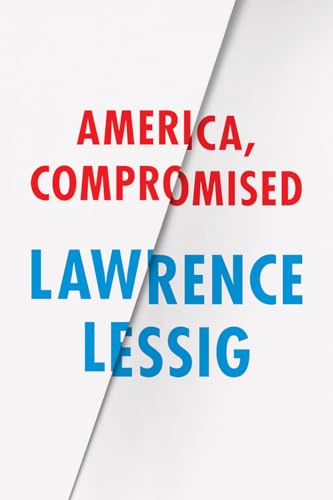
Inhaltsangabe
“There is not a single American awake to the world who is comfortable with the way things are.”
So begins Lawrence Lessig's sweeping indictment of contemporary American institutions and the corruption that besets them. We can all see it—from the selling of Congress to special interests to the corporate capture of the academy. Something is wrong. It’s getting worse.
And it’s our fault. What Lessig shows, brilliantly and persuasively, is that we can’t blame the problems of contemporary American life on bad people, as our discourse all too often tends to do. Rather, he explains, “We have allowed core institutions of America’s economic, social, and political life to become corrupted. Not by evil souls, but by good souls. Not through crime, but through compromise.” Every one of us, every day, making the modest compromises that seem necessary to keep moving along, is contributing to the rot at the core of American civic life. Through case studies of Congress, finance, the academy, the media, and the law, Lessig shows how institutions are drawn away from higher purposes and toward money, power, quick rewards—the first steps to corruption.
Lessig knows that a charge so broad should not be levied lightly, and that our instinct will be to resist it. So he brings copious, damning detail gleaned from years of research, building a case that is all but incontrovertible: America is on the wrong path. If we don’t acknowledge our own part in that, and act now to change it, we will hand our children a less perfect union than we were given. It will be a long struggle. This book represents the first steps.
So begins Lawrence Lessig's sweeping indictment of contemporary American institutions and the corruption that besets them. We can all see it—from the selling of Congress to special interests to the corporate capture of the academy. Something is wrong. It’s getting worse.
And it’s our fault. What Lessig shows, brilliantly and persuasively, is that we can’t blame the problems of contemporary American life on bad people, as our discourse all too often tends to do. Rather, he explains, “We have allowed core institutions of America’s economic, social, and political life to become corrupted. Not by evil souls, but by good souls. Not through crime, but through compromise.” Every one of us, every day, making the modest compromises that seem necessary to keep moving along, is contributing to the rot at the core of American civic life. Through case studies of Congress, finance, the academy, the media, and the law, Lessig shows how institutions are drawn away from higher purposes and toward money, power, quick rewards—the first steps to corruption.
Lessig knows that a charge so broad should not be levied lightly, and that our instinct will be to resist it. So he brings copious, damning detail gleaned from years of research, building a case that is all but incontrovertible: America is on the wrong path. If we don’t acknowledge our own part in that, and act now to change it, we will hand our children a less perfect union than we were given. It will be a long struggle. This book represents the first steps.
Die Inhaltsangabe kann sich auf eine andere Ausgabe dieses Titels beziehen.
Über die Autorin bzw. den Autor
Lawrence Lessig is the Roy L. Furman Professor of Law and Leadership at Harvard Law School, an attorney, and an activist. He cofounded Creative Commons in 2001 and is the author of numerous books, including, most recently, Republic, Lost: Version 2.0.
Auszug. © Genehmigter Nachdruck. Alle Rechte vorbehalten.
America, Compromised
By Lawrence LessigThe University of Chicago Press
Copyright © 2018 Lawrence Lessig
All rights reserved.
ISBN: 978-0-226-31653-6All rights reserved.
Contents
Preface,
Introduction,
1 CONGRESS,
2 OF FINANCE,
3 THE MEDIA,
4 THE ACADEMY,
5 THE LAW,
6 REMEDIES,
Conclusion,
Acknowledgments,
Notes,
Index,
CHAPTER 1
CONGRESS
In the fall of 2014, a protest broke out across Hong Kong, led by students at first, and eventually joined by their parents. The protest challenged a law that the Chinese government had proposed for regulating the elections China had promised for Hong Kong's "chief executive." At the time Britain handed back control over the colony to China, it negotiated a commitment that China would give the people of Hong Kong "a high degree of autonomy" and basic human rights. In August 2014, China explained how it would live up to that commitment.
The explanation was not promising — at least for an ordinary conception of what a democracy should be. As Beijing described it, "The ultimate aim is the selection of a Chief Executive by universal suffrage upon nomination by a broadly representative nominating committee in accordance with democratic procedures." That "nominating committee" would be composed of 1,200 citizens — which means, in a population of about 7 million, about .02% of Hong Kong. It would then select the candidates for whom Hong Kong would get to vote.
Hong Kong's "democracy" would come in two steps. In the first, the nominating committee (.02%) selects candidates. In the second, the voters select among the candidates the nominating committee had picked. To be able to run in the second stage, you had to do well in the first stage. Thus, to do well in the first stage required making the members of the nominating committee happy.
This structure triggered the strike that brought the city to a standstill. The nominators, the protesters believed, would be "dominated by a pro-Beijing business and political elite." That domination would bias and therefore corrupt the selection process. Hong Kong wanted a democracy, not, as Martin Lee, the chairman of the Hong Kong Democratic Party, put it, "democracy with Chinese characteristics."
It's not hard to see the problem that angered those Hong Kong protesters. If there's an ideal within the concept of democracy, it is that citizens are equal. That principle either means that at each stage of a democratic election, citizens should have equal weight in the decision of that stage. Or, less restrictively, that at each stage there should be no inequality imposed for an improper reason. What is "proper" or "improper" will differ, of course, depending on the tradition or context. But the principle is fundamental, if the regime is to be democratic.
That principle, the protesters charged, had been violated by the scheme that China had announced. The nominating committee, they believed, would be a filter. And that filter would be biased, either because it would have the wrong loyalty (to China, rather than Hong Kong), or because it would be non-representative (representing not "the people" but a "business and political elite"). Either way, it would breach the "equal weight principle" embedded in the idea of democratic representation. Either way, it would justify the charge that the people of Hong Kong were going to be denied a properly democratic procedure for electing their governor.
If this indeed is a distortion of democracy, China didn't invent it. Caesar Augustus probably did, and many others copied him afterwards — from Iran (where twelve members of the Guardian Counsel select the candidates that voters get to select among) to the Soviet Union (where nineteen members of the Politburo selected the candidates that voters selected among). This structure is common in what we're likely to view as fake democracies. It is an obvious way to defeat the ideal of citizen equality within any democratic regime.
And it has lived in America too. Consider the quip of Tammany Hall's William M. "Boss" Tweed: "I don't care who does the electing, so long as I get to do the nominating."
Tweed is describing a democracy with "Chinese characteristics," too: A two-stage process, in which Tweed controls the first stage. That control means the first stage is not representative. Candidates wishing to pass that first stage know they must make Tweed happy, and Tweed, we might presume, is not the perfect representative of the population meant to be governed. That control thus narrows the range of candidates who can run — relative to the range a representative body might have selected. Such control disciplines them. It distorts the democratic process.
We can call any n-stage process for electing representatives "Tweedist" if, at any critical stage, candidates are improperly dependent on a body that, of necessity, is not representative of the population being governed. "Improperly" because, of course, any primary will be dependent upon one slice of the population to be governed, but that filter is normal within any party system. And "of necessity," because we couldn't practice democracy practically if the validity of every election turned upon whether a representative public turned out. Instead the question is whether an imposed filter actually blocks, not whether the public engages. Hong Kong's nominating committee blocks; in America's mid-term elections, the public typically fails to engage.
So defined, it follows that not all small selecting bodies are in this sense Tweedist. If Hong Kong designed the nominating committee the way Professor James Fishkin describes a "deliberative poll" — with a randomly selected and representative body of citizens — the first stage would be small but not unrepresentative. Yet few small bodies are selected with the discipline of Fishkin's deliberative poll. Certainly, Hong Kong's was not. Instead, the bias of the Tweedist system flows from the unrepresentativeness of the nominating committee.
There are many examples of Tweedism across the history of the United States, though none more striking than the history of democracy in America's Old South. Though America was committed, through its Constitution, at least circa 1870, to secure to all (males at least) the right to vote regardless of race, for almost a hundred years after that commitment, African Americans were routinely excluded from the right to vote. Through a wide range of practices, including literacy tests, grandfather clauses, poll taxes, and complex registration systems, whites throughout the South succeeded in excluding blacks from voting. Yet none of these schemes was as transparently Tweedist as the all-white primary.
Practiced in many states, but in none more brazenly than Texas, the all-white primary explicitly excluded African Americans from voting in the Democratic primary, at first by law and eventually, effectively, through informal practice. Blacks were not necessarily forbidden from voting in the general election. But as the Democratic Party was the only party that mattered across the Old South, that formal fact meant little practically. Instead, so long as blacks were excluded from the first stage of this democratic process, the effect of Tweedism would be felt throughout the process. It may well be that blacks had ultimate influence over elected officials — since, in some cases at least, they could participate in the general election. That ultimate participation, however, could not cure the exclusion from the initial stage of the process.
The...
„Über diesen Titel“ kann sich auf eine andere Ausgabe dieses Titels beziehen.
Suchergebnisse für America, Compromised (Randy L. and Melvin R. Berlin...

Beispielbild für diese ISBN
America, Compromised (Berlin Family Lectures)
Verlag:
University of Chicago Press, 2018
ISBN 10: 022631653X
ISBN 13: 9780226316536
Gebraucht
Hardcover
Anbieter: World of Books (was SecondSale), Montgomery, IL, USA
Verkäuferbewertung 5 von 5 Sternen

Zustand: Good. Good condition ex-library book with usual library markings and stickers. Artikel-Nr. 00107017302
Gebraucht kaufen
EUR 4,37
Versand gratis
Versand innerhalb von USA
Versand innerhalb von USA
Anzahl: 1 verfügbar
Beispielbild für diese ISBN
America, Compromised
Verlag:
University of Chicago Press, 2018
ISBN 10: 022631653X
ISBN 13: 9780226316536
Gebraucht
Hardcover
Anbieter: ThriftBooks-Dallas, Dallas, TX, USA
Verkäuferbewertung 5 von 5 Sternen
Hardcover. Zustand: As New. No Jacket. Pages are clean and are not marred by notes or folds of any kind. ~ ThriftBooks: Read More, Spend Less. Artikel-Nr. G022631653XI2N00
Gebraucht kaufen
EUR 5,88
Versand gratis
Versand innerhalb von USA
Versand innerhalb von USA
Anzahl: 1 verfügbar
Beispielbild für diese ISBN
America, Compromised
Verlag:
University of Chicago Press, 2018
ISBN 10: 022631653X
ISBN 13: 9780226316536
Gebraucht
Hardcover
Anbieter: ThriftBooks-Atlanta, AUSTELL, GA, USA
Verkäuferbewertung 5 von 5 Sternen
Hardcover. Zustand: Good. No Jacket. Pages can have notes/highlighting. Spine may show signs of wear. ~ ThriftBooks: Read More, Spend Less. Artikel-Nr. G022631653XI3N00
Gebraucht kaufen
EUR 5,88
Versand gratis
Versand innerhalb von USA
Versand innerhalb von USA
Anzahl: 1 verfügbar
Beispielbild für diese ISBN
America, Compromised
Verlag:
University of Chicago Press, 2018
ISBN 10: 022631653X
ISBN 13: 9780226316536
Gebraucht
Hardcover
Anbieter: ThriftBooks-Atlanta, AUSTELL, GA, USA
Verkäuferbewertung 5 von 5 Sternen
Hardcover. Zustand: Very Good. No Jacket. Former library book; May have limited writing in cover pages. Pages are unmarked. ~ ThriftBooks: Read More, Spend Less. Artikel-Nr. G022631653XI4N10
Gebraucht kaufen
EUR 5,88
Versand gratis
Versand innerhalb von USA
Versand innerhalb von USA
Anzahl: 1 verfügbar
Beispielbild für diese ISBN
America, Compromised
Verlag:
University of Chicago Press, 2018
ISBN 10: 022631653X
ISBN 13: 9780226316536
Gebraucht
Hardcover
Anbieter: Better World Books, Mishawaka, IN, USA
Verkäuferbewertung 5 von 5 Sternen
Zustand: Good. Former library copy. Pages intact with minimal writing/highlighting. The binding may be loose and creased. Dust jackets/supplements are not included. Includes library markings. Stock photo provided. Product includes identifying sticker. Better World Books: Buy Books. Do Good. Artikel-Nr. 45838020-6
Gebraucht kaufen
EUR 6,41
Versand gratis
Versand innerhalb von USA
Versand innerhalb von USA
Anzahl: 2 verfügbar
Beispielbild für diese ISBN
America, Compromised
Verlag:
University of Chicago Press, 2018
ISBN 10: 022631653X
ISBN 13: 9780226316536
Gebraucht
Hardcover
Anbieter: Better World Books, Mishawaka, IN, USA
Verkäuferbewertung 5 von 5 Sternen
Zustand: Very Good. Former library copy. Pages intact with possible writing/highlighting. Binding strong with minor wear. Dust jackets/supplements may not be included. Includes library markings. Stock photo provided. Product includes identifying sticker. Better World Books: Buy Books. Do Good. Artikel-Nr. 38329003-75
Gebraucht kaufen
EUR 6,41
Versand gratis
Versand innerhalb von USA
Versand innerhalb von USA
Anzahl: 1 verfügbar
Beispielbild für diese ISBN
America, Compromised
Verlag:
The University of Chicago Press, 2018
ISBN 10: 022631653X
ISBN 13: 9780226316536
Neu
Hardcover
Anbieter: PBShop.store US, Wood Dale, IL, USA
Verkäuferbewertung 5 von 5 Sternen
HRD. Zustand: New. New Book. Shipped from UK. Established seller since 2000. Artikel-Nr. FW-9780226316536
Beispielbild für diese ISBN
America, Compromised
Verlag:
The University of Chicago Press, 2018
ISBN 10: 022631653X
ISBN 13: 9780226316536
Neu
Hardcover
Anbieter: PBShop.store UK, Fairford, GLOS, Vereinigtes Königreich
Verkäuferbewertung 5 von 5 Sternen
HRD. Zustand: New. New Book. Shipped from UK. Established seller since 2000. Artikel-Nr. FW-9780226316536
Neu kaufen
EUR 29,96
EUR 5,85 Versand
Versand von Vereinigtes Königreich nach USA
Versand von Vereinigtes Königreich nach USA
Anzahl: 15 verfügbar
Beispielbild für diese ISBN
America, Compromised Five Studies in Institutional Corruption
Anbieter: Revaluation Books, Exeter, Vereinigtes Königreich
Verkäuferbewertung 5 von 5 Sternen
Hardcover. Zustand: Brand New. 240 pages. 8.75x5.75x1.00 inches. In Stock. Artikel-Nr. __022631653X
Neu kaufen
EUR 26,32
EUR 11,66 Versand
Versand von Vereinigtes Königreich nach USA
Versand von Vereinigtes Königreich nach USA
Anzahl: 2 verfügbar
Beispielbild für diese ISBN
America, Compromised â" Five Studies in Institutional Corruption (Berlin Family Lectures)
Verlag:
University of Chicago Press, 2018
ISBN 10: 022631653X
ISBN 13: 9780226316536
Gebraucht
Paperback
Anbieter: WorldofBooks, Goring-By-Sea, WS, Vereinigtes Königreich
Verkäuferbewertung 5 von 5 Sternen
Paperback. Zustand: Very Good. The book has been read, but is in excellent condition. Pages are intact and not marred by notes or highlighting. The spine remains undamaged. Artikel-Nr. GOR013878450
Gebraucht kaufen
EUR 31,73
EUR 6,53 Versand
Versand von Vereinigtes Königreich nach USA
Versand von Vereinigtes Königreich nach USA
Anzahl: 1 verfügbar