
Verwandte Artikel zu No Caption Needed: Iconic Photographs, Public Culture,...
No Caption Needed: Iconic Photographs, Public Culture, and Liberal Democracy (Emersion: Emergent Village resources for communities of faith) - Hardcover
Inhaltsangabe
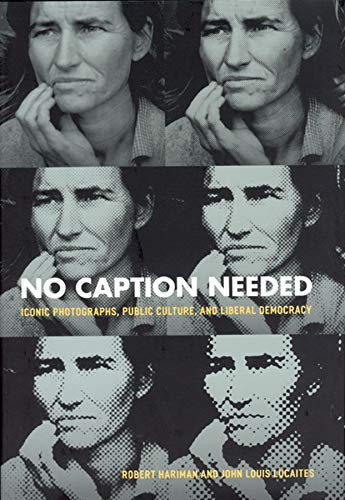
In No Caption Needed, Robert Hariman and John Louis Lucaites provide the definitive study of the iconic photograph as a dynamic form of public art. Their critical analyses of nine individual icons explore the photographs themselves and their subsequent circulation through an astonishing array of media, including stamps, posters, billboards, editorial cartoons, TV shows, Web pages, tattoos, and more. Iconic images are revealed as models of visual eloquence, signposts for collective memory, means of persuasion across the political spectrum, and a crucial resource for critical reflection.
Arguing against the conventional belief that visual images short-circuit rational deliberation and radical critique, Hariman and Lucaites make a bold case for the value of visual imagery in a liberal-democratic society. No Caption Needed is a compelling demonstration of photojournalism’s vital contribution to public life.
Die Inhaltsangabe kann sich auf eine andere Ausgabe dieses Titels beziehen.
Über die Autorin bzw. den Autor
Robert Hariman is professor of communication at Northwestern University and the author of Political Style: The Artistry of Power. John Louis Lucaites is professor of communication and culture at Indiana University. He is coauthor of Crafting Equality: America’s Anglo-African World.
Auszug. © Genehmigter Nachdruck. Alle Rechte vorbehalten.
No Caption Needed
Iconic Photographs, Public Culture, and Liberal DemocracyBy Robert Hariman John Louis LucaitesUniversity of Chicago Press
Copyright © 2007 The University of ChicagoAll right reserved.
ISBN: 978-0-226-31606-2
Chapter One
Migrant Mother
Dorothea Lange's "Migrant Mother" was photographed in February 1936 in a pea pickers' camp in Nipomo, California, while on assignment as a photographer for the Resettlement Administration (RA), which soon would become the better-known Farm Security Administration (FSA). As Lange told the story years later, the decision to stop at the pea picker's camp was fortuitous. She was driving home after a month in the field when she happened upon a sign identifying the camp. She tried to ignore the sign and drive on, but after twenty miles she was compelled to return to the camp, "following instinct, not reason." She shot six photographs in a very short period of time of the woman and members of her family, starting at a distance and working her way closer and closer after the fashion of a portrait photographer. Her photos first appeared in the San Francisco News on March 10, 1936, as part of a story demanding relief for the starving pea pickers. The feature was a success: relief was organized, and there is no record of death by starvation. This story of the photo's origin and impact is, of course, a bit too good. Every icon acquires a standard narrative and often others as well. The standard narrative includes a myth of origin, a tale of public uptake or impact, and a quest for the actual people in the picture to provide closure for the larger social drama captured by the image. In this case, the photo's origin is due to serendipity, not routine or craft. There is no mention of Lange's government subsidy nor of the fact that the photo was retouched to remove the woman's thumb in the lower right corner. Most tellingly, it slides over the fact that the iconic photo was not actually shown in the San Francisco News until the day following the original story. Iconic photos acquire mythic narratives: Lange becomes a poetic vehicle for the operation of historical forces; by mobilizing public opinion, the photographer provides the impetus to collective action. "The star illustration of moving somebody to do something is `Migrant Mother.'"
As was the custom among RA/FSA photographers who were trying to adhere to scientific method, her notes record no names but they do feature socioeconomic categories such as "destitute pea pickers" and "mother of seven children." The picture itself needs no such help to draw on the prior decades of documentary photography. Direct exposure of ordinary, anonymous, working-class people engaged in the basic tasks of everyday life amidst degraded circumstances was the template of the social reform photography established by Lewis Hine and others in the early part of the twentieth century. The connection between photographic documentary and collective action was a well-established line of response, available as long as the photographer did not include the signs of other genres such as the focus on dramatic events of ordinary photojournalism or the obvious manipulation of art photography. Many other photos also met this standard, however, while the "Migrant Mother" quickly achieved critical acclaim as a model of documentary photography, becoming the preeminent photo among the hundreds of thousands of images being produced by RA/FSA photographers and used to promote New Deal policies. Roy Stryker, the head of the RA/FSA photography section, dubbed Lange's photo the symbol for the whole project: "She has all the suffering of mankind in her but all of the perseverance too. A restraint and a strange courage. You can see anything you want to in her. She is immortal." According to a manager at the Library of Congress, where the image remains one of the most requested items in the photography collection, "It's the most striking image we have; it hits the heart.... an American icon."
Taken within the context of the Great Depression, it is not difficult to see how the photograph captures simultaneously a sense of individual worth and class victimage. The close portraiture creates a moment of personal anxiety as this specific woman, without name, silently harbors her fears for her children, while the dirty, ragged clothes and bleak setting signify the hard work and limited prospects of the laboring classes. The disposition of her body-and above all, the involuntary gesture of her right arm reaching up to touch her chin-communicates related tensions. We see both physical strength and palpable worry: a hand capable of productive labor and an absent-minded motion that implies the futility of any action in such impoverished circumstances. The remainder of the composition communicates both a reflexive defensiveness, as the bodies of the two standing children are turned inward and away from the photographer (as if from an impending blow), and a sense of inescapable vulnerability, for her body and head are tilted slightly forward to allow each of the three children the comfort they need, her shirt is unbuttoned, and the sleeping baby is in a partially exposed position.
These features of the photograph are cues for emotional responses that the composition manages with great economy. At its most obvious, "Migrant Mother" communicates the pervasive and paralyzing fear that was widely acknowledged to be a defining characteristic of the depression and experienced by many Americans irrespective of income. Thus, the photograph embodies a limit condition for democracy identified by Franklin Delano Roosevelt in his first inaugural address: "The only thing we have to fear is fear itself-nameless, unreasoning, unjustified terror." Roosevelt could not embody that emotion without bringing the country down with him, but perhaps this correspondence accounts in part for each being the most memorable text and image from the era. The shift from his oratory to her visual image has other consequences as well. Embodiment provides a dual function emotionally: it both represents and localizes feelings that can literally know no bounds. By depicting what was known to be a generalized anxiety within the specific form of a woman's body, that emotion is both made real and constrained by conventional attributions of gender.
Of course, the "Migrant Mother" is also overwhelmingly a photograph about class, and one that evokes not just sympathy but compassion, an impulse to help that crosses social boundaries. The powerful depiction of class difference becomes most obvious when the photograph is contrasted with other visual images that dotted the symbolic environment at the time, such as the National Association of Manufacturers (NAM) ad campaign. One especially prominent billboard in the NAM campaign featured the image of a middle-class family-including a smiling mom, self-assured dad, and rosy-cheeked cherubs in their Sunday-best clothing-out for a leisurely drive in the family car. The visual image is framed between two captions announcing "World's Highest Standard of Living" and "There's No Way Like the American Way." NAM was not known for enthusiastic support of the New Deal, and it is clear that visual images figured prominently in the competition for public opinion. The more memorable images would have to be more than straightforward depictions of one condition or another, however, and more than just idealized or realistic.
Class difference is a touchy subject in American political culture, and its presence is often carefully veiled. In "Migrant Mother" class is...
„Über diesen Titel“ kann sich auf eine andere Ausgabe dieses Titels beziehen.
Suchergebnisse für No Caption Needed: Iconic Photographs, Public Culture,...

Beispielbild für diese ISBN
No Caption Needed: Iconic Photographs, Public Culture, and Liberal Democracy
Verlag:
The University of Chicago Press, 2007
ISBN 10: 0226316068
ISBN 13: 9780226316062
Gebraucht
Hardcover
Anbieter: World of Books (was SecondSale), Montgomery, IL, USA
Verkäuferbewertung 5 von 5 Sternen

Hardback. Zustand: Good. Provides a definitive study of the iconic photograph as a dynamic form of public art. In this title, iconic images are revealed as models of visual eloquence, signposts for collective memory, means of persuasion across the political spectrum, and a crucial resource for critical reflection. Artikel-Nr. 00103726128
Gebraucht kaufen
EUR 5,67
Versand gratis
Versand innerhalb von USA
Versand innerhalb von USA
Anzahl: 1 verfügbar
Beispielbild für diese ISBN
No Caption Needed: Iconic Photographs, Public Culture, and Liberal Democracy
Verlag:
The University of Chicago Press, 2007
ISBN 10: 0226316068
ISBN 13: 9780226316062
Gebraucht
Hardcover
Anbieter: World of Books (was SecondSale), Montgomery, IL, USA
Verkäuferbewertung 5 von 5 Sternen
Hardback. Zustand: Very Good. Provides a definitive study of the iconic photograph as a dynamic form of public art. In this title, iconic images are revealed as models of visual eloquence, signposts for collective memory, means of persuasion across the political spectrum, and a crucial resource for critical reflection. Artikel-Nr. 00100306931
Gebraucht kaufen
EUR 5,67
Versand gratis
Versand innerhalb von USA
Versand innerhalb von USA
Anzahl: 1 verfügbar
Beispielbild für diese ISBN
No Caption Needed: Iconic Photographs, Public Culture, and Liberal Democracy
Verlag:
University of Chicago Press, 2007
ISBN 10: 0226316068
ISBN 13: 9780226316062
Gebraucht
Hardcover
Anbieter: ThriftBooks-Atlanta, AUSTELL, GA, USA
Verkäuferbewertung 5 von 5 Sternen
Hardcover. Zustand: Very Good. No Jacket. May have limited writing in cover pages. Pages are unmarked. ~ ThriftBooks: Read More, Spend Less. Artikel-Nr. G0226316068I4N00
Gebraucht kaufen
EUR 5,91
Versand gratis
Versand innerhalb von USA
Versand innerhalb von USA
Anzahl: 1 verfügbar
Beispielbild für diese ISBN
No Caption Needed: Iconic Photographs, Public Culture, and Liberal Democracy
Verlag:
University of Chicago Press, 2007
ISBN 10: 0226316068
ISBN 13: 9780226316062
Gebraucht
Hardcover
Anbieter: ThriftBooks-Dallas, Dallas, TX, USA
Verkäuferbewertung 5 von 5 Sternen
Hardcover. Zustand: Good. No Jacket. Pages can have notes/highlighting. Spine may show signs of wear. ~ ThriftBooks: Read More, Spend Less. Artikel-Nr. G0226316068I3N00
Gebraucht kaufen
EUR 5,91
Versand gratis
Versand innerhalb von USA
Versand innerhalb von USA
Anzahl: 1 verfügbar
Beispielbild für diese ISBN
No Caption Needed: Iconic Photographs, Public Culture and Liberal Democracy
Verlag:
University of Chicago Press, 2007
ISBN 10: 0226316068
ISBN 13: 9780226316062
Gebraucht
Hardcover
Anbieter: WorldofBooks, Goring-By-Sea, WS, Vereinigtes Königreich
Verkäuferbewertung 5 von 5 Sternen
Hardback. Zustand: Very Good. The book has been read, but is in excellent condition. Pages are intact and not marred by notes or highlighting. The spine remains undamaged. Artikel-Nr. GOR005162076
Gebraucht kaufen
EUR 40,71
EUR 6,51 Versand
Versand von Vereinigtes Königreich nach USA
Versand von Vereinigtes Königreich nach USA
Anzahl: 2 verfügbar
Beispielbild für diese ISBN
No Caption Needed
Anbieter: PBShop.store US, Wood Dale, IL, USA
Verkäuferbewertung 5 von 5 Sternen
HRD. Zustand: New. New Book. Shipped from UK. Established seller since 2000. Artikel-Nr. FW-9780226316062
Beispielbild für diese ISBN
No Caption Needed
Anbieter: PBShop.store UK, Fairford, GLOS, Vereinigtes Königreich
Verkäuferbewertung 5 von 5 Sternen
HRD. Zustand: New. New Book. Shipped from UK. Established seller since 2000. Artikel-Nr. FW-9780226316062
Neu kaufen
EUR 52,17
EUR 6,82 Versand
Versand von Vereinigtes Königreich nach USA
Versand von Vereinigtes Königreich nach USA
Anzahl: 15 verfügbar
Beispielbild für diese ISBN
No Caption Needed
Anbieter: Majestic Books, Hounslow, Vereinigtes Königreich
Verkäuferbewertung 4 von 5 Sternen

Zustand: New. pp. xi + 419 Illus. Artikel-Nr. 8245404
Neu kaufen
EUR 59,30
EUR 7,56 Versand
Versand von Vereinigtes Königreich nach USA
Versand von Vereinigtes Königreich nach USA
Anzahl: 3 verfügbar
Beispielbild für diese ISBN
No Caption Needed: Iconic Photographs, Public Culture, and Liberal Democracy
Anbieter: Kennys Bookstore, Olney, MD, USA
Verkäuferbewertung 5 von 5 Sternen
Zustand: New. 2007. annotated edition. Hardcover. . . . . . Books ship from the US and Ireland. Artikel-Nr. V9780226316062
Neu kaufen
EUR 57,80
EUR 9,23 Versand
Versand innerhalb von USA
Versand innerhalb von USA
Anzahl: Mehr als 20 verfügbar
Beispielbild für diese ISBN
No Caption Needed: Iconic Photographs, Public Culture, and Liberal Democracy
Anbieter: Ria Christie Collections, Uxbridge, Vereinigtes Königreich
Verkäuferbewertung 5 von 5 Sternen
Zustand: New. In English. Artikel-Nr. ria9780226316062_new
Neu kaufen
EUR 56,89
EUR 13,13 Versand
Versand von Vereinigtes Königreich nach USA
Versand von Vereinigtes Königreich nach USA
Anzahl: Mehr als 20 verfügbar