
Verwandte Artikel zu Theory and Reality: An Introduction to the Philosophy...
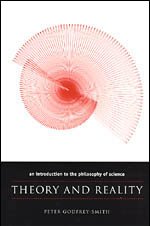
Theory and Reality: An Introduction to the Philosophy of Science (Science and Its Conceptual Foundations) - Hardcover
Inhaltsangabe
How does science work? Does it tell us what the world is "really" like? What makes it different from other ways of understanding the universe? In Theory and Reality, Peter Godfrey-Smith addresses these questions by taking the reader on a grand tour of one hundred years of debate about science. The result is a completely accessible introduction to the main themes of the philosophy of science.
Intended for undergraduates and general readers with no prior background in philosophy, Theory and Reality covers logical positivism; the problems of induction and confirmation; Karl Popper's theory of science; Thomas Kuhn and "scientific revolutions"; the views of Imre Lakatos, Larry Laudan, and Paul Feyerabend; and challenges to the field from sociology of science, feminism, and science studies. The book then looks in more detail at some specific problems and theories, including scientific realism, the theory-ladeness of observation, scientific explanation, and Bayesianism. Finally, Godfrey-Smith defends a form of philosophical naturalism as the best way to solve the main problems in the field.
Throughout the text he points out connections between philosophical debates and wider discussions about science in recent decades, such as the infamous "science wars." Examples and asides engage the beginning student; a glossary of terms explains key concepts; and suggestions for further reading are included at the end of each chapter. However, this is a textbook that doesn't feel like a textbook because it captures the historical drama of changes in how science has been conceived over the last one hundred years.
Like no other text in this field, Theory and Reality combines a survey of recent history of the philosophy of science with current key debates in language that any beginning scholar or critical reader can follow.
Intended for undergraduates and general readers with no prior background in philosophy, Theory and Reality covers logical positivism; the problems of induction and confirmation; Karl Popper's theory of science; Thomas Kuhn and "scientific revolutions"; the views of Imre Lakatos, Larry Laudan, and Paul Feyerabend; and challenges to the field from sociology of science, feminism, and science studies. The book then looks in more detail at some specific problems and theories, including scientific realism, the theory-ladeness of observation, scientific explanation, and Bayesianism. Finally, Godfrey-Smith defends a form of philosophical naturalism as the best way to solve the main problems in the field.
Throughout the text he points out connections between philosophical debates and wider discussions about science in recent decades, such as the infamous "science wars." Examples and asides engage the beginning student; a glossary of terms explains key concepts; and suggestions for further reading are included at the end of each chapter. However, this is a textbook that doesn't feel like a textbook because it captures the historical drama of changes in how science has been conceived over the last one hundred years.
Like no other text in this field, Theory and Reality combines a survey of recent history of the philosophy of science with current key debates in language that any beginning scholar or critical reader can follow.
Die Inhaltsangabe kann sich auf eine andere Ausgabe dieses Titels beziehen.
Über die Autorin bzw. den Autor
Peter Godfrey-Smith is an associate professor of philosophy and of history and philosophy of science at Stanford University. He is the author of Complexity and the Function of Mind in Nature.
Von der hinteren Coverseite
How does science work? Does it tell us what the world is "really" like? What makes it different from other ways of understanding the universe? In Theory and Reality, Peter Godfrey-Smith addresses these questions by taking the reader on a grand tour of one hundred years of debate about science. The result is a completely accessible introduction to the main themes of the philosophy of science.
Intended for undergraduates and general readers with no prior background in philosophy, Theory and Reality covers logical positivism; the problems of induction and confirmation; Karl Popper's theory of science; Thomas Kuhn and "scientific revolutions"; the views of Imre Lakatos, Larry Laudan, and Paul Feyerabend; and challenges to the field from sociology of science, feminism, and science studies. The book then looks in more detail at some specific problems and theories, including scientific realism, the theory-ladeness of observation, scientific explanation, and Bayesianism. Finally, Godfrey-Smith defends a form of philosophical naturalism as the best way to solve the main problems in the field.
Throughout the text he points out connections between philosophical debates and wider discussions about science in recent decades, such as the infamous "science wars." Examples and asides engage the beginning student; a glossary of terms explains key concepts; and suggestions for further reading are included at the end of each chapter. However, this is a textbook that doesn't feel like a textbook because it captures the historical drama of changes in how science has been conceived over the last one hundred years.
Like no other text in this field, Theory and Reality combines a survey of recent history of the philosophy of science with current key debates in language that any beginning scholar or critical reader can follow.
Aus dem Klappentext
How does science work? Does it tell us what the world is "really" like? What makes it different from other ways of understanding the universe? In Theory and Reality, Peter Godfrey-Smith addresses these questions by taking the reader on a grand tour of one hundred years of debate about science. The result is a completely accessible introduction to the main themes of the philosophy of science.
Intended for undergraduates and general readers with no prior background in philosophy, Theory and Reality covers logical positivism; the problems of induction and confirmation; Karl Popper's theory of science; Thomas Kuhn and "scientific revolutions"; the views of Imre Lakatos, Larry Laudan, and Paul Feyerabend; and challenges to the field from sociology of science, feminism, and science studies. The book then looks in more detail at some specific problems and theories, including scientific realism, the theory-ladeness of observation, scientific explanation, and Bayesianism. Finally, Godfrey-Smith defends a form of philosophical naturalism as the best way to solve the main problems in the field.
Throughout the text he points out connections between philosophical debates and wider discussions about science in recent decades, such as the infamous "science wars." Examples and asides engage the beginning student; a glossary of terms explains key concepts; and suggestions for further reading are included at the end of each chapter. However, this is a textbook that doesn't feel like a textbook because it captures the historical drama of changes in how science has been conceived over the last one hundred years.
Like no other text in this field, Theory and Reality combines a survey of recent history of the philosophy of science with current key debates in language that any beginning scholar or critical reader can follow.
Intended for undergraduates and general readers with no prior background in philosophy, Theory and Reality covers logical positivism; the problems of induction and confirmation; Karl Popper's theory of science; Thomas Kuhn and "scientific revolutions"; the views of Imre Lakatos, Larry Laudan, and Paul Feyerabend; and challenges to the field from sociology of science, feminism, and science studies. The book then looks in more detail at some specific problems and theories, including scientific realism, the theory-ladeness of observation, scientific explanation, and Bayesianism. Finally, Godfrey-Smith defends a form of philosophical naturalism as the best way to solve the main problems in the field.
Throughout the text he points out connections between philosophical debates and wider discussions about science in recent decades, such as the infamous "science wars." Examples and asides engage the beginning student; a glossary of terms explains key concepts; and suggestions for further reading are included at the end of each chapter. However, this is a textbook that doesn't feel like a textbook because it captures the historical drama of changes in how science has been conceived over the last one hundred years.
Like no other text in this field, Theory and Reality combines a survey of recent history of the philosophy of science with current key debates in language that any beginning scholar or critical reader can follow.
Auszug. © Genehmigter Nachdruck. Alle Rechte vorbehalten.
Theory and Reality
An Introduction to the Philosophy of ScienceBy Peter Godfrey-SmithUniversity of Chicago Press
Copyright © 2003 Peter Godfrey-SmithAll right reserved.
ISBN: 0226300625
Introduction
1.1 Setting Out
This book is a survey of roughly one hundred years of argument about the nature of science. Well look at a hundred years of argument about what science is, how it works, and what makes science different from other ways of investigating the world. Most of the ideas we will examine fall into the field called philosophy of science, but we will also spend a good deal of time looking at ideas developed by historians, sociologists, psychologists, and others.
The book mostly has the form of a grand tour through the decades; ideas will be discussed in roughly the order in which they appeared. Note the word roughly in the previous sentence; there are exceptions to the historical structuring of the book, and I will point out some of them as they arise.
Why is it best to start with older ideas and work through to the present? One reason is that the historical development of general ideas about science is itself an interesting topic. Another reason is that the philosophy of science has been in a state of fermentation and uncertainty in recent years. A good way to understand the maze of options and opinions in the field at the moment is to trace the path that brought us to the state were in now. But this book does not only aim to introduce the options. I will often take sides as we go along, trying to indicate which developments were probably wrong turns or red herrings. Other ideas will be singled out as being on the right track. Then toward the end of the book, I will start trying to put the pieces together into a picture of how science works.
Philosophy is an attempt to ask and answer some very basic questions about the universe and our place within it. These questions can sometimes seem far removed from practical concerns. But the debates covered in this book are not of that kind. Though these debates are connected to the most abstract questions about thought, knowledge, language, and reality, they have also turned out to have an importance that extends well outside of philosophy. They have made a difference to developments in many other academic fields, and some of the debates have reverberated much further, affecting discussions of education, medicine, and the proper place of science in society.
In fact, throughout the latter part of the twentieth century, all the fields concerned with the nature of science went on something of a roller-coaster ride. Some people thought that work in the history, philosophy, and sociology of science had shown that science does not deserve the dominating role it has acquired in Western cultures. They thought that a set of myths about the trustworthiness and superiority of mainstream science had been thoroughly undermined. Others disagreed, of course, and the resulting debates swirled across the intellectual scene, frequently entering political discussion as well. From time to time, scientific work itself was affected, especially in the social sciences. These debates came to be known as the Science Wars, a phrase that conveys a sense of how heated things became.
The Science Wars eventually cooled down, but now, as I write these words, it is fair to say that there is still a great deal of disagreement about even the most basic questions concerning the nature and status of scientific knowledge. These disagreements usually do not have much influence on the day-to-day practice of science, but sometimes they do. And they have huge importance for general discussions of human knowledge, cultural change, and our overall place in the universe. This book aims to introduce you to this remarkable series of debates, and to give you an understanding of the present situation.
1.2 The Scope of the Theory
If we want to understand how science works, it seems that the first thing we need to do is work out what exactly we are trying to explain. Where does science begin and end? Which kinds of activity count as science?
Unfortunately this is not something we can settle in advance. There is a lot of disagreement about what counts as science, and these disagreements are connected to all the other issues discussed in this book.
There is consensus about some central cases. People often think of physics as the purest example of science. Certainly physics has had a heroic history and a central role in the development of modern science. Molecular biology, however, is probably the science that has developed most rapidly and impressively over the past fifty years or so.
These seem to be central examples of science, though even here we encounter hints of controversy. A few have suggested that theoretical physics is becoming less scientific than it used to be, as it is evolving into an esoteric, mathematical modelbuilding exercise that has little contact with the real world (Horgan 1996). And molecular biology has recently been acquiring connections with business and industry that make it, in the eyes of some, a less exemplary science than it once was. Still, examples like these give us a natural starting point. The work done by physicists and molecular biologists when they test hypotheses is science. And playing a game of basketball, no matter how well one plays, is not doing science. But in the area between these clear cases, disagreement reigns.
At one time the classification of economics and psychology as sciences was controversial. Those fields have now settled into a scientific status, at least within the United States and similar countries. (Economics retains an amusing qualifier; it is often called the dismal science, a phrase due to Thomas Carlyle.) There is still a much-debated border region, however, and at the moment this includes areas like anthropology and archaeology. At Stanford University, where I teach, this kind of debate was one element of a process in which the Department of Anthropology split into two separate departments. Is anthropology, the general study of humankind, a fully scientific discipline that should be closely linked to biology, or is it a more interpretive discipline that should be more closely connected to the humanities?
The existence of this gray area should not be surprising, because in contemporary society the word science is a loaded and rhetorically powerful one. People will often find it a useful tactic to describe work in a borderline area as scientific or as unscientific. Some will call a field scientific to suggest that it uses rigorous methods and hence delivers results we should trust. Less commonly, but occasionally, a person might call an investigation scientific in order to say something negative about itto suggest that it is dehumanizing, perhaps. (The term scientistic is more often used when a negative impression is to be conveyed.) Because the words science and scientific have these rhetorical uses, we should not be surprised that people constantly argue back and forth about which kinds of intellectual work count as science.
The history of the term science is also relevant here. The current uses of the words science and scientist developed quite recently. The word science is derived from the Latin word scientia. In the ancient, medieval, and early modern world, scientia referred to the results of logical demonstrations that revealed general and necessary truths. Scientia could be gained in various fields, but the kind of proof involved...
„Über diesen Titel“ kann sich auf eine andere Ausgabe dieses Titels beziehen.
Suchergebnisse für Theory and Reality: An Introduction to the Philosophy...

Beispielbild für diese ISBN
Theory and Reality: An Introduction to the Philosophy of Science
Verlag:
University Of Chicago Press, 2007
ISBN 10: 0226300625
ISBN 13: 9780226300627
Gebraucht
Hardcover
Anbieter: Anybook.com, Lincoln, Vereinigtes Königreich
Verkäuferbewertung 5 von 5 Sternen

Zustand: Good. This is an ex-library book and may have the usual library/used-book markings inside.This book has hardback covers. In good all round condition. No dust jacket. Please note the Image in this listing is a stock photo and may not match the covers of the actual item,550grams, ISBN:0226300625. Artikel-Nr. 2920819
Gebraucht kaufen
EUR 67,54
EUR 15,55 Versand
Versand von Vereinigtes Königreich nach USA
Versand von Vereinigtes Königreich nach USA
Anzahl: 1 verfügbar
Beispielbild für diese ISBN
Theory and Reality: An Introduction to the Philosophy of Science
Verlag:
University Of Chicago Press, 2007
ISBN 10: 0226300625
ISBN 13: 9780226300627
Gebraucht
Hardcover
Anbieter: Anybook.com, Lincoln, Vereinigtes Königreich
Verkäuferbewertung 5 von 5 Sternen
Zustand: Good. This is an ex-library book and may have the usual library/used-book markings inside.This book has hardback covers. In good all round condition. No dust jacket. Please note the Image in this listing is a stock photo and may not match the covers of the actual item,600grams, ISBN:0226300625. Artikel-Nr. 2920818
Gebraucht kaufen
EUR 67,54
EUR 15,55 Versand
Versand von Vereinigtes Königreich nach USA
Versand von Vereinigtes Königreich nach USA
Anzahl: 1 verfügbar