
Verwandte Artikel zu After Preservation: Saving American Nature in the Age...
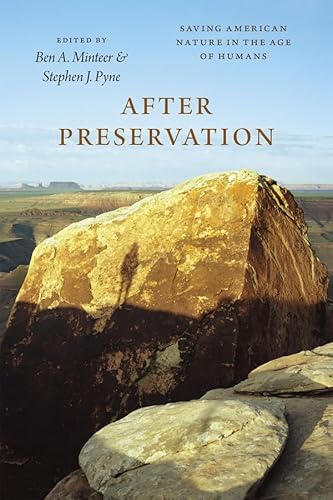
After Preservation: Saving American Nature in the Age of Humans (Emersion: Emergent Village resources for communities of faith) - Softcover
Inhaltsangabe
From John Muir to David Brower, from the creation of Yellowstone National Park to the Endangered Species Act, environmentalism in America has always had close to its core a preservationist ideal. Generations have been inspired by its ethos—to encircle nature with our protection, to keep it apart, pristine, walled against the march of human development. But we have to face the facts. Accelerating climate change, rapid urbanization, agricultural and industrial devastation, metastasizing fire regimes, and other quickening anthropogenic forces all attest to the same truth: the earth is now spinning through the age of humans. After Preservation takes stock of the ways we have tried to both preserve and exploit nature to ask a direct but profound question: what is the role of preservationism in an era of seemingly unstoppable human development, in what some have called the Anthropocene?
Ben A. Minteer and Stephen J. Pyne bring together a stunning consortium of voices comprised of renowned scientists, historians, philosophers, environmental writers, activists, policy makers, and land managers to negotiate the incredible challenges that environmentalism faces. Some call for a new, post-preservationist model, one that is far more pragmatic, interventionist, and human-centered. Others push forcefully back, arguing for a more chastened and restrained vision of human action on the earth. Some try to establish a middle ground, while others ruminate more deeply on the meaning and value of wilderness. Some write on species lost, others on species saved, and yet others discuss the enduring practical challenges of managing our land, water, and air.
From spirited optimism to careful prudence to critical skepticism, the resulting range of approaches offers an inspiring contribution to the landscape of modern environmentalism, one driven by serious, sustained engagements with the critical problems we must solve if we—and the wild garden we may now keep—are going to survive the era we have ushered in.
Contributors include: Chelsea K. Batavia, F. Stuart (Terry) Chapin III, Norman L. Christensen, Jamie Rappaport Clark, William Wallace Covington, Erle C. Ellis, Mark Fiege, Dave Foreman, Harry W. Greene, Emma Marris, Michelle Marvier, Bill McKibben, J. R. McNeill, Curt Meine, Ben A. Minteer, Michael Paul Nelson, Bryan Norton, Stephen J. Pyne, Andrew C. Revkin, Holmes Rolston III, Amy Seidl, Jack Ward Thomas, Diane J. Vosick, John A. Vucetich, Hazel Wong, and Donald Worster.
Die Inhaltsangabe kann sich auf eine andere Ausgabe dieses Titels beziehen.
Über die Autorinnen und Autoren
Ben A. Minteer holds the Arizona Zoological Society Endowed Chair in the School of Life Sciences at Arizona State University. He has published a number of books, including Refounding Environmental Ethics and The Landscape of Reform. Stephen J. Pyne is a Regents’ Professor in the School of Life Sciences at Arizona State University. He is the author, editor, or coeditor of many books, most recently The Last Lost World and Fire: Nature and Culture.
Ben A. Minteer holds the Arizona Zoological Society Endowed Chair in the School of Life Sciences at Arizona State University. He has published a number of books, including Refounding Environmental Ethics and The Landscape of Reform. Stephen J. Pyne is a Regents' Professor in the School of Life Sciences at Arizona State University. He is the author, editor, or coeditor of many books, most recently The Last Lost World and Fire: Nature and Culture.
Auszug. © Genehmigter Nachdruck. Alle Rechte vorbehalten.
After Preservation
Saving American Nature in the Age of Humans
By Ben A. Minteer, Stephen J. PyneThe University of Chicago Press
Copyright © 2015 The University of Chicago
All rights reserved.
ISBN: 978-0-226-25996-3All rights reserved.
Contents
Writing on Stone, Writing in the Wind Ben A. Minteer and Stephen J. Pyne,
Restoring the Nature of America Andrew C. Revkin,
Nature Preservation and Political Power in the Anthropocene J. R. McNeill,
Too Big for Nature Erle C. Ellis,
After Preservation? Dynamic Nature in the Anthropocene Holmes Rolston III,
Humility in the Anthropocene Emma Marris,
The Anthropocene and Ozymandias Dave Foreman,
The Higher Altruism Donald Worster,
The Anthropocene: Disturbing Name, Limited Insight John A. Vucetich, Michael Paul Nelson, and Chelsea K. Batavia,
Ecology and the Human Future Bryan Norton,
A Letter to the Editors: In Defense of the Relative Wild Curt Meine,
When Extinction Is a Virtue Ben A. Minteer,
Pleistocene Rewilding and the Future of Biodiversity Harry W. Greene,
The Democratic Promise of Nature Preservation Mark Fiege,
Green Fire Meets Red Fire Stephen J. Pyne,
Restoration, Preservation, and Conservation: An Example for Dry Forests of the West William Wallace Covington and Diane J. Vosick,
Preserving Nature on US Federal Lands: Managing Change in the Context of Change Norman L. Christensen,
After Preservation—the Case of the Northern Spotted Owl Jack Ward Thomas,
Celebrating and Shaping Nature: Conservation in a Rapidly Changing World F. Stuart Chapin III,
Move Over Grizzly Adams—Conservation for the Rest of Us Michelle Marvier and Hazel Wong,
Endangered Species Conservation: Then and Now Jamie Rappaport Clark,
Resembling the Cosmic Rhythms: The Evolution of Nature and Stewardship in the Age of Humans Amy Seidl,
Coda Bill McKibben,
Notes,
Contributors,
Index,
Footnotes,
CHAPTER 1
Writing on Stone, Writing in the Wind
The preservationist mission—to shield nature from human manipulation, intrusion, and above all, destruction—has inspired generations of American environmentalists to take action on behalf of threatened species and wild landscapes. The movement's visionaries are revered figures in the tradition, from Henry Thoreau and John Muir, to Aldo Leopold, David Brower, Rachel Carson, and Ed Abbey. The preservationist policy record, too, is widely celebrated and imitated around the world (though often with mixed results): The Wilderness Act (1964) and the Endangered Species Act (1973) have for decades served as legal bulwarks against the march of human development and ecological exploitation.
"Saving American nature," however, has never been easy. The historical record is also strewn with the wreckage of failed campaigns and cratered with ecological losses: the extinction of the passenger pigeon; the damming of Yosemite's Hetch Hetchy Valley; the relentless pressure on American wildlands exerted by countless chainsaws, bulldozers, roads, cities, and summer homes. And even the signature victories—protecting the spotted owl in the Pacific Northwest; keeping the Arctic National Wildlife Refuge closed to oil exploration; saving the California condor from the passenger pigeon's fate—remain tenuous and incomplete. Brower, who did as much as anyone in the tradition (and more than most) to make preservationism a potent political and cultural force in American life in the postwar era liked to say, in fact, that "when they [exploitationists] win, it's forever; when we win, it's merely a stay of execution." The preservationist challenge as he saw it was to maintain a sharp-eyed perseverance in the face of unrelenting environmental threats. If they wanted to ensure a human future rich in wild species and wilderness experiences, Brower implored, preservationists had better be "eternally vigilant."
Yet what exactly are preservationists to be "vigilant" in protecting? We've learned that this is far from a simple question in the time since Brower's zenith in American environmentalism. Rapidly changing biophysical conditions and shifting ecological baselines have at the very least seriously complicated the preservationist agenda. For some, especially for those who view "wild" as the essence of wilderness, it hardly matters because what results may be prompted by human actions but lies beyond human control.
For others these forces have made the very idea of preservation anathema to good conservation stewardship and environmental management in this century. Accelerating climate change, rapid urbanization and suburban sprawl, agricultural intensification, metastasizing fire regimes, the spread of invasive species, and other quickening anthropogenic forces—all appear to be collectively undermining venerable preservationist standards and sentiments. The traditional mantra—"preserve the wilderness!"—no longer seems very useful or compelling to those scientists, conservationists, and environmental writers today who argue that this celebrated object of preservationist passion and political concern is being radically challenged and transformed by global environmental change, most of it driven by humans. If it survives at all, they write, the future of the preservationist model in this "new normal" of global impact and disruption of earth systems will not resemble its past.
Many of these ideas about human influence and environmental control have converged recently around the idea of the "Anthropocene," a term that has migrated to environmentalist circles from its origins in discussions about the naming of the current geological period of human dominance on the planet. Originated by the Nobel Prize–winning atmospheric chemist Paul Crutzen and first promoted to the wider scientific community in an article published in the journal Nature in 2002, the term was an attempt to recognize the full suite of planetary changes driven by humans: extensive land transformation, control of the nitrogen cycle, water diversion, and especially anthropogenic alteration of the atmosphere through the emission of greenhouse gases (GHGs). People no longer just talked about the weather: they were changing the climate, although without much control. What had been an environmental fixture against which people acted was now another expression of the human presence. Crutzen argued that these changes, which he traced to the beginnings of the industrial era in the late eighteenth century, mark the beginning of a new geological period, the "Age of Man."
The "Anthropocene" has proved to be a polarizing designation. For some, the notion that humans have become a geological force on the planet—a species able to write its presence in the rocks—is a liberating revelation. It means that we should get on with the business of smart planetary management and get over outmoded myths of a separate, pristine, wild nature that exists free from human influence (and an environmental politics that limits human manipulations of nature). For others, the Anthropocene idea signals the tragic consummation of the destructive human domination of the earth, a last threshold crossed on the march to total ecological despotism. Even for those skeptical of its scientific basis, the Anthropocene remains a reminder of the singular power of humans on the landscape, and stands as a warning of what might lay ahead for us (and for nature) if we do not try to reverse the current course. The Anthropocene, in short, has...
„Über diesen Titel“ kann sich auf eine andere Ausgabe dieses Titels beziehen.
Suchergebnisse für After Preservation: Saving American Nature in the Age...

Beispielbild für diese ISBN
After Preservation: Saving Ame
Verlag:
University of Chicago Press, 2015
ISBN 10: 022625996X
ISBN 13: 9780226259963
Gebraucht
Softcover
Anbieter: World of Books (was SecondSale), Montgomery, IL, USA
Verkäuferbewertung 5 von 5 Sternen

Zustand: Very Good. Item in very good condition! Textbooks may not include supplemental items i.e. CDs, access codes etc. Artikel-Nr. 00100474575
Gebraucht kaufen
EUR 4,79
Versand gratis
Versand innerhalb von USA
Versand innerhalb von USA
Anzahl: 2 verfügbar
Beispielbild für diese ISBN
After Preservation: Saving American Nature in the Age of Humans
Verlag:
University of Chicago Press (edition First Edition), 2015
ISBN 10: 022625996X
ISBN 13: 9780226259963
Gebraucht
Paperback
Erstausgabe
Anbieter: BooksRun, Philadelphia, PA, USA
Verkäuferbewertung 5 von 5 Sternen
Paperback. Zustand: Very Good. First Edition. It's a well-cared-for item that has seen limited use. The item may show minor signs of wear. All the text is legible, with all pages included. It may have slight markings and/or highlighting. Artikel-Nr. 022625996X-11-1
Gebraucht kaufen
EUR 4,80
Versand gratis
Versand innerhalb von USA
Versand innerhalb von USA
Anzahl: 1 verfügbar
Beispielbild für diese ISBN
After Preservation: Saving American Nature in the Age of Humans
Verlag:
University of Chicago Press, 2015
ISBN 10: 022625996X
ISBN 13: 9780226259963
Gebraucht
Paperback
Anbieter: ThriftBooks-Atlanta, AUSTELL, GA, USA
Verkäuferbewertung 5 von 5 Sternen
Paperback. Zustand: As New. No Jacket. Pages are clean and are not marred by notes or folds of any kind. ~ ThriftBooks: Read More, Spend Less. Artikel-Nr. G022625996XI2N00
Gebraucht kaufen
EUR 6,05
Versand gratis
Versand innerhalb von USA
Versand innerhalb von USA
Anzahl: 1 verfügbar
Beispielbild für diese ISBN
After Preservation: Saving American Nature in the Age of Humans
Verlag:
University of Chicago Press, 2015
ISBN 10: 022625996X
ISBN 13: 9780226259963
Gebraucht
Paperback
Anbieter: ThriftBooks-Dallas, Dallas, TX, USA
Verkäuferbewertung 5 von 5 Sternen
Paperback. Zustand: Good. No Jacket. Pages can have notes/highlighting. Spine may show signs of wear. ~ ThriftBooks: Read More, Spend Less. Artikel-Nr. G022625996XI3N00
Gebraucht kaufen
EUR 6,05
Versand gratis
Versand innerhalb von USA
Versand innerhalb von USA
Anzahl: 1 verfügbar
Beispielbild für diese ISBN
After Preservation: Saving American Nature in the Age of Humans
Verlag:
University of Chicago Press, 2015
ISBN 10: 022625996X
ISBN 13: 9780226259963
Gebraucht
Paperback
Anbieter: ThriftBooks-Dallas, Dallas, TX, USA
Verkäuferbewertung 5 von 5 Sternen
Paperback. Zustand: Good. No Jacket. Former library book; Pages can have notes/highlighting. Spine may show signs of wear. ~ ThriftBooks: Read More, Spend Less. Artikel-Nr. G022625996XI3N10
Gebraucht kaufen
EUR 6,05
Versand gratis
Versand innerhalb von USA
Versand innerhalb von USA
Anzahl: 1 verfügbar
Beispielbild für diese ISBN
After Preservation: Saving American Nature in the Age of Humans
Verlag:
University of Chicago Press, 2015
ISBN 10: 022625996X
ISBN 13: 9780226259963
Gebraucht
Paperback
Anbieter: ThriftBooks-Dallas, Dallas, TX, USA
Verkäuferbewertung 5 von 5 Sternen
Paperback. Zustand: Very Good. No Jacket. May have limited writing in cover pages. Pages are unmarked. ~ ThriftBooks: Read More, Spend Less. Artikel-Nr. G022625996XI4N00
Gebraucht kaufen
EUR 6,05
Versand gratis
Versand innerhalb von USA
Versand innerhalb von USA
Anzahl: 1 verfügbar
Foto des Verkäufers
After Preservation: Saving American Nature in the Age of Humans (Emersion: Emergent Village resources for communities of faith)
Verlag:
University of Chicago Press, 2015
ISBN 10: 022625996X
ISBN 13: 9780226259963
Gebraucht
paperback
Anbieter: WeBuyBooks, Rossendale, LANCS, Vereinigtes Königreich
Verkäuferbewertung 5 von 5 Sternen
paperback. Zustand: Like New. Most items will be dispatched the same or the next working day. An apparently unread copy in perfect condition. Dust cover is intact with no nicks or tears. Spine has no signs of creasing. Pages are clean and not marred by notes or folds of any kind. Artikel-Nr. rev6364855052
Gebraucht kaufen
EUR 3,33
EUR 6,69 Versand
Versand von Vereinigtes Königreich nach USA
Versand von Vereinigtes Königreich nach USA
Anzahl: 1 verfügbar
Beispielbild für diese ISBN
After Preservation : Saving American Nature in the Age of Humans
Verlag:
University of Chicago Press, 2015
ISBN 10: 022625996X
ISBN 13: 9780226259963
Gebraucht
Softcover
Anbieter: Better World Books Ltd, Dunfermline, Vereinigtes Königreich
Verkäuferbewertung 5 von 5 Sternen
Zustand: Good. Pages intact with minimal writing/highlighting. The binding may be loose and creased. Dust jackets/supplements are not included. Stock photo provided. Product includes identifying sticker. Better World Books: Buy Books. Do Good. Artikel-Nr. 14482394-75
Gebraucht kaufen
EUR 6,10
EUR 5,90 Versand
Versand von Vereinigtes Königreich nach USA
Versand von Vereinigtes Königreich nach USA
Anzahl: 2 verfügbar
Beispielbild für diese ISBN
After Preservation
Anbieter: PBShop.store US, Wood Dale, IL, USA
Verkäuferbewertung 5 von 5 Sternen
PAP. Zustand: New. New Book. Shipped from UK. Established seller since 2000. Artikel-Nr. FW-9780226259963
Beispielbild für diese ISBN
After Preservation
Anbieter: PBShop.store UK, Fairford, GLOS, Vereinigtes Königreich
Verkäuferbewertung 5 von 5 Sternen
PAP. Zustand: New. New Book. Shipped from UK. Established seller since 2000. Artikel-Nr. FW-9780226259963
Neu kaufen
EUR 26,73
EUR 4,91 Versand
Versand von Vereinigtes Königreich nach USA
Versand von Vereinigtes Königreich nach USA
Anzahl: 15 verfügbar