
Verwandte Artikel zu The Hidden Game of Baseball: A Revolutionary Approach...
Inhaltsangabe
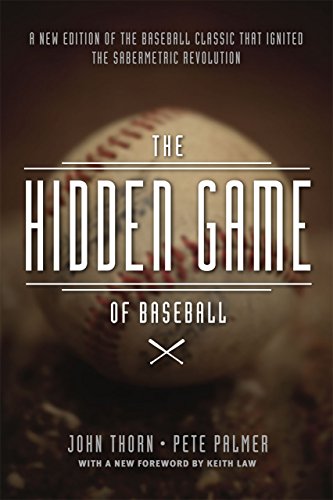
Long before Moneyball became a sensation or Nate Silver turned the knowledge he’d honed on baseball into electoral gold, John Thorn and Pete Palmer were using statistics to shake the foundations of the game. First published in 1984, The Hidden Game of Baseball ushered in the sabermetric revolution by demonstrating that we were thinking about baseball stats—and thus the game itself—all wrong. Instead of praising sluggers for gaudy RBI totals or pitchers for wins, Thorn and Palmer argued in favor of more subtle measurements that correlated much more closely to the ultimate goal: winning baseball games.
The new gospel promulgated by Thorn and Palmer opened the door for a flood of new questions, such as how a ballpark’s layout helps or hinders offense or whether a strikeout really is worse than another kind of out. Taking questions like these seriously—and backing up the answers with data—launched a new era, showing fans, journalists, scouts, executives, and even players themselves a new, better way to look at the game.
This brand-new edition retains the body of the original, with its rich, accessible analysis rooted in a deep love of baseball, while adding a new introduction by the authors tracing the book’s influence over the years. A foreword by ESPN’s lead baseball analyst, Keith Law, details The Hidden Game’s central role in the transformation of baseball coverage and team management and shows how teams continue to reap the benefits of Thorn and Palmer’s insights today. Thirty years after its original publication, The Hidden Game is still bringing the high heat—a true classic of baseball literature.
The new gospel promulgated by Thorn and Palmer opened the door for a flood of new questions, such as how a ballpark’s layout helps or hinders offense or whether a strikeout really is worse than another kind of out. Taking questions like these seriously—and backing up the answers with data—launched a new era, showing fans, journalists, scouts, executives, and even players themselves a new, better way to look at the game.
This brand-new edition retains the body of the original, with its rich, accessible analysis rooted in a deep love of baseball, while adding a new introduction by the authors tracing the book’s influence over the years. A foreword by ESPN’s lead baseball analyst, Keith Law, details The Hidden Game’s central role in the transformation of baseball coverage and team management and shows how teams continue to reap the benefits of Thorn and Palmer’s insights today. Thirty years after its original publication, The Hidden Game is still bringing the high heat—a true classic of baseball literature.
Die Inhaltsangabe kann sich auf eine andere Ausgabe dieses Titels beziehen.
Über die Autorin bzw. den Autor
John Thorn, a sports historian and author, has been the official baseball historian for Major League Baseball since 2011. He resides in New York. Pete Palmer is a statistician, baseball analyst, and a former consultant to Sports Information Center. He lives in New Hampshire and Florida. Together Thorn and Palmer were the lead editors of Total Baseball: The Official Encyclopedia of Major League Baseball. David Reuther was project manager for Total Baseball and an editor and publisher of children’s books for over thirty years.
Auszug. © Genehmigter Nachdruck. Alle Rechte vorbehalten.
The Hidden Game of Baseball
A Revolutionary Approach to Baseball and Its Statistics
By John Thorn, Pete Palmer, David ReutherThe University of Chicago Press
Copyright © 1985 John Thorn, Pete Palmer, and David Reuther
All rights reserved.
ISBN: 978-0-226-24248-4All rights reserved.
Contents
Foreword,
Preface,
Acknowledgments,
1. The Music of the Sphere and Ash,
2. What's Wrong with Traditional Baseball Statistics,
3. The New Statistics,
4. The Linear Weights System,
5. There's No Place Like Home,
6. The Theory of Relativity and Other Absolute Truths,
7. The Good Old Days Are Now,
8. The Book ... and the Computer,
9. Rising to the Occasion,
10. 44 Percent of Baseball,
11. Measuring the Unmeasurable,
12. What Makes Teams Win,
13. Great Single-Season Performances,
14. The Ultimate Baseball Statistic,
15. Rumblings in the Pantheon,
Key to Symbols Used in the Tables,
Tables:,
1. Lifetime Leaders,
2. Single-Season Leaders,
3. Season-by-Season Records, 1876–1984,
4. Complete Player Data, 1984,
Appendix: Top 500 Players of All Time (through 2013),
Notes,
Bibliography,
CHAPTER 1
THE MUSIC OF THE SPHERE AND ASH
On April 27, 1983, the Montreal Expos came to bat in the bottom of the eighth inning trailing the Houston Astros 4-2. First up to face pitcher Nolan Ryan was Tim Blackwell, a lifetime .228 hitter who had struck out in his first time at bat. At this routine juncture of this commonplace game, Ryan stared down at Blackwell, but his invisible—yet, for all that, more substantial—opponent was a man who had died the month before Ryan was born, a man about whom Ryan knew nothing, he confessed, except his statistical line. For at this moment of his seventeenth big-league year, Ryan had a career total of 3,507 strikeouts, only one short of the mark Walter Johnson set over twenty-one seasons, from 1907 to 1927. Long thought invulnerable, in 1983 Johnson's record was in imminent danger of falling not only to Ryan but also to Steve Carlton and Gaylord Perry.
Ryan fanned Blackwell and then froze the next batter, pinch-hitter Brad Mills, with a 1-and-2 curveball. The pinnacle was his. Johnson had been baseball's all-time strikeout leader since 1921, when he surpassed Cy Young. Ryan would hold that title only for a few weeks, then would have to eat Carlton's dust. During his brief tenure at the top, baseball savants scurried to assess the meaning of 3,509 for both the deposed King of K and the new.
What's in a number? The answer to "How many?" and sometimes agreat deal more. In this case, 3,509 men had come to the plate against Ryan and failed to put the ball in play, one more man than Johnson had returned to the dugout, cursing. So what's the big deal? That Ryan was .0002849 faster, scarier, tougher—better—than Johnson? An absolute number like 3,509, or 715 (the home-run record once thought invulnerable, too), does not resound with meaning unless it is placed into some context which will give it life.
In the aftermath of Ryan's feat, writers pointed out that he only needed sixteen full seasons, plus fractions of two others, in which to record 3,509 strikeouts while Johnson needed twenty-one, or that Johnson pitched over 2,500 more innings than Ryan. Coming into the 1983 season, Ryan had fanned 9.44 men per nine innings, while Johnson was way down the list at 5.33. And Ryan allowed fewer hits per nine innings than Johnson, or, for that matter, anyone in the history of the game. So, it would seem 3,509 was not just one batter better than Johnson, but rather was mere confirmation for the masses of a superiority that was clear to the cognoscenti years before.
However, other writers introduced mitigating factors on Johnson's behalf, much as Ruth found supporters as the home-run king even after Aaron hit number 715. These champions of the old order cited Johnson's won-lost record of 417-2791 and earned run average of 2.37 while scoffing at Ryan's mark, entering 1983, of 205-186 with an ERA of 3.11. This tack led to further argument in print, bringing in the quality of the teams each man pitched for and against, the resiliency of the ball, the attitudes of the batters in each era toward the strikeout, the advent of night ball, integration, expansion, the designated hitter, the overall talent pool, competition from other professional sports ... and on down into the black hole of subjectivism.
Why were so many things dragged into that discussion? Because the underlying question about 3,509 was: Does this total make Ryan better than Johnson, or even a better strikeout pitcher than Johnson? At the least, does it make him a great pitcher? In our drive to identify excellence on the baseball field (or off it), we inevitably look to the numbers as a means of encapsulating and comprehending experience. This quantifying habit is at the heart of baseball's hidden game, the one ceaselessly played by Ryan and Johnson and Ruth and Aaron—and, thanks to baseball's voluminous records, nearly 13,000 other players—in a stadium bounded only by the imagination.
The hidden game is played with statistics (and, it could be said, by them), but it extends beyond the record books. One enters the game whenever one attempts to evaluate performance, which is possible only through comparison, implied or explicit. How good a hitter isEddie Murray? How would Rogers Hornsby do if he were active today? Why can't the Red Sox get themselves some decent starting pitchers? What value does Oakland receive from Rickey Henderson's stolen bases? When is an intentional base on balls advisable? The answers to these and countless other questions are of concern to those who play the hidden game, for which this book serves as a guide.
In the eternal Hot Stove League, statistics stand in for their creators, and the better the statistics, the more "real" (i.e., reasonable) the results. In recent years baseball's already copious traditional stats have been supplemented, though not supplanted, by a variety of new formulations—some of them official, like the save and the game winning RBI, most of them outlaws, like Runs Created or Total Average, though not without adherents. And with the explosion of new stats has come an outspoken antistatistical camp, with the two sides aligning themselves along battle lines that were drawn almost at the dawn of baseball.
The antis might argue that baseball is an elementally simple game: pitch, hit, run, throw, catch—what else is there that matters? Playing it or watching it is deeply satisfying without examination of any sort, let alone rigorous statistical analysis. So why do we need new stats? Don't we have enough ways to measure performance? Don't we have too many? Why subject every incident on the field to such maniacal ledger-book accounting?
How can baseball's beauty fail to wither under the glare of intense mathematical scrutiny? For those of an antistatistical bent, baseball, like a butterfly, is poetry in motion and a cold, dead thing when pinned to the page. If we subject the game to ever more intricate analysis, in hope that it will yield up its mysteries, are we not breaking the butterfly upon a wheel, in Pope's phrase?
For the statistician, too, baseball is indeed like a butterfly, whose grace can be glimpsed while it is in flight ... but then it is gone, having scarcely registered upon the memory. One doesn't truly know any longer what it looked like, where it came from, how it vanished in an...
„Über diesen Titel“ kann sich auf eine andere Ausgabe dieses Titels beziehen.
Suchergebnisse für The Hidden Game of Baseball: A Revolutionary Approach...

Beispielbild für diese ISBN
The Hidden Game of Baseball
Anbieter: PBShop.store UK, Fairford, GLOS, Vereinigtes Königreich
Verkäuferbewertung 5 von 5 Sternen

PAP. Zustand: New. New Book. Shipped from UK. Established seller since 2000. Artikel-Nr. FW-9780226242484
Neu kaufen
EUR 32,98
EUR 5,86 Versand
Versand von Vereinigtes Königreich nach USA
Versand von Vereinigtes Königreich nach USA
Anzahl: 15 verfügbar
Beispielbild für diese ISBN
The Hidden Game of Baseball
Anbieter: PBShop.store US, Wood Dale, IL, USA
Verkäuferbewertung 5 von 5 Sternen
PAP. Zustand: New. New Book. Shipped from UK. Established seller since 2000. Artikel-Nr. FW-9780226242484
Beispielbild für diese ISBN
The Hidden Game of Baseball. A Revolutionary Approach to Baseball and its Statistics.
Verlag:
The University of Chicago Press, 2015
ISBN 10: 022624248X
ISBN 13: 9780226242484
Neu
Softcover
Anbieter: Kennys Bookstore, Olney, MD, USA
Verkäuferbewertung 5 von 5 Sternen
Zustand: New. Long before Moneyball became a sensation, or Nate Silver turned the knowledge he'd honed on baseball into electoral gold, the authors were using statistics to shake the foundations of the game. In this book, they argue in favor of more subtle measurements that correlated much more closely to the ultimate goal: winning baseball games. Num Pages: 440 pages, black & white illustrations. BIC Classification: WSJT. Category: (G) General (US: Trade). Dimension: 229 x 152 x 28. Weight in Grams: 590. . 2015. 3rd Edition. Paperback. . . . . Books ship from the US and Ireland. Artikel-Nr. V9780226242484
Neu kaufen
EUR 32,44
EUR 9,15 Versand
Versand innerhalb von USA
Versand innerhalb von USA
Anzahl: Mehr als 20 verfügbar
Beispielbild für diese ISBN
The Hidden Game of Baseball
Anbieter: Majestic Books, Hounslow, Vereinigtes Königreich
Verkäuferbewertung 4 von 5 Sternen

Zustand: New. pp. 440. Artikel-Nr. 311923445
Neu kaufen
EUR 35,78
EUR 7,58 Versand
Versand von Vereinigtes Königreich nach USA
Versand von Vereinigtes Königreich nach USA
Anzahl: 3 verfügbar
Beispielbild für diese ISBN
The Hidden Game of Baseball A Revolutionary Approach to Baseball and Its Statistics
Anbieter: Revaluation Books, Exeter, Vereinigtes Königreich
Verkäuferbewertung 5 von 5 Sternen
Paperback. Zustand: Brand New. 3rd enlarged edition. 440 pages. 9.50x6.00x1.00 inches. In Stock. Artikel-Nr. __022624248X
Neu kaufen
EUR 30,28
EUR 14,58 Versand
Versand von Vereinigtes Königreich nach USA
Versand von Vereinigtes Königreich nach USA
Anzahl: 2 verfügbar
Beispielbild für diese ISBN
The Hidden Game of Baseball: A Revolutionary Approach to Baseball and Its Statistics
Anbieter: Ria Christie Collections, Uxbridge, Vereinigtes Königreich
Verkäuferbewertung 5 von 5 Sternen
Zustand: New. In English. Artikel-Nr. ria9780226242484_new
Neu kaufen
EUR 33,36
EUR 13,17 Versand
Versand von Vereinigtes Königreich nach USA
Versand von Vereinigtes Königreich nach USA
Anzahl: Mehr als 20 verfügbar