
Verwandte Artikel zu The Megachurch and the Mainline: Remaking Religious...
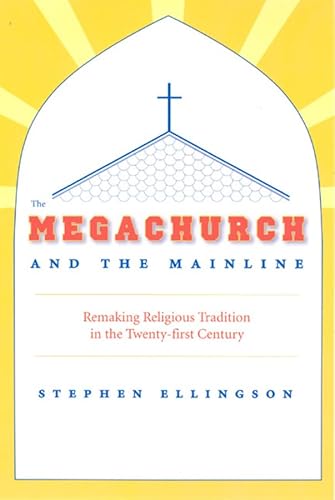
The Megachurch and the Mainline: Remaking Religious Tradition in the Twenty-First Century - Hardcover
Inhaltsangabe
Religious traditions provide the stories and rituals that define the core values of church members. Yet modern life in America can make those customs seem undesirable, even impractical. As a result, many congregations refashion church traditions so they may remain powerful and salient. How do these transformations occur? How do clergy and worshipers negotiate which aspects should be preserved or discarded?
Focusing on the innovations of several mainline Protestant churches in the San Francisco Bay Area, Stephen Ellingson’s The Megachurch and the Mainline provides new understandings of the transformation of spiritual traditions. For Ellingson, these particular congregations typify a new type of Lutheranism—one which combines the evangelical approaches that are embodied in the growing legion of megachurches with American society’s emphasis on pragmatism and consumerism. Here Ellingson provides vivid descriptions of congregations as they sacrifice hymns in favor of rock music and scrap traditional white robes and stoles for Hawaiian shirts, while also making readers aware of the long history of similar attempts to Americanize the Lutheran tradition.
This is an important examination of a religion in flux—one that speaks to the growing popularity of evangelicalism in America.
Die Inhaltsangabe kann sich auf eine andere Ausgabe dieses Titels beziehen.
Über die Autorin bzw. den Autor
Stephen Ellingson is assistant professor of sociology at Hamilton College. He is a coeditor of The Sexual Organization of the City, also published by the University of Chicago Press.
Auszug. © Genehmigter Nachdruck. Alle Rechte vorbehalten.
THE MEGACHURCH AND THE MAINLINE
REMAKING RELIGIOUS TRADITION IN THE TWENTY-FIRST CENTURYBy STEPHEN ELLINGSONTHE UNIVERSITY OF CHICAGO PRESS
Copyright © 2007 The University of ChicagoAll right reserved.
ISBN: 978-0-226-20489-5
Contents
Acknowledgments.........................................................................viiChapter 1 THE RESTRUCTURING OF AMERICAN RELIGIOUS TRADITIONS...........................1Chapter 2 THE TROUBLE WITH TRADITION...................................................20Chapter 3 CONSTRUCTING THE CATALYSTS OF CHANGE.........................................44Chapter 4 REFRAMING THE TRADITION......................................................78Chapter 5 IN THE IMAGE OF EVANGELICALISM...............................................107Chapter 6 CONFLICT, COMPROMISE, AND CONSENSUS..........................................144Chapter 7 TRADITION AND CHANGE IN THE AMERICAN RELIGIOUS LANDSCAPE.....................178Appendix: A Note on Data and Methods....................................................193Notes...................................................................................199References..............................................................................229Index...................................................................................241
Chapter One
THE RESTRUCTURING OF AMERICAN RELIGIOUS TRADITIONS
IT WAS A WARM and sunny afternoon as I pulled into the parking lot of Zion Lutheran Church in the heart of Silicon Valley. I came to attend the installation of the congregation's new associate pastor. As I walked from the parking lot behind the church to the front entrance, I heard the rock-and-roll band playing loudly and I could smell the fatted pig being barbequed. As I rounded the corner, I saw the band setup on the front lawn in front of two or three hundred folding chairs under a large tent. I had just sat down near the back when Tom, a member I had met recently at the church's twelve-step Bible study, invited me to join him and his wife, and soon I found myself in the front row. The outdoor sanctuary filled up quickly as it neared the five o'clock starting time, and then the band launched into a set of simple "praise music" songs; the only one I recognized was an upbeat, jazzy rendition of the classic hymn "Joyful, Joyful We Adore You." Several clergy walked through the band and sat down on chairs in front of the band; all were wearing brightly colored Hawaiian shirts. The senior pastor of Zion welcomed everyone to the service and invited us all to the postservice luau. The service continued with another praise song led by the rock band, and then one of the pastors read two passages from the New Testament.
Then came the main event: several of the visiting clergy delivered three- to four-minute sermons on the question that the new pastor had posed to them some weeks before, "What keeps you going?" The first pastor spoke about the days when he is overwhelmed by the job-too many deaths and illnesses, too many meetings, not enough time or compassion to deal with it all. "When I want to quit I turn to the Living Word. Hear the word of the prophet Isaiah, 'The grass fades, the flowers wither, but the word of our God will stand forever.'" He gave a brief excursus on the centrality of daily Bible study for successful ministry and concluded with the following sage advice: "More oft en than not I am driven to my knees by the demands of being a pastor. Ministry is about living with bruised knees, and scripture is the one thing that is constant; it is what I turn to when God drives me to my knees."
A second pastor rose and began with a serious look on his face, "What keeps me going as a pastor? The minister's edition of The Lutheran Book of Worship? [long pause] No, that won't help." His opening lines were met with peals of laughter, but then he turned serious. He held up his leather-bound, floppy Bible, gestured with it, and solemnly said, "This is what I turn to when things get bad." He read a passage from the Old Testament book of Micah and instructed his junior colleague that the Bible contains everything we need to know about being disciples.
A third pastor finished the sermon time by reading two passages from works by the patron saints of orthodoxy and contemporary evangelicalism, C. S. Lewis and George MacDonald. In the story from MacDonald, God is likened to a master carpenter whom we invite to make some modest repairs on our house. Once inside, God starts doing repairs-unclogging drains, fixing the leaking roof. But then, like some contractor run amok, God starts the major renovations-tearing out walls, building turrets and new rooms. The pastor wryly noted that "we just want to live in a small cottage, but God wants to build a palace in order to live there with you. I keep going after thirty years of ministry because I want to find out what God will do with me and all the other Christians in my life."
The service rapidly concluded with the laying on of hands and praying for the new pastor, another up-tempo praise song, and then the youth group ambushed their new pastor and dressed him in all things Hawaiian-grass skirt, coconut-shell bra, straw hat. As they did so, the chairperson of the call committee informed us that the Hawaiian theme not only was good fun but had a serious side. He continued by regaling us with the story of how the Hawaiian shirt was created. Apparently, Western missionaries were so appalled at the nakedness of the native islanders when they arrived to convert them in the nineteenth century that they gave them shirts to cover up their nakedness. The natives, delighted by the gift of the shirts, made them their own by decorating the plain white shirts with bright colors and flowers. "We should be like the Hawaiians," he said, "obedient but joyful." The service ended and the luau began.
A few months later I attended the ordination service of a new pastor at Grace Lutheran Church in the Oakland suburbs. I entered the sanctuary to the sound of drumming. Eight young people were sitting in one of the four front rows pounding away on a variety of large African drums. The service began with a dozen robed clergy processing into the pastel-painted sanctuary arranged as a partial theater-in-the-round, singing a song from the contemporary Lutheran hymnal. The senior pastor of Grace welcomed us by using a traditional South African greeting (the newly ordained pastor would soon leave for a three-year stint at a South African Lutheran parish) and then asked us to greet one another in the same manner. All the men said, "Nda," and the women responded, "Ah" (making a glissando from high to low). We then followed one of the three regularly sung liturgies in the hymnal of the Evangelical Lutheran Church in America (ELCA). For the scripture-reading rite, a young woman sang the Shema for the Old Testament lesson, and a Roman Catholic priest and two faculty members from the local Lutheran seminary read a number of texts from the New Testament, all of which emphasized God's love, inclusivity, and justice.
The senior pastor read the Gospel lesson, from the fourth chapter of Luke, in which Jesus delivers his first sermon and identifies his own calling to be one in which he will bring good news to the poor, set the prisoners free, and make the blind see. The pastor's sermon drew parallels between Jesus' call and the new pastor's call. "Like Jesus," he said, "you are called to speak the good news: light, joy, FREEDOM!!"...
„Über diesen Titel“ kann sich auf eine andere Ausgabe dieses Titels beziehen.
Suchergebnisse für The Megachurch and the Mainline: Remaking Religious...

Beispielbild für diese ISBN
The Megachurch and the Mainline : Remaking Religious Tradition in the Twenty-First Century
Verlag:
University of Chicago Press, 2007
ISBN 10: 0226204898
ISBN 13: 9780226204895
Gebraucht
Hardcover
Anbieter: Better World Books, Mishawaka, IN, USA
Verkäuferbewertung 5 von 5 Sternen

Zustand: Very Good. Former library copy. Pages intact with possible writing/highlighting. Binding strong with minor wear. Dust jackets/supplements may not be included. Includes library markings. Stock photo provided. Product includes identifying sticker. Better World Books: Buy Books. Do Good. Artikel-Nr. 57882651-6
Gebraucht kaufen
EUR 45,41
Versand gratis
Versand innerhalb von USA
Versand innerhalb von USA
Anzahl: 1 verfügbar