
Verwandte Artikel zu Code of the Suburb: Inside the World of Young Middle-Class...
Code of the Suburb: Inside the World of Young Middle-Class Drug Dealers (Fieldwork Encounters and Discoveries) - Softcover
Buch 12 von 18: Fieldwork Encounters and Discoveries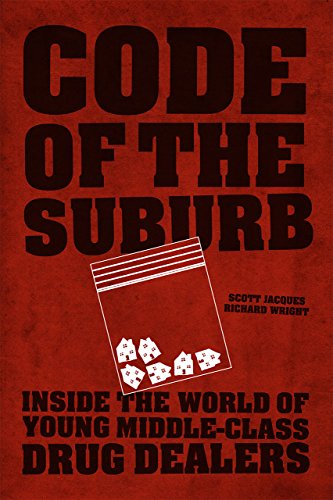
Inhaltsangabe
When we think about young people dealing drugs, we tend to picture it happening on urban streets, in disadvantaged, crime-ridden neighborhoods. But drugs are used everywhere—even in upscale suburbs and top-tier high schools—and teenage users in the suburbs tend to buy drugs from their peers, dealers who have their own culture and code, distinct from their urban counterparts.
In Code of the Suburb, Scott Jacques and Richard Wright offer a fascinating ethnography of the culture of suburban drug dealers. Drawing on fieldwork among teens in a wealthy suburb of Atlanta, they carefully parse the complicated code that governs relationships among buyers, sellers, police, and other suburbanites. That code differs from the one followed by urban drug dealers in one crucial respect: whereas urban drug dealers see violent vengeance as crucial to status and security, the opposite is true for their suburban counterparts. As Jacques and Wright show, suburban drug dealers accord status to deliberate avoidance of conflict, which helps keep their drug markets more peaceful—and, consequently, less likely to be noticed by law enforcement.
Offering new insight into both the little-studied area of suburban drug dealing, and, by extension, the more familiar urban variety, Code of the Suburb will be of interest to scholars and policy makers alike.
Die Inhaltsangabe kann sich auf eine andere Ausgabe dieses Titels beziehen.
Über die Autorin bzw. den Autor
Scott Jacques is assistant professor of criminal justice and criminology in the Andrew Young School of Policy Studies at Georgia State University.Richard Wright is professor of criminal justice and criminology in the Andrew Young School of Policy Studies at Georgia State University.
„Über diesen Titel“ kann sich auf eine andere Ausgabe dieses Titels beziehen.
Suchergebnisse für Code of the Suburb: Inside the World of Young Middle-Class...

Beispielbild für diese ISBN
Code of the Suburb : Inside the World of Young Middle-Class Drug Dealers
Verlag:
University of Chicago Press, 2015
ISBN 10: 022616411X
ISBN 13: 9780226164113
Gebraucht
Softcover
Anbieter: Better World Books, Mishawaka, IN, USA
Verkäuferbewertung 5 von 5 Sternen

Zustand: Good. Former library copy. Pages intact with minimal writing/highlighting. The binding may be loose and creased. Dust jackets/supplements are not included. Includes library markings. Stock photo provided. Product includes identifying sticker. Better World Books: Buy Books. Do Good. Artikel-Nr. 41033972-6
Gebraucht kaufen
EUR 10,07
Versand gratis
Versand innerhalb von USA
Versand innerhalb von USA
Anzahl: 1 verfügbar
Beispielbild für diese ISBN
Code of the Suburb : Inside the World of Young Middle-Class Drug Dealers
Verlag:
University of Chicago Press, 2015
ISBN 10: 022616411X
ISBN 13: 9780226164113
Gebraucht
Softcover
Anbieter: Better World Books, Mishawaka, IN, USA
Verkäuferbewertung 5 von 5 Sternen
Zustand: Good. Pages intact with minimal writing/highlighting. The binding may be loose and creased. Dust jackets/supplements are not included. Stock photo provided. Product includes identifying sticker. Better World Books: Buy Books. Do Good. Artikel-Nr. 68198121-6
Gebraucht kaufen
EUR 10,07
Versand gratis
Versand innerhalb von USA
Versand innerhalb von USA
Anzahl: 1 verfügbar
Beispielbild für diese ISBN
Code of the Suburb
Anbieter: PBShop.store US, Wood Dale, IL, USA
Verkäuferbewertung 5 von 5 Sternen
PAP. Zustand: New. New Book. Shipped from UK. Established seller since 2000. Artikel-Nr. FW-9780226164113
Beispielbild für diese ISBN
Code of the Suburb: Inside the World of Young Middle-Class Drug Dealers (Fieldwork Encounters and Discoveries)
Verlag:
University of Chicago Press, 2015
ISBN 10: 022616411X
ISBN 13: 9780226164113
Gebraucht
paperback
Anbieter: Sell Books, Elland, YORKS, Vereinigtes Königreich
Verkäuferbewertung 5 von 5 Sternen
paperback. Zustand: Acceptable. Please see the condition note after this for details, if this is missing please consider Acceptable to mean poor quality that could include major staining, water damage, writing, missing dustjacket, etc etc. Our books are dispatched from a Yorkshire former cotton mill. We list via barcode/ISBN so please note that the images are stock images and may not be the exact copy you receive, furthermore the details about edition and year might not be accurate as many publishers reuse the same ISBN for multiple editions and as we simply scan a barcode or enter an ISBN we do not check the validity of the edition data when listing. If you're looking for an exact edition please don't order (at least not without checking with us first, although we don't always have time to check). We aim to dispatch prompty, the service used will depend on order value and book size. We can ship to most countries, see our shipping policies. Payment is via Abe only. Artikel-Nr. L-BIR00413-MIX-20230901-A
Gebraucht kaufen
EUR 24,24
EUR 14,30 Versand
Versand von Vereinigtes Königreich nach USA
Versand von Vereinigtes Königreich nach USA
Anzahl: 1 verfügbar
Beispielbild für diese ISBN
Code of the Suburb
Anbieter: PBShop.store UK, Fairford, GLOS, Vereinigtes Königreich
Verkäuferbewertung 5 von 5 Sternen
PAP. Zustand: New. New Book. Shipped from UK. Established seller since 2000. Artikel-Nr. FW-9780226164113
Neu kaufen
EUR 36,83
EUR 4,89 Versand
Versand von Vereinigtes Königreich nach USA
Versand von Vereinigtes Königreich nach USA
Anzahl: 15 verfügbar
Beispielbild für diese ISBN
Code of the Suburb: Inside the World of Young Middle-Class Drug Dealers (Fieldwork Encounters and Discoveries)
Anbieter: Kennys Bookstore, Olney, MD, USA
Verkäuferbewertung 5 von 5 Sternen
Zustand: New. 2015. Paperback. Offers an ethnography of the culture of suburban drug dealers. This book shows that suburban drug dealers accord status to deliberate avoidance of conflict, which helps keep their drug markets more peaceful - and, consequently, less likely to be noticed by law enforcement. Series: Fieldwork Encounters and Discoveries. Num Pages: 208 pages, 10 halftones. BIC Classification: 1KBB; JFSC; JFSP2; JKVG. Category: (G) General (US: Trade). Dimension: 60 x 90 x 13. Weight in Grams: 295. . . . . . Books ship from the US and Ireland. Artikel-Nr. V9780226164113
Neu kaufen
EUR 37,05
EUR 9,33 Versand
Versand innerhalb von USA
Versand innerhalb von USA
Anzahl: Mehr als 20 verfügbar
Beispielbild für diese ISBN
Code of the Suburb
Anbieter: Majestic Books, Hounslow, Vereinigtes Königreich
Verkäuferbewertung 4 von 5 Sternen

Zustand: New. pp. 208. Artikel-Nr. 311924483
Neu kaufen
EUR 40,69
EUR 7,65 Versand
Versand von Vereinigtes Königreich nach USA
Versand von Vereinigtes Königreich nach USA
Anzahl: 3 verfügbar
Beispielbild für diese ISBN
Code of the Suburb: Inside the World of Young Middle-Class Drug Dealers (Fieldwork Encounters and Discoveries)
Anbieter: Ria Christie Collections, Uxbridge, Vereinigtes Königreich
Verkäuferbewertung 5 von 5 Sternen
Zustand: New. In English. Artikel-Nr. ria9780226164113_new
Neu kaufen
EUR 40,90
EUR 11,03 Versand
Versand von Vereinigtes Königreich nach USA
Versand von Vereinigtes Königreich nach USA
Anzahl: Mehr als 20 verfügbar
Beispielbild für diese ISBN
Code of the Suburb Inside the World of Young MiddleClass Drug Dealers
Anbieter: Revaluation Books, Exeter, Vereinigtes Königreich
Verkäuferbewertung 5 von 5 Sternen
Paperback. Zustand: Brand New. 208 pages. 8.75x6.00x0.50 inches. In Stock. Artikel-Nr. x-022616411X
Neu kaufen
EUR 51,70
EUR 11,77 Versand
Versand von Vereinigtes Königreich nach USA
Versand von Vereinigtes Königreich nach USA
Anzahl: 2 verfügbar
Foto des Verkäufers
Code of the Suburb : Inside the World of Young Middle-Class Drug Dealers
Verlag:
University Of Chicago Press Mai 2015, 2015
ISBN 10: 022616411X
ISBN 13: 9780226164113
Neu
Taschenbuch
Anbieter: AHA-BUCH GmbH, Einbeck, Deutschland
Verkäuferbewertung 5 von 5 Sternen
Taschenbuch. Zustand: Neu. Neuware - When we think about young people dealing drugs, we tend to picture it happening on urban streets, in disadvantaged, crime-ridden neighborhoods. But drugs are used everywhere--even in upscale suburbs and top-tier high schools--and teenage users in the suburbs tend to buy drugs from their peers, dealers who have their own culture and code, distinct from their urban counterparts. In Code of the Suburb, Scott Jacques and Richard Wright offer a fascinating ethnography of the culture of suburban drug dealers. Drawing on fieldwork among teens in a wealthy suburb of Atlanta, they carefully parse the complicated code that governs relationships among buyers, sellers, police, and other suburbanites. That code differs from the one followed by urban drug dealers in one crucial respect: whereas urban drug dealers see violent vengeance as crucial to status and security, the opposite is true for their suburban counterparts. As Jacques and Wright show, suburban drug dealers accord status to deliberate avoidance of conflict, which helps keep their drug markets more peaceful--and, consequently, less likely to be noticed by law enforcement. Offering new insight into both the little-studied area of suburban drug dealing, and, by extension, the more familiar urban variety, Code of the Suburb will be of interest to scholars and policy makers alike. Artikel-Nr. 9780226164113
Neu kaufen
EUR 52,62
EUR 35,00 Versand
Versand von Deutschland nach USA
Versand von Deutschland nach USA
Anzahl: 2 verfügbar