
Verwandte Artikel zu Trilobite Book: A Visual Journey
Inhaltsangabe
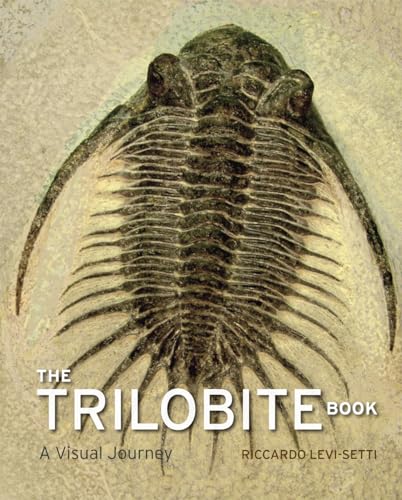
Distant relatives of modern lobsters, horseshoe crabs, and spiders, trilobites swam the planet’s prehistoric seas for 300 million years, from the Lower Cambrian to the end of the Permian eras—and they did so very capably. Trilobite fossils have been unearthed on every continent, with more than 20,000 species identified by science. One of the most arresting animals of our pre-dinosaur world, trilobites are also favorites among the fossil collectors of today, their crystalline eyes often the catalyst for a lifetime of paleontological devotion. And there is no collector more devoted—or more venerated—than Riccardo Levi-Setti. With The Trilobite Book, a much anticipated follow-up to his classic Trilobites, Levi-Setti brings us a glorious and revealing guide to these surreal arthropods of ancient Earth.
Featuring specimens from Bohemia to Newfoundland, California to the Tucson Gem and Mineral Show, and Wales to the Anti-Atlas Mountains of Morocco, Levi-Setti’s magnificent book reanimates these “butterflies of the seas” in 235 astonishing full-color photographs. All original, Levi-Setti’s images serve as the jumping-off point for tales of his global quests in search of these highly sought-after fossils; for discussions of their mineralogical origins, as revealed by their color; and for unraveling the role of the now-extinct trilobites in our planetary history.
Sure to enthrall paleontologists with its scientific insights and amateur enthusiasts with its beautiful and informative images, The Trilobite Book combines the best of science, technology, aesthetics, and personal adventure. It will inspire new collectors for eras to come.
Featuring specimens from Bohemia to Newfoundland, California to the Tucson Gem and Mineral Show, and Wales to the Anti-Atlas Mountains of Morocco, Levi-Setti’s magnificent book reanimates these “butterflies of the seas” in 235 astonishing full-color photographs. All original, Levi-Setti’s images serve as the jumping-off point for tales of his global quests in search of these highly sought-after fossils; for discussions of their mineralogical origins, as revealed by their color; and for unraveling the role of the now-extinct trilobites in our planetary history.
Sure to enthrall paleontologists with its scientific insights and amateur enthusiasts with its beautiful and informative images, The Trilobite Book combines the best of science, technology, aesthetics, and personal adventure. It will inspire new collectors for eras to come.
Die Inhaltsangabe kann sich auf eine andere Ausgabe dieses Titels beziehen.
Über die Autorin bzw. den Autor
Riccardo Levi-Setti, professor emeritus of physics at the University of Chicago, has served as director of the Enrico Fermi Institute and as an honorary research associate at the Field Museum, Chicago. Although he is trained as a physicist, trilobites have long been his passion. He lives in Chicago.
Auszug. © Genehmigter Nachdruck. Alle Rechte vorbehalten.
The Trilobite Book
A Visual Journey
By Riccardo Levi-SettiThe University of Chicago Press
Copyright © 2014 The University of Chicago
All rights reserved.
ISBN: 978-0-226-12441-4All rights reserved.
Contents
Preface,
Acknowledgments,
1. INTRODUCTION: WHY COLOR?,
2.1. BOHEMIA,
2.2. MOROCCO,
2.3. WESTERN NORTH AMERICA,
2.4. EASTERN NEWFOUNDLAND,
2.5. UNITED KINGDOM,
2.6. RUSSIA,
2.7. TUCSON GEM AND MINERAL SHOW,
3. THE EYES OF TRILOBITES,
References,
Index to Genera,
CHAPTER 1
INTRODUCTION: WHY COLOR?
As we split open a slab of shale, especially if it is of Cambrian age, trilobites often appear in brilliant shades of ochre, against a gray-greenish background, the color of the matrix encasing them. The color of the trilobite shell, or carapace, has little to do with the original color of the living trilobite. It is the result of chemical processes, such as mineralization, which took place after the burial and decay of the dead animal or its molting exuviae. These processes are called diagenesis and are part of a broader set of burial events that depend on the environment and fall under the comprehensive name of taphonomy. Taphonomy involves the nature of the minerals making up the shale and of those dissolved in the surrounding water or infiltrated after burial and fossilization. And yet, the color that our vision perceives has an emotional impact that makes our "treasure hunt" for trilobites both attractive and addictive.
Unfortunately, the rigor of the scientific paleontological literature has predominantly denied such emotional responses by erasing any trace of color with whitening coatings, which reduce the graphical reproduction of the subject matter to black-and-white photography. However, there is a reason for the whitening process: the aerosols used for the whitening carry an electrical charge that makes the coating stick preferentially to the tips of protruding details, thus enhancing somewhat the resulting informative three-dimensional contrast. Such whitening has been the fate of many images presented in my earlier trilobite books.
The rise of digital photography and the fact that color printing is now more affordable make it possible to exploit to its fullest the splendid complexity of human vision, which, with its trichromatic sensitivity, unique among primates, connects directly to the emotional response that color images may elicit as well as to artistic expression. Is this of added value over black-and-white images when looking at trilobites? It is my contention that, indeed, color images of trilobites convey more information about the fine structure of the object, such as that enhanced by aerosol whitening, than is usually appreciated. Under illumination of a color reproduction similar to that used in taking the picture (e.g., daylight or halogen lighting,), the response of the eye retina contains a subtle contribution from a phenomenon called chromostereopsis. The latter is an optical phenomenon whereby different colors may elicit different depth perceptions. Much has been discussed in the literature in regard to this phenomenon and how the brain processes the signals from the retina in regard to color processing hand in hand with the perception of form and boundaries. The net result is that color images seem to stand out with some illusion of relief. (An excellent and updated summary of this visual phenomenon can be found on the web under "Chromostereopsis" in Wikipedia, The Free Encyclopedia.)
My input on this issue is a comparison I made between black-and-white images of trilobites whitened with white aerosols of magnesium oxide (the old trick to enhance 3-D contrast mentioned above) and color images of the same prior to whitening (an example of this comparison is shown in plate 1). This comparison showed clearly that the structural information delivered by both images is essentially identical, thus confirming that the color image does provide the relief evidence sought by paleontologists for publication. On this ground, to publish my trilobite pictures in color has more to offer than just the entertainment of browsing through a coffee-table book.
Now I must turn to the choices I made about which trilobite images to include and which of their geographic origins to highlight. On both grounds, my choices were greatly biased. As to the choice of depositional location, this was dictated by preconceived notions of accessibility, renown, and sometimes also by exotic appeal. A certain predilection for the most ancient geological settings, the Lower and Middle Cambrian, will transpire here—a predilection perhaps fostered by my encounters with my mentor, the late Franco Rasetti, who regarded Cambrian trilobites as the most rewarding of his attention. However, the principal bias results from my choice of illustrating complete, fully articulated trilobite specimens. Complete specimens are a rare occurrence in the fossil record of trilobites, which restricts greatly the taphonomy of their burial, which, in turn, is responsible for their ultimate appearance, inclusive of their color. Complete outstretched trilobites, with all sutures intact, indicate sudden burial of living individuals in a tranquil environment, at some depth in the sea, remote from the disturbance of wave motion. Such episodes of sudden burial are known to occur as a result of gentle but massive deposition of silt in suspension in so-called turbidity waves, the result of surface storms and sometimes volcanic ash fallout. The sediments often reveal a cyclic or rhythmic alternating repetition of mineral content, as documented, for example, in the layers of the Manuels River Formation of Conception Bay, Newfoundland—which I studied long ago with my colleague Jan Bergström of Sweden. After the death of a trilobite, several pathways lead to fossilization of the remains, which depend critically on the chemistry of the local environment. With few by now famous exceptions, like the Burgess Shale of British Columbia and the Chengjiang fauna of China, where soft tissues are beautifully preserved, the decay of the biopolymers making up the soft tissues, generally fostered by bacterial action even in anaerobic marine sediments, leaves no trace of internal, nonmineralized structures. Only the trilobite exoskeleton, the carapace, partially mineralized by calcite, often escapes complete dissolution, and this may survive unaltered over geological eras. However, over time, mineralogical alterations, diagenesis, still conspire to modify the chemical nature of the fossilized carapace, leading to a multitude of final appearances, and in particular colors, of the fossil trilobite.
Thus, the brilliant ochre colors frequently encountered in the carapace of trilobites preserved in clay-mineral shales are the result of a three-step taphonomic-di-agenetic process, favored by a marine environment rich in dissolved iron hydroxide and oxygen starved. In the first step, residual organic matter is digested by sulfate-reducing anaerobic bacteria yielding hydrogen sulfide (HS-). In the second step, HS- combines with iron ions (Fe2+) to yield iron sulfide FeS2 (the mineral pyrite, fool's gold). These two steps may occur within a few weeks after burial. The third step, which may occur over millions of years, involves the oxidation of the pyrite to the minerals limonite (FeO2, yellow ochre) and hematite (FeO3, red ochre). Sometimes, the pyrite replacement survives over eons, and we find the trilobites amidst a multitude of pyrite nodules, in particular in carbon-rich black...
„Über diesen Titel“ kann sich auf eine andere Ausgabe dieses Titels beziehen.
Suchergebnisse für Trilobite Book: A Visual Journey

Beispielbild für diese ISBN
The Trilobite Book : A Visual Journey
Verlag:
University of Chicago Press, 2014
ISBN 10: 022612441X
ISBN 13: 9780226124414
Gebraucht
Hardcover
Anbieter: Better World Books, Mishawaka, IN, USA
Verkäuferbewertung 5 von 5 Sternen

Zustand: Very Good. Former library copy. Pages intact with possible writing/highlighting. Binding strong with minor wear. Dust jackets/supplements may not be included. Includes library markings. Stock photo provided. Product includes identifying sticker. Better World Books: Buy Books. Do Good. Artikel-Nr. 12021204-20
Gebraucht kaufen
EUR 36,42
Versand gratis
Versand innerhalb von USA
Versand innerhalb von USA
Anzahl: 1 verfügbar
Foto des Verkäufers
THE TRILOBITE BOOK A Visual Journey
Verlag:
University of Chicago Press, 2014. 9780226124414, 2014
ISBN 10: 022612441X
ISBN 13: 9780226124414
Gebraucht
Hardcover
Erstausgabe
Anbieter: Rothwell & Dunworth (ABA, ILAB), Dulverton, Vereinigtes Königreich
Verkäuferbewertung 5 von 5 Sternen
1st edn 1st printing. 4to. Original silver lettered black cloth (Fine), dustwrapper (Fine). Pp. x + 273, illus throughout with coloured plates (no inscriptions). Artikel-Nr. 199609
Gebraucht kaufen
EUR 36,57
EUR 15,98 Versand
Versand von Vereinigtes Königreich nach USA
Versand von Vereinigtes Königreich nach USA
Anzahl: 1 verfügbar
Beispielbild für diese ISBN
The Trilobite Book
Verlag:
The University of Chicago Press, 2014
ISBN 10: 022612441X
ISBN 13: 9780226124414
Neu
Hardcover
Anbieter: PBShop.store UK, Fairford, GLOS, Vereinigtes Königreich
Verkäuferbewertung 5 von 5 Sternen
HRD. Zustand: New. New Book. Shipped from UK. Established seller since 2000. Artikel-Nr. WG-9780226124414
Neu kaufen
EUR 51,38
EUR 9,03 Versand
Versand von Vereinigtes Königreich nach USA
Versand von Vereinigtes Königreich nach USA
Anzahl: 11 verfügbar
Beispielbild für diese ISBN
The Trilobite Book: A Visual Journey
Anbieter: Kennys Bookstore, Olney, MD, USA
Verkäuferbewertung 5 von 5 Sternen
Zustand: New. Distant relatives of modern lobsters, horseshoe crabs, and spiders, trilobites swam the planet's prehistoric seas for 300 million years, from the Lower Cambrian to the end of the Permian eras - and they did so very capably. This is a revealing guide to these surreal arthropods of ancient Earth. Num Pages: 288 pages, 235 colour plates. BIC Classification: WNR. Category: (G) General (US: Trade). Dimension: 260 x 215 x 26. Weight in Grams: 1258. . 2014. Hardcover. . . . . Books ship from the US and Ireland. Artikel-Nr. V9780226124414
Neu kaufen
EUR 56,28
EUR 9,37 Versand
Versand innerhalb von USA
Versand innerhalb von USA
Anzahl: 11 verfügbar
Beispielbild für diese ISBN
The Trilobite Book
Anbieter: Majestic Books, Hounslow, Vereinigtes Königreich
Verkäuferbewertung 4 von 5 Sternen

Zustand: New. pp. 288. Artikel-Nr. 53996958
Neu kaufen
EUR 59,36
EUR 7,69 Versand
Versand von Vereinigtes Königreich nach USA
Versand von Vereinigtes Königreich nach USA
Anzahl: 3 verfügbar
Beispielbild für diese ISBN
The Trilobite Book A Visual Journey
Anbieter: Revaluation Books, Exeter, Vereinigtes Königreich
Verkäuferbewertung 5 von 5 Sternen
Hardcover. Zustand: Brand New. 273 pages. 10.50x8.50x1.00 inches. In Stock. Artikel-Nr. __022612441X
Neu kaufen
EUR 53,64
EUR 17,75 Versand
Versand von Vereinigtes Königreich nach USA
Versand von Vereinigtes Königreich nach USA
Anzahl: 1 verfügbar
Beispielbild für diese ISBN
The Trilobite Book: A Visual Journey
Anbieter: Ria Christie Collections, Uxbridge, Vereinigtes Königreich
Verkäuferbewertung 5 von 5 Sternen
Zustand: New. In English. Artikel-Nr. ria9780226124414_new
Neu kaufen
EUR 64,29
EUR 17,68 Versand
Versand von Vereinigtes Königreich nach USA
Versand von Vereinigtes Königreich nach USA
Anzahl: 12 verfügbar
Beispielbild für diese ISBN
TRILOBITE BOOK A VISUAL JOU
Anbieter: Speedyhen, Hertfordshire, Vereinigtes Königreich
Verkäuferbewertung 5 von 5 Sternen
Zustand: NEW. Artikel-Nr. NW9780226124414
Neu kaufen
EUR 49,52
EUR 48,53 Versand
Versand von Vereinigtes Königreich nach USA
Versand von Vereinigtes Königreich nach USA
Anzahl: 1 verfügbar
Foto des Verkäufers
Trilobite Book
Anbieter: moluna, Greven, Deutschland
Verkäuferbewertung 5 von 5 Sternen
Zustand: New. Distant relatives of modern lobsters, horseshoe crabs, and spiders, trilobites swam the planet s prehistoric seas for 300 million years, from the Lower Cambrian to the end of the Permian eras - and they did so very capably. This is a revealing guide to thes. Artikel-Nr. 5897513
Neu kaufen
EUR 59,99
EUR 48,99 Versand
Versand von Deutschland nach USA
Versand von Deutschland nach USA
Anzahl: 1 verfügbar
Foto des Verkäufers
The Trilobite Book - A Visual Journey | A Visual Journey
Verlag:
The University of Chicago Press, 2014
ISBN 10: 022612441X
ISBN 13: 9780226124414
Neu
Hardcover
Anbieter: preigu, Osnabrück, Deutschland
Verkäuferbewertung 5 von 5 Sternen
Buch. Zustand: Neu. The Trilobite Book - A Visual Journey | A Visual Journey | Riccardo Levi-Setti | Buch | Einband - fest (Hardcover) | Englisch | 2014 | The University of Chicago Press | EAN 9780226124414 | Verantwortliche Person für die EU: Libri GmbH, Europaallee 1, 36244 Bad Hersfeld, gpsr[at]libri[dot]de | Anbieter: preigu. Artikel-Nr. 105643052
Neu kaufen
EUR 67,40
EUR 70,00 Versand
Versand von Deutschland nach USA
Versand von Deutschland nach USA
Anzahl: 1 verfügbar