
Verwandte Artikel zu Baboon Metaphysics: The Evolution of a Social Mind
Inhaltsangabe
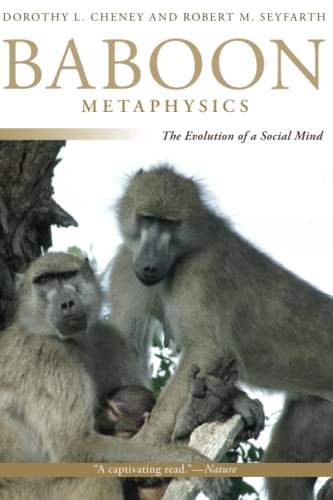
In 1838 Charles Darwin jotted in a notebook, “He who understands baboon would do more towards metaphysics than Locke.” Baboon Metaphysics is Dorothy L. Cheney and Robert M. Seyfarth’s fascinating response to Darwin’s challenge.
Cheney and Seyfarth set up camp in Botswana’s Okavango Delta, where they could intimately observe baboons and their social world. Baboons live in groups of up to 150, including a handful of males and eight or nine matrilineal families of females. Such numbers force baboons to form a complicated mix of short-term bonds for mating and longer-term friendships based on careful calculations of status and individual need.
But Baboon Metaphysics is concerned with much more than just baboons’ social organization—Cheney and Seyfarth aim to fully comprehend the intelligence that underlies it. Using innovative field experiments, the authors learn that for baboons, just as for humans, family and friends hold the key to mitigating the ill effects of grief, stress, and anxiety.
Written with a scientist’s precision and a nature-lover’s eye, Baboon Metaphysics gives us an unprecedented and compelling glimpse into the mind of another species.
“The vivid narrative is like a bush detective story.”—Steven Poole, Guardian
“Baboon Metaphysics is a distillation of a big chunk of academic lives. . . . It is exactly what such a book should be—full of imaginative experiments, meticulous scholarship, limpid literary style, and above all, truly important questions.”—Alison Jolly, Science
“Cheney and Seyfarth found that for a baboon to get on in life involves a complicated blend of short-term relationships, friendships, and careful status calculations. . . . Needless to say, the ensuing political machinations and convenient romantic dalliances in the quest to become numero uno rival the bard himself.”—Science News
“Cheney and Seyfarth’s enthusiasm is obvious, and their knowledge is vast and expressed with great clarity. All this makes Baboon Metaphysics a captivating read. It will get you thinking—and maybe spur you to travel to Africa to see it all for yourself.”—Asif A. Ghazanfar, Nature
“Through ingenious playback experiments . . . Cheney and Seyfarth have worked out many aspects of what baboons used their minds for, along with their limitations. Reading a baboon’s mind affords an excellent grasp of the dynamics of baboon society. But more than that, it bears on the evolution of the human mind and the nature of human existence.”—Nicholas Wade, New York Times
Die Inhaltsangabe kann sich auf eine andere Ausgabe dieses Titels beziehen.
Über die Autorin bzw. den Autor
Dorothy L. Cheney is professor of biology and Robert M. Seyfarth is professor of psychology at the University of Pennsylvania. They are the authors of How Monkeys See the World, also published by the University of Chicago Press.
Auszug. © Genehmigter Nachdruck. Alle Rechte vorbehalten.
FOUNDATIONS OF TROPICAL FOREST BIOLOGY
Classic Papers with CommentariesTHE UNIVERSITY OF CHICAGO PRESS
Copyright © 2002 The University of ChicagoAll right reserved.
ISBN: 978-0-226-10244-3
Contents
Preface......................................................................................................................................xviiIntroduction Robin L. Chazdon...............................................................................................................1PART ONE Tropical Naturalists of the Sixteenth through Nineteenth Centuries Robin L. Chazdon and the Earl of Cranbrook.....................5PART TWO What Shaped Tropical Biotas as We See Them Today? T. C. Whitmore..................................................................69PART THREE Ecological and Evolutionary Perspectives on the Origins of Tropical Diversity Douglas W. Schemske...............................163PART FOUR Plant-Animal Interactions and Community Structure Bette A. Loiselle and Rodolfo Dirzo............................................269PART FIVE Coevolution Robert J. Marquis and Rodolfo Dirzo..................................................................................339PART SIX Case Studies of Arthropod Diversity and Distribution Scott E. Miller, Vojtech Novotny, and Yves Basset............................407PART SEVEN Terrestrial Vertebrate Diversity B. A. Loiselle, R. W. Sussman, and the Earl of Cranbrook.......................................441PART EIGHT Floristic Composition and Species Richness Robin L. Chazdon and Julie S. Denslow................................................513PART NINE Forest Dynamics and Regeneration David F. R. P. Burslem and M.D. Swaine..........................................................577PART TEN Ecosystem Ecology in the Tropics Julie S. Denslow and Robin L. Chazdon............................................................639PART ELEVEN Human Impact and Species Extinction Rodolfo Dirzo and Robert W. Sussman........................................................703PART TWELVE Securing a Sustainable Future for Tropical Moist Forests D. Lamb and T. C. Whitmore............................................771Bibliography.................................................................................................................................837List of Contributors.........................................................................................................................861
Chapter One
Tropical Naturalists of the Sixteenth through Nineteenth Centuries
Robin L. Chazdon and the Earl of Cranbrook
An earnest desire to visit a tropical country, to behold the luxuriance of animal and vegetable life said to exist there, and to see with my own eyes all those wonders which I had so much delighted to read of in the narratives of travellers, were the motives that induced me to break through the trammel of business, and the ties of home, and start for some far land where endless summer reigns. -A. R. Wallace, A Narrative of Travels on the Amazon and Rio Negro (London: Ward, Lock and Co., 1889)
The story of tropical biology begins with naturalists-explorers with a keen curiosity, an eye for variation, and a passion for collecting. Cartographers, missionaries, collectors, and chroniclers set out from their home bases in Europe to discover new worlds and to document the riches they discovered. These trailblazers brought home a new vision that changed the world in countless ways. Their many published works still speak to us today. In this part we highlight works of these pioneering tropical biologists, some of whom never lived to see their major works in print.
Naturalists of the Early Colonial Period
Sixteenth- and seventeenth-century missionaries and explorers laid the groundwork for later scientific expeditions by beginning the process of documenting the biological riches of tropical regions of the New and Old Worlds (von Hagen 1951). Gonzalo Fernndez de Oviedo y Valds spent thirty-four years in the New World as a colonial administrator and royal chronicler to King Ferdinand of Spain. Oviedo's famous Sumario de la natural histria de las Indias was published in 1526 in Spanish, English, and French. Jos de Acosta, a Jesuit priest sent to Peru as a missionary, published Histria natural y moral de las Indias in 1590. This treatise on native life, medical flora, and diseases of the New World enjoyed phenomenal success in Europe. Early in the seventeenth century, the Dutch prince Maurice von Nassau-Siesgen traveled to Recife, Brazil, with fellow European naturalists and collected many botanical and zoological treasures, surpassing anything done earlier in the Americas. These collections were studied by Georg Marcgrave and Willem Piso, the first European scientists to study the flora and fauna of Brazil (F. Ortiz-Crespo, personal communication).
Compared to other centuries, however, the seventeenth was a "sterile century" for natural history in the Hispanic world-not a word was published during this time of inquisitions, prohibitions, and exclusivism (von Hagen 1951). Elsewhere in Europe, however, the lamp of curiosity burned as brightly as before. As natural sciences developed alongside advances in medical understanding, the seafaring nations of northwestern Europe extended ever further into the tropical world, in exploration for trade and discovery for its own sake. The coasts of Africa, India, Ceylon, the East Indies, and beyond were visited and trading outposts established. The Dutch had strong interests in botany. Their universities were equipped with botanical gardens and heated houses to cultivate tender tropical plants (Burkill 1965).
The Dutch East India Company set its capital at Batavia on Java, in the early part of the seventeenth century, and its officer Georg Everard Rumpf (Latinized as Rumphius) was soon settled further east in Amboina in the Moluccas. In 1662, Rumphius set out to make a systematic study of the flora, fauna, and geology of Amboina and arranged a leave of absence to devote himself full time to natural history endeavors (Sirks 1945). Disaster struck in 1670, when he went blind. Four years later, he lost his wife and youngest daughter in a violent earthquake. As if these disasters weren't enough, his books, collections, and manuscripts were destroyed by fire in 1687, and then the manuscript of his major work, Amboinsche Kruidboek (also known as Herbarium Amboinense), was lost at sea (although a copy survived). This and his other great work, Amboinsche Rariteitkamer, were published posthumously. In this monumental work, Rumpf describes and illustrates the organisms of the seas surrounding Ambon Bay, as well as minerals and rare concretions taken from animals and plants. An English translation is now available for the first time, under the title The Ambonese Curiosity Cabinet (Rumpf 1999). Yet, in his lifetime, through his specimens and correspondence, descriptions, and anecdotes of the natural history of this tropical region, Rumphius became known to the world of scholars and educated people generally. His floristic descriptions laid the foundations for a knowledge of the vegetation of Amboina and other islands of the Malay Archipelago. Moreover, as a precursor of the binary nomenclature of Linnaeus, he developed a system for naming crustaceans based on two names, a generic name followed...
„Über diesen Titel“ kann sich auf eine andere Ausgabe dieses Titels beziehen.
Suchergebnisse für Baboon Metaphysics: The Evolution of a Social Mind

Beispielbild für diese ISBN
Baboon Metaphysics: The Evolution of a Social Mind
Verlag:
University of Chicago Press (edition 1), 2008
ISBN 10: 0226102440
ISBN 13: 9780226102443
Gebraucht
Paperback
Anbieter: BooksRun, Philadelphia, PA, USA
Verkäuferbewertung 5 von 5 Sternen

Paperback. Zustand: Very Good. 1. It's a well-cared-for item that has seen limited use. The item may show minor signs of wear. All the text is legible, with all pages included. It may have slight markings and/or highlighting. Artikel-Nr. 0226102440-8-1
Gebraucht kaufen
EUR 5,67
Versand gratis
Versand innerhalb von USA
Versand innerhalb von USA
Anzahl: 1 verfügbar
Beispielbild für diese ISBN
Baboon Metaphysics : The Evolution of a Social Mind
Verlag:
University of Chicago Press, 2008
ISBN 10: 0226102440
ISBN 13: 9780226102443
Gebraucht
Softcover
Anbieter: Better World Books, Mishawaka, IN, USA
Verkäuferbewertung 5 von 5 Sternen
Zustand: Very Good. Pages intact with possible writing/highlighting. Binding strong with minor wear. Dust jackets/supplements may not be included. Stock photo provided. Product includes identifying sticker. Better World Books: Buy Books. Do Good. Artikel-Nr. 42443109-6
Gebraucht kaufen
EUR 10,42
Versand gratis
Versand innerhalb von USA
Versand innerhalb von USA
Anzahl: 1 verfügbar
Beispielbild für diese ISBN
Baboon Metaphysics
Anbieter: PBShop.store US, Wood Dale, IL, USA
Verkäuferbewertung 5 von 5 Sternen
PAP. Zustand: New. New Book. Shipped from UK. Established seller since 2000. Artikel-Nr. FW-9780226102443
Beispielbild für diese ISBN
Baboon Metaphysics The Evolution of a Social Mind
Anbieter: Revaluation Books, Exeter, Vereinigtes Königreich
Verkäuferbewertung 5 von 5 Sternen
Paperback. Zustand: Brand New. 1st edition. 348 pages. 9.25x6.00x0.75 inches. In Stock. Artikel-Nr. __0226102440
Neu kaufen
EUR 16,47
EUR 14,80 Versand
Versand von Vereinigtes Königreich nach USA
Versand von Vereinigtes Königreich nach USA
Anzahl: 1 verfügbar
Beispielbild für diese ISBN
Baboon Metaphysics
Anbieter: PBShop.store UK, Fairford, GLOS, Vereinigtes Königreich
Verkäuferbewertung 5 von 5 Sternen
PAP. Zustand: New. New Book. Shipped from UK. Established seller since 2000. Artikel-Nr. FW-9780226102443
Neu kaufen
EUR 26,82
EUR 5,94 Versand
Versand von Vereinigtes Königreich nach USA
Versand von Vereinigtes Königreich nach USA
Anzahl: 15 verfügbar
Beispielbild für diese ISBN
Baboon Metaphysics
Anbieter: Majestic Books, Hounslow, Vereinigtes Königreich
Verkäuferbewertung 4 von 5 Sternen

Zustand: New. pp. 358. Artikel-Nr. 8248712
Neu kaufen
EUR 28,33
EUR 7,69 Versand
Versand von Vereinigtes Königreich nach USA
Versand von Vereinigtes Königreich nach USA
Anzahl: 3 verfügbar
Beispielbild für diese ISBN
Baboon Metaphysics
Verlag:
The University of Chicago Press, 2008
ISBN 10: 0226102440
ISBN 13: 9780226102443
Neu
Softcover
Anbieter: Kennys Bookstore, Olney, MD, USA
Verkäuferbewertung 5 von 5 Sternen
Zustand: New. In 1838 Charles Darwin jotted in a notebook, 'He who understands baboon would do more towards metaphysics than Locke.' This book offers a response to Darwin's challenge. Num Pages: 358 pages, 50 halftones, 1 line drawing. BIC Classification: PSVW79. Category: (P) Professional & Vocational. Dimension: 230 x 156 x 19. Weight in Grams: 494. . 2008. 1st Edition. Paperback. . . . . Books ship from the US and Ireland. Artikel-Nr. V9780226102443
Neu kaufen
EUR 29,37
EUR 9,41 Versand
Versand innerhalb von USA
Versand innerhalb von USA
Anzahl: Mehr als 20 verfügbar
Beispielbild für diese ISBN
Baboon Metaphysics: The Evolution of a Social Mind
Anbieter: Ria Christie Collections, Uxbridge, Vereinigtes Königreich
Verkäuferbewertung 5 von 5 Sternen
Zustand: New. In English. Artikel-Nr. ria9780226102443_new
Neu kaufen
EUR 29,55
EUR 13,36 Versand
Versand von Vereinigtes Königreich nach USA
Versand von Vereinigtes Königreich nach USA
Anzahl: Mehr als 20 verfügbar
Beispielbild für diese ISBN
Baboon Metaphysics The Evolution of a Social Mind
Anbieter: Revaluation Books, Exeter, Vereinigtes Königreich
Verkäuferbewertung 5 von 5 Sternen
Paperback. Zustand: Brand New. 1st edition. 348 pages. 9.25x6.00x0.75 inches. In Stock. Artikel-Nr. x-0226102440
Neu kaufen
EUR 38,32
EUR 14,80 Versand
Versand von Vereinigtes Königreich nach USA
Versand von Vereinigtes Königreich nach USA
Anzahl: 2 verfügbar
Beispielbild für diese ISBN
Baboon Metaphysics - The Evolution of a Social Mind The Evolution of a Social Mind
Verlag:
University of Chicago Press, 2008
ISBN 10: 0226102440
ISBN 13: 9780226102443
Gebraucht
Softcover
Anbieter: Mooney's bookstore, Den Helder, Niederlande
Verkäuferbewertung 4 von 5 Sternen
Zustand: Very Good. Artikel-Nr. 02067354F4BE2F4
Gebraucht kaufen
EUR 39,01
EUR 14,95 Versand
Versand von Niederlande nach USA
Versand von Niederlande nach USA
Anzahl: 1 verfügbar