
Verwandte Artikel zu The Chicago Guide to Landing a Job in Academic Biology...
The Chicago Guide to Landing a Job in Academic Biology (Chicago Guides to Academic Life) - Softcover
Buch 1 von 17: Chicago Guides to Academic Life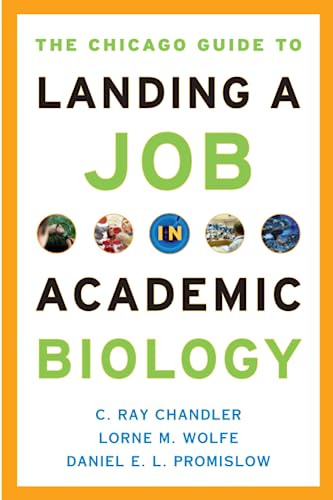
Inhaltsangabe
The Chicago Guide to Landing a Job in Academic Biology is an indispensable guide for graduate students and post-docs as they enter that domain red in tooth and claw: the job market.
An academic career in the biological sciences typically demands well over a decade of technical training. So it’s ironic that when a scholar reaches the most critical stage in that career—the search for a job following graduate work—he or she receives little or no formal preparation. Instead, students are thrown into the job market with only cursory guidance on how to search for and land a position.
Now there’s help. Carefully, clearly, and with a welcome sense of humor, The Chicago Guide to Landing a Job in Academic Biology leads graduate students and postdoctoral fellows through the perils and rewards of their first job search. The authors—who collectively have for decades mentored students and served on hiring committees—have honed their advice in workshops at biology meetings across the country. The resulting guide covers everything from how to pack an overnight bag without wrinkling a suit to selecting the right job to apply for in the first place. The authors have taken care to make their advice useful to all areas of academic biology—from cell biology and molecular genetics to evolution and ecology—and they give tips on how applicants can tailor their approaches to different institutions from major research universities to small private colleges.
With jobs in the sciences ever more difficult to come by, The Chicago Guide to Landing a Job in Academic Biology is designed to help students and post-docs navigate the tricky terrain of an academic job search—from the first year of a graduate program to the final negotiations of a job offer.
Die Inhaltsangabe kann sich auf eine andere Ausgabe dieses Titels beziehen.
Über die Autorin bzw. den Autor
C. Ray Chandler is professor of biology at Georgia Southern University. Lorne M. Wolfe is professor of biology at Georgia Southern University. Daniel E. L. Promislow is professor of genetics at the University of Georgia.
Auszug. © Genehmigter Nachdruck. Alle Rechte vorbehalten.
THE CHICAGO GUIDE TO LANDING A JOB IN ACADEMIC BIOLOGY
By C. Ray Chandler Lorne M. Wolfe Daniel E. L. PromislowThe University of Chicago Press
Copyright © 2007 The University of ChicagoAll right reserved.
ISBN: 978-0-226-10130-9
Contents
Preface..................................................viiAcknowledgments..........................................ix1: The Academic Job Market...............................12: Choosing a Graduate Program...........................133: Prepare Early for Your Job Search.....................254: Target Your Job Search................................355: The Application.......................................416: Preparing for the Interview...........................717: The Interview.........................................798: The Seminar...........................................919: Social Time...........................................10910: The Negotiations.....................................11711: All in the Family....................................131Afterword................................................147References Cited.........................................149
Chapter One
The Academic Job Market
Doug and Holly work in the Department of Biology at a medium- sized public university in the Midwest.
Holly thrives in her department. In large lecture classes, her students are wowed by her energy and creativity. In her seminar classes, students feel like they are not just learning what scientists think, but how to think like scientists. Holly loves the process of scientific discovery and has made a point of including undergraduates in just about every research project in her lab. She loves working with the students and has been so productive that she was recently named editor of a major journal in her field. She also runs the master's program and has managed to recruit some excellent graduate students. Despite her busy life as teacher, researcher, administrator, and editor, Holly also manages to find time to relax with her family and play the accordion in a polka band! She has the perfect job (even if her taste in music leaves something to be desired).
Doug wasn't sure about taking an academic job at a school without a Ph.D. program but liked the idea of living close to where he grew up. And without any ideas for alternative careers, he decided to give it a try. Doug joined Holly's department three years ago with great promise, having spent four years as a postdoc in a very productive biochemistry lab. Doug was amazed by just how different having an academic job was from life as a postdoc, where all he did was research. Doug resents the fact that he has to teach, because it interferes with his research. His students sense this, and some of his courses have failed to attract enough students to justify their existence. Doug resents his department head because of the burden of the service tasks he has been assigned, which he thinks only interfere with his research. Of course, despite working late nights and weekends, he doesn't seem to get much research done, because of the burden of his teaching and service duties. Doug is worried about tenure, and rightly so.
Bruce flew in from Boston to interview for a job in Doug and Holly's department. During breakfast with the graduate students, he surprised them by telling them that he couldn't imagine living in the Midwest. In Bruce's seminar, he managed to combine a disinterested tone with an unfocused talk that gave no indication of his future direction.
Holly's happy, Doug's disgruntled, and Bruce is unemployed.
* * *
This story nicely summarizes one of the major hurdles in the academic life of a biologist: getting an academic job in which you can be a happy and productive professional. What do Holly and Doug have that Bruce doesn't? Why is Doug unhappy in exactly the same job environment in which Holly thrives? The answer is complex because there is no single path in academia. For some, the road is straight and narrow. You might have already decided by elementary school that someday you would be working as an academic biologist-yes, some of us are that geeky. For others, the path is rather more unpredictable, with time spent in the Peace Corps, perhaps, or maybe a few years laying bricks (nothing like real work to drive you into academia). Some find academia enormously satisfying, while others never seem to be quite happy with the academic life. The three of us writing this book have followed our own, quite different paths to a faculty position in academia.
Ultimately all the pieces of the above story, and our own real lives as biologists, intersect at the one experience that all academics share-the job search. The outcome of the search determines whether or not you get a job (Holly vs. Bruce) and whether you wind up in a university that makes you happy or miserable (Holly vs. Doug). Surprisingly, during our graduate training, we give little thought to this phase in our academic careers on which so much depends and that nobody can avoid. Remarkably, biologists who spend ten years laboring over a dissertation or weeks assessing the merits of a single statistical test will exhaust their "training" in job-search skills in a single ten-minute chat with their advisor. This casual approach is inadequate because the process of searching for and obtaining an academic job at a modern university is challenging and complex. Furthermore, the amount of time and money invested in academic training is staggering; much is at stake.
If you have picked up this book, you have probably been in school for at least fifteen years, and maybe even distressingly close to twenty-five or thirty years. Pursuit of an academic career in the biological sciences requires more training than your average surgeon or NASA astronaut. So it is ironic that one of the most critical stages in this career-namely, following graduate or postdoctoral work with a successful job search and interview-is one for which graduate students and postdocs receive little or no formal training. All too often, after years of detailed course work, research training, and firsthand research experience, students are launched into the job market with only cursory guidance on how to search and interview successfully for a job consistent with their goals and abilities. The most common wisdom seems to be "publish a lot and ask about start-up." Sound advice, but hardly enough to cover the vagaries of searching for a position in a complex academic job market. And it is a complex market-far more complex than the simple "big school" versus "small school" dichotomy that most applicants use to characterize their job prospects.
It is our belief, based on our own-eventually successful-job searches and on our experience on search committees in recent years that most candidates for academic positions would benefit from specific guidance concerning (1) appropriate professional development during graduate training, (2) the search for an appropriate job opening, (3) the mechanics of applying for an academic job, and (4) the strategies for a successful interview. Although any successful search is predicated on a strong rsum (publications, good teaching experience), there are so many good competitors in today's job market that skills associated with the search, application, and interview process can make the difference between a job offer and a rejection letter. Thus, the purpose of this book is to provide formal guidance in developing these skills. This book will help you navigate the tricky terrain of an academic job in...
„Über diesen Titel“ kann sich auf eine andere Ausgabe dieses Titels beziehen.
Suchergebnisse für The Chicago Guide to Landing a Job in Academic Biology...

Beispielbild für diese ISBN
The Chicago Guide to Landing a Job in Academic Biology
Verlag:
University of Chicago Press, 2007
ISBN 10: 0226101304
ISBN 13: 9780226101309
Gebraucht
Paperback
Anbieter: ThriftBooks-Atlanta, AUSTELL, GA, USA
Verkäuferbewertung 5 von 5 Sternen

Paperback. Zustand: Fair. No Jacket. Readable copy. Pages may have considerable notes/highlighting. ~ ThriftBooks: Read More, Spend Less. Artikel-Nr. G0226101304I5N00
Gebraucht kaufen
EUR 7,76
Versand gratis
Versand innerhalb von USA
Versand innerhalb von USA
Anzahl: 1 verfügbar
Beispielbild für diese ISBN
The Chicago Guide to Landing a Job in Academic Biology
Anbieter: Majestic Books, Hounslow, Vereinigtes Königreich
Verkäuferbewertung 4 von 5 Sternen

Zustand: New. pp. 176. Artikel-Nr. 8248724
Neu kaufen
EUR 14,73
EUR 7,66 Versand
Versand von Vereinigtes Königreich nach USA
Versand von Vereinigtes Königreich nach USA
Anzahl: 1 verfügbar
Beispielbild für diese ISBN
The Chicago Guide to Landing a Job in Academic Biology
Anbieter: PBShop.store US, Wood Dale, IL, USA
Verkäuferbewertung 5 von 5 Sternen
PAP. Zustand: New. New Book. Shipped from UK. Established seller since 2000. Artikel-Nr. FW-9780226101309
Beispielbild für diese ISBN
The Chicago Guide to Landing a Job in Academic Biology
Anbieter: PBShop.store UK, Fairford, GLOS, Vereinigtes Königreich
Verkäuferbewertung 5 von 5 Sternen
PAP. Zustand: New. New Book. Shipped from UK. Established seller since 2000. Artikel-Nr. FW-9780226101309
Neu kaufen
EUR 21,95
EUR 4,90 Versand
Versand von Vereinigtes Königreich nach USA
Versand von Vereinigtes Königreich nach USA
Anzahl: 15 verfügbar
Beispielbild für diese ISBN
The Chicago Guide to Landing a Job in Academic Biology
Anbieter: Revaluation Books, Exeter, Vereinigtes Königreich
Verkäuferbewertung 5 von 5 Sternen
Paperback. Zustand: Brand New. 150 pages. 8.75x6.00x0.50 inches. In Stock. Artikel-Nr. __0226101304
Neu kaufen
EUR 18,78
EUR 11,79 Versand
Versand von Vereinigtes Königreich nach USA
Versand von Vereinigtes Königreich nach USA
Anzahl: 2 verfügbar
Beispielbild für diese ISBN
The Chicago Guide to Landing a Job in Academic Biology
Verlag:
The University of Chicago Press, 2007
ISBN 10: 0226101304
ISBN 13: 9780226101309
Neu
Softcover
Anbieter: Kennys Bookstore, Olney, MD, USA
Verkäuferbewertung 5 von 5 Sternen
Zustand: New. Leads graduate students and postdoctoral fellows through the perils and rewards of their first job search. This volume covers topics ranging from how to pack an overnight bag without wrinkling a suit to the decision-making processes of hiring committees to selecting the right job to apply for in the first place. Num Pages: 176 pages, 12 halftones, 54 line drawing. BIC Classification: JNM; PS; VSC. Category: (P) Professional & Vocational. Dimension: 228 x 153 x 10. Weight in Grams: 228. . 2007. New ed. Paperback. . . . . Books ship from the US and Ireland. Artikel-Nr. V9780226101309
Neu kaufen
EUR 24,07
EUR 9,33 Versand
Versand innerhalb von USA
Versand innerhalb von USA
Anzahl: Mehr als 20 verfügbar
Beispielbild für diese ISBN
The Chicago Guide to Landing a Job in Academic Biology (Chicago Guides to Academic Life)
Anbieter: Ria Christie Collections, Uxbridge, Vereinigtes Königreich
Verkäuferbewertung 5 von 5 Sternen
Zustand: New. In English. Artikel-Nr. ria9780226101309_new
Neu kaufen
EUR 24,30
EUR 11,05 Versand
Versand von Vereinigtes Königreich nach USA
Versand von Vereinigtes Königreich nach USA
Anzahl: Mehr als 20 verfügbar