
When the Press Fails: Political Power and the News Media from Iraq to Katrina (Studies in Communication, Media, and Public Opinion) - Hardcover
Buch 2 von 14: Studies in Communication, Media, and Public Opinion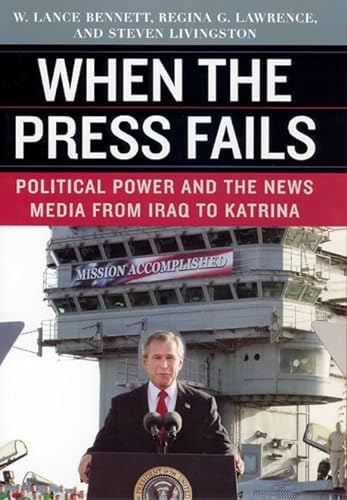
Inhaltsangabe
A sobering look at the intimate relationship between political power and the news media, When the Press Fails argues the dependence of reporters on official sources disastrously thwarts coverage of dissenting voices from outside the Beltway.
The result is both an indictment of official spin and an urgent call to action that questions why the mainstream press failed to challenge the Bush administration’s arguments for an invasion of Iraq or to illuminate administration policies underlying the Abu Ghraib controversy. Drawing on revealing interviews with Washington insiders and analysis of content from major news outlets, the authors illustrate the media’s unilateral surrender to White House spin whenever oppositional voices elsewhere in government fall silent. Contrasting these grave failures with the refreshingly critical reporting on Hurricane Katrina—a rare event that caught officials off guard, enabling journalists to enter a no-spin zone—When the Press Fails concludes by proposing new practices to reduce reporters’ dependence on power.
“The hand-in-glove relationship of the U.S. media with the White House is mercilessly exposed in this determined and disheartening study that repeatedly reveals how the press has toed the official line at those moments when its independence was most needed.”—George Pendle, Financial Times
“Bennett, Lawrence, and Livingston are indisputably right about the news media’s dereliction in covering the administration’s campaign to take the nation to war against Iraq.”—Don Wycliff, Chicago Tribune
“The hand-in-glove relationship of the U.S. media with the White House is mercilessly exposed in this determined and disheartening study that repeatedly reveals how the press has toed the official line at those moments when its independence was most needed.”—George Pendle, Financial Times
“Bennett, Lawrence, and Livingston are indisputably right about the news media’s dereliction in covering the administration’s campaign to take the nation to war against Iraq.”—Don Wycliff, Chicago Tribune
“[This] analysis of the weaknesses of Washington journalism deserves close attention.”—Russell Baker, New York Review of Books
Die Inhaltsangabe kann sich auf eine andere Ausgabe dieses Titels beziehen.
Über die Autorin bzw. den Autor
W. Lance Bennett is professor of political science and the Ruddick C. Lawrence Professor of Communication at the University of Washington. Regina G. Lawrence is the Kevin P. Reilly Sr. Chair of Political Communication in the Manship School of Mass Communication at Louisiana State University. Steven Livingston is professor of media and international affairs in the School of Media and Public Affairs and the Elliott School of International Affairs at George Washington University.
Auszug. © Genehmigter Nachdruck. Alle Rechte vorbehalten.
When the Press Fails
Political Power and the News Media from Iraq to KatrinaBy W. Lance Bennett Regina G. Lawrence Steven LivingstonUniversity of Chicago Press
Copyright © 2007 The University of ChicagoAll right reserved.
ISBN: 978-0-226-04284-8
Chapter One
Press Politics in America The Case of the Iraq War
We now know that officials in the Bush administration built a case for the U.S. invasion of Iraq that was open to serious challenge. We also know that evidence disputing ongoing official claims about the war was often available to the mainstream press in a timely fashion. Yet the recurrent pattern, even years into the conflict, was for the official government line to trump evidence to the contrary in the news produced by mainstream news outlets reaching the preponderance of the people. Several years into the conflict, public opinion finally began to reflect the reality of a disintegrating Iraq heading toward civil war, with American troops caught in the middle. But that reckoning came several years too late to head off a disaster that historians may well deem far worse than Vietnam.
There is little doubt that reporting which challenges the public pronouncements of those in power is difficult when anything deviating from authorized versions of reality is met with intimidating charges of bias. Out of fairness, the press generally reports those charges, which in turn reverberate through the echo chambers of talk radio and pundit TV, with the ironic result that the media contribute to their own credibility problem. Yet it is precisely the lack of clear standards of press accountability (particularly guidelines for holding officials accountable) that opens the mainstream news to charges of bias from all sides. In short, the absence of much agreement on what the press should be doing makes it all the more difficult for news organizations to navigate an independent course through pressurized political situations.
The key question is, can the American press as it is currently constituted offer critical, independent reporting when democracy needs it most? In particular, this book examines whether the press capable of offering viewpoints independent of government spin at two key moments when democracy would most benefit: (1) when government's own public-inquiry mechanisms fail to question potentially flawed or contentious policy initiatives, and (2) when credible sources outside government who might illuminate those policies are available to mainstream news organizations. It may seem obvious that the press should contest dubious policies under these circumstances, but our research indicates otherwise. The great irony of the U.S. press system is that it generally performs well-presenting competing views and vigorous debate-when government is already weighing competing initiatives in its various legal, legislative, or executive settings. Unfortunately, quite a different press often shows up when policy decisions of dubious wisdom go unchallenged within government arenas.
The Iraq Story as Told by the Unwritten Rules of Washington Journalism
Our story begins with the post-9/11 publicity given to the Bush administration's claims that Iraqi dictator Saddam Hussein possessed weapons of mass destruction (the now infamous WMDs), and had connections to the terrorists who attacked the United States. Leading news organizations so emphasized those claims over available information to the contrary that two prestigious newspapers later issued apologies to their readers for having gotten so caught up in the inner workings of power in an administration determined to go to war that they lost focus on other voices and other views. Here are excerpts from a now legendary New York Times report from the editors to their readers:
We have found a number of instances of coverage that was not as rigorous as it should have been. In some cases, information that was controversial then, and seems questionable now, was insufficiently qualified or allowed to stand unchallenged. Looking back, we wish we had been more aggressive in re-examining the claims as new evidence emerged-or failed to emerge.
The problematic articles varied in authorship and subject matter, but many shared a common feature. They depended at least in part on information from a circle of Iraqi informants, defectors and exiles bent on "regime change" in Iraq, people whose credibility has come under increasing public debate in recent weeks.... Complicating matters for journalists, the accounts of these exiles were often eagerly confirmed by United States officials convinced of the need to intervene in Iraq....
Some critics of our coverage during that time have focused blame on individual reporters. Our examination, however, indicates that the problem was more complicated. Editors at several levels who should have been challenging reporters and pressing for more skepticism were perhaps too intent on rushing scoops into the paper.... Articles based on dire claims about Iraq tended to get prominent display, while follow-up articles that called the original ones into question were sometimes buried. In some cases, there was no follow-up at all.
Despite this introspection, much the same pattern of deferring to officials and underreporting available challenges to their claims would soon repeat itself-beginning the very month in which this critical self-assessment appeared-in reporting on the treatment of prisoners in U.S. military detention centers in Iraq and elsewhere. The importance of the Abu Ghraib story for understanding the close dependence of the press on government spin is developed more fully in chapter 3. For now, the point is that this pattern of calibrating political reality in the news to the inner circles of Washington power will go on, despite occasional moments of self-examination by the press, unless leading news organizations and the journalism profession somehow resolve (and develop a standard) to temper their preoccupation with the powerful officials whose communication experts often manage them so well.
Part of the reason the Iraq story was written much as the Bush administration told it is that nearly every installment was well staged and fed expertly to reporters. It also helped that during the events leading up to the war and much of its aftermath, the stories spun by the Bush team were pretty much the only sustained official versions in town-thanks in part to the particularly hard-hitting style of news management practiced by the administration (discussed in chapter 5). As indicated below, plenty of other sources and bodies of evidence outside official Washington power circles could have been elevated to challenge the administration's stories, but those challenges either did not emerge aggressively or were reported only in passing-again, because of the administration's tactics and the unwritten rules followed by the mainstream press for selecting, emphasizing, and sustaining stories. And so, from the WMD story that sold the war to the "mission accomplished" Hollywood ending (which, of course, did not mark the "end" of the war), the unwritten rule of favoring prepackaged, officially sanctioned news events reveals why the ideal of a watchdog press is in trouble.
Mission Accomplished
Consider for a moment that day in May of 2003, when President Bush, wearing a Top Gun flight suit, gave his "Mission Accomplished" speech on an aircraft carrier staged as a big-screen movie set. Nearly every major U. S. news...
„Über diesen Titel“ kann sich auf eine andere Ausgabe dieses Titels beziehen.
Weitere beliebte Ausgaben desselben Titels

Suchergebnisse für When the Press Fails: Political Power and the News...

Beispielbild für diese ISBN
When the Press Fails: Political Power and the News Media from Iraq to Katrina (Studies in Communication, Media, and Public Opinion)
Verlag:
University of Chicago Press, 2007
ISBN 10: 0226042847
ISBN 13: 9780226042848
Gebraucht
Hardcover
Anbieter: World of Books (was SecondSale), Montgomery, IL, USA
Verkäuferbewertung 5 von 5 Sternen

Zustand: Good. Item in good condition. Textbooks may not include supplemental items i.e. CDs, access codes etc. Artikel-Nr. 00095392477
Gebraucht kaufen
EUR 5,93
Versand gratis
Versand innerhalb von USA
Versand innerhalb von USA
Anzahl: 2 verfügbar
Beispielbild für diese ISBN
When the Press Fails : Political Power and the News Media from Iraq to Katrina
Verlag:
University of Chicago Press, 2007
ISBN 10: 0226042847
ISBN 13: 9780226042848
Gebraucht
Hardcover
Anbieter: Better World Books, Mishawaka, IN, USA
Verkäuferbewertung 5 von 5 Sternen
Zustand: Good. Former library copy. Pages intact with minimal writing/highlighting. The binding may be loose and creased. Dust jackets/supplements are not included. Includes library markings. Stock photo provided. Product includes identifying sticker. Better World Books: Buy Books. Do Good. Artikel-Nr. GRP38225954
Gebraucht kaufen
EUR 6,26
Versand gratis
Versand innerhalb von USA
Versand innerhalb von USA
Anzahl: 1 verfügbar
Beispielbild für diese ISBN
When the Press Fails: Political Power and the News Media from Iraq to Katrina (Studies in Communication, Media, and Public Opinion)
Verlag:
University of Chicago Press, 2007
ISBN 10: 0226042847
ISBN 13: 9780226042848
Gebraucht
Hardcover
Anbieter: Wonder Book, Frederick, MD, USA
Verkäuferbewertung 5 von 5 Sternen
Zustand: Very Good. Very Good condition. Very Good dust jacket. A copy that may have a few cosmetic defects. May also contain light spine creasing or a few markings such as an owner's name, short gifter's inscription or light stamp. Bundled media such as CDs, DVDs, floppy disks or access codes may not be included. Artikel-Nr. T12H-03042
Gebraucht kaufen
EUR 6,33
Versand gratis
Versand innerhalb von USA
Versand innerhalb von USA
Anzahl: 1 verfügbar
Beispielbild für diese ISBN
When the Press Fails: Political Power and the News Media from Iraq to Katrina (Studies in Communication, Media, and Public Opinion)
Verlag:
University of Chicago Press, 2007
ISBN 10: 0226042847
ISBN 13: 9780226042848
Gebraucht
Hardcover
Anbieter: Wonder Book, Frederick, MD, USA
Verkäuferbewertung 5 von 5 Sternen
Zustand: Very Good. Very Good condition. Like New dust jacket. A copy that may have a few cosmetic defects. May also contain light spine creasing or a few markings such as an owner's name, short gifter's inscription or light stamp. Artikel-Nr. N06C-04420
Gebraucht kaufen
EUR 6,33
Versand gratis
Versand innerhalb von USA
Versand innerhalb von USA
Anzahl: 1 verfügbar
Beispielbild für diese ISBN
When the Press Fails - Political Power and the News Media from Iraq to Katrina (Studies in Communication, Media, and Public Opinion (CHUP))
Anbieter: AwesomeBooks, Wallingford, Vereinigtes Königreich
Verkäuferbewertung 5 von 5 Sternen
Hardcover. Zustand: Very Good. When the Press Fails - Political Power and the News Media from Iraq to Katrina (Studies in Communication, Media, and Public Opinion (CHUP)) This book is in very good condition and will be shipped within 24 hours of ordering. The cover may have some limited signs of wear but the pages are clean, intact and the spine remains undamaged. This book has clearly been well maintained and looked after thus far. Money back guarantee if you are not satisfied. See all our books here, order more than 1 book and get discounted shipping. Artikel-Nr. 7719-9780226042848
Gebraucht kaufen
EUR 4,80
EUR 4,83 Versand
Versand von Vereinigtes Königreich nach USA
Versand von Vereinigtes Königreich nach USA
Anzahl: 2 verfügbar
Beispielbild für diese ISBN
When the Press Fails : Political Power and the News Media from Iraq to Katrina
Verlag:
University of Chicago Press, 2007
ISBN 10: 0226042847
ISBN 13: 9780226042848
Gebraucht
Hardcover
Anbieter: Better World Books Ltd, Dunfermline, Vereinigtes Königreich
Verkäuferbewertung 5 von 5 Sternen
Zustand: Very Good. Former library copy. Pages intact with possible writing/highlighting. Binding strong with minor wear. Dust jackets/supplements may not be included. Includes library markings. Stock photo provided. Product includes identifying sticker. Better World Books: Buy Books. Do Good. Artikel-Nr. 8601668-6
Gebraucht kaufen
EUR 5,65
EUR 5,86 Versand
Versand von Vereinigtes Königreich nach USA
Versand von Vereinigtes Königreich nach USA
Anzahl: 1 verfügbar
Beispielbild für diese ISBN
When the Press Fails - Political Power and the News Media from Iraq to Katrina (Studies in Communication, Media, and Public Opinion (CHUP))
Anbieter: Bahamut Media, Reading, Vereinigtes Königreich
Verkäuferbewertung 5 von 5 Sternen
Hardcover. Zustand: Very Good. This book is in very good condition and will be shipped within 24 hours of ordering. The cover may have some limited signs of wear but the pages are clean, intact and the spine remains undamaged. This book has clearly been well maintained and looked after thus far. Money back guarantee if you are not satisfied. See all our books here, order more than 1 book and get discounted shipping. Artikel-Nr. 6545-9780226042848
Gebraucht kaufen
EUR 5,19
EUR 8,17 Versand
Versand von Vereinigtes Königreich nach USA
Versand von Vereinigtes Königreich nach USA
Anzahl: 2 verfügbar
Beispielbild für diese ISBN
When the Press Fails: Political Power and the News Media from Iraq to Katrina (Studies in Communication, Media, and Public Opinion)
Verlag:
University Of Chicago Press, 2007
ISBN 10: 0226042847
ISBN 13: 9780226042848
Gebraucht
Hardcover
Anbieter: Anybook.com, Lincoln, Vereinigtes Königreich
Verkäuferbewertung 5 von 5 Sternen
Zustand: Good. This is an ex-library book and may have the usual library/used-book markings inside.This book has hardback covers. In good all round condition. Dust jacket in fair condition. Please note the Image in this listing is a stock photo and may not match the covers of the actual item,600grams, ISBN:9780226042848. Artikel-Nr. 9796922
Gebraucht kaufen
EUR 3,86
EUR 15,93 Versand
Versand von Vereinigtes Königreich nach USA
Versand von Vereinigtes Königreich nach USA
Anzahl: 1 verfügbar
Beispielbild für diese ISBN
When the Press Fails Political Power and the News Media from Iraq to Katrina
Verlag:
The University of Chicago Press, 2007
ISBN 10: 0226042847
ISBN 13: 9780226042848
Neu
Hardcover
Anbieter: PBShop.store US, Wood Dale, IL, USA
Verkäuferbewertung 5 von 5 Sternen
HRD. Zustand: New. New Book. Shipped from UK. Established seller since 2000. Artikel-Nr. FW-9780226042848
Beispielbild für diese ISBN
When the Press Fails Political Power and the News Media from Iraq to Katrina
Verlag:
The University of Chicago Press, 2007
ISBN 10: 0226042847
ISBN 13: 9780226042848
Neu
Hardcover
Anbieter: PBShop.store UK, Fairford, GLOS, Vereinigtes Königreich
Verkäuferbewertung 5 von 5 Sternen
HRD. Zustand: New. New Book. Shipped from UK. Established seller since 2000. Artikel-Nr. FW-9780226042848
Neu kaufen
EUR 31,27
EUR 5,88 Versand
Versand von Vereinigtes Königreich nach USA
Versand von Vereinigtes Königreich nach USA
Anzahl: 4 verfügbar