
Verwandte Artikel zu CENTERED MIND P: What the Science of Working Memory...
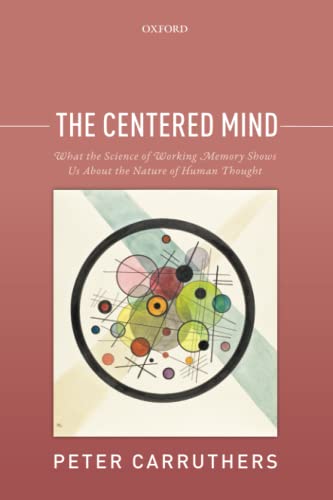
CENTERED MIND P: What the Science of Working Memory Shows Us About the Nature of Human Thought - Softcover
Inhaltsangabe
The Centered Mind offers a new view of the nature and causal determinants of both reflective thinking and, more generally, the stream of consciousness. Peter Carruthers argues that conscious thought is always sensory-based, relying on the resources of the working-memory system. This system has been much studied by cognitive scientists. It enables sensory images to be sustained and manipulated through attentional signals directed at midlevel sensory areas of the brain. When abstract conceptual representations are bound into these images, we consciously experience ourselves as making judgments or arriving at decisions. Thus one might hear oneself as judging, in inner speech, that it is time to go home, for example. However, our amodal (non-sensory) propositional attitudes are never actually among the contents of this stream of conscious reflection. Our beliefs, goals, and decisions are only ever active in the background of consciousness, working behind the scenes to select the sensory-based imagery that occurs in working memory. They are never themselves conscious.
Drawing on extensive knowledge of the scientific literature on working memory and related topics, Carruthers builds an argument that challenges the central assumptions of many philosophers. In addition to arguing that non-sensory propositional attitudes are never conscious, he also shows that they are never under direct intentional control. Written with his usual clarity and directness, The Centered Mind will be essential reading for all philosophers and cognitive scientists interested in the nature of human thought processes.
Die Inhaltsangabe kann sich auf eine andere Ausgabe dieses Titels beziehen.
Über die Autorin bzw. den Autor
Peter Carruthers, University of Maryland
Peter Carruthers is Professor of Philosophy at the University of Maryland. He is the author of numerous articles and books in philosophy of mind and cognitive science, and has co-edited seven volumes of interdisciplinary essays in cognitive science.
„Über diesen Titel“ kann sich auf eine andere Ausgabe dieses Titels beziehen.
Suchergebnisse für CENTERED MIND P: What the Science of Working Memory...

Beispielbild für diese ISBN
The Centered Mind: What the Science of Working Memory Shows Us About the Nature of Human Thought
Anbieter: Revaluation Books, Exeter, Vereinigtes Königreich
Verkäuferbewertung 5 von 5 Sternen

Paperback. Zustand: Brand New. reprint edition. 304 pages. 9.50x6.50x0.75 inches. In Stock. Artikel-Nr. zk0198801327
Neu kaufen
EUR 64,45
EUR 11,67 Versand
Versand von Vereinigtes Königreich nach USA
Versand von Vereinigtes Königreich nach USA
Anzahl: 1 verfügbar