
Verwandte Artikel zu Haydn's Symphonic Forms: Essays in Compositional...
Inhaltsangabe
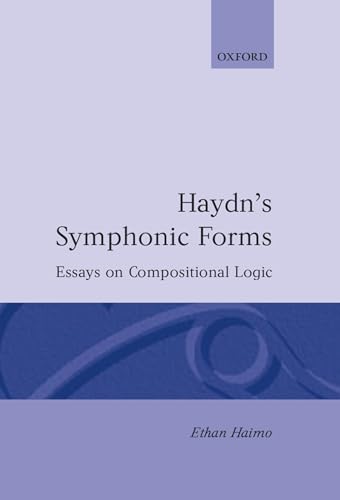
Haydn never discussed his compositional ideas in much detail, either in the interviews he gave to an early biographer or in his surviving correspondence. Moreover, relatively few sketches of his compositions have been preserved. Therefore, attempts to reconstruct Haydn's compositional thought, and in particular his formal logic, must rely on evidence drawn from close analyses of the works themselves. Using his symphonies as its subject, this book attempts to clarify what Haydn's fundamental principles of formal logic might have been. It shows how Haydn employed those basic compositional principles to structure his forms, providing explanations that account for specific details of individual movements as well as the relationships between the movements. Beyond what they show about Haydn's formal thought and the individual works discussed, the analyses in this book also have a larger purpose: to argue in support of the idea that compositions cannot be analysed in a meaningful manner if the analysis is divorced from the work's historical context.
Die Inhaltsangabe kann sich auf eine andere Ausgabe dieses Titels beziehen.
Über die Autorin bzw. den Autor
Ethan Hiamo is Professor of Music at the University of Notre Dame, Indiana, USA.
Von der hinteren Coverseite
Haydn never discussed his ideas about composition in much detail, either in the interviews he gave to an early biographer or in his surviving correspondence. Moreover, relatively few sketches of his compositions have been preserved. Attempts to reconstruct Haydn's compositional thought, and in particular his formal logic, must therefore rely on evidence drawn from close analyses of the works themselves. Using the symphonies as his subject, Ethan Haimo attempts to clarify what Haydn's fundamental principles of formal logic might have been. He shows how Haydn employed those basic compositional principles to structure his forms, and provides explanations that account for specific details of individual movements as well as the relationship between movements. Beyond what they show about the composer's formal thought and the individual works discussed, the analyses in the book also have a larger purpose: to argue in support of the idea that compositions cannot be analysed in a meaningful manner if the analysis is divorced from the work's historical context.
„Über diesen Titel“ kann sich auf eine andere Ausgabe dieses Titels beziehen.
Suchergebnisse für Haydn's Symphonic Forms: Essays in Compositional...

Beispielbild für diese ISBN
Haydn's Symphonic Forms: Essays in Compositional Logic (Oxford Monographs on Music)
Anbieter: Phatpocket Limited, Waltham Abbey, HERTS, Vereinigtes Königreich
Verkäuferbewertung 5 von 5 Sternen

Zustand: Acceptable. Used - Acceptable. Dust cover damaged. Your purchase helps support Sri Lankan Children's Charity 'The Rainbow Centre'. Ex-library with wear and barcode page may have been removed. Our donations to The Rainbow Centre have helped provide an education and a safe haven to hundreds of children who live in appalling conditions. Artikel-Nr. Z1-S-039-03456
Gebraucht kaufen
EUR 99,97
EUR 12,69 Versand
Versand von Vereinigtes Königreich nach USA
Versand von Vereinigtes Königreich nach USA
Anzahl: 1 verfügbar
Beispielbild für diese ISBN
Haydn's Symphonic Forms: Essays in Compositional Logic (Oxford Monographs on Music)
Anbieter: Ria Christie Collections, Uxbridge, Vereinigtes Königreich
Verkäuferbewertung 5 von 5 Sternen
Zustand: New. In English. Artikel-Nr. ria9780198163923_new
Neu kaufen
EUR 294,71
EUR 13,46 Versand
Versand von Vereinigtes Königreich nach USA
Versand von Vereinigtes Königreich nach USA
Anzahl: Mehr als 20 verfügbar
Beispielbild für diese ISBN
Haydn's Symphonic Forms: Essays in Compositional Logic (Oxford Monographs on Music)
Anbieter: Kennys Bookstore, Olney, MD, USA
Verkäuferbewertung 5 von 5 Sternen
Zustand: New. Haydn never discussed his compositional ideas in much detail, either in the interviews he gave or in his surviving correspondence. Using his symphonies as its subject, this book attempts to clarify what Haydn's fundamental principles of formal logic might have been. Series: Oxford Monographs on Music. Num Pages: 310 pages, music examples, tables. BIC Classification: AVA; AVGC4; AVH. Category: (P) Professional & Vocational. Dimension: 242 x 162 x 22. Weight in Grams: 572. . 1995. Illustrated. hardcover. . . . . Books ship from the US and Ireland. Artikel-Nr. V9780198163923
Neu kaufen
EUR 375,83
EUR 9,36 Versand
Versand innerhalb von USA
Versand innerhalb von USA
Anzahl: Mehr als 20 verfügbar