
Verwandte Artikel zu An Introduction to Historical Linguistics
Inhaltsangabe
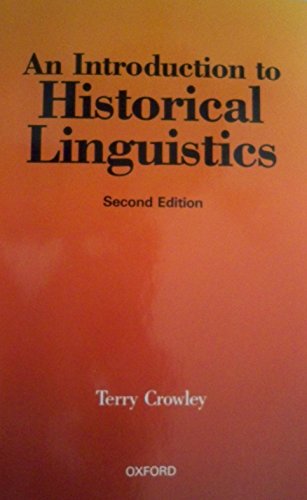
All languages change, just as other aspects of human society are constantly changing. This is an introduction to the concepts and techniques of diachronic linguistics, the study of language change over time. It covers all major areas of historical linguistics, presenting concepts in a concise manner. While examples are given from a wide range of languages, most major concepts and techniques are illustrated by material drawn from the languages of Australia and the Pacific. This edition has been substantially revised and rewritten. Further exercises have been added for student use, and there are new sections on language planning and language contact.
Die Inhaltsangabe kann sich auf eine andere Ausgabe dieses Titels beziehen.
Weitere beliebte Ausgaben desselben Titels

Suchergebnisse für An Introduction to Historical Linguistics

Beispielbild für diese ISBN
An Introduction to Historical
Verlag:
Oxford University Press, 1993
ISBN 10: 0195582470
ISBN 13: 9780195582475
Gebraucht
Softcover
Anbieter: World of Books (was SecondSale), Montgomery, IL, USA
Verkäuferbewertung 5 von 5 Sternen

Zustand: Good. Good condition ex-library book with usual library markings and stickers. Artikel-Nr. 00108269916
Gebraucht kaufen
EUR 10,71
Versand gratis
Versand innerhalb von USA
Versand innerhalb von USA
Anzahl: 1 verfügbar
Beispielbild für diese ISBN
An Introduction to Historical Linguistics
Verlag:
Oxford University Press, Incorporated, 1993
ISBN 10: 0195582470
ISBN 13: 9780195582475
Gebraucht
Softcover
Anbieter: Better World Books Ltd, Dunfermline, Vereinigtes Königreich
Verkäuferbewertung 5 von 5 Sternen
Zustand: Very Good. 2nd Edition. Former library copy. Pages intact with possible writing/highlighting. Binding strong with minor wear. Dust jackets/supplements may not be included. Includes library markings. Stock photo provided. Product includes identifying sticker. Better World Books: Buy Books. Do Good. Artikel-Nr. 54938867-20
Gebraucht kaufen
EUR 7,04
EUR 5,85 Versand
Versand von Vereinigtes Königreich nach USA
Versand von Vereinigtes Königreich nach USA
Anzahl: 1 verfügbar
Beispielbild für diese ISBN
An Introduction to Historical Linguistics
Verlag:
Oxford University Press, 1993
ISBN 10: 0195582470
ISBN 13: 9780195582475
Gebraucht
Paperback
Anbieter: ThriftBooks-Dallas, Dallas, TX, USA
Verkäuferbewertung 5 von 5 Sternen
Paperback. Zustand: Very Good. No Jacket. May have limited writing in cover pages. Pages are unmarked. ~ ThriftBooks: Read More, Spend Less. Artikel-Nr. G0195582470I4N00
Gebraucht kaufen
EUR 14,26
Versand gratis
Versand innerhalb von USA
Versand innerhalb von USA
Anzahl: 1 verfügbar
Beispielbild für diese ISBN
An Introduction to Historical Linguistics
Verlag:
Oxford University Press, Incorporated, 1993
ISBN 10: 0195582470
ISBN 13: 9780195582475
Gebraucht
Softcover
Anbieter: Better World Books, Mishawaka, IN, USA
Verkäuferbewertung 5 von 5 Sternen
Zustand: Good. 2nd Edition. Pages intact with minimal writing/highlighting. The binding may be loose and creased. Dust jackets/supplements are not included. Stock photo provided. Product includes identifying sticker. Better World Books: Buy Books. Do Good. Artikel-Nr. 3144334-75
Gebraucht kaufen
EUR 14,35
Versand gratis
Versand innerhalb von USA
Versand innerhalb von USA
Anzahl: 1 verfügbar
Beispielbild für diese ISBN
An Introduction to Historical Linguistics
Verlag:
Oxford University Press, 1994
ISBN 10: 0195582470
ISBN 13: 9780195582475
Gebraucht
Softcover
Anbieter: Anybook.com, Lincoln, Vereinigtes Königreich
Verkäuferbewertung 5 von 5 Sternen
Zustand: Fair. This is an ex-library book and may have the usual library/used-book markings inside.This book has soft covers. Clean from markings. In fair condition, suitable as a study copy. Please note the Image in this listing is a stock photo and may not match the covers of the actual item,700grams, ISBN:9780195582475. Artikel-Nr. 9194070
Gebraucht kaufen
EUR 7,12
EUR 15,92 Versand
Versand von Vereinigtes Königreich nach USA
Versand von Vereinigtes Königreich nach USA
Anzahl: 1 verfügbar
Beispielbild für diese ISBN
An Introduction to Historical Linguistics
Verlag:
Oxford University Press, 1993
ISBN 10: 0195582470
ISBN 13: 9780195582475
Gebraucht
Paperback
Anbieter: Prior Books Ltd, Cheltenham, Vereinigtes Königreich
Verkäuferbewertung 5 von 5 Sternen
Paperback. Zustand: Very Good. 2nd Edition. A very good copy, square and tight with no creases or splits. Contents fresh and clean, not showing any pen-marks. Not from a library so no such stamps or labels. Thus a tidy book in very presentable condition. Artikel-Nr. 064318
Gebraucht kaufen
EUR 4,82
EUR 25,75 Versand
Versand von Vereinigtes Königreich nach USA
Versand von Vereinigtes Königreich nach USA
Anzahl: 1 verfügbar
Beispielbild für diese ISBN
An Introduction to Historical Linguistics
Verlag:
OUP Australia and New Zealand, 1993
ISBN 10: 0195582470
ISBN 13: 9780195582475
Gebraucht
Taschenbuch
Anbieter: Antiquariat Armebooks, Frankfurt am Main, Deutschland
Verkäuferbewertung 5 von 5 Sternen
Taschenbuch. Zustand: Gut. 331 Seiten Oxford - 2nd. 1994 : Terry Crowley - tb - 9-81-2-L3 IX-FBYL-82JI Sprache: Englisch Gewicht in Gramm: 590. Artikel-Nr. 234812
Gebraucht kaufen
EUR 12,95
EUR 20,00 Versand
Versand von Deutschland nach USA
Versand von Deutschland nach USA
Anzahl: 1 verfügbar
Beispielbild für diese ISBN
An Introduction to Historical Linguistics
Verlag:
OUP Australia and New Zealand, 1993
ISBN 10: 0195582470
ISBN 13: 9780195582475
Gebraucht
Paperback
Anbieter: Fireside Bookshop, Stroud, GLOS, Vereinigtes Königreich
Verkäuferbewertung 5 von 5 Sternen
Paperback. Zustand: Very Good. Second Edition. Type: Book Small plain label inside cover. 199. Artikel-Nr. 054391
Gebraucht kaufen
EUR 11,46
EUR 29,26 Versand
Versand von Vereinigtes Königreich nach USA
Versand von Vereinigtes Königreich nach USA
Anzahl: 1 verfügbar
Foto des Verkäufers
An Introduction to Historical Linguistics
Verlag:
OUP Australia and New Zealand, 1992
ISBN 10: 0195582470
ISBN 13: 9780195582475
Gebraucht
Softcover
Anbieter: Book Broker, Berlin, Deutschland
Verkäuferbewertung 5 von 5 Sternen
Zustand: Gut. 2. 331 S. Alle Bücher & Medienartikel von Book Broker sind stets in gutem & sehr gutem gebrauchsfähigen Zustand. Die Ausgabe des gelieferten Exemplars kann um bis zu 10 Jahre vom angegebenen Veröffentlichungsjahr abweichen und es kann sich um eine abweichende Auflage handeln. Unser Produktfoto entspricht dem hier angebotenen Artikel, dieser weist folgende Merkmale auf: Helle/saubere Seiten in fester Bindung. Mit Namenseintrag. Leichte Gebrauchsspuren. Sprache: Englisch Gewicht in Gramm: 614 Taschenbuch, Maße: 15.24 cm x 2.11 cm x 23.19 cm. Artikel-Nr. 661487092
Gebraucht kaufen
EUR 16,74
EUR 35,62 Versand
Versand von Deutschland nach USA
Versand von Deutschland nach USA
Anzahl: 1 verfügbar
Foto des Verkäufers
An Introduction to Historical Linguistics.
Verlag:
Oxford University Press, 1993
ISBN 10: 0195582470
ISBN 13: 9780195582475
Gebraucht
Softcover
Anbieter: Scrinium Classical Antiquity, Aalten, Niederlande
Verkäuferbewertung 5 von 5 Sternen
Oxford University Press, Oakland (.), 1994. (Reprint 1st ed.). 331p. Paperback. Nice copy. Appears unread. ?The field of linguistics began as historical linguistics, and historical linguistics began as Indo-European linguistics. Although a complete conceptual separation of the first two was achieved by the beginning of this century through the work of Saussure, in some quarters the second two have yet to be completely disentangled. It is a great merit of Crowley?s book that he relies primarily on examples drawn from non-Indo-European languages to elucidate the principles of historical linguistics, thereby reminding us of the independence of these principles from the particular facts that led to their formulation. The refreshing and novel character of this text (?) is to some extent a product of practical circumstances: in teaching historical linguistics to Pacific Island students at the University of Papua New Guinea, Crowley discovered that virtually all of the available textbooks are implicitly written for native speakers of English, and draw almost exclusively on Indo-European examples to illustrate points of method and theory. By keeping the nonnative English-speaker in mind, Crowley has succeeded in laying out the main outlines of historical linguistics in an exceptionally lucid and engaging style. (?) [The book - ND] begins with background material that includes an advisory on how to use the book (13-14), a chart of phonetic symbols drawn from the International Phonetic Alphabet (15), and maps of Australia, New Guinea, and a portion of Melanesia (16-19), those areas in which many of the languages referred to in the text are spoken. (?) The remainder (?) consists of thirteen chapters, each followed by a set of ?reading guide questions?, a set of exercises, and recommendations for further reading. The book concludes with (1) eleven data sets (sets of reconstructed forms and their reflexes in one or more daughter languages (?); (2) a language index with 101 language names (?) ; (3) a list of references; and (4) an index of slightly over three pages. Chapter 1, Introduction, provides an exceptionally clear sketch of why systematic similarities exist between some languages, as well as a useful discussion of the social valuation of linguistic variation and of language planning. (?) Chapter 2, Types of sound change, has two broad purposes: to familiarize the beginning student with common types of sound change, and to reduce the exuberant diversity of attested sound changes to an orderly classification into basic types. On the whole, this is a well-constructed chapter that presents more detail in a clearer form than many older texts. (?) Chapter 3, Expressing sound changes, introduces some common formalisms for stating sound changes, particularly conditioned sound changes. It is a short, but useful chapter, (?). Chapter 4, Phonetic vs. phonemic change, is an excellent introduction to the classification of types of sound change, distinctly superior to the discussions in most other texts. (?) Chapter 5, The comparative method, provides a solid, hands-on introduction to linguistic reconstruction through a comparison of four Polynesian languages. (?) In summary, [this is - ND] an excellent book in need of further revision.? (ROBERT BLUST in Oceanic Linguistics, 1996, pp.328-335). From the library of the late Prof. Dr. Ludo De Lannoy. Artikel-Nr. 64104
Gebraucht kaufen
EUR 28,00
EUR 27,50 Versand
Versand von Niederlande nach USA
Versand von Niederlande nach USA
Anzahl: 1 verfügbar