
Verwandte Artikel zu The Interactional Instinct: The Evolution and Acquisition...
Inhaltsangabe
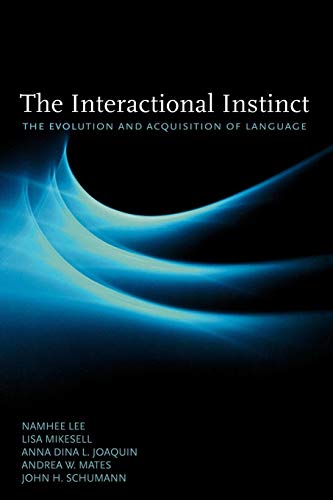
Offers a radical view of language structure, based on evolutionary theory and complex adaptive systems theory
Die Inhaltsangabe kann sich auf eine andere Ausgabe dieses Titels beziehen.
Über die Autorin bzw. den Autor
Namhee Lee: Visiting Lecturer, Assistant Professor, Defense Language Institute
Anna Dina L. Joaquin: doctoral student, Applied Linguistics, UCLA
Lisa Mikesell : doctoral student, Applied Linguistics, UCLA
Andrea W. Mates : doctoral student, Applied Linguistics, UCLA
John H. Schumann: Professor of Applied Linguistics, UCLA
„Über diesen Titel“ kann sich auf eine andere Ausgabe dieses Titels beziehen.
Suchergebnisse für The Interactional Instinct: The Evolution and Acquisition...

Beispielbild für diese ISBN
The Interactional Instinct. The Evolution and Acquisition of Language.
Anbieter: Kennys Bookshop and Art Galleries Ltd., Galway, GY, Irland
Verkäuferbewertung 5 von 5 Sternen

Zustand: New. The Interactional Instinct presents a theory of language based on linguistic, evolutionary, and biological evidence indicating that language is a culturally inherited artifact that requires no a priori hard wiring of linguistic knowledge. Its structure evolved phylo- genetically from interaction among speakers and is acquired through emotionally entrained interaction with conspecifics. Num Pages: 248 pages, 11 black and white half tone, 7 line illustrations. BIC Classification: CF; JMR. Category: (U) Tertiary Education (US: College). Dimension: 232 x 157 x 15. Weight in Grams: 362. . 2009. Paperback. . . . . Artikel-Nr. V9780195384239
Neu kaufen
EUR 45,30
EUR 9,50 Versand
Versand von Irland nach USA
Versand von Irland nach USA
Anzahl: Mehr als 20 verfügbar
Foto des Verkäufers
The Interactional Instinct
Verlag:
Oxford University Press Inc, US, 2009
ISBN 10: 0195384237
ISBN 13: 9780195384239
Neu
Paperback
Anbieter: Rarewaves.com USA, London, LONDO, Vereinigtes Königreich
Verkäuferbewertung 5 von 5 Sternen
Paperback. Zustand: New. Illustrated. The Interactional Instinct explores the evolution of language from the theoretical view that language could have emerged without a biologically instantiated Universal Grammar. In the first part of the book, the authors speculate that a hominid group with a lexicon of about 600 words could combine these items to make larger meanings. Combinations that are successfully produced, comprehended, and learned become part of the language. Any combination that is incompatible with human mental capacities is abandoned. The authors argue for the emergence of language structure through interaction constrained by human psychology and physiology. In the second part of the book, the authors argue that language acquisition is based on an "interactional instinct" that emotionally entrains the infant on caregivers. This relationship provides children with a motivational and attentional mechanism that ensures their acquisition of language. In adult second language acquisition, the interactional instinct is no longer operating, but in some individuals with sufficient aptitude and motivation, successful second-language acquisition can be achieved. The Interactional Instinct presents a theory of language based on linguistic, evolutionary, and biological evidence indicating that language is a culturally inherited artifact that requires no a priori hard wiring of linguistic knowledge. Artikel-Nr. LU-9780195384239
Neu kaufen
EUR 54,93
Versand gratis
Versand von Vereinigtes Königreich nach USA
Versand von Vereinigtes Königreich nach USA
Anzahl: Mehr als 20 verfügbar
Foto des Verkäufers
Interactional Instinct : The Evolution and Acquisition of Language
Anbieter: GreatBookPricesUK, Woodford Green, Vereinigtes Königreich
Verkäuferbewertung 5 von 5 Sternen
Zustand: New. Artikel-Nr. 6229357-n
Neu kaufen
EUR 46,65
EUR 17,98 Versand
Versand von Vereinigtes Königreich nach USA
Versand von Vereinigtes Königreich nach USA
Anzahl: Mehr als 20 verfügbar
Beispielbild für diese ISBN
The Interactional Instinct: The Evolution and Acquisition of Language
Anbieter: Ria Christie Collections, Uxbridge, Vereinigtes Königreich
Verkäuferbewertung 5 von 5 Sternen
Zustand: New. In English. Artikel-Nr. ria9780195384239_new
Neu kaufen
EUR 55,16
EUR 11,83 Versand
Versand von Vereinigtes Königreich nach USA
Versand von Vereinigtes Königreich nach USA
Anzahl: Mehr als 20 verfügbar
Beispielbild für diese ISBN
The Interactional Instinct. The Evolution and Acquisition of Language.
Anbieter: Kennys Bookstore, Olney, MD, USA
Verkäuferbewertung 5 von 5 Sternen
Zustand: New. The Interactional Instinct presents a theory of language based on linguistic, evolutionary, and biological evidence indicating that language is a culturally inherited artifact that requires no a priori hard wiring of linguistic knowledge. Its structure evolved phylo- genetically from interaction among speakers and is acquired through emotionally entrained interaction with conspecifics. Num Pages: 248 pages, 11 black and white half tone, 7 line illustrations. BIC Classification: CF; JMR. Category: (U) Tertiary Education (US: College). Dimension: 232 x 157 x 15. Weight in Grams: 362. . 2009. Paperback. . . . . Books ship from the US and Ireland. Artikel-Nr. V9780195384239
Neu kaufen
EUR 58,25
EUR 9,55 Versand
Versand innerhalb von USA
Versand innerhalb von USA
Anzahl: Mehr als 20 verfügbar
Foto des Verkäufers
Interactional Instinct : The Evolution and Acquisition of Language
Verlag:
Oxford University Press, 2009
ISBN 10: 0195384237
ISBN 13: 9780195384239
Gebraucht
Softcover
Anbieter: GreatBookPricesUK, Woodford Green, Vereinigtes Königreich
Verkäuferbewertung 5 von 5 Sternen
Zustand: As New. Unread book in perfect condition. Artikel-Nr. 6229357
Gebraucht kaufen
EUR 54,95
EUR 17,98 Versand
Versand von Vereinigtes Königreich nach USA
Versand von Vereinigtes Königreich nach USA
Anzahl: Mehr als 20 verfügbar
Foto des Verkäufers
The Interactional Instinct
Verlag:
Oxford University Press Inc, US, 2009
ISBN 10: 0195384237
ISBN 13: 9780195384239
Neu
Paperback
Anbieter: Rarewaves.com UK, London, Vereinigtes Königreich
Verkäuferbewertung 5 von 5 Sternen
Paperback. Zustand: New. Illustrated. The Interactional Instinct explores the evolution of language from the theoretical view that language could have emerged without a biologically instantiated Universal Grammar. In the first part of the book, the authors speculate that a hominid group with a lexicon of about 600 words could combine these items to make larger meanings. Combinations that are successfully produced, comprehended, and learned become part of the language. Any combination that is incompatible with human mental capacities is abandoned. The authors argue for the emergence of language structure through interaction constrained by human psychology and physiology. In the second part of the book, the authors argue that language acquisition is based on an "interactional instinct" that emotionally entrains the infant on caregivers. This relationship provides children with a motivational and attentional mechanism that ensures their acquisition of language. In adult second language acquisition, the interactional instinct is no longer operating, but in some individuals with sufficient aptitude and motivation, successful second-language acquisition can be achieved. The Interactional Instinct presents a theory of language based on linguistic, evolutionary, and biological evidence indicating that language is a culturally inherited artifact that requires no a priori hard wiring of linguistic knowledge. Artikel-Nr. LU-9780195384239
Neu kaufen
EUR 51,65
EUR 77,92 Versand
Versand von Vereinigtes Königreich nach USA
Versand von Vereinigtes Königreich nach USA
Anzahl: Mehr als 20 verfügbar