
Verwandte Artikel zu Managing Quality Fads: How America Learned to Play...
Inhaltsangabe
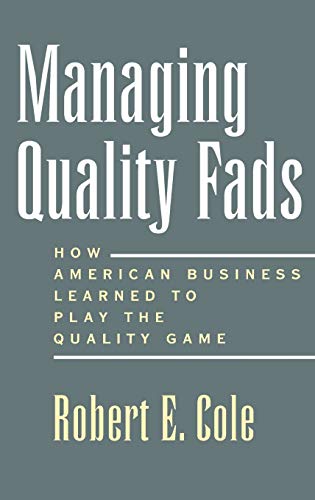
Can managers learn from fads? That is the question Robert Cole addresses in this insightful book about the various factors supporting and inhibiting organizational learning. A longtime student of the Japanese and American quality movements, Cole focuses on the response of American industry to the challenge posed in the early 1980s by high quality goods from Japan. While most American managers view this challenge as slowly but successfully met, many academics see the quality movement that emerged from it as just another fad. In seeking to reconcile these two views, Cole explores the reasons behind American industry's slow response to Japanese quality, arguing that a variety of institutional factors inhibited management action in the early 1980s. He then describes the reshaping of institutions that allowed American companies to close the quality gap and to achieve sustained quality improvements in the 1990s. Hewlett-Packard serves as an example of a company that made this institutional transition more effectively than most. Cole describes Hewlett-Packard's successful strategies while also pointing out the serious problems that it and other companies face as they attempt to adapt, improve, and go beyond Japanese practices. He also uses Hewlett-Packard, an exemplar of the highly decentralized company, to explore effective strategies for the creation, dissemination, and implementation of knowledge. Unprecedented as a scholarly treatment of the quality movement,^IManaging Quality Fads^R provides several important lessons for those interested in management decision making under conditions of uncertainty and organizational transformation in a rapidly changing business environment.
Die Inhaltsangabe kann sich auf eine andere Ausgabe dieses Titels beziehen.
Über die Autorin bzw. den Autor
An author who has been writing about Japanese and American quality movements for over twenty years, Robert E. Cole began studying Japanese practices in the mid-1970s and then looked at how these practices were--or were not--adopted by U.S. firms in the 1980s. As a consultant to Fortune 500 companies he has witnessed first-hand the progress of corporate efforts to respond to the Japanese challenge. In 1993 he was inducted into the International Academy of Quality, whose membership is limited to 20 North American experts and 60 members worldwide. He is the editor of The Death and Life of the American Quality Movement (Oxford University Press, 1995). He is Professor of Business Administration and Sociology, and Laura Tyson Mitchell II Professor of Leadership and Communication, in the Haas School of Business at the University of California at Berkeley.
„Über diesen Titel“ kann sich auf eine andere Ausgabe dieses Titels beziehen.
Suchergebnisse für Managing Quality Fads: How America Learned to Play...

Beispielbild für diese ISBN
Managing Quality Fads: How America Learned to Play the Quality Game: How American Business Learned to Play the Quality Game
Verlag:
Oxford University Press, 1999
ISBN 10: 0195122607
ISBN 13: 9780195122602
Gebraucht
Hardcover
Anbieter: Ammareal, Morangis, Frankreich
Verkäuferbewertung 5 von 5 Sternen

No jacket. Zustand: Très bon. Ancien livre de bibliothèque. Sans jaquette. Edition 1999. Ammareal reverse jusqu'à 15% du prix net de cet article à des organisations caritatives. ENGLISH DESCRIPTION Book Condition: Used, Very good. Former library book. No dust jacket. Edition 1999. Ammareal gives back up to 15% of this item's net price to charity organizations. Artikel-Nr. F-280-691
Gebraucht kaufen
EUR 5,55
EUR 16,50 Versand
Versand von Frankreich nach USA
Versand von Frankreich nach USA
Anzahl: 1 verfügbar
Beispielbild für diese ISBN
Managing Quality Fads
Anbieter: Kennys Bookstore, Olney, MD, USA
Verkäuferbewertung 5 von 5 Sternen
Zustand: New. This book explores the reasons why American industry was so slow to respond to the challenge of high quality goods from Japan in the postwar period. Num Pages: 304 pages, 8 line drawings. BIC Classification: 1KBB; KJMV5; KJU; KN. Category: (P) Professional & Vocational. Dimension: 242 x 162 x 26. Weight in Grams: 579. . 1999. Hardback. . . . . Books ship from the US and Ireland. Artikel-Nr. V9780195122602
Neu kaufen
EUR 126,08
EUR 9,16 Versand
Versand innerhalb von USA
Versand innerhalb von USA
Anzahl: Mehr als 20 verfügbar
Beispielbild für diese ISBN
Managing Quality Fads: How American Business Learned to Play the Quality Game
Anbieter: Ria Christie Collections, Uxbridge, Vereinigtes Königreich
Verkäuferbewertung 5 von 5 Sternen
Zustand: New. In English. Artikel-Nr. ria9780195122602_new
Neu kaufen
EUR 131,83
EUR 13,17 Versand
Versand von Vereinigtes Königreich nach USA
Versand von Vereinigtes Königreich nach USA
Anzahl: Mehr als 20 verfügbar