
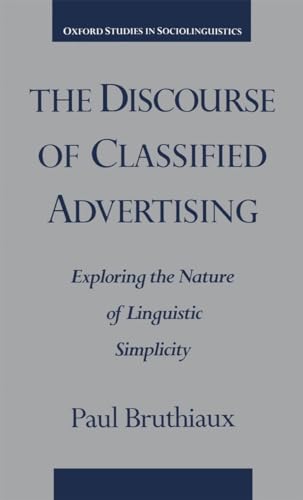
The Discourse of Classified Advertising: Exploring the Nature of Linguistic Simplicity (Oxford Studies in Sociolinguistics) - Hardcover
Inhaltsangabe
Linguists who have studied simplified varieties of a given language, such as pidgins or the language of care-givers, have tended to explain similarities in their structure by the fact that they use the same mechanisms of simplification. Bruthiaux tests this idea by looking at the structure of classified ads in American English, using a body of 800 ads from four categories: automobile sales, apartments for rent, help wanted, and personal ads.
Bruthiaux's thesis is that strict, uniform constraints on space should result in uniformly simple texts, no matter which category they are in, and that any variation would be due to the particular needs of each category. To prove this he describes the linguistic structure of classified ads, and shows that they are characterized by a minimal degree of morphosyntactic elaboration. He then examines aspects of their conventions to highlight the role of pre-patterned and prefabricated segments whose collocational rigidity may force the inclusion of otherwise dispensable items. He finds that there is indeed significant variation across ad categories in terms of morphosyntactic elaboration, and concludes that this is due to a greater or lesser need to be explicit, as well as a greater or lesser anticipation of interaction. Finally, he examines the implications of these findings for the study of linguistic simplification and register variation.
Die Inhaltsangabe kann sich auf eine andere Ausgabe dieses Titels beziehen.
Über die Autorin bzw. den Autor
Paul Bruthiaux teaches academic English in the American Language Institute at the University of Southern California.
Von der hinteren Coverseite
Linguists who have studied simplified varieties of a given language, such as pidgins or the language of caregivers, have tended to explain similarities in their structure by arguing that they use the same mechanisms of simplification. Bruthiaux tests this idea by looking at the structure of classified advertisements in American English, using a body of 800 ads from four categories: automobile sales, apartments for rent, jobs offered, and personal ads. Bruthiaux's thesis is that strict, uniform constraints on space should result in uniformly simple texts, no matter which category they are in, and that any variation would be due to the particular functional needs to each category. To prove this he describes the linguistic structure of classified ads, and shows that they are characterized by a minimal degree of syntactic elaboration. He then examines aspects of their conventions to highlight the role of prepatterned and prefabricated segments whose collocational rigidity may force the inclusion of otherwise dispensable items. He finds that there is indeed significant variation across ad categories in terms of syntactic elaboration, and links this to variation in the need to be explicit, as well as in anticipation of interaction between writer and reader. Finally, he examines the implications of these findings for the study of linguistic simplification and register variation.
„Über diesen Titel“ kann sich auf eine andere Ausgabe dieses Titels beziehen.
Suchergebnisse für The Discourse of Classified Advertising: Exploring...

Beispielbild für diese ISBN
The Discourse of Classified Advertising: Exploring the Nature of Linguistic Simplicity (Oxford Studies in Sociolinguistics)
Anbieter: Ria Christie Collections, Uxbridge, Vereinigtes Königreich
Verkäuferbewertung 5 von 5 Sternen

Zustand: New. In. Artikel-Nr. ria9780195100327_new
Neu kaufen
EUR 151,68
EUR 13,83 Versand
Versand von Vereinigtes Königreich nach USA
Versand von Vereinigtes Königreich nach USA
Anzahl: Mehr als 20 verfügbar
Beispielbild für diese ISBN
The Discourse of Classified Advertising. Exploring the Nature of Linguistic Simplicity.
Anbieter: Kennys Bookstore, Olney, MD, USA
Verkäuferbewertung 5 von 5 Sternen
Zustand: New. Bruthiaux examines the linguistic nature of classified advertising in English based on a broad corpus of advertisements. His study looks at variation in degree of syntactic elaboration and considers the role of conventionalization in this process. Series: Oxford Studies in Sociolinguistics. Num Pages: 224 pages, tables. BIC Classification: CFB; KJSA. Category: (P) Professional & Vocational. Dimension: 217 x 146 x 20. Weight in Grams: 424. . 1996. Hardback. . . . . Books ship from the US and Ireland. Artikel-Nr. V9780195100327
Neu kaufen
EUR 212,46
EUR 9,05 Versand
Versand innerhalb von USA
Versand innerhalb von USA
Anzahl: Mehr als 20 verfügbar