
Verwandte Artikel zu Totalitarianism P: Part Three of The Origins of Totalitarian...
Totalitarianism P: Part Three of The Origins of Totalitarianism – Hannah Arendt on Bolshevism and National Socialism - Softcover
Buch 3 von 3: The Origins of Totalitarianism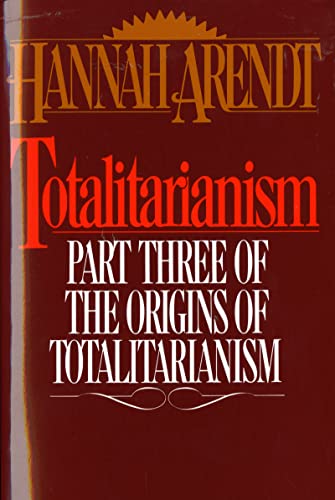
Inhaltsangabe
In the final volume, Arendt focuses on the two genuine forms of the totalitarian state in history-the dictatorships of Bolshevism after 1930 and of National Socialism after 1938. Index.
Die Inhaltsangabe kann sich auf eine andere Ausgabe dieses Titels beziehen.
Über die Autorin bzw. den Autor
Hannah Arendt (1906–1975) is considered one of the most important and influential thinkers of the twentieth century. A political theorist and philosopher, she is also the author of Crises of the Republic, On Violence, The Life of the Mind, and Men in Dark Times. The Origins of Totalitarianism was first published in 1951.
Auszug. © Genehmigter Nachdruck. Alle Rechte vorbehalten.
Totalitarianism
Part Three of The Origins of Totalitarianism
By Hannah ArendtHoughton Mifflin Harcourt Publishing Company
Copyright © 1968 Hannah Arendt
All rights reserved.
ISBN: 978-0-15-690650-0All rights reserved.
Contents
Title Page,
Table of Contents,
Copyright,
Introduction,
Epigraph,
A Classless Society,
The Totalitarian Movement,
Totalitarianism in Power,
Ideology and Terror: A Novel Form of Government,
Bibliography,
Index,
About the Author,
Footnotes,
CHAPTER 1
A Classless Society
I: The Masses
NOTHING is more characteristic of the totalitarian movements in general and of the quality of fame of their leaders in particular than the startling swiftness with which they are forgotten and the startling ease with which they can be replaced. What Stalin accomplished laboriously over many years through bitter factional struggles and vast concessions at least to the name of his predecessor — namely, to legitimate himself as Lenin's political heir — Stalin's successors attempted to do without concessions to the name of their predecessor, even though Stalin had thirty years' time and could manipulate a propaganda apparatus, unknown in Lenin's day, to immortalize his name. The same is true for Hitler, who during his lifetime exercised a fascination to which allegedly no one was immune, and who after his defeat and death is today so thoroughly forgotten that he scarcely plays any further role even among the neo-Fascist and neo-Nazi groups of postwar Germany. This impermanence no doubt has something to do with the proverbial fickleness of the masses and the fame that rests on them; more likely, it can be traced to the perpetual-motion mania of totalitarian movements which can remain in power only so long as they keep moving and set everything around them in motion. Therefore, in a certain sense this very impermanence is a rather flattering testimonial to the dead leaders insofar as they succeeded in contaminating their subjects with the specifically totalitarian virus; for if there is such a thing as a totalitarian personality or mentality, this extraordinary adaptability and absence of continuity are no doubt its outstanding characteristics. Hence it might be a mistake to assume that the inconstancy and forgetfulness of the masses signify that they are cured of the totalitarian delusion, which is occasionally identified with the Hitler or Stalin cult; the opposite might well be true.
It would be a still more serious mistake to forget, because of this impermanence, that the totalitarian regimes, so long as they are in power, and the totalitarian leaders, so long as they are alive, "command and rest upon mass support" up to the end. Hitler's rise to power was legal in terms of majority rule and neither he nor Stalin could have maintained the leadership of large populations, survived many interior and exterior crises, and braved the numerous dangers of relentless intra-party struggles if they had not had the confidence of the masses. Neither the Moscow trials nor the liquidation of the Rohm faction would have been possible if these masses had not supported Stalin and Hitler. The widespread belief that Hitler was simply an agent of German industrialists and that Stalin was victorious in the succession struggle after Lenin's death only through a sinister conspiracy are both legends which can be refuted by many facts but above all by the leaders' indisputable popularity. Nor can their popularity be attributed to the victory of masterful and lying propaganda over ignorance and stupidity. For the propaganda of totalitarian movements which precede and accompany totalitarian regimes is invariably as frank as it is mendacious, and would-be totalitarian rulers usually start their careers by boasting of their past crimes and carefully outlining their future ones. The Nazis "were convinced that evil-doing in our time has a morbid force of attraction," Bolshevik assurances inside and outside Russia that they do not recognize ordinary moral standards have become a mainstay of Communist propaganda, and experience has proved time and again that the propaganda value of evil deeds and general contempt for moral standards is independent of mere self-interest, supposedly the most powerful psychological factor in politics.
The attraction of evil and crime for the mob mentality is nothing new. It has always been true that the mob will greet "deeds of violence with the admiring remark: it may be mean but it is very clever." The disturbing factor in the success of totalitarianism is rather the true selflessness of its adherents: it may be understandable that a Nazi or Bolshevik will not be shaken in his conviction by crimes against people who do not belong to the movement or are even hostile to it; but the amazing fact is that neither is he likely to waver when the monster begins to devour its own children and not even if he becomes a victim of persecution himself, if he is framed and condemned, if he is purged from the party and sent to a forced-labor or a concentration camp. On the contrary, to the wonder of the whole civilized world, he may even be willing to help in his own prosecution and frame his own death sentence if only his status as a member of the movement is not touched. It would be naive to consider this stubbornness of conviction which outlives all actual experiences and cancels all immediate self-interest a simple expression of fervent idealism. Idealism, foolish or heroic, always springs from some individual decision and conviction and is subject to experience and argument. The fanaticism of totalitarian movements, contrary to all forms of idealism, breaks down the moment the movement leaves its fanaticized followers in the lurch, killing in them any remaining conviction that might have survived the collapse of the movement itself. But within the organizational framework of the movement, so long as it holds together, the fanaticized members can be reached by neither experience nor argument; identification with the movement and total conformism seem to have destroyed the very capacity for experience, even if it be as extreme as torture or the fear of death.
The totalitarian movements aim at and succeed in organizing masses — not classes, like the old interest parties of the Continental nation-states; not citizens with opinions about, and interests in, the handling of public affairs, like the parties of Anglo-Saxon countries. While all political groups depend upon proportionate strength, the totalitarian movements depend on the sheer force of numbers to such an extent that totalitarian regimes seem impossible, even under otherwise favorable circumstances, in countries with relatively small populations. After the first World War, a deeply antidemocratic, prodictatorial wave of semitotalitarian and totalitarian movements swept Europe; Fascist movements spread from Italy to nearly all Central and Eastern European countries (the Czech part of Czechoslovakia was one of the notable exceptions); yet even Mussolini, who was so fond of the term "totalitarian state," did not attempt to establish a full-fledged totalitarian regime and contented himself with dictatorship and one- party rule. Similar nontotalitarian dictatorships sprang up in prewar Rumania, Poland, the Baltic states, Hungary, Portugal and Franco Spain. The Nazis, who had an unfailing instinct for such differences, used to comment contemptuously on the shortcomings of their Fascist allies while their genuine admiration for the Bolshevik regime in Russia (and the Communist Party in...
„Über diesen Titel“ kann sich auf eine andere Ausgabe dieses Titels beziehen.
Suchergebnisse für Totalitarianism P: Part Three of The Origins of Totalitarian...

Beispielbild für diese ISBN
Totalitarianism: Part Three of the Origins of Totalitarianism
Anbieter: ThriftBooks-Phoenix, Phoenix, AZ, USA
Verkäuferbewertung 5 von 5 Sternen

Paperback. Zustand: Fair. No Jacket. Readable copy. Pages may have considerable notes/highlighting. ~ ThriftBooks: Read More, Spend Less. Artikel-Nr. G0156906503I5N00
Gebraucht kaufen
EUR 8,92
Versand gratis
Versand innerhalb von USA
Versand innerhalb von USA
Anzahl: 1 verfügbar
Beispielbild für diese ISBN
Totalitarianism: Part Three of the Origins of Totalitarianism
Anbieter: ThriftBooks-Reno, Reno, NV, USA
Verkäuferbewertung 5 von 5 Sternen
Paperback. Zustand: Good. No Jacket. Pages can have notes/highlighting. Spine may show signs of wear. ~ ThriftBooks: Read More, Spend Less. Artikel-Nr. G0156906503I3N00
Gebraucht kaufen
EUR 8,92
Versand gratis
Versand innerhalb von USA
Versand innerhalb von USA
Anzahl: 2 verfügbar
Beispielbild für diese ISBN
Totalitarianism: Part Three of the Origins of Totalitarianism
Anbieter: ThriftBooks-Reno, Reno, NV, USA
Verkäuferbewertung 5 von 5 Sternen
Paperback. Zustand: Fair. No Jacket. Readable copy. Pages may have considerable notes/highlighting. ~ ThriftBooks: Read More, Spend Less. Artikel-Nr. G0156906503I5N00
Gebraucht kaufen
EUR 8,92
Versand gratis
Versand innerhalb von USA
Versand innerhalb von USA
Anzahl: 1 verfügbar
Beispielbild für diese ISBN
Totalitarianism: Part Three of the Origins of Totalitarianism
Anbieter: ThriftBooks-Phoenix, Phoenix, AZ, USA
Verkäuferbewertung 5 von 5 Sternen
Paperback. Zustand: Good. No Jacket. Pages can have notes/highlighting. Spine may show signs of wear. ~ ThriftBooks: Read More, Spend Less. Artikel-Nr. G0156906503I3N00
Gebraucht kaufen
EUR 8,92
Versand gratis
Versand innerhalb von USA
Versand innerhalb von USA
Anzahl: 1 verfügbar
Beispielbild für diese ISBN
Totalitarianism: Part Three of the Origins of Totalitarianism
Anbieter: ThriftBooks-Atlanta, AUSTELL, GA, USA
Verkäuferbewertung 5 von 5 Sternen
Paperback. Zustand: Fair. No Jacket. Readable copy. Pages may have considerable notes/highlighting. ~ ThriftBooks: Read More, Spend Less. Artikel-Nr. G0156906503I5N00
Gebraucht kaufen
EUR 8,94
Versand gratis
Versand innerhalb von USA
Versand innerhalb von USA
Anzahl: 2 verfügbar
Beispielbild für diese ISBN
Totalitarianism: Part Three of the Origins of Totalitarianism
Anbieter: ThriftBooks-Dallas, Dallas, TX, USA
Verkäuferbewertung 5 von 5 Sternen
Paperback. Zustand: Good. No Jacket. Pages can have notes/highlighting. Spine may show signs of wear. ~ ThriftBooks: Read More, Spend Less. Artikel-Nr. G0156906503I3N00
Gebraucht kaufen
EUR 8,94
Versand gratis
Versand innerhalb von USA
Versand innerhalb von USA
Anzahl: 2 verfügbar
Beispielbild für diese ISBN
Totalitarianism: Part Three of the Origins of Totalitarianism
Anbieter: ThriftBooks-Atlanta, AUSTELL, GA, USA
Verkäuferbewertung 5 von 5 Sternen
Paperback. Zustand: Good. No Jacket. Pages can have notes/highlighting. Spine may show signs of wear. ~ ThriftBooks: Read More, Spend Less. Artikel-Nr. G0156906503I3N00
Gebraucht kaufen
EUR 8,94
Versand gratis
Versand innerhalb von USA
Versand innerhalb von USA
Anzahl: 2 verfügbar
Beispielbild für diese ISBN
Totalitarianism: Part Three of the Origins of Totalitarianism
Anbieter: ThriftBooks-Dallas, Dallas, TX, USA
Verkäuferbewertung 5 von 5 Sternen
Paperback. Zustand: Good. No Jacket. Former library book; Pages can have notes/highlighting. Spine may show signs of wear. ~ ThriftBooks: Read More, Spend Less. Artikel-Nr. G0156906503I3N10
Gebraucht kaufen
EUR 8,94
Versand gratis
Versand innerhalb von USA
Versand innerhalb von USA
Anzahl: 1 verfügbar
Beispielbild für diese ISBN
Totalitarianism: Part Three of the Origins of Totalitarianism
Anbieter: ThriftBooks-Dallas, Dallas, TX, USA
Verkäuferbewertung 5 von 5 Sternen
Paperback. Zustand: Fair. No Jacket. Readable copy. Pages may have considerable notes/highlighting. ~ ThriftBooks: Read More, Spend Less. Artikel-Nr. G0156906503I5N00
Gebraucht kaufen
EUR 8,94
Versand gratis
Versand innerhalb von USA
Versand innerhalb von USA
Anzahl: 2 verfügbar
Beispielbild für diese ISBN
Totalitarianism : Part Three of the Origins of Totalitarianism
Verlag:
HarperCollins Publishers, 1968
ISBN 10: 0156906503
ISBN 13: 9780156906500
Gebraucht
Softcover
Anbieter: Better World Books, Mishawaka, IN, USA
Verkäuferbewertung 5 von 5 Sternen
Zustand: Good. Pages intact with minimal writing/highlighting. The binding may be loose and creased. Dust jackets/supplements are not included. Stock photo provided. Product includes identifying sticker. Better World Books: Buy Books. Do Good. Artikel-Nr. 4205650-6
Gebraucht kaufen
EUR 9,16
Versand gratis
Versand innerhalb von USA
Versand innerhalb von USA
Anzahl: 1 verfügbar