
Verwandte Artikel zu The Robber Barons: The Great American Capitalists,...
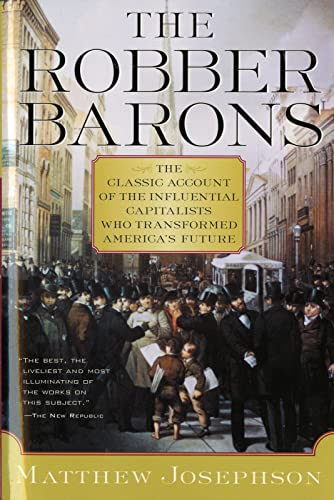
The Robber Barons: The Great American Capitalists, 1861-1901 (Harvest Book): A Definitive History of the Gilded Age Titans Who Transformed the American Economy - Softcover
Inhaltsangabe
Rockefeller, Morgan, Vanderbilt, Carnegie, Harriman, Gould, Frick...this is the story of the giant american capitalists who seized economic power after the Civil War and altered the shape of american life forever. Index.
Die Inhaltsangabe kann sich auf eine andere Ausgabe dieses Titels beziehen.
Über die Autorin bzw. den Autor
Matthew Josephson (1899-1978) received a Guggenheim fellowship and was elected to the National Institute of Arts and Letters. He is the author of, among other books, Al Smith: Hero of the Cities, winner of the Van Wyck Brooks prize for biography and history.
Auszug. © Genehmigter Nachdruck. Alle Rechte vorbehalten.
The Robber Barons
The Great American Capitalists, 1861–1901
By Matthew JosephsonHoughton Mifflin Harcourt Publishing Company
Copyright © 1962 Matthew Josephson
All rights reserved.
ISBN: 978-0-15-676790-3All rights reserved.
Contents
Title Page,
Contents,
Copyright,
Dedication,
Foreword,
PART ONE,
The National Scene: The National Character,
What the Young Men Dream,
Of Empire-Builders,
The Winning of the West,
Two Captains of Industry,
The Fight for Erie,
Grandeurs and Miseries of Empire-Building,
PART TWO,
Rising from the Ruins,
Mephistopheles,
Caesar Borgia in California,
Giants of the Northwest,
Certain Industrialists Arose,
Morgan and the Railways,
The Robber Barons,
Again the Robber Barons,
Concentration: The Great Trusts,
The Empire of Morgan,
Battle of Giants,
Bibliography,
Index,
About the Author,
Footnotes,
CHAPTER 1
THE NATIONAL SCENE: THE NATIONAL CHARACTER
THE cannonading that began at Charleston with the dawn of April 12, 1861, sounded the tocsin for the men of the new American union. The fatal clash of the two economic nations within the republic could no longer be escaped; the "irrepressible conflict" was at hand. When the trivial siege of Sumter was over, the North rallied from its stupor, its breathless waiting. A people who had barely known themselves a nation were unified at last by danger. The North, with a passion no less bitter than the South's, moved to crush the rebel who had ruled the national policy for generations, and stubbornly barred the way of industrial growth as if he would halt inevitability itself.
In legions, the recruits, the young men of '61, marched away to Bull Run for the three months' war. On both sides they were the soldiers of a people without tradition or gift for military heroics; a people which had come out to attend three earlier wars only in small numbers, with remarkable apathy. The frontier democracy had known as little of the rule of the military captain as of the feudal noble or the prince of the Church. Its sons were no soldiers, yet possessed deathless courage; it had few battle leaders; most of these must rise up from disaster. Therefore the conflict would be long, the most stubborn, the most sanguinary in all the history of the West, and colossal in its scale of operations.
If the South did not truly estimate its powers for such a contest, neither did the North know its strength, its wealth, its destiny. Not many in either camp could have pictured the incredible transformations which would accompany those thundering years. And fewer still knew or sensed what the Civil War was really fought for.
The epoch of martial glory and martial stupidity need concern us but little here. We observe only that its grand blood-letting fixes a turning point at which the trend of our history declares itself: the opening of the Second American Revolution, that "industrial revolution" which worked upon society with far greater effect than the melodramatic battles. After Appomattox, in 1865, it is widely and conveniently assumed, the Old Order was ended.
"Had they been Tyrian traders of the year 1000 B.C., landing from a galley fresh from Gibraltar," writes Henry Adams concerning his family's return from diplomatic duties abroad, "they could hardly have been stranger on the shore of a world so changed from what it had been ten years before." All this is true figuratively. But literally the symptoms of the future order of things, all the new shapes and forces existed vigorously in the days of Jefferson, side by side with the institutions and conditions of pre-capitalist or feudal eras. The process of change, the departure from the old ways toward large-scale industry, toward giant capitalism, toward a centralized, national economy, was long in preparing, gradual, and not too imperceptible. When the abyss of the Civil War suddenly yawned before men's eyes it but registered a "lag" which had existed already during the whole of the preceding generation. Where England had officially recognized its economic transition peacefully by the repeal of the Corn Laws, America, through blood and iron, consecrated its own industrial revolution by the end of what had been comparatively free trade....
All this we see in retrospect. But besides the young men who marched to Bull Run, there were other young men of '61 whose instinctive sense of history proved to be unerring. Loving not the paths of glory they slunk away quickly, bent upon business of their own. They were warlike enough and pitiless yet never risked their skin: they fought without military rules or codes of honor or any tactics or weapons familiar to men: they were the strange, new mercenary soldiers of economic life. The plunder and trophies of victory would go neither to the soldier nor the statesman, but to these other young men of '61, who soon figured as "massive interests moving obscurely in the background" of wars. Hence these, rather than the military captains or tribunes, are the subject of this history.
2
Shortly before or very shortly after 1840 were born nearly all the galaxy of uncommon men who were to be the overlords of the future society. They were born at a historical moment when by an easy effort one could as well look back at the mellow past as scan the eventful future. Their parents could remember the disturbed but very simple and light-hearted times of Mr. Jefferson, when pigs wandered unmolested at the steps of the Capitol; and it was only a comparatively few years since Mr. Jackson had "driven the money-changers from the temple."
It was not true of course that the early Republic was a millennium of free farmers and artisans; yet in the simplicity of its organization and of its mercantile economy, the nation belonged almost to a precapitalist age. Over great regions of the country men still worked for a "livelihood" rather than for "money." This man of the mercantile age, certainly contrasted with his successor, a few generations later, "did not stand on his head or run on all fours," but was a "natural man" and in himself was "the meteyard of all things." The handicrafts were widespread; little shops and factories were interspersed among the farms of New England. And it was still true, in many parts of the earlier America, that the artisan, as in olden times, loved his work and feared more that it might not be worthy of him than that he might not put a high enough price upon it. It was also true that goods circulated at a slow rate. The ingenious Yankee and his wife wove their cloth, turned their own furniture, molded their own pottery, in a manner now considered quaint but then truly economical. As their traffic in goods and moneys, while limited to narrow regions, was carried on at the pace of the horse-drawn post, the ox-cart, the river or canal vessel, so their opportunities were narrowed, while differences in station were correspondingly moderate. Thus although there were instances enough of large inequalities of wealth and power, there was more individual equality than in other countries. And of the possessors of great fortunes we note that their wealth was based on ownership of land. This was true of New York as of Virginia. In New England and elsewhere along the coast, the shipping trade was the medium of great fortune; but in this commerce too the pace of trade was long-breathed, temperate, at first.
In such spacious and leisurely days the art of politics and the art of rhetoric tended to flourish....
„Über diesen Titel“ kann sich auf eine andere Ausgabe dieses Titels beziehen.
Suchergebnisse für The Robber Barons: The Great American Capitalists,...

Beispielbild für diese ISBN
The Robber Barons: The Great American Capitalists, 1861-1901
Verlag:
Harcourt Brace International, 1962
ISBN 10: 0156767902
ISBN 13: 9780156767903
Gebraucht
Paperback
Anbieter: World of Books (was SecondSale), Montgomery, IL, USA
Verkäuferbewertung 5 von 5 Sternen

Paperback. Zustand: Fair. Prize-winning historian and biographer Matthew Josephson's The Robber Barons is the story of the Gilded Age's giant American capitalists who seized economic power after the Civil War and altered the shape of American life forever. The definitive book on the rise and power of early American capitalists, The Robber Barons examines the careers of such masters of finance and industry as J. P. Morgan, John D. Rockefeller, Andrew Carnegie, Cornelius Vanderbilt, Jay Gould, E. H. Harriman, and Henry Clay Frick. In a fascinating narrative, mixing social, economic, and political history, Josephson shows that under the command of these industry titans, the country progressed from a mainly agrarian-mercantile society to an economy propelled predominantly by mass production. "With great verve and a fine sense of its dramatic values, what [Josephson] has written is not a mere series of biographies but a genuine history, with the stories of the great American capitalists skillfully interwoven, and with an eye always on the broader social background."--New York Times Book Review. Artikel-Nr. CIN0156767902A
Gebraucht kaufen
EUR 7,55
Versand gratis
Versand innerhalb von USA
Versand innerhalb von USA
Anzahl: 1 verfügbar
Beispielbild für diese ISBN
The Robber Barons: The Great American Capitalists, 1861-1901
Verlag:
Harcourt Brace International, 1962
ISBN 10: 0156767902
ISBN 13: 9780156767903
Gebraucht
Paperback
Anbieter: World of Books (was SecondSale), Montgomery, IL, USA
Verkäuferbewertung 5 von 5 Sternen
Paperback. Zustand: Good. Prize-winning historian and biographer Matthew Josephson's The Robber Barons is the story of the Gilded Age's giant American capitalists who seized economic power after the Civil War and altered the shape of American life forever. The definitive book on the rise and power of early American capitalists, The Robber Barons examines the careers of such masters of finance and industry as J. P. Morgan, John D. Rockefeller, Andrew Carnegie, Cornelius Vanderbilt, Jay Gould, E. H. Harriman, and Henry Clay Frick. In a fascinating narrative, mixing social, economic, and political history, Josephson shows that under the command of these industry titans, the country progressed from a mainly agrarian-mercantile society to an economy propelled predominantly by mass production. "With great verve and a fine sense of its dramatic values, what [Josephson] has written is not a mere series of biographies but a genuine history, with the stories of the great American capitalists skillfully interwoven, and with an eye always on the broader social background."--New York Times Book Review. Artikel-Nr. 00108101270
Gebraucht kaufen
EUR 14,21
Versand gratis
Versand innerhalb von USA
Versand innerhalb von USA
Anzahl: 2 verfügbar
Beispielbild für diese ISBN
The Robber Barons: A Definitive History of the Gilded Age Titans Who Transformed the American Economy
Anbieter: Twice Read Books, Napa, CA, USA
Verkäuferbewertung 5 von 5 Sternen
Soft cover. Zustand: Fine. Like new. Artikel-Nr. 000612
Gebraucht kaufen
EUR 14,65
Versand gratis
Versand innerhalb von USA
Versand innerhalb von USA
Anzahl: 1 verfügbar
Beispielbild für diese ISBN
The Robber Barons: The Great American Capitalists, 1861-1901
Verlag:
Harcourt Brace International, 1962
ISBN 10: 0156767902
ISBN 13: 9780156767903
Gebraucht
Paperback
Anbieter: World of Books (was SecondSale), Montgomery, IL, USA
Verkäuferbewertung 5 von 5 Sternen
Paperback. Zustand: Very Good. Prize-winning historian and biographer Matthew Josephson's The Robber Barons is the story of the Gilded Age's giant American capitalists who seized economic power after the Civil War and altered the shape of American life forever. The definitive book on the rise and power of early American capitalists, The Robber Barons examines the careers of such masters of finance and industry as J. P. Morgan, John D. Rockefeller, Andrew Carnegie, Cornelius Vanderbilt, Jay Gould, E. H. Harriman, and Henry Clay Frick. In a fascinating narrative, mixing social, economic, and political history, Josephson shows that under the command of these industry titans, the country progressed from a mainly agrarian-mercantile society to an economy propelled predominantly by mass production. "With great verve and a fine sense of its dramatic values, what [Josephson] has written is not a mere series of biographies but a genuine history, with the stories of the great American capitalists skillfully interwoven, and with an eye always on the broader social background."--New York Times Book Review. Artikel-Nr. CIN0156767902VG
Gebraucht kaufen
EUR 14,65
Versand gratis
Versand innerhalb von USA
Versand innerhalb von USA
Anzahl: 1 verfügbar
Beispielbild für diese ISBN
The Robber Barons
Anbieter: Roundabout Books, Greenfield, MA, USA
Verkäuferbewertung 4 von 5 Sternen

paperback. Zustand: Very Good. Condition Notes: Clean, unmarked copy with some edge wear. Good binding. Dust jacket included if issued with one. We ship in recyclable American-made mailers. 100% money-back guarantee on all orders. Artikel-Nr. 1725627
Gebraucht kaufen
EUR 16,46
Versand gratis
Versand innerhalb von USA
Versand innerhalb von USA
Anzahl: 1 verfügbar
Foto des Verkäufers
The Robber Barons The Great American Capitalists 1861-1901
Verlag:
Harper Paperbacks, New York, NY, 1962
ISBN 10: 0156767902
ISBN 13: 9780156767903
Gebraucht
Paperback
Anbieter: True Oak Books, Highland, NY, USA
Verkäuferbewertung 5 von 5 Sternen
Paperback. Zustand: Good+. Reissue Edition. 474 pages; Minor pencil markings on contents pages. Personal stamp on prelim. Minor wear to back cover's top edge. Light creasing to spine. Minor smudges and scratches to the exterior edges of textblock. Good condition otherwise. No other noteworthy defects. No markings on text pages. ; - We offer free returns for any reason and respond promptly to all inquiries. Your order will be packaged with care and ship on the same or next business day. Buy with confidence. Artikel-Nr. HVD-53272-A-0
Gebraucht kaufen
EUR 16,49
Versand gratis
Versand innerhalb von USA
Versand innerhalb von USA
Anzahl: 1 verfügbar
Beispielbild für diese ISBN
The Robber Barons
Anbieter: Robinson Street Books, IOBA, Binghamton, NY, USA
Verkäuferbewertung 4 von 5 Sternen
Paperback. Zustand: used: good. Prompt Shipment, shipped in Boxes, Tracking PROVIDEDBusinessGood condition, minor crease to cover, bumped tips, remainder mark on top edge, prompt shipping with tracking. Artikel-Nr. Bing737IB020
Gebraucht kaufen
EUR 12,41
EUR 8,47 Versand
Versand innerhalb von USA
Versand innerhalb von USA
Anzahl: 1 verfügbar
Beispielbild für diese ISBN
The Robber Barons: The Great American Capitalists, 1861-1901 (Harvest Book)
Verlag:
Harcourt Brace International, United States, Orlando, 1962
ISBN 10: 0156767902
ISBN 13: 9780156767903
Gebraucht
Paperback
Anbieter: WorldofBooks, Goring-By-Sea, WS, Vereinigtes Königreich
Verkäuferbewertung 5 von 5 Sternen
Paperback. Zustand: Very Good. The book has been read, but is in excellent condition. Pages are intact and not marred by notes or highlighting. The spine remains undamaged. Artikel-Nr. GOR003416642
Gebraucht kaufen
EUR 14,46
EUR 6,61 Versand
Versand von Vereinigtes Königreich nach USA
Versand von Vereinigtes Königreich nach USA
Anzahl: 1 verfügbar
Beispielbild für diese ISBN
The Robber Barons [Paperback] Josephson, Matthew
Anbieter: GridFreed, San Diego, CA, USA
Verkäuferbewertung 5 von 5 Sternen
Paperback. Zustand: New. In shrink wrap. Artikel-Nr. 10-04458
Neu kaufen
EUR 17,41
EUR 6,20 Versand
Versand innerhalb von USA
Versand innerhalb von USA
Anzahl: 1 verfügbar
Beispielbild für diese ISBN
The Robber Barons: The Great American Capitalists, 1861-1901 (Harvest Book)
Anbieter: medimops, Berlin, Deutschland
Verkäuferbewertung 5 von 5 Sternen
Zustand: good. Befriedigend/Good: Durchschnittlich erhaltenes Buch bzw. Schutzumschlag mit Gebrauchsspuren, aber vollständigen Seiten. / Describes the average WORN book or dust jacket that has all the pages present. Artikel-Nr. M00156767902-G
Gebraucht kaufen
EUR 18,02
EUR 10,00 Versand
Versand von Deutschland nach USA
Versand von Deutschland nach USA
Anzahl: 1 verfügbar