
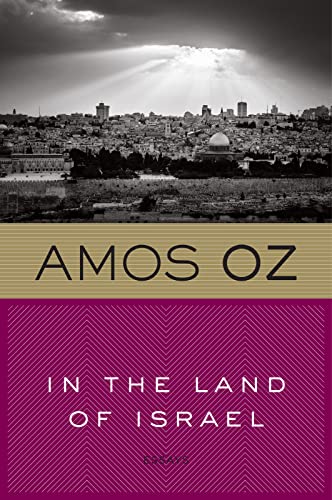
In the Land of Israel (Harvest in Translation): An Insider's View of Israeli Politics and Society Through Arab and Israeli Voices - Softcover
Inhaltsangabe
“An exemplary instance of a writer using his craft to come to grips with what is happening politically and to illuminate certain aspects of Israeli society that have generally been concealed by polemical formulas.” —The New York Times
Notebook in hand, Amos Oz traveled throughout Israel and the West Bank in the early 1980s to talk with workers, soldiers, religious zealots, aging pioneers, new immigrants, desperate Arabs, and visionaries, asking them questions about Israel’s past, present, and future. What he heard is set down here in those distinctive voices, alongside Oz’s observations and reflections. A classic insider’s view of a land whose complex past and troubled present make for an uncertain future.
“Oz’s vignettes . . . wondrously re-create whole worlds with an economy of words.” —Philadelphia Inquirer
Notebook in hand, Amos Oz traveled throughout Israel and the West Bank in the early 1980s to talk with workers, soldiers, religious zealots, aging pioneers, new immigrants, desperate Arabs, and visionaries, asking them questions about Israel’s past, present, and future. What he heard is set down here in those distinctive voices, alongside Oz’s observations and reflections. A classic insider’s view of a land whose complex past and troubled present make for an uncertain future.
“Oz’s vignettes . . . wondrously re-create whole worlds with an economy of words.” —Philadelphia Inquirer
Die Inhaltsangabe kann sich auf eine andere Ausgabe dieses Titels beziehen.
Über die Autorin bzw. den Autor
AMOS OZ (1939–2018) was born in Jerusalem. He was the recipient of the Prix Femina, the Frankfurt Peace Prize, the Goethe Prize, the Primo Levi Prize, and the National Jewish Book Award, among other international honors. His work, including A Tale of Love and Darkness and In the Land of Israel, has been translated into forty-four languages.
Von der hinteren Coverseite
“An exemplary instance of a writer using his craft to come to grips with what is happening politically and to illuminate certain aspects of Israeli society that have generally been concealed by polemical formulas.” —The New York Times
Notebook in hand, Amos Oz traveled throughout Israel and the West Bank in the early 1980s to talk with workers, soldiers, religious zealots, aging pioneers, new immigrants, desperate Arabs, and visionaries, asking them questions about Israel’s past, present, and future. What he heard is set down here in those distinctive voices, alongside Oz’s observations and reflections. A classic insider’s view of a land whose complex past and troubled present make for an uncertain future.
“Oz’s vignettes . . . wondrously re-create whole worlds with an economy of words.” —Philadelphia Inquirer
AMOS OZ was born in Jerusalem in 1939. He is the author of numerous works of fiction and nonfiction, including his acclaimed memoir A Tale of Love and Darkness, which was an international bestseller and a recipient of the National Jewish Book Award.
Notebook in hand, Amos Oz traveled throughout Israel and the West Bank in the early 1980s to talk with workers, soldiers, religious zealots, aging pioneers, new immigrants, desperate Arabs, and visionaries, asking them questions about Israel’s past, present, and future. What he heard is set down here in those distinctive voices, alongside Oz’s observations and reflections. A classic insider’s view of a land whose complex past and troubled present make for an uncertain future.
“Oz’s vignettes . . . wondrously re-create whole worlds with an economy of words.” —Philadelphia Inquirer
AMOS OZ was born in Jerusalem in 1939. He is the author of numerous works of fiction and nonfiction, including his acclaimed memoir A Tale of Love and Darkness, which was an international bestseller and a recipient of the National Jewish Book Award.
Auszug. © Genehmigter Nachdruck. Alle Rechte vorbehalten.
In the Land of Israel
By Amos Oz, Maurie Goldberg-BarturaHoughton Mifflin Harcourt Publishing Company
Copyright © 1983 Amos Oz and Am Oved Publishers Ltd
All rights reserved.
ISBN: 978-0-15-648114-4All rights reserved.
Contents
Title Page,
Contents,
Copyright,
Author's Note to the Original Edition,
Author's Note to the Harvest Edition,
Translator's Note,
Map,
Thank God for His Daily Blessings,
The Insult and the Fury,
The Finger of God?,
Just a Peace,
The Tender Among You, and Very Delicate,
An Argument on Life and Death (A),
An Argument on Life and Death (B),
The Dawn,
On Light and Shade and Love,
A Cosmic Jew,
At the End of That Autumn: A Midwinter Epilogue,
Some Reactions to In the Land of Israel,
A Postscript Ten Years Later: The Middle East Between Shakespeare and Chekhov,
Glossary,
About the Author,
Connect with HMH,
Footnotes,
CHAPTER 1
Thank God for His Daily Blessings
IN THE GEULAH QUARTER of Jerusalem, on Rabbi Meir Street, imprinted on one of the metal sewer covers is the English inscription "City of Westminster" — a reminder of the British Mandate in Palestine. The grocery store that was here forty years ago is still here. A new man sits there and studies Scriptures. It is after the High Holy Days: in Geulah, in Achvah, in Kerem Avraham, and in Mekor Baruch, the tatters of the flimsy booths built for the Feast of Tabernacles are still visible in the yards. Their greenery has faded and turned gray. There is a chill in the air. From porch to porch, the entire width of the alleyways, stretch laundry lines with white and colored clothes: these are the eternal morning blossoms of the neighborhood in which I grew up. The Kings of Israel Street, which was once Geulah Street, throbs with pious Jews in black garb, bearded, bespectacled, chattering in Yiddish, tumultuous, in a hurry, scented with the heavy aroma of Eastern European Ashkenazi cooking. An ultraorthodox woman, young, very pretty, pushes a twin baby carriage full of plastic-net shopping bags with bread, vegetables, canned goods, fish wrapped in newspaper, bottles of wine, cooking oil, soft drinks. Her hair is modestly covered but her fingers are richly adorned with rings. She stops to chat with another woman in one of the courtyards in a mixture of Yiddish, Hebrew, and English.
"Er iz a meshuggener — he's crazy. He came back here from Brussels mit di gantze mishpocheh — with his whole family. Poor Esther." A Brooklyn accent in a figure from Lodz or Krakow. The other woman, behind the fence, answers in English, "It's a shame."
New people, but the alleys and the courtyards arevirtually unchanged. During my childhood, Eastern European intellectuals and educated refugees from Germany and Austria used to live here side by side with the ultraorthodox. There were artisans here, and scholars, trade-union functionaries, National Religious Party hacks and dedicated Revisionists, clerks in the Mandatory government and workers in the Jewish Agency, members of the Haganah and the Irgun, youth from Betar and the United Socialist Movement and the Bnai Akiva, the religious youth movement, noted scholars, village fools, madmen burning with prophetic light, world reformers who would compose and dedicate to one another fiery brochures about the brutal realities of Zionism, or about how the Palestinian Arabs originated from the ancient Hebrews, or about the blessings of organic vegetarianism. Almost every man was a kind of messiah, eager to crucify his opponents and willing to be crucified for his own faith in turn.
All of them have gone. Or changed their minds. Or pulled up their roots from here and gone to more moderate places. But they left behind them a vibrant Jewish shtetl. The potted plants so carefully nurtured by enthusiastic would-be fanners have long since died. The gardens and pigeon coops have gone to rubble. In the courtyards stand sheds of tin and plywood and piles of junk. Yeshiva students, Hasidim, petty merchants have overflowed into this place from the Meah Shearim and the Sanhedria quarters, or bunched up here from Toronto, from New York, and from Belgium. They have many children. Most of the children, even the littlest ones, wear glasses. Yiddish is the language of the street. Zionism was here once and was repelled. Were it not for the stone, and the olive trees and the pines, were it not for that particular quality of light in Jerusalem, you might think you are standing in some Eastern European Jewish shtetl before Hitler. Eastern European with perhaps a tinge of America, and a slight, remote echo from neighboring Israel.
Next to "Photo Geulah, Especially for the Ultra-orthodox," there is a notice board: "Performance tonight in the Convention Center by Mordecai Ben David Werdiger and the Diaspora Yeshiva Band. Tickets at the Bookshop, Beer Books. Special discounts for groups. Proceeds to be donated for Torah education in Jerusalem." Someone has defaced the notice with tar and scrawled the words "Criminals of Israel," painting, for added emphasis, a fat swastika. The explanation apparently lies in another notice, on a stone wall nearby: Rabbi Yisrael Yaakov Kravesky proclaims, "A clarion call to shun ugliness and anything resembling it, with regard to community singing, men and women together, in the guise of holiness and piety, which leads to the pitfalls of levity and immodesty, heaven forbid. Even if it were guaranteed to be arranged in a kosher way, they still err, for now that the Temple is destroyed, because of our many transgressions, it is forbidden to sing, especially in gatherings with musical instruments. Rather, one may find joy only in those commandments prescribed by the Lord, Blessed be He, without the jesting and riotousness which are poison to the spirit in the garb of piety. May he who cares for his soul keep his distance."
In medieval prayer-book Hebrew, ancient hatreds simmer and bubble, controversies in the name of God entangled, as in days gone by, in enmities born from lust for authority and dominion: Mitnagdim versus Hasidim, the followers of one rebbe versus the followers of another, sect against sect, thundering wrath or sour cruelty draped with the robes of scholarship, keen and pious. The Orthodox Eastern European Jewish world continues as though nothing had happened, but the fathers of modern Hebrew literature, Mendele and Berdyczewsky, Bialik and Brenner and the others, would have banished this reality from the world around them and from within their souls. In an eruption of rebellion and loathing, they portrayed this world as a swamp, a heap of dead words and extinguished souls. They reviled it and at the same time immortalized it in their books. However, you cannot afford to loathe this reality, because between then and now it was choked and burned, exterminated by Hitler. Nor can you even afford yourself a measure of secret admiration for the incredible vitality of this Judaism, for as it grows and swells, it threatens your own spiritual existence and eats away at the roots of your own world, prepared to inherit it all when you and your kind have gone.
Through a ground-floor window an old man can be seen, swaying in his chair before an open book. Jerusalem's autumn light is kept outside: his room is dim. He turns his head, looks at you without seeing you — wanting, perhaps, not to see you. An old woman fills his glass with tea from a sooty kettle and disappears into the darkness. You do not permit yourself to hate them but you cannot avoid...
„Über diesen Titel“ kann sich auf eine andere Ausgabe dieses Titels beziehen.
Weitere beliebte Ausgaben desselben Titels

Suchergebnisse für In the Land of Israel (Harvest in Translation): An...

Beispielbild für diese ISBN
In The Land Of Israel: An Insider's View of Israeli Politics and Society Through Arab and Israeli Voices
Anbieter: World of Books (was SecondSale), Montgomery, IL, USA
Verkäuferbewertung 5 von 5 Sternen

Zustand: Good. Item in good condition. Textbooks may not include supplemental items i.e. CDs, access codes etc. Artikel-Nr. 00097126988
Gebraucht kaufen
EUR 3,89
Versand gratis
Versand innerhalb von USA
Versand innerhalb von USA
Anzahl: 2 verfügbar
Beispielbild für diese ISBN
In The Land Of Israel: An Insider's View of Israeli Politics and Society Through Arab and Israeli Voices
Anbieter: World of Books (was SecondSale), Montgomery, IL, USA
Verkäuferbewertung 5 von 5 Sternen
Zustand: Very Good. Item in very good condition! Textbooks may not include supplemental items i.e. CDs, access codes etc. Artikel-Nr. 00094793621
Gebraucht kaufen
EUR 3,89
Versand gratis
Versand innerhalb von USA
Versand innerhalb von USA
Anzahl: 3 verfügbar
Beispielbild für diese ISBN
In The Land Of Israel: An Insider's View of Israeli Politics and Society Through Arab and Israeli Voices
Verlag:
Mariner Books (edition Reprint), 1993
ISBN 10: 0156481146
ISBN 13: 9780156481144
Gebraucht
Paperback
Anbieter: BooksRun, Philadelphia, PA, USA
Verkäuferbewertung 5 von 5 Sternen
Paperback. Zustand: Fair. Reprint. The item might be beaten up but readable. May contain markings or highlighting, as well as stains, bent corners, or any other major defect, but the text is not obscured in any way. Artikel-Nr. 0156481146-7-1
Gebraucht kaufen
EUR 4,49
Versand gratis
Versand innerhalb von USA
Versand innerhalb von USA
Anzahl: 1 verfügbar
Beispielbild für diese ISBN
In The Land Of Israel: An Insider's View of Israeli Politics and Society Through Arab and Israeli Voices
Verlag:
Mariner Books (edition Reprint), 1993
ISBN 10: 0156481146
ISBN 13: 9780156481144
Gebraucht
Paperback
Anbieter: BooksRun, Philadelphia, PA, USA
Verkäuferbewertung 5 von 5 Sternen
Paperback. Zustand: Very Good. Reprint. It's a well-cared-for item that has seen limited use. The item may show minor signs of wear. All the text is legible, with all pages included. It may have slight markings and/or highlighting. Artikel-Nr. 0156481146-11-6
Gebraucht kaufen
EUR 4,73
Versand gratis
Versand innerhalb von USA
Versand innerhalb von USA
Anzahl: 1 verfügbar
Beispielbild für diese ISBN
In the Land of Israel
Verlag:
HarperCollins Publishers, 1993
ISBN 10: 0156481146
ISBN 13: 9780156481144
Gebraucht
Softcover
Anbieter: Better World Books, Mishawaka, IN, USA
Verkäuferbewertung 5 von 5 Sternen
Zustand: Good. Reprint. Pages intact with minimal writing/highlighting. The binding may be loose and creased. Dust jackets/supplements are not included. Stock photo provided. Product includes identifying sticker. Better World Books: Buy Books. Do Good. Artikel-Nr. 3929552-6
Gebraucht kaufen
EUR 6,08
Versand gratis
Versand innerhalb von USA
Versand innerhalb von USA
Anzahl: 2 verfügbar
Beispielbild für diese ISBN
In the Land of Israel
Verlag:
HarperCollins Publishers, 1993
ISBN 10: 0156481146
ISBN 13: 9780156481144
Gebraucht
Softcover
Anbieter: Better World Books, Mishawaka, IN, USA
Verkäuferbewertung 5 von 5 Sternen
Zustand: Good. Reprint. Former library copy. Pages intact with minimal writing/highlighting. The binding may be loose and creased. Dust jackets/supplements are not included. Includes library markings. Stock photo provided. Product includes identifying sticker. Better World Books: Buy Books. Do Good. Artikel-Nr. 9283808-6
Gebraucht kaufen
EUR 6,08
Versand gratis
Versand innerhalb von USA
Versand innerhalb von USA
Anzahl: 1 verfügbar
Beispielbild für diese ISBN
In the Land of Israel
Anbieter: ThriftBooks-Reno, Reno, NV, USA
Verkäuferbewertung 5 von 5 Sternen
Paperback. Zustand: Very Good. No Jacket. May have limited writing in cover pages. Pages are unmarked. ~ ThriftBooks: Read More, Spend Less. Artikel-Nr. G0156481146I4N00
Gebraucht kaufen
EUR 6,25
Versand gratis
Versand innerhalb von USA
Versand innerhalb von USA
Anzahl: 1 verfügbar
Beispielbild für diese ISBN
In the Land of Israel
Anbieter: ThriftBooks-Atlanta, AUSTELL, GA, USA
Verkäuferbewertung 5 von 5 Sternen
Paperback. Zustand: Very Good. No Jacket. May have limited writing in cover pages. Pages are unmarked. ~ ThriftBooks: Read More, Spend Less. Artikel-Nr. G0156481146I4N00
Gebraucht kaufen
EUR 6,25
Versand gratis
Versand innerhalb von USA
Versand innerhalb von USA
Anzahl: 1 verfügbar
Beispielbild für diese ISBN
In the Land of Israel
Anbieter: ThriftBooks-Dallas, Dallas, TX, USA
Verkäuferbewertung 5 von 5 Sternen
Paperback. Zustand: Very Good. No Jacket. May have limited writing in cover pages. Pages are unmarked. ~ ThriftBooks: Read More, Spend Less. Artikel-Nr. G0156481146I4N00
Gebraucht kaufen
EUR 6,25
Versand gratis
Versand innerhalb von USA
Versand innerhalb von USA
Anzahl: 1 verfügbar
Beispielbild für diese ISBN
In the Land of Israel (Harvest in Translation)
Anbieter: Wonder Book, Frederick, MD, USA
Verkäuferbewertung 5 von 5 Sternen
Zustand: Very Good. Very Good condition. A copy that may have a few cosmetic defects. May also contain light spine creasing or a few markings such as an owner's name, short gifter's inscription or light stamp. Artikel-Nr. E05N-01681
Gebraucht kaufen
EUR 6,32
Versand gratis
Versand innerhalb von USA
Versand innerhalb von USA
Anzahl: 2 verfügbar