
Verwandte Artikel zu A Short History of the American Stomach: A Sharp-Witted...
A Short History of the American Stomach: A Sharp-Witted Tour from Diet Gurus and Extreme Feeders to Extinction - Softcover
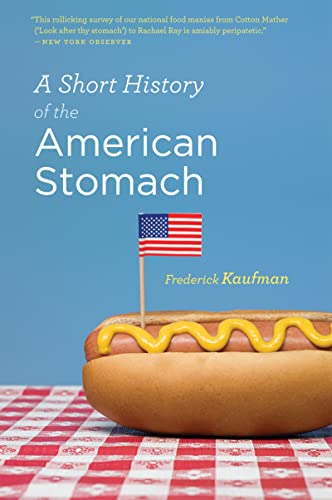
Inhaltsangabe
Frederick Kaufman offers a piquant sampling of American history by way of the stomach.Travel with him as he tracks down our earliest foodies; discovers the secret history of Puritan purges; introduces diet gurus of the nineteenth century such asWilliam Alcott, who believed that “nothing ought to be mashed before it is eaten”; traces extreme feeders from Paul Bunyan to eating-contest champ Dale Boone (descended from Daniel, of course); and investigates our blithe efforts to re-create the plants and animals that we’ve eaten to the point of extinction.With outraged wit and an incredible range of sources that includes everything from Cotton Mather’s diary to interviews with Amish black-market raw-milk dealers, Kaufman takes readers on a Bourdainmeets- Pollan tour of the American gut.
Die Inhaltsangabe kann sich auf eine andere Ausgabe dieses Titels beziehen.
Über die Autorin bzw. den Autor
Frederick Kaufman is a professor of English at the City University of New York and CUNY's Graduate School of Journalism. He has written about American food culture and other subjects for Harper's Magazine, the New Yorker, Gourmet, Gastronomica, and the New York Times Magazine, among others. He lives in New York.
Von der hinteren Coverseite
"This rollicking survey of our national food manias from Cotton Mather ('Look after thy stomach') to Rachael Ray is amiably peripatetic."--New York Observer
Frederick Kaufman offers a piquant sampling of American history by way of the stomach. Travel with him as he discovers the secret history of Puritan purges; introduces diet gurus of the nineteenth century; traces extreme feeders from Paul Bunyan to eating-contest champ Dale Boone (descended from Daniel, of course); and investigates our blithe efforts to re-create the plants and animals that we've eaten to the point of extinction. With outraged wit and an incredible range of sources that includes everything from Cotton Mather’s diary to interviews with Amish black-market raw-milk dealers, Kaufman provides a revelatory look at how we eat now.
"Witty and polemical... [Kaufman] makes some valuable points about how the stomach influences the ways Americans view themselves."--Los Angeles Times
"This brief, chatty tour offers a fascinating interior view of the nation's gut-centricity."--Christian Science Monitor
"For the foodie on your gift list."--zagat.com
FREDERICK KAUFMAN is a professor of English at the City University of New York and CUNY's Graduate School of Journalism. He has written about American food culture and other subjects for Harper's Magazine, the New Yorker, Gourmet, Gastronomica, Saveur, and the New York Times Magazine, among others. He lives in New York.
Auszug. © Genehmigter Nachdruck. Alle Rechte vorbehalten.
1
Debbie Does Salad
A modern epicure is almost always eating the present dish as a kind of introduction to something else.
—William Alcott, 1846
In the year 2000 an American Cinco de Mayo celebration featured the world’s largest taco, fashioned from nine hundred pounds of meat. The taco generated a fair bit of press but could not compare to the sensation created almost two hundred years earlier when supporters of Thomas Jefferson presented the president with a New Year’s gift, a nine-hundred-pound “Mammoth Cheese,” said to have been produced from the milk of one thousand Republican cows. Such tales amuse but don’t amaze us anymore. The outrageous demands of the American stomach have become our daily bread.
But back in the day when Federalists walked the earth, the stomach could still engender shock and awe. In January of 1803, not too long after the presentation of that mammoth cheese, a young journalist who called himself Jonathan Oldstyle traversed the most fashionable streets of New York City, astonished by the extraordinary abundance of food, and by the extraordinary might of its consumption. He published his cultural observations in New York’s Morning Chronicle:
I had marched into the theatre through rows of tables heaped up with delicacies of every kind—here a pyramid of apples or oranges invited the playful palate of the dainty; while there a regiment of mince pies and custards promised a more substantial regale to the hungry. I entered the box, and looked around with astonishment . . . The crackling of nuts and the crunching of apples saluted my ears on every side. Surely, thought I, never was an employment followed up with more assiduity than that of gormandizing; already it pervades every public place of amusement . . .
The eating mania prevails through every class of society; not a soul but has caught the infection. Eating clubs are established in every street and alley, and it is impossible to turn a corner without hearing the hissing of frying pans, winding the savory steams of roast and boiled, or seeing some hungry genius bolting raw oysters in the middle of the street.
Within a decade, this young food writer would become America’s most famous author. His name was Washington Irving.
Irving was a social critic, and his food writing, social commentary. In an 1807 edition of Salmagundi (a literary magazine he founded with his brother and a friend), Irving declared that
the barbarous nations of antiquity immolated human victims to the memory of their lamented dead, but the enlightened Americans offer up whole hecatombs of geese and calves, and oceans of wine in honour of the illustrious living . . .
Irving had perceived that eating and drinking in the pristine nation introduced an entirely new set of rituals and sacraments, for food and food alone could embody “the sublime spectacle of love of country, elevating itself from a sentiment into an appetite.”
A few decades after Irving’s magazine pieces, the obsessions of nineteenth-century food maniacs had matured from raw oysters, raw apples, and nuts into the liver puddings and chicken jellies of Miss Eliza Leslie’s Directions for Cookery. The most popular cookbook of the nineteenth century, Directions plowed its way through sixty printings, sold hundreds of thousands of copies, and made its author one of the first in a long line of celebrity chefs. And Miss Leslie, famous for her sarcasm and wit, grew so expansive that in her final years she could not walk.
A century and a half before the advent of Zagat online and starchefs.com, American food delirium had already engendered a sect of haute-bourgeois extravagance—our first clearly recognizable foodies (as opposed to the chowhounds, who had been gnawing bark off the trees from the very beginning). Hard-line nineteenth-century food moralists such as Sylvester Graham and William Alcott may have railed against the immoral luxuries of white bread, store-bought milk, and more than two ingredients per dish, but Jacksonian gastrosophisticates continued to lust after Miss Leslie’s peach leather and gooseberry fool, cocoa-nut pudding, and raspberry charlotte. The food protestants knew that beneath such culinary desires lay perversity, sickness, and damnation, but their rhetoric could hardly diminish the popularity of America’s first haunt of high cuisine, the restaurant Delmonico’s, where the menu featured chateaubriand, lobster Newburg, and limitless liters of Château Margaux. With dread imagination, the reformers could envision a marketplace glutted with disease-inducing excitements (i.e., spices) and chemically tainted butter. Never could they have conceived of our present debauched trade in chocolate fountains and olive stoners, thermoforks, ergonomic meat hammers, and bidirectional marinade injectors.
America’s eating infection has progressed, just as our obsessive need to possess recipes has morphed from shoe boxes stuffed with file cards to cookbooks.com, a database that brims with one million possibilities. To sample every one of them (at a steady rate of three meals per day, one new recipe per meal) would take more than nine hundred years.
But don’t be absurd. Nobody cooks all those recipes. In fact, everyone knows recipes...
„Über diesen Titel“ kann sich auf eine andere Ausgabe dieses Titels beziehen.
Suchergebnisse für A Short History of the American Stomach: A Sharp-Witted...

Beispielbild für diese ISBN
A Short History Of The American Stomach: A Sharp-Witted Tour from Diet Gurus and Extreme Feeders to Extinction
Anbieter: World of Books (was SecondSale), Montgomery, IL, USA
Verkäuferbewertung 5 von 5 Sternen

Zustand: Good. Item in good condition. Textbooks may not include supplemental items i.e. CDs, access codes etc. Artikel-Nr. 00095269330
Gebraucht kaufen
EUR 6,26
Versand gratis
Versand innerhalb von USA
Versand innerhalb von USA
Anzahl: 2 verfügbar
Beispielbild für diese ISBN
A Short History of the American Stomach
Anbieter: Wonder Book, Frederick, MD, USA
Verkäuferbewertung 5 von 5 Sternen
Zustand: Very Good. Very Good condition. A copy that may have a few cosmetic defects. May also contain light spine creasing or a few markings such as an owner's name, short gifter's inscription or light stamp. Artikel-Nr. O08F-02644
Gebraucht kaufen
EUR 6,27
Versand gratis
Versand innerhalb von USA
Versand innerhalb von USA
Anzahl: 1 verfügbar
Beispielbild für diese ISBN
A Short History of the American Stomach
Verlag:
HarperCollins Publishers, 2009
ISBN 10: 0156034697
ISBN 13: 9780156034692
Gebraucht
Softcover
Anbieter: Better World Books, Mishawaka, IN, USA
Verkäuferbewertung 5 von 5 Sternen
Zustand: Good. Reprint. Pages intact with minimal writing/highlighting. The binding may be loose and creased. Dust jackets/supplements are not included. Stock photo provided. Product includes identifying sticker. Better World Books: Buy Books. Do Good. Artikel-Nr. GRP73182168
Gebraucht kaufen
EUR 7,04
Versand gratis
Versand innerhalb von USA
Versand innerhalb von USA
Anzahl: 1 verfügbar
Beispielbild für diese ISBN
A Short History of the American Stomach
Anbieter: ThriftBooks-Atlanta, AUSTELL, GA, USA
Verkäuferbewertung 5 von 5 Sternen
Paperback. Zustand: Very Good. No Jacket. May have limited writing in cover pages. Pages are unmarked. ~ ThriftBooks: Read More, Spend Less. Artikel-Nr. G0156034697I4N00
Gebraucht kaufen
EUR 7,53
Versand gratis
Versand innerhalb von USA
Versand innerhalb von USA
Anzahl: 1 verfügbar
Foto des Verkäufers
A Short History of the American Stomach
Anbieter: WeBuyBooks, Rossendale, LANCS, Vereinigtes Königreich
Verkäuferbewertung 5 von 5 Sternen
paperback. Zustand: Good. Most items will be dispatched the same or the next working day. A copy that has been read but remains in clean condition. All of the pages are intact and the cover is intact and the spine may show signs of wear. The book may have minor markings which are not specifically mentioned. A tan to the pages. Artikel-Nr. rev4288930962
Gebraucht kaufen
EUR 12,94
EUR 6,25 Versand
Versand von Vereinigtes Königreich nach USA
Versand von Vereinigtes Königreich nach USA
Anzahl: 1 verfügbar
Beispielbild für diese ISBN
A Short History of the American Stomach
Anbieter: Revaluation Books, Exeter, Vereinigtes Königreich
Verkäuferbewertung 5 von 5 Sternen
Paperback. Zustand: Brand New. reprint edition. 224 pages. 8.00x5.25x0.50 inches. In Stock. Artikel-Nr. x-0156034697
Neu kaufen
EUR 20,89
EUR 11,66 Versand
Versand von Vereinigtes Königreich nach USA
Versand von Vereinigtes Königreich nach USA
Anzahl: 2 verfügbar