
Verwandte Artikel zu Golden Country: A Sweeping Historical Saga of Three...
Golden Country: A Sweeping Historical Saga of Three Families, Broadway Glamour, and Gangsters - Softcover
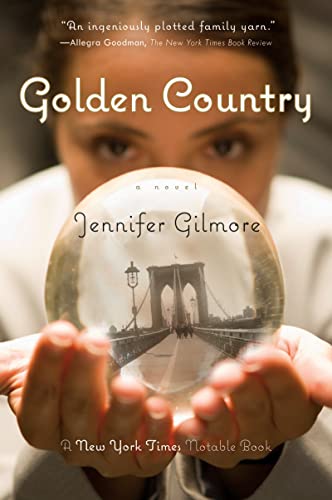
Inhaltsangabe
**DEBUT FICTION**
Golden Country vividly brings to life the intertwining stories of three immigrants seeking their fortunes: the handsome and ambitious Seymour, a salesman turned gangster turned Broadway producer; the gentle and pragmatic Joseph, a door-to-door salesman who is driven to invent a cleanser effective enough to wipe away the shame of his brother?s mob connections; and the irresistible Frances Gold, who grows up in Brooklyn, stars in Seymour?s first show, and marries the man who invents television. Their three families, though inextricably connected for years, are brought together for the first time by the engagement of Seymour?s son and Joseph?s daughter. David and Miriam?s marriage must endure the inheritance of not only their parents? wealth but also the burdens of their pasts.
Spanning the first half of the twentieth century, Golden Country captures the exuberance of the American dream while exposing its underbelly?disillusionment, greed, and the disaffection bred by success.
Die Inhaltsangabe kann sich auf eine andere Ausgabe dieses Titels beziehen.
Über die Autorin bzw. den Autor
JENNIFER GILMORE's first novel, Golden Country, was a New York Times Notable Book of 2006 and a finalist for the National Jewish Book Award and the Los Angeles Times Book Prize. She is now an author of a few novels, one of which, The Mothers, is being adapted to film.
Von der hinteren Coverseite
A LOS ANGELES TIMES BOOK PRIZE FINALIST
A NATIONAL JEWISH BOOK AWARD FINALIST
Golden Country vividly brings to life the intertwining stories of three immigrants seeking their fortunes: the handsome and ambitious Seymour, a salesman turned gangster turned Broadway producer; the gentle and pragmatic Joseph, a door-to-door salesman who is driven to invent a cleanser effective enough to wipe away the shame of his brother’s mob connections; and the irresistible Frances Gold, who grows up in Brooklyn, stars in Seymour’s first show, and marries the man who invents television.
"Gilmore's lively prose captures both the exuberance and the disillusionment of the immigrant experience."--Entertainment Weekly
"With a voice at turns wise and barbed with sharp humor, Gilmore warns: be careful what you wish for, the American Dream can sometimes be a nightmare."--Vanity Fair
"Jennifer Gilmore might just be the Jewish answer to Jhumpa Lahiri. Her absorbing novel captures the sadness and wonder of the immigrant experience."--W Magazine
"This novel is extremely engaging . . . well researched and charmingly recalled."?The Washington Post Book World
JENNIFER GILMORE’s work has appeared in magazines, journals, and anthologies, including the New York Times Magazine, Allure, Nerve, and Salon. She lives in Brooklyn, New York. Visit www.JenniferGilmore.net.
Auszug. © Genehmigter Nachdruck. Alle Rechte vorbehalten.
Golden Country
By Jennifer GilmoreHarvest Books
Copyright © 2007 Jennifer GilmoreAll right reserved.
ISBN: 9780156034371
Chapter One
Irving Berlin! 1957
It was Joseph Brodsky, the one person who had never caused any trouble, who did not want his daughter to marry David Bloom.
"I will not have my grandchildren brought up on filthy money," Joseph told his wife the evening after Miriam had called from New York with the news.
Married! Miriam had screamed so happily into the phone. Instantly Joseph remembered her, a girl in a yellow bathing suit on the dock by Sebago Lake, her hands on her hips. When had her bones grown into a woman's body? He imagined her limbs elongating before his eyes as if he were watching the time-lapse film of a flower blooming, a crystal forming: his daughter growing up and away from him.
Joseph had been readying for sleep before the phone call. Now, sitting on the edge of his bed, he paused a moment before removing his shoes. Then he set upright the milk carton he had taken to putting by the bed so he wouldn't have to get up to urinate so many times during the night. Joseph was beginning to feel the effects of age -- the real effects, ones that seemed to rise up from that strange place deep within him where his faith was stored -- and to refuse the marriage troubled him. He wanted to be sure his daughters were taken care of. But David Bloom? Of all the men on earth. He didn't know the boy well, it was true, but history is history. End of story.
"What are you talking about, Joe?" Esther sat at her vanity slathering her face with cold cream.
"Mob ties." Joseph nodded his head to emphasize the gravity of this statement. He thought of his own brother, the day he left Brooklyn for that gang of thugs and how his mother gave all of Solomon's belongings -- his comic books, shirts, his telescope with the broken lens -- to Henrietta Szold. For the Hadassah, his mother had said. And that woman had sent the package back -- a clean cardboard box tied tightly with twine -- without so much as a note.
"How do you know for sure?" Esther asked Joseph.
"I know because I know," he told her.
Only once had Joseph discussed Solomon, and that had been when he'd come home late from a terribly hard day on the long selling road. Frustrated by how little such a long day had yielded, Joseph walked in the door, drank three glasses of peach schnapps, told Esther the story, wept, and then tried unsuccessfully to undo his wife's bra in the kitchen.
"And how's that?" Esther watched in the mirror as her husband dipped his feet into his leather slippers. "For Christ's sake, Joe. Miriam can't be running around that city -- single and loose in Manhattan -- forever."
If only from the state of her daughter's bitten nails, Joseph knew that Esther was right. He could see that Miriam had anxieties. She'd been neurotic since she was a girl -- once they'd had to drag her out of a child's bathtub filled with chemicals. Esther had found her in a ball, coiled as tightly as a pin curl. I'm getting clean, Miriam had said when questioned as to what on earth she had been doing. But what did that mean? My little girl, Joseph had thought when he was confronted with the image of that pink, raw body. And then the image much later, of the girl in New York, a brand-new nose hidden beneath seeping bandages. Her eyes were two bruises on the moon of that blanched, frightened face. This had been the only time Joseph had questioned his wife's intentions.
Miriam might have anxiety, but some of the Brodskys' friends' kids had been true problems. Ethel Cohen's daughter was institutionalized. Drugs, they'd said. Imagine. And Arthur Friedman's boy was a no-good drunk. No matter how Art tried, that boy was always showing up at his doorstep at all hours, inebriated. Joseph knew he had been blessed with two good girls, who had not given them a moment's real worry.
"I just know, Es." Joseph spoke softly, rubbing his head. "Please believe me." His scalp shone brightly, shiny as linoleum, through his thinning hair.
Esther turned away from the mirror to look directly at her husband, one arm hooked over the back of the chair. Her face was a mask of white, but for her eyes, black as ebony buttons, and her pink mouth, drawn up like a change purse. Even like this, like a snowman she looks, thought Joseph, she was a treasure to him.
"Whatever you say," Esther said. "Evidently he's not a gangster anymore. Now the man hangs around with Irving Berlin. Broadway, Joe." Esther paused, uncharacteristically hesitant about what she was about to say. She held her head high as she looked in the mirror. "Do you want your daughter to be one of those girls in that terrible city who gets a reputation as a tramp in her youth and as a lesbian in her old age? And that, mind you, is only if she ages well."
"Now come on, Esther," Joseph said. The previous day Esther had read him something about the problem of single girls in the city, from "Dear Maggie," the syndicated etiquette column that his wife and her friends phoned one another over daily. Especially since the war, Esther had read, pointing her chin toward Joseph, as if it had all been his fault. She's your daughter too, Joseph had told her.
Now Joseph turned away from his wife and to the window, the boughs of the evergreen at the side of the yard sagging with last night's snow. Beyond his yard and down the hill was Casco Bay, where last week Joseph had seen a seal at low tide. Looking up the habits of the harbor seal at the Portland library hours after the sighting, he had had to laugh at himself. How on earth did I get here? he had thought happily, knocking a pencil to the side of his head as he read about molting seasons.
Broadway, thought Joseph. Irving Berlin. Esther went down to New York City all the time now to see Miriam and catch a matinee, and Joseph knew this thrilled her. But Joseph, who'd had to be begged by his wife to move so far north, rarely liked to go back to New York. He liked the peace of his new little town, where he walked to the Penny Wise for milk, removing his hat for the neighbors he passed in the street. He liked his walks through the woods, stomping over moss and earth, the pleasant smell of pine, the call of the lighthouse that blinked in the distance through the fog.
The one time Esther had gone with Seymour and Sarah Bloom, she had come home chattering about the house seats and how the Blooms knew the very best places to eat on Broadway. When they came in from the street, a table by a window was waiting just for them, a flickering candle in its center. She made it clear to Joseph that though she didn't want to live anywhere else but Portland, dinner and a show in that beautiful, beckoning city was a perfect evening.
"Not just off zhe Mob," Joseph said. "Off a people like you and me." He slapped his chest. "Good people."
But Irving Berlin! Joseph got up from the bed, and Esther noticed he did so a bit wearily. He looked up to see his wife rub her own throbbing hands -- she'd had to get her wedding ring loosened last month just so it could slide over the knuckles of her once-slender fingers -- and clutch the bedpost to stand up. Joseph knew he was no longer the handsome and strong man Esther had once walked arm in arm with...
„Über diesen Titel“ kann sich auf eine andere Ausgabe dieses Titels beziehen.
Suchergebnisse für Golden Country: A Sweeping Historical Saga of Three...

Beispielbild für diese ISBN
Golden Country
Anbieter: World of Books (was SecondSale), Montgomery, IL, USA
Verkäuferbewertung 5 von 5 Sternen

Paperback. Zustand: Good. **DEBUT FICTION** Golden Country vividly brings to life the intertwining stories of three immigrants seeking their fortunes: the handsome and ambitious Seymour, a salesman turned gangster turned Broadway producer; the gentle and pragmatic Joseph, a door-to-door salesman who is driven to invent a cleanser effective enough to wipe away the shame of his brother's mob connections; and the irresistible Frances Gold, who grows up in Brooklyn, stars in Seymour's first show, and marries the man who invents television. Their three families, though inextricably connected for years, are brought together for the first time by the engagement of Seymour's son and Joseph's daughter. David and Miriam's marriage must endure the inheritance of not only their parents' wealth but also the burdens of their pasts. Spanning the first half of the twentieth century, Golden Country captures the exuberance of the American dream while exposing its underbelly--disillusionment, greed, and the disaffection bred by success. Artikel-Nr. 00033267730
Gebraucht kaufen
EUR 3,22
Versand gratis
Versand innerhalb von USA
Versand innerhalb von USA
Anzahl: 1 verfügbar
Beispielbild für diese ISBN
Golden Country
Verlag:
Harper Perennial (edition Reprint), 2007
ISBN 10: 0156034379
ISBN 13: 9780156034371
Gebraucht
Paperback
Anbieter: BooksRun, Philadelphia, PA, USA
Verkäuferbewertung 5 von 5 Sternen
Paperback. Zustand: Very Good. Reprint. It's a well-cared-for item that has seen limited use. The item may show minor signs of wear. All the text is legible, with all pages included. It may have slight markings and/or highlighting. Artikel-Nr. 0156034379-11-18
Gebraucht kaufen
EUR 5,42
Versand gratis
Versand innerhalb von USA
Versand innerhalb von USA
Anzahl: 1 verfügbar
Beispielbild für diese ISBN
Golden Country
Anbieter: ThriftBooks-Dallas, Dallas, TX, USA
Verkäuferbewertung 5 von 5 Sternen
Paperback. Zustand: Very Good. No Jacket. May have limited writing in cover pages. Pages are unmarked. ~ ThriftBooks: Read More, Spend Less. Artikel-Nr. G0156034379I4N00
Gebraucht kaufen
EUR 6,33
Versand gratis
Versand innerhalb von USA
Versand innerhalb von USA
Anzahl: 1 verfügbar
Beispielbild für diese ISBN
Golden Country
Anbieter: ThriftBooks-Dallas, Dallas, TX, USA
Verkäuferbewertung 5 von 5 Sternen
Paperback. Zustand: As New. No Jacket. Pages are clean and are not marred by notes or folds of any kind. ~ ThriftBooks: Read More, Spend Less. Artikel-Nr. G0156034379I2N00
Gebraucht kaufen
EUR 6,33
Versand gratis
Versand innerhalb von USA
Versand innerhalb von USA
Anzahl: 1 verfügbar
Beispielbild für diese ISBN
Golden Country
Verlag:
Harper Perennial, 2007
ISBN 10: 0156034379
ISBN 13: 9780156034371
Gebraucht
Softcover
Signiert
Anbieter: Wonder Book, Frederick, MD, USA
Verkäuferbewertung 5 von 5 Sternen
Zustand: Good. Signed Copy . Signed by author on title page. Spine slanted. Artikel-Nr. W00D-01551
Gebraucht kaufen
EUR 6,41
Versand gratis
Versand innerhalb von USA
Versand innerhalb von USA
Anzahl: 1 verfügbar
Beispielbild für diese ISBN
Golden Country
Anbieter: Wonder Book, Frederick, MD, USA
Verkäuferbewertung 5 von 5 Sternen
Zustand: Good. Good condition. A copy that has been read but remains intact. May contain markings such as bookplates, stamps, limited notes and highlighting, or a few light stains. Artikel-Nr. S07D-03325
Gebraucht kaufen
EUR 6,41
Versand gratis
Versand innerhalb von USA
Versand innerhalb von USA
Anzahl: 3 verfügbar
Beispielbild für diese ISBN
Golden Country
Verlag:
HarperCollins Publishers, 2007
ISBN 10: 0156034379
ISBN 13: 9780156034371
Gebraucht
Softcover
Anbieter: Better World Books, Mishawaka, IN, USA
Verkäuferbewertung 5 von 5 Sternen
Zustand: Good. Reprint. Pages intact with minimal writing/highlighting. The binding may be loose and creased. Dust jackets/supplements are not included. Stock photo provided. Product includes identifying sticker. Better World Books: Buy Books. Do Good. Artikel-Nr. 3136013-75
Gebraucht kaufen
EUR 7,00
Versand gratis
Versand innerhalb von USA
Versand innerhalb von USA
Anzahl: 1 verfügbar
Beispielbild für diese ISBN
Golden Country
Verlag:
HarperCollins Publishers, 2007
ISBN 10: 0156034379
ISBN 13: 9780156034371
Gebraucht
Softcover
Anbieter: Better World Books: West, Reno, NV, USA
Verkäuferbewertung 5 von 5 Sternen
Zustand: Good. Reprint. Pages intact with minimal writing/highlighting. The binding may be loose and creased. Dust jackets/supplements are not included. Stock photo provided. Product includes identifying sticker. Better World Books: Buy Books. Do Good. Artikel-Nr. 3136013-75
Gebraucht kaufen
EUR 7,00
Versand gratis
Versand innerhalb von USA
Versand innerhalb von USA
Anzahl: 1 verfügbar
Beispielbild für diese ISBN
Golden Country
Anbieter: medimops, Berlin, Deutschland
Verkäuferbewertung 5 von 5 Sternen
Zustand: good. Befriedigend/Good: Durchschnittlich erhaltenes Buch bzw. Schutzumschlag mit Gebrauchsspuren, aber vollständigen Seiten. / Describes the average WORN book or dust jacket that has all the pages present. Artikel-Nr. M00156034379-G
Gebraucht kaufen
EUR 4,37
EUR 10,00 Versand
Versand von Deutschland nach USA
Versand von Deutschland nach USA
Anzahl: 1 verfügbar
Beispielbild für diese ISBN
Golden Country
Anbieter: Robinson Street Books, IOBA, Binghamton, NY, USA
Verkäuferbewertung 4 von 5 Sternen

Trade paperbac. Zustand: Good. Prompt Shipment, shipped in Boxes, Tracking PROVIDEDHistorical fictionGOOD TRADE PAPER BACK. EX LIBRARY, MAY HAVE INK STAMPS/POCKETS. GOOD PAGES. Artikel-Nr. BING725MD015
Gebraucht kaufen
EUR 12,39
EUR 8,46 Versand
Versand innerhalb von USA
Versand innerhalb von USA
Anzahl: 1 verfügbar