
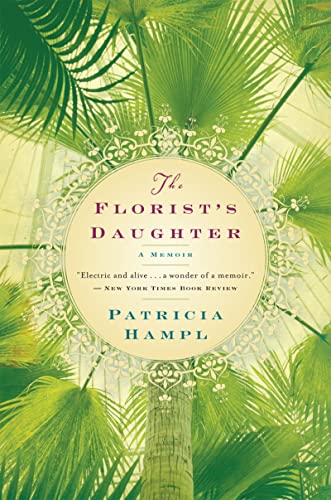
The Florist's Daughter: An Intimate Memoir of a Mother-Daughter Bond in Postwar Midwestern America - Softcover
Inhaltsangabe
During the long farewell of her mother’s dying, Patricia Hampl revisits her midwestern girlhood.Daughter of a debonair Czech father, whose floral work gave him entrée to St. Paul society, and a distrustful Irishwoman with an uncanny ability to tell a tale,Hampl remained, primarily and passionately, a daughter well into adulthood. She traces the arc of faithfulness and struggle that comes with that role—from the postwar years past the turbulent sixties. At the heart of The Florist’s Daughter is the humble passion of people who struggled out of the Depression into a better chance, not only for themselves but for the common good.Widely recognized as one of our most masterly memoirists, Patricia Hampl has written an extraordinary memoir that is her most intimate, yet most universal, work to date.This transporting work will resonate with readers of Francine du Plessix Gray’s Them: A Memoir of Parents and JeannetteWall’s The Glass Castle.
Die Inhaltsangabe kann sich auf eine andere Ausgabe dieses Titels beziehen.
Über die Autorin bzw. den Autor
PATRICIA HAMPL is the author of four memoirs—A Romantic Education, Virgin Time, I Could Tell You Stories, and Blue Arabesque—and two collections of poetry. She has received a MacArthur Fellowship, among many other awards. She lives in St. Paul, Minnesota.
Auszug. © Genehmigter Nachdruck. Alle Rechte vorbehalten.
The Florist's Daughter
A Memoir
By Patricia HamplHoughton Mifflin Harcourt Publishing Company
Copyright © 2007 Patricia Hampl
All rights reserved.
ISBN: 978-0-15-603403-6All rights reserved.
CHAPTER 1
For once, no flowers. Past midnight and very quiet along this corridor. The clock on the opposite wall is round, a cartoon clock. Funny, the idea of keeping time — here of all places. Beneath the clock, a square calendar announces in bold what is now the wrong date, April 3.
I could walk over, just a few steps, tear the page away from the calendar, and make it today, April 4. But that would cause a ripping sound, and I'd have to let go of her hand. So, leave it. In this room it's yesterday. We won't reach today until this is over, the time warp we entered three days ago. She'd appreciate that, irony being her last grasp on reality.
"This time," the doctor said in the hallway last night — it might have been two nights ago — "you understand this time, this is it?"
Five years ago I had faced him wild-eyed in the ER after her first stroke. "What do you want us to do?" he had asked then.
What do I want you to do? I have a graduate degree in lyric poetry, what do I know? But I heard myself say, "Treat her like a sixteen-year-old who's just crashed on her boyfriend's motorcycle."
And he did. They did. The whole high-tech array of surgical, medical, therapeutic systems revved into high gear.
But this time I don't try to save her. I look at the doctor, by now my accomplice, and I say Oh yes when he says You understand ... this is it, eager to prove myself no trouble, a maker of no fuss. Not something she could be accused of. "I get the feeling your mother doesn't ... like me," he confided a year ago, this mild man of goodwill and even better bedside manner. "I walk in the room and she scowls. As if she hates me."
You got that right. I experience a surge of perverse pride at her capacity to alienate those with power over her, the self-immolating integrity of her fury. Her essential unfairness, throwing guilt like a girl, underhand. For her, no such thing as an innocent bystander. Cross her path and the poisoned dart springs from the quiver of her heart. The look. Narrowed eyes, pinched disdainful mouth, brilliant mime of venomous dislike. I know it well, doctor. "You Goody Two-shoes," she spit out once when I was cleaning her apartment, mopping up cigarette ash around her chair. She didn't bother to disguise her contempt for me as a nonsmoker — obviously, I didn't know how to enjoy life.
But that sour face of her elderly fury keeps disappearing just as she is disappearing. Even this latest face, the one propped on the hospital pillow, the hieratic visage that seems polished and will soon be an object, even this one is hard to keep in focus. I'm sitting here, holding her hand, but it's the ardent face from 1936 that keeps appearing, the face in the photograph placed on the shelf above the piano all the years of my girlhood and beyond. Heart-shaped with high cheekbones and eyes set wonderfully wide, it is the face of a romantic lead.
Not because she was beautiful — she wasn't beautiful. She was seriously pretty, the way Scott Fitzgerald described the real heartbreakers. The slightly dazzled eyes (she refused to wear her glasses) looked out with a shyness clearly feigned. That was the entrancing part — you could tell she wasn't really shy. She was happy. And a little startled by it. She couldn't keep the happiness of her body-and-soul off her face. Neither could my father — because of course he's standing next to her. Though not yet my father, not yet her husband.
Both of them gaze directly at the camera, standing by a cottonwood tree on a sandy bank of the Mississippi. Springtime from the look of the tree, site of a picnic, no doubt. She slouches her trim self stylishly, just touching his lean body. A claim being made. She's happy and he looks ... proud. They both have a slightly abashed shyness stamped on their faces. Good-lookers. They're stepping into their future, he in an open-neck shirt, she in jodhpurs and a little leather jacket. It's their first picture together.
I stared at it all my girlhood as if at a problem to be solved — who are these people? — while I tooled my way through a Chopin mazurka, a Bach prelude, under the erotic glory of two kids crazy in love who looked down from another planet, not the one we inhabited together — Mother, Dad, Peter, me — in our bungalow on Linwood Avenue.
"The nurses can set up a cot for you," the doctor said last night. The low cot is wedged next to her now. I'm perched on the edge, barely hoisted above the floor, a supplicant crouched below the elevated royal bed. I gaze up at the tiny body, the porcelain face. There's a yellow legal pad on my lap. I'm a note-taker from long habit.
It's her habit, in fact, one I borrowed or inherited or stole from her. Note-taking, newspaper clipping, file making, all the librarian traits of wordiness and archival passion she displayed. Her favorite books were biographies (how smoothly the past tense inserts itself already), big thumpers of Dolley Madison and Abigail Adams on the American history side, Parnell and Wolfe Tone for the Irish obsession. And now on the yellow legal pad, the beginning of hers:
HAMPL, MARY MARUM
Age 85
Mary Catherine Ann Teresa Eleanor Marum Hampl born July 26, 1917, in St. Peter, MN, to Martha Smith and Joseph Marum. The family moved to St. Paul when she was five, and she lived the rest of her life in this city she loved, in "God's country," as she always called Minnesota. A 1935 graduate of Mechanic Arts High School, she married her classmate Stanislaus Hampl in 1940 in the St. Paul Cathedral. They were together 58 years until Stan's death in 1998 ...
That's as far as I've gotten, having made the first artistic decision — loading on all the pretty names. They make her sound like a crowned head. I always wondered if she conferred most of them on herself.
I should probably put in her astrological sign. She was always glad to give it, raising her flyaway mane imperiously above her petite frame to say, "I'm Leo — the Lion." She liked to read my horoscope aloud (placid Pisces) in the morning after she read hers, and my father's and brother's (both the Bull, as men should be), to see how we were all doing, cosmically speaking. "Too bad," she would say sympathetically after giving me the wan future Jeane Dixon so often predicted for my watery self.
Not until the night nurse stops in and glances down does it occur to me that composing my mother's obit with my left hand as I hold her unconscious hand with my right might strike an outsider as offensive. Not to her, I want to protest. She would have expected nothing less, the dutiful writer-daughter scribbling in the half-light, holding the dying hand while hitting the high points of her subject's life that is finally going to see print. For a great reader, this is a great death.
She's glad I'm her daughter ("I'm proud of you," she says with some frequency), but for this I'm required to play my role, to be the Writer. "Are you working?" she asks, ever aware of any slacking off. Writing is my vocation — her word, the word of my upwardly mobile Catholic childhood. For years after she retired from her job at the library, she devoted herself to cataloging all my work, any scrap I had written. I spent the day working on the Archive. Yet she really thought being a librarian would have been the better...
„Über diesen Titel“ kann sich auf eine andere Ausgabe dieses Titels beziehen.
Weitere beliebte Ausgaben desselben Titels

Suchergebnisse für The Florist's Daughter: An Intimate Memoir of a...

Beispielbild für diese ISBN
The Florist's Daughter: An Intimate Memoir of a Mother-Daughter Bond in Postwar Midwestern America
Anbieter: World of Books (was SecondSale), Montgomery, IL, USA
Verkäuferbewertung 5 von 5 Sternen

Zustand: Very Good. Item in very good condition! Textbooks may not include supplemental items i.e. CDs, access codes etc. Artikel-Nr. 00104846373
Gebraucht kaufen
EUR 4,54
Versand gratis
Versand innerhalb von USA
Versand innerhalb von USA
Anzahl: 1 verfügbar
Beispielbild für diese ISBN
The Florist's Daughter: An Intimate Memoir of a Mother-Daughter Bond in Postwar Midwestern America
Anbieter: World of Books (was SecondSale), Montgomery, IL, USA
Verkäuferbewertung 5 von 5 Sternen
Zustand: Acceptable. Item in very good condition! Textbooks may not include supplemental items i.e. CDs, access codes etc. Artikel-Nr. 00076781287
Gebraucht kaufen
EUR 4,54
Versand gratis
Versand innerhalb von USA
Versand innerhalb von USA
Anzahl: 1 verfügbar
Beispielbild für diese ISBN
The Florist's Daughter: An Intimate Memoir of a Mother-Daughter Bond in Postwar Midwestern America
Anbieter: World of Books (was SecondSale), Montgomery, IL, USA
Verkäuferbewertung 5 von 5 Sternen
Zustand: Good. Item in good condition. Textbooks may not include supplemental items i.e. CDs, access codes etc. Artikel-Nr. 00088025867
Gebraucht kaufen
EUR 4,54
Versand gratis
Versand innerhalb von USA
Versand innerhalb von USA
Anzahl: 4 verfügbar
Beispielbild für diese ISBN
The Florist's Daughter: An Intimate Memoir of a Mother-Daughter Bond in Postwar Midwestern America
Verlag:
Mariner Books (edition Reprint), 2009
ISBN 10: 0156034034
ISBN 13: 9780156034036
Gebraucht
Paperback
Anbieter: BooksRun, Philadelphia, PA, USA
Verkäuferbewertung 5 von 5 Sternen
Paperback. Zustand: Very Good. Reprint. It's a well-cared-for item that has seen limited use. The item may show minor signs of wear. All the text is legible, with all pages included. It may have slight markings and/or highlighting. Artikel-Nr. 0156034034-11-1
Gebraucht kaufen
EUR 4,55
Versand gratis
Versand innerhalb von USA
Versand innerhalb von USA
Anzahl: 1 verfügbar
Beispielbild für diese ISBN
The Florist's Daughter
Anbieter: ThriftBooks-Dallas, Dallas, TX, USA
Verkäuferbewertung 5 von 5 Sternen
Paperback. Zustand: Very Good. No Jacket. May have limited writing in cover pages. Pages are unmarked. ~ ThriftBooks: Read More, Spend Less. Artikel-Nr. G0156034034I4N00
Gebraucht kaufen
EUR 5,79
Versand gratis
Versand innerhalb von USA
Versand innerhalb von USA
Anzahl: 1 verfügbar
Beispielbild für diese ISBN
The Florist's Daughter
Anbieter: ThriftBooks-Phoenix, Phoenix, AZ, USA
Verkäuferbewertung 5 von 5 Sternen
Paperback. Zustand: Very Good. No Jacket. May have limited writing in cover pages. Pages are unmarked. ~ ThriftBooks: Read More, Spend Less. Artikel-Nr. G0156034034I4N00
Gebraucht kaufen
EUR 5,79
Versand gratis
Versand innerhalb von USA
Versand innerhalb von USA
Anzahl: 1 verfügbar
Beispielbild für diese ISBN
The Florist's Daughter
Verlag:
HarperCollins Publishers, 2009
ISBN 10: 0156034034
ISBN 13: 9780156034036
Gebraucht
Softcover
Erstausgabe
Anbieter: Better World Books: West, Reno, NV, USA
Verkäuferbewertung 5 von 5 Sternen
Zustand: Good. 1st Edition. Pages intact with minimal writing/highlighting. The binding may be loose and creased. Dust jackets/supplements are not included. Stock photo provided. Product includes identifying sticker. Better World Books: Buy Books. Do Good. Artikel-Nr. 2873524-6
Gebraucht kaufen
EUR 6,20
Versand gratis
Versand innerhalb von USA
Versand innerhalb von USA
Anzahl: 1 verfügbar
Beispielbild für diese ISBN
The Florist's Daughter
Verlag:
HarperCollins Publishers, 2009
ISBN 10: 0156034034
ISBN 13: 9780156034036
Gebraucht
Softcover
Erstausgabe
Anbieter: Better World Books, Mishawaka, IN, USA
Verkäuferbewertung 5 von 5 Sternen
Zustand: Good. 1st Edition. Pages intact with minimal writing/highlighting. The binding may be loose and creased. Dust jackets/supplements are not included. Stock photo provided. Product includes identifying sticker. Better World Books: Buy Books. Do Good. Artikel-Nr. 2873524-6
Gebraucht kaufen
EUR 6,61
Versand gratis
Versand innerhalb von USA
Versand innerhalb von USA
Anzahl: 2 verfügbar
Beispielbild für diese ISBN
The Florist's Daughter
Anbieter: Wonder Book, Frederick, MD, USA
Verkäuferbewertung 5 von 5 Sternen
Zustand: Very Good. Very Good condition. A copy that may have a few cosmetic defects. May also contain light spine creasing or a few markings such as an owner's name, short gifter's inscription or light stamp. Artikel-Nr. U07B-08726
Gebraucht kaufen
EUR 6,78
Versand gratis
Versand innerhalb von USA
Versand innerhalb von USA
Anzahl: 1 verfügbar
Beispielbild für diese ISBN
The Florist's Daughter
Anbieter: Wonder Book, Frederick, MD, USA
Verkäuferbewertung 5 von 5 Sternen
Zustand: Good. Good condition. A copy that has been read but remains intact. May contain markings such as bookplates, stamps, limited notes and highlighting, or a few light stains. Artikel-Nr. U06C-02380
Gebraucht kaufen
EUR 6,78
Versand gratis
Versand innerhalb von USA
Versand innerhalb von USA
Anzahl: 1 verfügbar