
Verwandte Artikel zu The Club Dumas
Inhaltsangabe
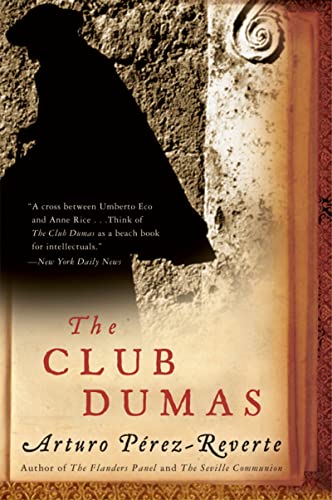
A provocative literary thriller that playfully pays tribute to classic tales of mystery and adventure
 
Lucas Corso is a book detective, a middle-aged mercenary hired to hunt down rare editions for wealthy and unscrupulous clients. When a well-known bibliophile is found dead, leaving behind part of the original manuscript of Alexandre Dumas's The Three Musketeers, Corso is brought in to authenticate the fragment. He is soon drawn into a swirling plot involving devil worship, occult practices, and swashbuckling derring-do among a cast of characters bearing a suspicious resemblance to those of Dumas's masterpiece. Aided by a mysterious beauty named for a Conan Doyle heroine, Corso travels from Madrid to Toledo to Paris on the killer's trail in this twisty intellectual romp through the book world.
Die Inhaltsangabe kann sich auf eine andere Ausgabe dieses Titels beziehen.
Über die Autorin bzw. den Autor
ARTURO PEREZ-REVERTE is the award-winning author of many critically acclaimed novels, including The Club Dumas, The Flanders Panel, and the Captain Alatriste series. A retired war journalist, he lives in Madrid and is a member of the Royal Spanish Academy.
Von der hinteren Coverseite
#1 International Bestseller
"A thriller of marvelous intricacy."?The New York Times Book Review
Lucas Corso is a book detective, a mercenary hired to hunt down rare editions for wealthy and unscrupulous clients. When a well-known bibliophile is found hanged, leaving behind part of the original manuscript of Alexandre Dumas’ The Three Musketeers, Corso is brought in to authenticate the fragment. He is soon drawn into a swirling plot involving devil worship, occult practices, and swashbuckling derring-do among a cast of characters bearing a suspicious resemblance to those of Dumas’ masterpiece.
"A thriller of marvelous intricacy."?The New York Times Book Review
Lucas Corso is a book detective, a mercenary hired to hunt down rare editions for wealthy and unscrupulous clients. When a well-known bibliophile is found hanged, leaving behind part of the original manuscript of Alexandre Dumas’ The Three Musketeers, Corso is brought in to authenticate the fragment. He is soon drawn into a swirling plot involving devil worship, occult practices, and swashbuckling derring-do among a cast of characters bearing a suspicious resemblance to those of Dumas’ masterpiece.
"Erudite, funny, loopy, brilliant . . . action-adventure spiced with dollops of idiosyncrasy?and some very good talk."?The Philadelphia Inquirer
"A noir metafiction . . . Even a reader armed with a Latin dictionary and a copy of The Three Musketeers cannot anticipate the thrilling twists of this stylish, Escher-like mystery."?The New Yorker
Arturo Perez-Reverte is the internationally best-selling author of CAPTAIN ALATRISTE. His books have been translated into twenty-nine languages in more than fifty countries and have sold millions of copies worldwide. He lives in Spain and was elected to the Spanish Royal Academy in 2003.
Auszug. © Genehmigter Nachdruck. Alle Rechte vorbehalten.
The Club Dumas
By Arturo Perez-ReverteHarvest Books
Copyright ©2006 Arturo Perez-ReverteAll right reserved.
ISBN: 9780156032834
I. "THE ANJOU WINE"
The reader must be prepared to witness the most sinister scenes.
-E. Sue, THE MYSTERIES OF PARIS
My name is Boris Balkan and I once translated The Charterhouse of Parma. Apart from that, I've edited a few books on the nineteenth-century popular novel, my reviews and articles appear in supplements and journals throughout Europe, and I organize summer-school courses on contemporary writers. Nothing spectacular, I'm afraid. Particularly these days, when suicide disguises itself as homicide, novels are written by Roger Ackroyd's doctor, and far too many people insist on publishing two hundred pages on the fascinating emotions they experience when they look in the mirror.
But let's stick to the story.
I first met Lucas Corso when he came to see me; he was carrying "The Anjou Wine" under his arm. Corso was a mercenary of the book world, hunting down books for other people. That meant talking fast and getting his hands dirty. He needed good reflexes, patience, and a lot of luck-and a prodigious memory to recall the exact dusty corner of an old man's shop where a book now worth a fortune lay forgotten. His clientele was small and select: a couple of dozen book dealers in Milan, Paris, London, Barcelona, and Lausanne, the kind that sell through catalogues, make only safe investments, and never handle more than fifty or so titles at any one time. High-class dealers in early printed books, for whom thousands of dollars depend on whether something is parchment or vellum or three centimeters wider in the margin. Jackals on the scent of the Gutenberg Bible, antique-fair sharks, auction-room leeches, they would sell their grandmothers for a first edition. But they receive their clients in rooms with leather sofas, views of the Duomo or Lake Constance, and they never get their hands-or their consciences-dirty. That's what men like Corso are for.
He took his canvas bag off his shoulder and put it on the floor by his scuffed oxfords. He stared at the framed portrait of Rafael Sabatini that stands on my desk next to the fountain pen I use for correcting articles and proofs. I was pleased, because most visitors paid Sabatini little attention, taking him for an aged relative. I waited for Corso's reaction. He was half smiling as he sat down-a youthful expression, like that of a cartoon rabbit in a dead-end street. The kind of look that wins over the audience straightaway. In time I found out he could also smile like a cruel, hungry wolf, and that he chose his smiles to suit the circumstances. But that was much later. Now he seemed trustworthy, so I decided to risk a password.
"He was born with the gift of laughter," I quoted, pointing at the portrait. and with a feeling that the world was mad . . . "
Corso nodded slowly and deliberately. I felt a friendly complicity with him, which, in spite of all that happened later, I still feel. From a hidden packet he brought out an unfiltered cigarette that was as crumpled as his old overcoat and corduroy trousers. He turned it over in his fingers, watching me through steel-rimmed glasses set crookedly on his nose under an untidy fringe of slightly graying hair. As if holding a hidden gun, he kept his other hand in one of his pockets, a pocket huge and deformed by books, catalogues, papers, and, as I also found out later, a hip flask full of Bols gin.
". . . and this was his entire inheritance." He completed the quotation effortlessly, then settled himself in the armchair and smiled again. "But to be honest, I prefer Captain Blood."
With a stern expression I lifted my fountain pen. "You're mistaken. Scaramouche is to Sabatini what The Three Musketeers is to Dumas." I bowed briefly to the portrait. "'He was born with the gift of laughter. . . .' In the entire history of the adventure serial no two opening lines can compare."
"That may be true," Corso conceded after a moment's reflection. Then he laid the manuscript on the table, in a protective folder with plastic pockets, one for each page. "It's a coincidence you should mention Dumas."
He pushed the folder toward me, turning it around so I could read its contents. The text was in French, written on one side of the page only. There were two types of paper, both discolored by age: one white, the other pale blue with light squares. The handwriting on each was different-on the white pages it was smaller and more spiky. The handwriting of the blue paper, in black ink, also appeared on the white pages but as annotations only. There were fifteen pages in all, eleven of them blue.
"Interesting." I looked up at Corso. He was watching me, his calm gaze moving from the folder to me, then back again. "Where did you find it?"
He scratched an eyebrow, no doubt calculating whether he needed to provide such details in exchange for the information he wanted. The result was a third facial expression, this time an innocent rabbit. Corso was a professional.
"Around. Through a client of a client."
"I see."
He paused briefly, cautious. Caution is a sign of prudence and reserve, but also of shrewdness. And we both knew it.
"Of course," he added, "I'll give you names if you request them."
I answered that it wouldn't be necessary, which seemed to reassure him. He adjusted his glasses before asking my opinion of the manuscript. Not answering immediately, I turned to the first page. The title was written in capital letters, in thicker strokes: LE VIN D'ANJOU.
I read aloud the first few lines: "Apr?s de nouvelles presque d?sesp?r?es du roi, le bruit de sa convalescence commen?ait ? se r?pandre dans le camp. . . ." I couldn't help smiling.
Corso indicated his approval, inviting me to comment.
"Without the slightest doubt," I said, "this is by Alexandre Dumas p?re. 'The Anjou Wine': chapter forty-something, I seem to remember, of The Three Musketeers."
"Forty-two," confirmed Corso. "Chapter forty-two."
"Is it authentic? Dumas's original manuscript?"
"That's why I'm here. I want you to tell me."
I shrugged slightly, reluctant to assume such a responsibility.
"Why me?"
It was a stupid question, the kind that only serves to gain time. It must have seemed like false modesty, because he suppressed a look of impatience.
"You're an expert," he retorted, somewhat dryly. "As well as being Spain's most influential literary critic, you know all there is to know about the nineteenth-century popular novel."
"You're forgetting Stendhal."
"Not at all. I read your translation of The Charterhouse of Parma"
"Indeed. I am honored."
"Don't be. I preferred Consuelo Berges's version."
We both smiled. I continued to find him likable, and I was beginning to form an idea of his style.
"Do you know any of my books?" I asked.
"Some. Lupin, Raffles, Rocambole, Holmes, for instance. And your studies of Valle-Inclan, Baroja, and Galdos. Also Dumas: the Shadow of a Giant. And your essay on The Count of Monte Cristo."
"Have you read all those?"
"No. I work with books, but that doesn't mean I have to read them."
He was lying. Or at least exaggerating. The man was conscientious: before coming to see me, he'd looked at everything about me he could lay his hands on. He was one of those compulsive readers who have devoured anything in print from a most tender age-although it was highly unlikely that Corso's childhood ever merited the term "tender."
"I understand," I...
„Über diesen Titel“ kann sich auf eine andere Ausgabe dieses Titels beziehen.
Suchergebnisse für The Club Dumas

Beispielbild für diese ISBN
The Club Dumas
Anbieter: World of Books (was SecondSale), Montgomery, IL, USA
Verkäuferbewertung 5 von 5 Sternen

Zustand: Good. #1 International Bestseller"A thriller of marvelous intricacy" (The New York Times Book Review), The Club Dumas is a provocative literary thriller that playfully pays tribute to classic tales of mystery and adventure.Lucas Corso is a book detective, a middle-aged mercenary hired to hunt down rare editions for wealthy and unscrupulous clients. When a well-known bibliophile is found dead, leaving behind part of the original manuscript of Alexandre Dumas's The Three Musketeers, Corso is brought in to authenticate the fragment. He is soon drawn into a swirling plot involving devil worship, occult practices, and swashbuckling derring-do among a cast of characters bearing a suspicious resemblance to those of Dumas's masterpiece. Aided by a mysterious beauty named for a Conan Doyle heroine, Corso travels from Madrid to Toledo to Paris on the killer's trail in this twisty intellectual romp through the book world."Erudite, funny, loopy, brilliant.action-adventure spied with dollops of idiosyncrasy -- and some very good talk."--The Philadelphia Inquirer. Artikel-Nr. 00102057070
Gebraucht kaufen
EUR 4,50
Versand gratis
Versand innerhalb von USA
Versand innerhalb von USA
Anzahl: Mehr als 20 verfügbar
Beispielbild für diese ISBN
The Club Dumas
Anbieter: World of Books (was SecondSale), Montgomery, IL, USA
Verkäuferbewertung 5 von 5 Sternen
Zustand: Fair. #1 International Bestseller"A thriller of marvelous intricacy" (The New York Times Book Review), The Club Dumas is a provocative literary thriller that playfully pays tribute to classic tales of mystery and adventure.Lucas Corso is a book detective, a middle-aged mercenary hired to hunt down rare editions for wealthy and unscrupulous clients. When a well-known bibliophile is found dead, leaving behind part of the original manuscript of Alexandre Dumas's The Three Musketeers, Corso is brought in to authenticate the fragment. He is soon drawn into a swirling plot involving devil worship, occult practices, and swashbuckling derring-do among a cast of characters bearing a suspicious resemblance to those of Dumas's masterpiece. Aided by a mysterious beauty named for a Conan Doyle heroine, Corso travels from Madrid to Toledo to Paris on the killer's trail in this twisty intellectual romp through the book world."Erudite, funny, loopy, brilliant.action-adventure spied with dollops of idiosyncrasy -- and some very good talk."--The Philadelphia Inquirer. Artikel-Nr. 00103325842
Gebraucht kaufen
EUR 4,50
Versand gratis
Versand innerhalb von USA
Versand innerhalb von USA
Anzahl: 4 verfügbar
Beispielbild für diese ISBN
The Club Dumas
Anbieter: ThriftBooks-Phoenix, Phoenix, AZ, USA
Verkäuferbewertung 5 von 5 Sternen
Paperback. Zustand: Good. No Jacket. Pages can have notes/highlighting. Spine may show signs of wear. ~ ThriftBooks: Read More, Spend Less. Artikel-Nr. G015603283XI3N00
Gebraucht kaufen
EUR 5,96
Versand gratis
Versand innerhalb von USA
Versand innerhalb von USA
Anzahl: 2 verfügbar
Beispielbild für diese ISBN
The Club Dumas
Anbieter: ThriftBooks-Reno, Reno, NV, USA
Verkäuferbewertung 5 von 5 Sternen
Paperback. Zustand: Good. No Jacket. Pages can have notes/highlighting. Spine may show signs of wear. ~ ThriftBooks: Read More, Spend Less. Artikel-Nr. G015603283XI3N00
Gebraucht kaufen
EUR 5,96
Versand gratis
Versand innerhalb von USA
Versand innerhalb von USA
Anzahl: 2 verfügbar
Beispielbild für diese ISBN
The Club Dumas
Anbieter: ThriftBooks-Atlanta, AUSTELL, GA, USA
Verkäuferbewertung 5 von 5 Sternen
Paperback. Zustand: Good. No Jacket. Pages can have notes/highlighting. Spine may show signs of wear. ~ ThriftBooks: Read More, Spend Less. Artikel-Nr. G015603283XI3N00
Gebraucht kaufen
EUR 5,99
Versand gratis
Versand innerhalb von USA
Versand innerhalb von USA
Anzahl: 3 verfügbar
Beispielbild für diese ISBN
The Club Dumas
Anbieter: ThriftBooks-Dallas, Dallas, TX, USA
Verkäuferbewertung 5 von 5 Sternen
Paperback. Zustand: Good. No Jacket. Pages can have notes/highlighting. Spine may show signs of wear. ~ ThriftBooks: Read More, Spend Less. Artikel-Nr. G015603283XI3N00
Gebraucht kaufen
EUR 5,99
Versand gratis
Versand innerhalb von USA
Versand innerhalb von USA
Anzahl: 3 verfügbar
Beispielbild für diese ISBN
The Club Dumas
Anbieter: BooksRun, Philadelphia, PA, USA
Verkäuferbewertung 5 von 5 Sternen
Paperback. Zustand: Fair. The item might be beaten up but readable. May contain markings or highlighting, as well as stains, bent corners, or any other major defect, but the text is not obscured in any way. Artikel-Nr. 015603283X-7-1
Gebraucht kaufen
EUR 6,05
Versand gratis
Versand innerhalb von USA
Versand innerhalb von USA
Anzahl: 1 verfügbar
Beispielbild für diese ISBN
The Club Dumas
Anbieter: BooksRun, Philadelphia, PA, USA
Verkäuferbewertung 5 von 5 Sternen
Paperback. Zustand: Very Good. It's a well-cared-for item that has seen limited use. The item may show minor signs of wear. All the text is legible, with all pages included. It may have slight markings and/or highlighting. Artikel-Nr. 015603283X-11-22
Gebraucht kaufen
EUR 6,95
Versand gratis
Versand innerhalb von USA
Versand innerhalb von USA
Anzahl: 1 verfügbar
Beispielbild für diese ISBN
The Club Dumas
Anbieter: Wonder Book, Frederick, MD, USA
Verkäuferbewertung 5 von 5 Sternen
Zustand: Good. Good condition. A copy that has been read but remains intact. May contain markings such as bookplates, stamps, limited notes and highlighting, or a few light stains. Artikel-Nr. M13D-01377
Gebraucht kaufen
EUR 7,15
Versand gratis
Versand innerhalb von USA
Versand innerhalb von USA
Anzahl: 1 verfügbar
Beispielbild für diese ISBN
The Club Dumas
Anbieter: Wonder Book, Frederick, MD, USA
Verkäuferbewertung 5 von 5 Sternen
Zustand: As New. Like New condition. A near perfect copy that may have very minor cosmetic defects. Artikel-Nr. A04A-04352
Gebraucht kaufen
EUR 7,15
Versand gratis
Versand innerhalb von USA
Versand innerhalb von USA
Anzahl: 1 verfügbar