
Verwandte Artikel zu Christianity and Evolution: Believing Scientist Teilhard'...
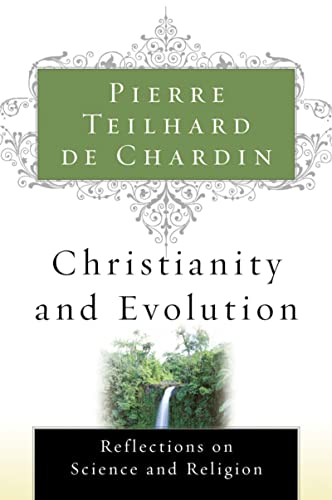
Christianity and Evolution: Believing Scientist Teilhard's Nineteen Essays on Integrating Religion and Science (Harvest Book, Hb 276) - Softcover
Inhaltsangabe
Nineteen essays concerned with the relationship of science and religion. As a believing scientist, Teilhard wrestled with the problem of presenting to the believer a scientific picture that would enlarge his religious vision and to the scientist a statement of religious ideas that would integrate with his understanding of reality. Foreword by N. M. Wildiers; Index. Translated by René Hague.A Helen and Kurt Wolff Book
Die Inhaltsangabe kann sich auf eine andere Ausgabe dieses Titels beziehen.
Über die Autorin bzw. den Autor
Pierre Teilhard de Chardin (1881-1955) was a Jesuit priest and paleontologist who studied chemistry, physics, botany, and zoology and received his doctorate in geology. The author of several works of philosophy and religion, he is considered by many to be among the foremost thinkers of our time. Toward the Future was first published in 1973.
Auszug. © Genehmigter Nachdruck. Alle Rechte vorbehalten.
Christianity And Evolution
By Pierre Teilhard de Chardin, René HagueHoughton Mifflin Harcourt Publishing Company
Copyright © 1969 Editions du Seuil
All rights reserved.
ISBN: 978-0-15-602818-9All rights reserved.
Contents
Title Page,
Contents,
Copyright,
Foreword,
NOTE ON THE PHYSICAL UNION BETWEEN THE HUMANITY OF CHRIST AND THE FAITHFUL IN,
THE COURSE OF THEIR SANCTIFICATION,
ON THE NOTION OF CREATIVE TRANSFORMATION,
NOTE ON THE MODES OF DIVINE ACTION IN THE UNIVERSE,
FALL, REDEMPTION, AND GEOCENTRISM,
NOTE ON SOME POSSIBLE HISTORICAL REPRESENTATIONS OF ORIGINAL SIN,
PANTHEISM AND CHRISTIANITY,
CHRISTOLOGY AND EVOLUTION,
HOW I BELIEVE,
SOME GENERAL VIEWS ON THE ESSENCE OF CHRISTIANITY,
CHRIST THE EVOLVER, OR A LOGICAL DEVELOPMENT OF THE IDEA OF REDEMPTION,
INTRODUCTION TO THE CHRISTIAN LIFE,
CHRISTIANITY AND EVOLUTION: SUGGESTIONS FOR A NEW THEOLOGY,
REFLECTIONS ON ORIGINAL SIN,
THE CHRISTIAN PHENOMENON,
MONOGENISM AND MONOPHYLETISM: AN ESSENTIAL DISTINCTION,
WHAT THE WORLD IS LOOKING FOR FROM THE CHURCH OF GOD AT THIS MOMENT,
THE CONTINGENCE OF THE UNIVERSE AND MANâ&8364;(tm)S ZEST FOR SURVIVAL,
A SEQUEL TO THE PROBLEM OF HUMAN ORIGINS: THE PLURALITY OF INHABITED WORLDS,
THE GOD OF EVOLUTION,
MY LITANY,
Index,
About the Author,
Footnotes,
CHAPTER 1
NOTE ON THE PHYSICAL UNION BETWEEN THE HUMANITY OF CHRIST AND THE FAITHFUL IN THE COURSE OF THEIR SANCTIFICATION
We may distinguish a priori (and meet a posteriori in different theological and mystical currents) three different tendencies in the ways of explaining how Christ 'vitis et vita vera,' Christ'caput creationis et ecclesiae', acts upon the faithful in the course of their sanctification. There are some Christians who understand Christ's saving influence primarily by analogy with our moral, juridical, categorical forms of causality; with, that is, some suggestion of the letter of the law, of something imposed from outside. Others, however, are more inclined to look at the 'natural', intrinsic, side of things, and try to explain Christ's action as experienced by us by relating it chiefly to the physical and organic causalities of the universe. These latter fall, again, into two classes: those who attach the vivifying action upon souls above all to the Word, in Jesus Christ — and those who tend to attribute as large as possible a part in this physical operation to the humanity of our Lord.
It calls for no great experience of the Christian soul to see that the last of these three tendencies — that which tends to magnify (to 'emphasize') the physical links between Christ's humanity and ourselves — is particularly vigorous today.
The object of this note is to indicate a possible way of understanding and establishing this thesis — accepted in practice by many Christians in their interior life — that the holiness of the Christian develops and is completed in a sort of contact (physical and permanent) with the actually human reality of Christ the Saviour.
A solid basis for the demonstration, or rather the suggestions, we have in mind may profitably be sought in a consideration of the consummated mystical body (that is, the Pauline pleroma). In the first place, since the pleroma is the kingdom of God in its completed form, the properties attributed to it by Scripture must be regarded as specially characteristic of the entire supernatural organism, even if they are to be found only in an ill-defined form in any particular preparatory phase of beatification. Secondly, in no other reality is the physical and personal action of the theandric Christ made manifest to us by revelation more than in the Church triumphant. When we try to sum up the Church's teaching and the thought of the saints on the innermost nature of beatitude, we find that in heaven both Christ and the elect must be regarded as forming one living whole, disposed in a strict hierarchic pattern. Each elect soul, it is true, possesses God directly, and finds in that unique possession the fulfilment of his own individuality. But, however individual this possession of the divine, this contact, may be, they are not obtained individually. The beatific vision, which illuminates each of the elect for himself alone, is at the same time a collective act performed by the whole mystical organism at once 'per modum unius potentiae' (as one single force). The organ made for seeing God is not (if you get to the bottom of the dogma) the isolated human soul; it is the human soul united to all the other souls, under the humanity of Christ We attain God in heaven 'sicuti est' (as he is), but in the measure in which we are assumed by Christ into the mystical extensions of his substance. Briefly, the state of beatitude must be understood as a state of permanent eucharistic union in which we will be raised up and maintained as a body (that is to say 'per modum unius'— as one single being) and 'in corpore Christi' (in the body of Christ). This explains the fundamental relationship between the eucharist and charity, between love of God and love of our neighbour.
If this is indeed the condition of holiness 'in termino' (at its term), that is to say a union with God in Jesus-Christ-Man, it would appear that there is only one way in which we can understand the nature of holiness 'in via' (on its road to that term): in which, that is, we can understand our sanctification as it is here and now laboriously being effected. Since beatification coincides with a certain degree of physical incorporation in the created being of our Lord, we must inevitably admit that in the course of his meritorious life the believer is introduced into, and progresses further in, a certain state of physical connexion with the humanity of Christ the Saviour. If we are not to establish an unwarranted disparity between the state of grace and the state of glory, we must say that grace does more than attach us by its spiritual instillation to the divinity of the Word: it brings with it a certain progressive inclusion in a created organism, physically centred on the humanity of Christ.
Far from conflicting with the eucharist or serving as a repetition of the eucharist, this 'habitual' communion effected by sanctifying grace between Christ and the faithful gives its full significance, we should note, to sacramental reception of the sacred species.
In the first place, it is quite certain that the eucharist, of which many of the elect will have been unable to partake during their life on earth, is not the only means by which the faithful can achieve contact — contact which is necessary as a 'necessary' means — with Christ's humanity: the contact which is to ensure their integration in the pleroma. We become members of Christ before any external contact with his sacramental body.
Moreover, it is equally clear that in receiving the eucharist, adherence to the flesh of Christ, as produced by consuming the species, is effected on a physical plane that is very different from that on which the evident quantitative contact between our body and the Host takes place. Is it not, in fact, precisely at the moment when this quantitative contact would tend to be fully established (by assimilation) that the species undergo corruption and the divine presence becomes less marked?
The eucharist, in short, can be fully explained only in terms of a mode of contact with...
„Über diesen Titel“ kann sich auf eine andere Ausgabe dieses Titels beziehen.
Suchergebnisse für Christianity and Evolution: Believing Scientist Teilhard'...

Beispielbild für diese ISBN
Christianity and Evolution
Anbieter: ThriftBooks-Phoenix, Phoenix, AZ, USA
Verkäuferbewertung 5 von 5 Sternen

Paperback. Zustand: Very Good. No Jacket. May have limited writing in cover pages. Pages are unmarked. ~ ThriftBooks: Read More, Spend Less. Artikel-Nr. G0156028182I4N00
Gebraucht kaufen
EUR 10,32
Versand gratis
Versand innerhalb von USA
Versand innerhalb von USA
Anzahl: 1 verfügbar
Beispielbild für diese ISBN
Christianity and Evolution
Anbieter: ThriftBooks-Atlanta, AUSTELL, GA, USA
Verkäuferbewertung 5 von 5 Sternen
Paperback. Zustand: Very Good. No Jacket. Missing dust jacket; May have limited writing in cover pages. Pages are unmarked. ~ ThriftBooks: Read More, Spend Less. Artikel-Nr. G0156028182I4N01
Gebraucht kaufen
EUR 10,32
Versand gratis
Versand innerhalb von USA
Versand innerhalb von USA
Anzahl: 1 verfügbar
Beispielbild für diese ISBN
Christianity and Evolution
Anbieter: ThriftBooks-Atlanta, AUSTELL, GA, USA
Verkäuferbewertung 5 von 5 Sternen
Paperback. Zustand: Very Good. No Jacket. May have limited writing in cover pages. Pages are unmarked. ~ ThriftBooks: Read More, Spend Less. Artikel-Nr. G0156028182I4N00
Gebraucht kaufen
EUR 10,32
Versand gratis
Versand innerhalb von USA
Versand innerhalb von USA
Anzahl: 1 verfügbar
Beispielbild für diese ISBN
Christianity and Evolution
Anbieter: ThriftBooks-Dallas, Dallas, TX, USA
Verkäuferbewertung 5 von 5 Sternen
Paperback. Zustand: Very Good. No Jacket. May have limited writing in cover pages. Pages are unmarked. ~ ThriftBooks: Read More, Spend Less. Artikel-Nr. G0156028182I4N00
Gebraucht kaufen
EUR 10,32
Versand gratis
Versand innerhalb von USA
Versand innerhalb von USA
Anzahl: 1 verfügbar
Beispielbild für diese ISBN
Christianity and Evolution
Anbieter: Books From California, Simi Valley, CA, USA
Verkäuferbewertung 4 von 5 Sternen

paperback. Zustand: Fine. Artikel-Nr. mon0004119405
Gebraucht kaufen
EUR 6,94
EUR 4,45 Versand
Versand innerhalb von USA
Versand innerhalb von USA
Anzahl: 1 verfügbar
Beispielbild für diese ISBN
Christianity and Evolution (Harvest Book, Hb 276)
Anbieter: WorldofBooks, Goring-By-Sea, WS, Vereinigtes Königreich
Verkäuferbewertung 5 von 5 Sternen
Paperback. Zustand: Very Good. The book has been read, but is in excellent condition. Pages are intact and not marred by notes or highlighting. The spine remains undamaged. Artikel-Nr. GOR010878429
Gebraucht kaufen
EUR 5,75
EUR 6,63 Versand
Versand von Vereinigtes Königreich nach USA
Versand von Vereinigtes Königreich nach USA
Anzahl: 1 verfügbar
Beispielbild für diese ISBN
Christianity and Evolution
Anbieter: Revaluation Books, Exeter, Vereinigtes Königreich
Verkäuferbewertung 5 von 5 Sternen
Paperback. Zustand: Brand New. 264 pages. 7.75x5.25x0.75 inches. In Stock. Artikel-Nr. x-0156028182
Neu kaufen
EUR 19,35
EUR 11,84 Versand
Versand von Vereinigtes Königreich nach USA
Versand von Vereinigtes Königreich nach USA
Anzahl: 2 verfügbar