
Verwandte Artikel zu Sign Of Jonas (ReIssue) Pa (Harvest Book)
Inhaltsangabe
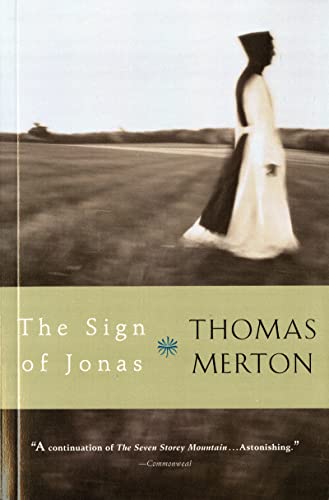
Begun five years after he entered the Abbey of Our Lady of Gethsemani, The Sign of Jonas is an extraordinary view of Merton’s life in a Trappist monastery, and it serves also as a spiritual log recording the deep meaning and increasing sureness he felt in his vocation: the growth of a mind that finds in its contracted physical world new intellectual and spiritual dimensions.
Die Inhaltsangabe kann sich auf eine andere Ausgabe dieses Titels beziehen.
Über die Autorin bzw. den Autor
Thomas Merton (1915-1968) was born in France and came to live in the United States at the age of 24. He received several awards recognizing his contribution to religious study and contemplation, including the Pax Medal in 1963, and remained a devoted spiritualist and a tireless advocate for social justice until his death in 1968.
Auszug. © Genehmigter Nachdruck. Alle Rechte vorbehalten.
The Sign of Jonas
By Thomas MertonHoughton Mifflin Harcourt Publishing Company
Copyright © 1981 The Trustees of the Merton Legacy Trust
All rights reserved.
ISBN: 978-0-15-602800-4All rights reserved.
Contents
Title Page,
Contents,
Copyright,
Dedication,
Epigraph,
Journey to Nineveh,
Solemn Profession,
Death of an Abbot,
Major Orders,
To the Altar of God,
The Whale and the Ivy,
The Sign of Jonas,
Fire Watch, July 4, 1952,
About the Author,
Connect with HMH,
Footnotes,
CHAPTER 1
PART ONE
Solemn Profession
December, 1946 to December, 1947 This Journal started when I had been five years in the monastery. That meant that I was coming to the end of my term of simple vows and was making up my mind to take solemn vows and stay in the monastery for good.
When you enter a Cistercian monastery you spend some time as a postulant. After that you are a novice for two years, during which you hope to learn the rudiments of the Trappist life and discover whether or not you belong in the monastery. After that you make temporary simple vows for three years. These serve to prolong your probation. If, after these five years of probation, you want to leave, you are free to do so. If you stay, you make solemn perpetual vows. By these vows you consecrate your whole life to God in the monastery. After that you just forget about going back to the world.
By the grace of God it was easy for me to forget the world as soon as I left it. I never wanted to go back. However, I often wondered if I should not go to some other monastery. This was what is known as a "temptation." But at the time when I began writing this Journal I could not be quite sure whether it was a temptation or not. And I was a great nuisance to my spiritual directors on that account.
At that time I thought I was upset by the fact that DomFrederic, who was then Abbot, wanted me to write a lot of books. Perhaps I was less upset than I thought. But in any case, I did have to write a lot of books, some of which were terrible.
In December, 1946, I received word from a New York publisher that one of these books had been accepted. The book was called The Seven Storey Mountain and it was an autobiography. As things turned out, it became quite popular. I thought it would, but I did not like to admit it, because that might possibly be pride. And maybe it was.
(I remember when I was a novice, before I wrote the book, I went to confession and confessed, as a temptation, that I had thought of writing an autobiography, and the confessor found this extremely funny. He said: "Ha! Ha! Ha! When Chesterton wrote his autobiography he showed it to one of his friends and he was told that it didn't amount to much. Now if that happened to Chesterton, what would happen to you? ..." And, indeed, I have been told in set terms by some of the readers of the book that it does not amount to much. I do not say that I expected it to be a good book, I just say I expected it to be popular.)
All this time I was studying theology, and I was a cleric in minor Orders. To be exact, I had been ordained exorcist on the Feast of Saint Michael and All Angels in 1946, and it seemed that I would not reach the priesthood for a hundred years.
So on the Feast of Saint Joseph — March 19, 1947 — I made my solemn vows.
I did not become a better monk after solemn vows than I had been before them, and I went on worrying about much the same things and striving to write a book called The Waters of Siloe in which I solemnly declare how monks are supposed to act if they want to be monks. I am beginning to realize how much of an impertinence this was. The reason why I wrote the book was that Dom Frederic wanted a history of the Order and of the monastery to be published when we celebrated the hundredth anniversary of our foundation. But I found myself involved in a discussion of monastic ideals. Perhaps, from my own point of view at least, this was useful. Thinking about monastic ideals isnot the same as living up to them, but at any rate such thinking has an important place in a monk's life, because you cannot begin to do anything unless you have some idea what you are trying to do.
There is nothing to prevent a monk from praying even while he writes a book. This discovery did not come to me until I finally resigned myself to being a writer, and found out that the job had one big compensation: it brought me solitude. In 1946 and 1947 I did not have a room to myself to write in, and so it did not occur to me to pray while I was writing. The room where I worked was shared by another monk with another typewriters canonist, working on some involved problem of law. He was, in fact, my professor of theology and later became my confessor. He was also one of the censors whose penance was to read the pages that flowed with such regularity from my typewriter in those innocent days.
Among other things that happened during this year, I had to serve as the secretary of the Abbot General of the Order when he came to Gethsemani to make an official Visitation. Then in July some monks were sent to Utah to make a foundation. During the year I had the job of assistant cantor, which sounds like much more than it is, and during the summer I read books aloud in the dining-room of the guest house to the visitors who came on weekend retreats to the monastery.
December 10 ADVENT [1946]
It is five years since I came to the monastery. It is the same kind of day, overcast. But now it is raining. I wish I knew how to begin to be grateful to God and to Our Lady for bringing me here.
There was a long interval after afternoon work. It was good to be in the big quiet church. The church is dark, these winter afternoons.
December 13 SAINT LUCY
The years since I entered Gethsemani have gone by like five weeks. It was a fine bright day, not very cold, with little clouds very high up in a clear sky. Yesterday, although it is Advent and we are not supposed to receive any letters at all, Dom Frederic* gave me a letter from Naomi Burton of Curtis Brown, Ltd. I had sent her the manuscript of The Seven Storey Mountain. Her letter about it was very good and she is quite sure it will find a publisher. Anyway, my idea — and hers also — is to turn it over to Robert Giroux at Harcourt, Brace.
At work — writing — I am doing a little better. I mean, I am less tied up in it, more peaceful and more detached. Taking one thing at a time and going over it slowly and patiently (if I can ever be said to do anything slowly and patiently) and forgetting about the other jobs that have to take their turn. For instance, Jay Laughlin wants two anthologies for New Directions press. I wonder if I will ever be able to do them. If God wills. Meanwhile, for myself, I have only one desire and that is the desire for solitude — to disappear into God, to be submerged in His peace, to be lost in the secret of His Face.
December 14 SATURDAY
This afternoon we were working on the road from the old horsebarn to the lower bottom, filling in a deep gully that had washed out all along the road, down to the bottom of the hill. It was another bright, warm day. The new brick horsebarn, under the water tower, where the vineyard used to be, is almost finished. They are clearing ground already for the new garden house. There were some fat turkeys in the pen. Father Joel has already started to put up the crib, in the...
„Über diesen Titel“ kann sich auf eine andere Ausgabe dieses Titels beziehen.
Suchergebnisse für Sign Of Jonas (ReIssue) Pa (Harvest Book)

Foto des Verkäufers
The Sign of Jonas
Anbieter: Goodwill of Ventura and Santa Barbara Counties, Oxnard, CA, USA
Verkäuferbewertung 5 von 5 Sternen

Zustand: good. Good: The book has been read but is in good condition. It has very minimal damage to the cover, including scuff marks, but no holes or tears. The dust jacket for hard covers may not be included. The binding has minimal wear. The majority of pages are undamaged with minimal creasing or tearing, minimal pencil underlining of text, no highlighting of text, and no writing in the margins. There are no missing pages. See the seller's listing for full details and a description of any imperfections. Artikel-Nr. VSBV.015602800X.G
Gebraucht kaufen
EUR 6,78
EUR 4,47 Versand
Versand innerhalb von USA
Versand innerhalb von USA
Anzahl: 1 verfügbar
Beispielbild für diese ISBN
The Sign of Jonas
Anbieter: Better World Books: West, Reno, NV, USA
Verkäuferbewertung 5 von 5 Sternen
Zustand: Very Good. Former library copy. Pages intact with possible writing/highlighting. Binding strong with minor wear. Dust jackets/supplements may not be included. Includes library markings. Stock photo provided. Product includes identifying sticker. Better World Books: Buy Books. Do Good. Artikel-Nr. 16177264-75
Gebraucht kaufen
EUR 11,67
Versand gratis
Versand innerhalb von USA
Versand innerhalb von USA
Anzahl: 1 verfügbar
Beispielbild für diese ISBN
The Sign of Jonas
Anbieter: Books From California, Simi Valley, CA, USA
Verkäuferbewertung 4 von 5 Sternen

Paperback. Zustand: Very Good. Artikel-Nr. mon0004185925
Gebraucht kaufen
EUR 7,80
EUR 4,47 Versand
Versand innerhalb von USA
Versand innerhalb von USA
Anzahl: 1 verfügbar
Beispielbild für diese ISBN
The Sign of Jonas
Anbieter: Revaluation Books, Exeter, Vereinigtes Königreich
Verkäuferbewertung 5 von 5 Sternen
Paperback. Zustand: Brand New. 384 pages. 7.75x5.25x1.00 inches. In Stock. Artikel-Nr. x-015602800X
Neu kaufen
EUR 25,57
EUR 11,84 Versand
Versand von Vereinigtes Königreich nach USA
Versand von Vereinigtes Königreich nach USA
Anzahl: 2 verfügbar
Beispielbild für diese ISBN
The Sign of Jonas
Anbieter: Kennys Bookstore, Olney, MD, USA
Verkäuferbewertung 5 von 5 Sternen
Zustand: New. 2002. paperback. . . . . . Books ship from the US and Ireland. Artikel-Nr. V9780156028004
Neu kaufen
EUR 31,28
EUR 9,41 Versand
Versand innerhalb von USA
Versand innerhalb von USA
Anzahl: Mehr als 20 verfügbar