
Verwandte Artikel zu Words Fail Me: What Everyone Who Writes Should Know...
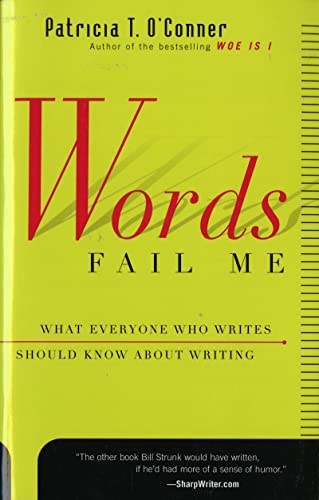
Words Fail Me: What Everyone Who Writes Should Know about Writing: What Everyone Who Writes Should Know about Writing – The Funny and Painless Grammar Companion (Harvest Book) - Softcover
Inhaltsangabe
A fun, focused guide to making words work for you
Whether you are working on the novel that's been in the back of your mind for years or simply facing an increasing demand to write well at work or school, the fact remains: we all write more often these days, be it reports, e-mails, blog posts, or texts. But despite the increase in written communication, the fundamentals of good writing have been lost. Grammar maven Patricia T. O'Conner comes to the rescue with the most painless, practical, and funny writing book ever written. In short, snappy chapters filled with crystal-clear examples, amusing comparisons, and humorous allegories that cover everything from "Pronoun Pileups" and "Verbs That Zing" to "What to Do When You're Stuck," O'Conner provides simple, straightforward tips to help you sort through your thoughts and make your sentences strong.
Die Inhaltsangabe kann sich auf eine andere Ausgabe dieses Titels beziehen.
Über die Autorin bzw. den Autor
PATRICIA T. O'CONNER is the author of five books about the English language, including the bestsellingWoe Is I. A former editor at The New York Times Book Review, her writing has appeared in many magazines and newspapers, including The New York Times and Newsweek.,
Auszug. © Genehmigter Nachdruck. Alle Rechte vorbehalten.
Words Fail Me
What Everyone Who Writes Should Know About Writing
By Patricia T. O'ConnerHoughton Mifflin Harcourt Publishing Company
Copyright © 1999 Patricia T. O'Conner
All rights reserved.
ISBN: 978-0-15-601087-0All rights reserved.
Contents
Title Page,
Contents,
Dedication,
Copyright,
Acknowledgments,
Introduction,
PART 1,
1. Is Your Egg Ready to Hatch?,
2. "The Party to Whom I Am Speaking",
3. Get with the Program,
4. Commencement Address,
5. From Here to Uncertainty,
PART 2,
6. Pompous Circumstances,
7. The Life of the Party,
8. Call Waiting,
9. Now, Where Were We?,
10. The It Parade,
11. Smothering Heights,
12. Too Marvelous for Words,
13. Made for Each Other,
14. Give Me a Break,
15. The Elongated Yellow Fruit,
16. Training Wheels,
17. Critique of Poor Reason,
18. Grammar Moses,
19. Down for the Count,
PART 3,
20. Lost Horizon,
21. Wimping Out,
22. Everybody's Favorite Subject,
23. Promises, Promises,
24. You Got Rhythm,
25. The Human Comedy,
26. I Second That Emotion,
27. The Importance of Being Honest,
28. Once around the Block,
29. Debt before Dishonor,
30. Revise and Consent,
Appendix,
Bibliography,
Index,
Footnotes,
CHAPTER 1
Is Your Egg Ready to Hatch?
KNOW THE SUBJECT
Let's face it. Some subjects are harder to explain than others. A pipe organ is more complicated than a kazoo (even I can play Bach on the kazoo). No subject, though, is so complicated that it can't be explained in clear English. If you can't explain something to another person, maybe — just maybe — you don't quite understand it yourself.
Anything worth writing about is worth explaining. But you can't make something clear to someone else if it isn't clear to you. Before you write about a subject, make sure you know it inside and out. If there are questions in your mind, don't skip them or cover them up. Do your best to find the answers. Then, if questions remain, you can always be honest and say so; the reader will forgive you.
Whenever there's something wrong with your writing, suspect that there's something wrong with your thinking. Perhaps your writing is unclear because your ideas are unclear. Think, read, learn some more. When your egg is ready to hatch, it'll hatch. In the meantime, sit on it a bit longer.
The old admonition to "write what you know" is a cliché, but it's still good advice. No matter how vivid and fertile your imagination, you'll write best what you know best. Dr. Spock patted thousands of babies' bottoms, and generations of parents have turned to his venerable book on child care. Ben Hogan was the king of the swing, and his book on the fundamentals of golf has been a classic for years.
Speaking of classics, Melville and Conrad spent years at sea, and you can almost smell the salt air in their writing. In his rough-and-tumble youth, Dickens worked in a blacking factory, lived in the poorhouse, and clerked and ran errands in law offices and courts. Not surprisingly, his most lifelike characters aren't from high society. They're street people, beggars, thieves and spongers, laborers, petty clerks, and of course lawyers.
You may have noticed that in Jane Austen's novels, ladies are always present. What did the men say among themselves over their port when the women had withdrawn? Austen never took part in exclusively male conversation, so there is none in her novels. What's unfamiliar is kept offstage.
Not all of us have the luxury of writing only about what we know. A college student who's asked to write a paper on Kierkegaard can't very well decline and say he'd rather write about the Spice Girls. An ad executive with a fabulous wine cellar isn't likely to turn down the Bud account just because she thinks beer is déclassé. If you have to write about something unfamiliar, learn about it. Once you know the subject, you're ready to write.
You're probably wondering about those exceptions to the rule — writers who convincingly describe things they couldn't have seen with their own eyes. Anne Rice's Interview with the Vampire is vivid and convincing, even though she's never met one of the undead (at least, I hope she hasn't). She modeled the vampire Lestat after her blond husband, and set much of the atmospheric tale in her native New Orleans. Her writing comes alive because she's borrowed from what she knows in order to create a fictional world that's as real as the real thing.
Don't let the exceptions mislead you, though. An author who invents a world she hasn't seen, a reality she hasn't known, must be hellishly good to be believable. Most of us aren't hellishly good. We must know whereof we speak.
CHAPTER 2"The Party to Whom I Am Speaking"
KNOW THE AUDIENCE
A piece of writing requires at least two people: one to write it and one to read it. Who's going to read yours? It's important to ask, because people who don't know their readers or who forget about them aren't very good writers. You'll save yourself all kinds of trouble by learning this lesson early.
All writers, remember, are readers first. You'll read a lot more than you'll ever write. Let the reader in you influence the writer in you. Put yourself in the reader's place, then write what you'd like to read.
If the very idea of writing strikes fear into your soul, or if you freeze up when you start to write, you may have a problem imagining your reader. Fear of writing is often fear of the reader, especially one you don't know. And no wonder. Nothing is more daunting than an audience of strangers. Break the ice and get acquainted.
Similarly, if your writing is unfocused, your reader may be out of focus, too. When you can't see the target, you don't know where to aim. Sharpen your focus and bring the reader into the picture. Clarifying your audience will clarify your thinking and your writing.
All writing has an intended audience, even the telephone book (it may be monotonous, short on verbs, and heavy on numbers and proper nouns, but it sure knows its readers!). Your audience probably won't be as wide as your area code, but it could be almost anyone — your landlord, a garden club, the parole board, Internet jocks, a college admissions director, fiction readers, the editorial-page editor, the Supreme Court. Someone is always on the receiving end, but who? It's a big world out there, and before you write you have to narrow it down. Once you've identified your audience, everything you do — every decision you make about vocabulary, tone, sentence structure, imagery, humor, and the rest — should be done with this target, your reader, in mind.
Draw a mental picture of your reader and carry it with you as you write. Stop working now and then, and, like Lily Tomlin's telephone operator, ask, "Is this the party to whom I am speaking?"
Of course, you might have a different audience every time you write; where writing is concerned, one size does not fit all. As much as possible, try to anticipate your reader's needs, sophistication, likes and dislikes, attention span, mood, tastes, and sense of humor. In our personal relationships, this kind of discretion is called tact; in writing, it's called knowing your audience.
Here's how it works. Say you're writing a brochure for an investment firm, giving financial advice to the newly widowed. You'll want to...
„Über diesen Titel“ kann sich auf eine andere Ausgabe dieses Titels beziehen.
Suchergebnisse für Words Fail Me: What Everyone Who Writes Should Know...

Beispielbild für diese ISBN
Words Fail Me
Anbieter: World of Books (was SecondSale), Montgomery, IL, USA
Verkäuferbewertung 5 von 5 Sternen

Paperback. Zustand: Fair. A guide to proper writing offers advice on organizing ideas, formulating sentences, following grammatical rules, and using verbs and adjectives. Artikel-Nr. 00096517267
Gebraucht kaufen
EUR 4,46
Versand gratis
Versand innerhalb von USA
Versand innerhalb von USA
Anzahl: 3 verfügbar
Beispielbild für diese ISBN
Words Fail Me
Anbieter: World of Books (was SecondSale), Montgomery, IL, USA
Verkäuferbewertung 5 von 5 Sternen
Paperback. Zustand: Good. A guide to proper writing offers advice on organizing ideas, formulating sentences, following grammatical rules, and using verbs and adjectives. Artikel-Nr. 00084790522
Gebraucht kaufen
EUR 4,46
Versand gratis
Versand innerhalb von USA
Versand innerhalb von USA
Anzahl: 14 verfügbar
Beispielbild für diese ISBN
Words Fail Me: What Everyone Who Writes Should Know about Writing
Anbieter: ThriftBooks-Dallas, Dallas, TX, USA
Verkäuferbewertung 5 von 5 Sternen
Paperback. Zustand: Very Good. No Jacket. May have limited writing in cover pages. Pages are unmarked. ~ ThriftBooks: Read More, Spend Less. Artikel-Nr. G0156010879I4N00
Gebraucht kaufen
EUR 6,23
Versand gratis
Versand innerhalb von USA
Versand innerhalb von USA
Anzahl: 1 verfügbar
Beispielbild für diese ISBN
Words Fail Me: What Everyone Who Writes Should Know about Writing
Anbieter: ThriftBooks-Atlanta, AUSTELL, GA, USA
Verkäuferbewertung 5 von 5 Sternen
Paperback. Zustand: Very Good. No Jacket. May have limited writing in cover pages. Pages are unmarked. ~ ThriftBooks: Read More, Spend Less. Artikel-Nr. G0156010879I4N00
Gebraucht kaufen
EUR 6,28
Versand gratis
Versand innerhalb von USA
Versand innerhalb von USA
Anzahl: 1 verfügbar
Beispielbild für diese ISBN
Words Fail Me: What Everyone Who Writes Should Know about Writing
Anbieter: ThriftBooks-Atlanta, AUSTELL, GA, USA
Verkäuferbewertung 5 von 5 Sternen
Paperback. Zustand: Good. No Jacket. Pages can have notes/highlighting. Spine may show signs of wear. ~ ThriftBooks: Read More, Spend Less. Artikel-Nr. G0156010879I3N00
Gebraucht kaufen
EUR 6,28
Versand gratis
Versand innerhalb von USA
Versand innerhalb von USA
Anzahl: 1 verfügbar
Beispielbild für diese ISBN
Words Fail Me : What Everyone Who Writes Should Know about Writing
Verlag:
HarperCollins Publishers, 2000
ISBN 10: 0156010879
ISBN 13: 9780156010870
Gebraucht
Softcover
Anbieter: Better World Books, Mishawaka, IN, USA
Verkäuferbewertung 5 von 5 Sternen
Zustand: Good. 1st Harvest Ed. Pages intact with minimal writing/highlighting. The binding may be loose and creased. Dust jackets/supplements are not included. Stock photo provided. Product includes identifying sticker. Better World Books: Buy Books. Do Good. Artikel-Nr. GRP94674163
Gebraucht kaufen
EUR 6,55
Versand gratis
Versand innerhalb von USA
Versand innerhalb von USA
Anzahl: 2 verfügbar
Beispielbild für diese ISBN
Words Fail Me: What Everyone Who Writes Should Know about Writing
Verlag:
Collins Reference (edition Reprint), 2000
ISBN 10: 0156010879
ISBN 13: 9780156010870
Gebraucht
Paperback
Anbieter: BooksRun, Philadelphia, PA, USA
Verkäuferbewertung 5 von 5 Sternen
Paperback. Zustand: Very Good. Reprint. It's a well-cared-for item that has seen limited use. The item may show minor signs of wear. All the text is legible, with all pages included. It may have slight markings and/or highlighting. Artikel-Nr. 0156010879-8-18
Gebraucht kaufen
EUR 6,72
Versand gratis
Versand innerhalb von USA
Versand innerhalb von USA
Anzahl: 1 verfügbar
Beispielbild für diese ISBN
Words Fail Me: What Everyone Who Writes Should Know about Writing
Verlag:
Collins Reference (edition First Edition), 2000
ISBN 10: 0156010879
ISBN 13: 9780156010870
Gebraucht
Paperback
Erstausgabe
Anbieter: BooksRun, Philadelphia, PA, USA
Verkäuferbewertung 5 von 5 Sternen
Paperback. Zustand: Very Good. First Edition. It's a well-cared-for item that has seen limited use. The item may show minor signs of wear. All the text is legible, with all pages included. It may have slight markings and/or highlighting. Artikel-Nr. 0156010879-11-1
Gebraucht kaufen
EUR 6,75
Versand gratis
Versand innerhalb von USA
Versand innerhalb von USA
Anzahl: 1 verfügbar
Beispielbild für diese ISBN
Words Fail Me: What Everyone Who Writes Should Know about Writing
Anbieter: Wonder Book, Frederick, MD, USA
Verkäuferbewertung 5 von 5 Sternen
Zustand: Very Good. Very Good condition. A copy that may have a few cosmetic defects. May also contain light spine creasing or a few markings such as an owner's name, short gifter's inscription or light stamp. Artikel-Nr. U05K-00150
Gebraucht kaufen
EUR 7,13
Versand gratis
Versand innerhalb von USA
Versand innerhalb von USA
Anzahl: 3 verfügbar
Beispielbild für diese ISBN
Words Fail Me: What Everyone Who Writes Should Know about Writing
Anbieter: Wonder Book, Frederick, MD, USA
Verkäuferbewertung 5 von 5 Sternen
Zustand: Good. Good condition. A copy that has been read but remains intact. May contain markings such as bookplates, stamps, limited notes and highlighting, or a few light stains. Artikel-Nr. J09P-00734
Gebraucht kaufen
EUR 7,13
Versand gratis
Versand innerhalb von USA
Versand innerhalb von USA
Anzahl: 1 verfügbar