
Verwandte Artikel zu Born Blue
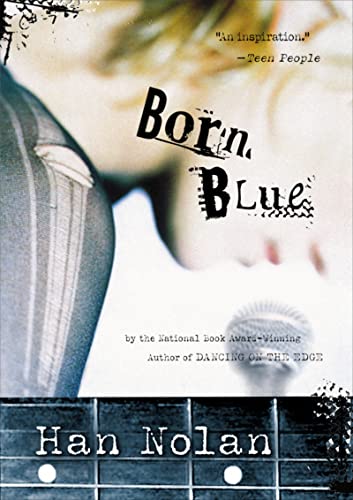
Inhaltsangabe
Leshaya is a survivor. Rescued from the brink of death, this child of a heroin addict has seen it all: revolving foster homes, physical abuse, an unwanted pregnancy. Now, as her tumultuous childhood is coming to an end, she is determined to make a life for herself by doing the only thing that makes her feel whole . . . singing.
Han Nolan pulls no punches in this hard-hitting story of a girl at the bottom who dreams of nothing but the top.
Han Nolan pulls no punches in this hard-hitting story of a girl at the bottom who dreams of nothing but the top.
Die Inhaltsangabe kann sich auf eine andere Ausgabe dieses Titels beziehen.
Über die Autorin bzw. den Autor
HAN NOLAN has won many awards for her teen fiction, including the National Book Award for Dancing on the Edge. She lives in New England.
Auszug. © Genehmigter Nachdruck. Alle Rechte vorbehalten.
Born Blue
By Han NolanHoughton Mifflin Harcourt Publishing Company
Copyright © 2001 Han Nolan
All rights reserved.
ISBN: 978-0-15-204697-2All rights reserved.
CHAPTER 1
My first memory of myself I be drowning. I can close my eyes and feel myself getting pushed back under all that heavy water, my legs kicking and straining for the sandy bottom. Alls I find be more water rushing at me and over me, big walls of water hitting me whole and tossing me upside down, and I got no breath left, so I open my mouth and I swallow a gallon of salt water and choke, and more water get up my nose and burn in my head, and I go for a breath again, and the whole time I thinking, Mama's gonna be mad at me, Mama's gonna be mad. Then I ain't thinking nothin' and all the struggling stops, and I wake up in a dark room I know ain't mine. I think I be dead, but I scream, anyways, and a lady I never seen come in and holds me till daylight.
That were back when I were four years old. They couldn't find Mama Linda for a long time, and then when they did, they said I couldn't see her 'cause she were sick and needed help. I kept on crying for her and asking for her and telling all them grown-up people who now in my life that I wanted my mama. When were I gonna see my mama?
I got put in a foster home with Patsy and Pete, my foster parents, and some babies that come and went — there was always some babies in the home — and a foster brother named Harmon Finch.
I remember the house that Pete and Patsy lived in like I just moved out yesterday. I don't think after all these years I yet got the smell of that place outta me. It were in a town just outside of Mobile, Alabama, a little poky town. The house were a big old nasty with yellow paint and brown trim and mostly just fallin' down ugly. It had more puke smells in it than a toilet bowl, and all of them some kind of sour, like sour feet and sour cheese and wet sour and fart and BO. Most of them come from Pete, and the rest come from Patsy's cooking or the way she didn't never keep a house. Them smells just flooded the place, and weren't a spot you could go to get away from it but outside when the wind were blowing just right.
Only thing good about living in that home were knowing Harmon. It didn't take me any time to figure out that Patsy and Pete had no use for either of us 'cept to boss us round and make our lives miserable. All their attention went to the babies, so me and Harmon got to be best friends fast. Back then he a shy boy, seven years old and walking round with a shoe box everywhere. He carried it under his skinny black arm, and anybody got too close, anybody ask to see what he got in the box, he bring it round and hug it tight to his chest with both arms and twist side to side — sayin' No! with his body. Always when he said no 'bout something, he used his whole body. He were physical like that, and soon as we 'come friends he were huggin' me all the time, and I huggin' back, and never since have I felt safe and sure with a hug the way I done Harmon's.
Harmon were three years older than me, and when he little he were a skinny runty thing you wouldn't imagine could ever grow up to be much, but he grew up tall and round — not fat, just beefy. He got the friendliest face I ever seen in a person, too, with a big smile so full of goodwill it could melt anybody's heart, and it turns his own face so soft and good you fell in love with him right away; everybody do. He got happy round eyes, and eyelashes so long he got to cut them to look a man, and chubby cheeks that make him look too young and sweet for any kind of hell raisin', but he say that be fine by him.
In the foster home those babies come and went so fast, weren't worth it to bother looking at them and learning their faces, but me and Harmon stayed on and stayed so close you knew if you saw one of us coming you saw the other. Patsy and Pete, thinking they was being cute, called us chocolate and vanilla 'cause of our skin, and it just burned me up to hear it. I didn't like being called vanilla or anything to do with white. White was Mama Linda and her not coming to see me, and Patsy and Pete and their steely meanness, and the evil-eye lady with the pistol in her boot who lived across the street and talked all the time 'bout shooting us and hanging us out for scarecrows in her cornfield. No, I didn't like white.
Harmon showed me what he got in the shoe box — cassette tapes of lady singers. He got Aretha Franklin and Ella Fitzgerald and Odetta, Sarah Vaughan, Etta James, Billie Holiday, and Roberta Flack. I couldn't read all that till I were six years old, but there were a Fisher-Price tape player in the house, and one time I said to Harmon, "Harmon, what's on them tapes? Can I hear?"
"Be music," he said. "They my daddy's tapes."
We dug out the tape player from a pile of toys we was supposed to keep in a box in the basement. We listened in front of the toy box 'cause we knew if a toy wandered too far from that box, we got the strap.
We listened to the ladies singin'. I laid down on the floor on top of a rug that smelled wet and sour, and Harmon laid down next to me, and we stared up at the ceiling that looked like white cardboard and listened to those pretty voices. Sometimes while I were listening I'd look at the pictures of the ladies on the front of the cassettes, and I'd look at the words I couldn't read, and I'd get all happy and easy feelin' inside. I loved the ladies. I loved their singin'.
Pete and Patsy wanted to know what we was doin' down in the basement so quiet, and they said we doin' dirty things, and I felt all twisted nasty hearing their ugly words.
It were our secret 'bout loving the ladies. We'd go outside and climb into the Japanese maple tree Patsy said were the only tree we allowed to climb, and talk our secret talk 'bout loving the ladies.
"They pretty, Harmon," I said once.
"Mm-hmm." Harmon nodded.
"They make me happy."
"Me, too," Harmon said. "They make me want to jump."
"You want to jump out the tree?"
"I want to jump and jump and turn myself around."
I said, "They make me want to sing. Harmon, I want to sing." I said that and I felt something inside me go different from everything else I ever felt. It felt like something strong were sitting inside me. Like it were sitting in my belly waiting on something, and it made me feel hungry. I got to feeling so hungry I thought there weren't enough food in the world could fill me up.
"Harmon, let's go see if they got any bread to eat," I said.
After that time, when I thought of the ladies, when I heard the ladies sing, I had to eat bread so I didn't go feeling that hunger. I'd eat the crust first and then roll up the rest into a ball, dip it in the sugar bowl, and suck on it, getting all the sweet out of it, and then I'd eat it down and start on another one.
Patsy wanted to know why I ate so much bread. She said I looked like dough. Said maybe she should pop me in the oven and see if I bake. I stayed clear of her best I could.
Sometimes we would go sit in the Japanese maple tree with a stack of bread and eat and dream the ladies' music till it would get so late we 'bout fell right out the tree asleep.
That whole time I lived with Patsy and Pete and Harmon and the babies that come and go, I loved Harmon and the ladies most, and almost every day I lived there, which lasted almost three years, we'd go to the basement and listen to the ladies sing. But Harmon didn't dance and I didn't sing. We was too scared to get the strap. We'd lay on the sour rug and dream we was singin' and dancin', and I had me a stack of bread on a...
„Über diesen Titel“ kann sich auf eine andere Ausgabe dieses Titels beziehen.
Suchergebnisse für Born Blue

Beispielbild für diese ISBN
Born Blue
Anbieter: World of Books (was SecondSale), Montgomery, IL, USA
Verkäuferbewertung 5 von 5 Sternen

Zustand: Good. Item in good condition. Textbooks may not include supplemental items i.e. CDs, access codes etc. Artikel-Nr. 00082685838
Gebraucht kaufen
EUR 3,66
Versand gratis
Versand innerhalb von USA
Versand innerhalb von USA
Anzahl: 10 verfügbar
Beispielbild für diese ISBN
Born Blue
Anbieter: World of Books (was SecondSale), Montgomery, IL, USA
Verkäuferbewertung 5 von 5 Sternen
Zustand: Acceptable. Item in acceptable condition! Textbooks may not include supplemental items i.e. CDs, access codes etc. Artikel-Nr. 00100154519
Gebraucht kaufen
EUR 3,66
Versand gratis
Versand innerhalb von USA
Versand innerhalb von USA
Anzahl: 2 verfügbar
Foto des Verkäufers
Born Blue
Anbieter: Dream Books Co., Denver, CO, USA
Verkäuferbewertung 5 von 5 Sternen
Zustand: acceptable. This copy has clearly been enjoyedâ"expect noticeable shelf wear and some minor creases to the cover. Binding is strong, and all pages are legible. May contain previous library markings or stamps. Artikel-Nr. DBV.0152046976.A
Gebraucht kaufen
EUR 4,72
Versand gratis
Versand innerhalb von USA
Versand innerhalb von USA
Anzahl: 1 verfügbar
Beispielbild für diese ISBN
Born Blue
Anbieter: Wonder Book, Frederick, MD, USA
Verkäuferbewertung 5 von 5 Sternen
Zustand: Very Good. Very Good condition. A copy that may have a few cosmetic defects. May also contain light spine creasing or a few markings such as an owner's name, short gifter's inscription or light stamp. Bundled media such as CDs, DVDs, floppy disks or access codes may not be included. Artikel-Nr. O12B-02150
Gebraucht kaufen
EUR 6,32
Versand gratis
Versand innerhalb von USA
Versand innerhalb von USA
Anzahl: 1 verfügbar
Beispielbild für diese ISBN
Born Blue
Anbieter: Wonder Book, Frederick, MD, USA
Verkäuferbewertung 5 von 5 Sternen
Zustand: Good. Good condition. A copy that has been read but remains intact. May contain markings such as bookplates, stamps, limited notes and highlighting, or a few light stains. Artikel-Nr. E01M-00081
Gebraucht kaufen
EUR 6,32
Versand gratis
Versand innerhalb von USA
Versand innerhalb von USA
Anzahl: 1 verfügbar
Beispielbild für diese ISBN
Born Blue
Verlag:
HarperCollins Publishers, 2003
ISBN 10: 0152046976
ISBN 13: 9780152046972
Gebraucht
Softcover
Anbieter: Better World Books, Mishawaka, IN, USA
Verkäuferbewertung 5 von 5 Sternen
Zustand: Good. Pages intact with minimal writing/highlighting. The binding may be loose and creased. Dust jackets/supplements are not included. Stock photo provided. Product includes identifying sticker. Better World Books: Buy Books. Do Good. Artikel-Nr. 3132140-6
Gebraucht kaufen
EUR 6,46
Versand gratis
Versand innerhalb von USA
Versand innerhalb von USA
Anzahl: 2 verfügbar
Beispielbild für diese ISBN
Born Blue
Anbieter: ThriftBooks-Dallas, Dallas, TX, USA
Verkäuferbewertung 5 von 5 Sternen
Paperback. Zustand: Very Good. No Jacket. May have limited writing in cover pages. Pages are unmarked. ~ ThriftBooks: Read More, Spend Less. Artikel-Nr. G0152046976I4N00
Gebraucht kaufen
EUR 6,74
Versand gratis
Versand innerhalb von USA
Versand innerhalb von USA
Anzahl: 1 verfügbar
Beispielbild für diese ISBN
Born Blue
Anbieter: ThriftBooks-Phoenix, Phoenix, AZ, USA
Verkäuferbewertung 5 von 5 Sternen
Paperback. Zustand: Very Good. No Jacket. May have limited writing in cover pages. Pages are unmarked. ~ ThriftBooks: Read More, Spend Less. Artikel-Nr. G0152046976I4N00
Gebraucht kaufen
EUR 6,74
Versand gratis
Versand innerhalb von USA
Versand innerhalb von USA
Anzahl: 1 verfügbar
Beispielbild für diese ISBN
Born Blue
Verlag:
HMH Books for Young Readers, 2003
ISBN 10: 0152046976
ISBN 13: 9780152046972
Gebraucht
Taschenbuch
Anbieter: Versandantiquariat Felix Mücke, Grasellenbach - Hammelbach, Deutschland
Verkäuferbewertung 5 von 5 Sternen
Taschenbuch. Zustand: Gut. 308 Seiten Artikel stammt aus Nichtraucherhaushalt! R13688 Sprache: Englisch Gewicht in Gramm: 222. Artikel-Nr. 689394
Gebraucht kaufen
EUR 1,89
EUR 60,00 Versand
Versand von Deutschland nach USA
Versand von Deutschland nach USA
Anzahl: 1 verfügbar