
Verwandte Artikel zu Does Santa Exist?: A Philosophical Investigation
Inhaltsangabe
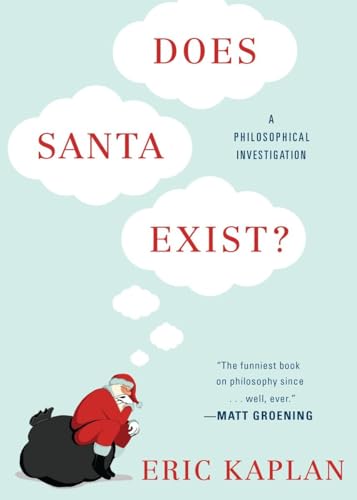
A humorous philosophical investigation into the existence of Santa from a co–executive producer of The Big Bang Theory—the perfect stocking stuffer for the deep thinker on everyone’s list.
Emmy award–winning comedy writer and philosophy scholar Eric Kaplan brilliantly turns a search for the truth about Santa into a laugh-out-loud metaphysical romp. Surveying everything from the analytic philosophy of Bertrand Russell and Ludwig Wittgenstein to Buddhism, Taoism, and Kabbalah, Kaplan alights on comedy—including The Big Bang Theory and Monty Python—as the best way to resolve life’s most profound paradoxes, including the existence of perfect moments, Santa, and even God.
Die Inhaltsangabe kann sich auf eine andere Ausgabe dieses Titels beziehen.
Über die Autorin bzw. den Autor
Eric Kaplan has a BA in Philosophy from Harvard University and is currently completing his dissertation at U.C. Berkeley. He lives in Studio City, California.
Auszug. © Genehmigter Nachdruck. Alle Rechte vorbehalten.
A NOTE TO THE READER
This book has three titles designed by the writer to appeal to three different audiences, but as luck would have it, all three look the same in contemporary written English, viz.: Does Santa Exist?
The first title, Does Santa Exist?, with the words stressed more or less equally, is for readers who would like to consider whether or not the kindly, bearded gift giver exists.
The second title, Does Santa Exist?, should be read with a rising stress on the final word, sort of like this: “Does Santa Exist?” This title is a lure for readers who would like to know whether, if Santa does do anything in the ontological line, that thing he does qualifies as existing. Their interest, in other words, lies less in Santa and more in the concept of existence.
The third title, Does Santa Exist?, should be read as the conclusion of the following very short little dialogue on the relationship between science and faith:
A: Just because something is not part of scientific discourse doesn’t mean it can’t still exist.
B: Really? Does Santa Exist?!
For readers drawn to this title, the question “Does Santa Exist?” should be pronounced as if it is a reductio ad absurdum argument against the claim that things exist that are beyond the ken of science. Their chief interest in this book, presuming they have any, is as a consideration of whether or not that reductio argument is valid.
ELK
INTRODUCTION
My Son, His Friend’s Mother, and Two Explanations
The ontology of Santa Claus didn’t impinge on my life until my son, Ari, was in kindergarten. Ari did not believe in Santa Claus. He was supposed to go to the zoo in early December with his friend Schuyler, and Schuyler’s mother, Tammi, called me up and said she didn’t want her son to go because there were reindeer there, and reindeer, she felt, would lead to a discussion of Santa Claus. Tammi’s son, Schuyler, did believe in Santa Claus: He was still firmly a sweet child and not yet in sour and rebellious teenager territory, and she wanted him, at least for a while, to stay that way. So Tammi wanted to cancel the playdate to ensure that Ari would not tell her son, “There is no Santa—he’s just your parents,” and shake his belief.
I found this a troubling interaction because I thought Tammi was sacrificing her son’s friendship with Ari, who was real, in order to preserve his relationship with Santa Claus, who was not.
Why was I so sure he didn’t exist? Not because I’ve never seen him—I’ve never seen Israeli supermodel Bar Refaeli and she exists, or at least did as of this writing. And not because if I went to the North Pole, I wouldn’t see him and his elves—just a lot of snow and ice and so forth—because there are any number of explanations that would square with that. Santa might emit a field from his beard that makes people miss him, the elves might have a machine that causes light to bend, or I could have met him and then been convinced by Mrs. Claus to undergo brain surgery that erased my memory. No, the real reason, I’m sure, is that nobody had ever told me he did, and belief in Santa Claus did not fit in with a number of other things I knew to be true—e.g., reindeer don’t fly, toys come from the store, etc.
I told this story to my daughter and she said, “I believe in Santa Claus.” I also asked her if she believed in the Easter bunny and she said, “Yes. I’m a kid, so I believe in everything.”
I told this story to my wife, who is a psychologist raised in Communist Romania, and she said something along the lines of “American parents lie to their children about this stupidity, and then the children grow up and find out their parents lied to them. No wonder American children are screwed up.”
I remained puzzled by Tammi’s behavior. I could think of two possible solutions:
THE LIAR EXPLANATION
For some reason back in the past, American children were taught to believe in Santa Claus—probably because their parents thought it was a good way to scare them into being good. When the children grew up and stopped believing in Santa Claus, they decided it would be a good idea to trick their children into believing. So society is basically divided into two groups of people—the liars and the lied to. The liars have motivations ranging from the benevolent (parents presumably) to the self-interested (the sellers of Christmas merchandise, American politicians who want a national myth that will unite a nation of immigrants). Let’s be blunt and call this the LIAR story.
I’ve observed evidence that the LIAR story is true. I work in Hollywood, which pumps a lot of images and stories out into the consciousness of the globe. When we were writing an episode of a television show called The Big Bang Theory, in which the character Sheldon kills Santa Claus in a Dungeons and Dragons game, one of the writers wanted to be sure that our story left the existence of Santa Claus open, because his kids were going to watch the show and they believed in Santa Claus. Of course, since he was a writer for a U.S. sitcom that is supported by commercials, his benevolent motivations for lying meshed with the less benevolent motivators of our advertisers.
THE CRAZY EXPLANATION
Another solution to the puzzle was that something in Tammi’s mind is divided or dissociated. So, according to this theory, it’s possible that a part of Tammi’s mind does believe in Santa Claus. She doesn’t talk about it when she talks to other adults, but when alone with her child, she believes. The part of Tammi that believes in Santa might not even be a part that has access to her mouth. So she might never say, “I believe in Santa Claus,” but she is disposed to have dreams, fantasies, and feelings related to Saint Nick. As a consequence, she is uncomfortable with having her son lose faith in Santa Claus because some system in her brain believes too.
How can one person believe and not believe in Santa Claus? If you are a strong proponent of the conspiracy story, you may not believe this is the case—you might think that if she ever does confess to Santa belief, she is just lying. After all, she buys toys at the store—how can she honestly maintain they come down the chimney?
But people believe different things at different times and in different contexts. Let’s imagine Tammi goes home and goes to bed. As she drifts off to sleep, she hears a voice in her head, one that sounds like her own. It says, “Santa does exist. I remember waiting for him to come. How do I know he didn’t? Yes, part of me thinks he didn’t come and never will, but why should I listen to that part?”
Tammi has a couple of different Tammis inside her. She has the Tammi who once believed in Santa but now buys toys from the store, and she has the Tammi who still does believe in Santa. This Tammi feels good when she thinks about Santa and angry when she thinks about Eric not believing in Santa. This Tammi can effortlessly respond to Santa images and Santa television shows and songs about Santa.
Tammi’s self could be divided; she could be more than one of her Tammis at the same time—that is, she could have one voice in her head that says, “Of course Santa Claus does not exist,” and another voice that says, “I hope he brings me something good!” Or her self could be divided across time. That is, she could make fun of Santa Claus all year long until Christmas season and then talk during Christmas as if she does believe in the jolly old saint.
Since it...
„Über diesen Titel“ kann sich auf eine andere Ausgabe dieses Titels beziehen.
Suchergebnisse für Does Santa Exist?: A Philosophical Investigation

Beispielbild für diese ISBN
Does Santa Exist?: A Philosophical Investigation
Anbieter: World of Books (was SecondSale), Montgomery, IL, USA
Verkäuferbewertung 5 von 5 Sternen

Zustand: Very Good. Item in very good condition! Textbooks may not include supplemental items i.e. CDs, access codes etc. Artikel-Nr. 00102195128
Gebraucht kaufen
EUR 5,52
Versand gratis
Versand innerhalb von USA
Versand innerhalb von USA
Anzahl: 1 verfügbar
Beispielbild für diese ISBN
Does Santa Exist?: A Philosophical Investigation
Anbieter: ThriftBooks-Atlanta, AUSTELL, GA, USA
Verkäuferbewertung 5 von 5 Sternen
Paperback. Zustand: Good. No Jacket. Pages can have notes/highlighting. Spine may show signs of wear. ~ ThriftBooks: Read More, Spend Less. Artikel-Nr. G0147516420I3N00
Gebraucht kaufen
EUR 6,20
Versand gratis
Versand innerhalb von USA
Versand innerhalb von USA
Anzahl: 1 verfügbar
Beispielbild für diese ISBN
Does Santa Exist? : A Philosophical Investigation
Verlag:
Penguin Publishing Group, 2015
ISBN 10: 0147516420
ISBN 13: 9780147516428
Gebraucht
Softcover
Anbieter: Better World Books, Mishawaka, IN, USA
Verkäuferbewertung 5 von 5 Sternen
Zustand: Good. Reprint. Pages intact with minimal writing/highlighting. The binding may be loose and creased. Dust jackets/supplements are not included. Stock photo provided. Product includes identifying sticker. Better World Books: Buy Books. Do Good. Artikel-Nr. 9787990-6
Gebraucht kaufen
EUR 6,35
Versand gratis
Versand innerhalb von USA
Versand innerhalb von USA
Anzahl: 1 verfügbar
Beispielbild für diese ISBN
Does Santa Exist? : A Philosophical Investigation
Verlag:
Penguin Publishing Group, 2015
ISBN 10: 0147516420
ISBN 13: 9780147516428
Gebraucht
Softcover
Anbieter: Better World Books, Mishawaka, IN, USA
Verkäuferbewertung 5 von 5 Sternen
Zustand: Good. Reprint. Former library copy. Pages intact with minimal writing/highlighting. The binding may be loose and creased. Dust jackets/supplements are not included. Includes library markings. Stock photo provided. Product includes identifying sticker. Better World Books: Buy Books. Do Good. Artikel-Nr. 13763709-6
Gebraucht kaufen
EUR 6,35
Versand gratis
Versand innerhalb von USA
Versand innerhalb von USA
Anzahl: 1 verfügbar
Beispielbild für diese ISBN
Does Santa Exist? : A Philosophical Investigation
Verlag:
Penguin Publishing Group, 2015
ISBN 10: 0147516420
ISBN 13: 9780147516428
Gebraucht
Softcover
Anbieter: Better World Books, Mishawaka, IN, USA
Verkäuferbewertung 5 von 5 Sternen
Zustand: Very Good. Reprint. Pages intact with possible writing/highlighting. Binding strong with minor wear. Dust jackets/supplements may not be included. Stock photo provided. Product includes identifying sticker. Better World Books: Buy Books. Do Good. Artikel-Nr. 11320627-75
Gebraucht kaufen
EUR 6,35
Versand gratis
Versand innerhalb von USA
Versand innerhalb von USA
Anzahl: 1 verfügbar
Beispielbild für diese ISBN
Does Santa Exist?: A Philosophical Investigation
Anbieter: Wonder Book, Frederick, MD, USA
Verkäuferbewertung 5 von 5 Sternen
Zustand: Good. Good condition. A copy that has been read but remains intact. May contain markings such as bookplates, stamps, limited notes and highlighting, or a few light stains. Artikel-Nr. G02F-02337
Gebraucht kaufen
EUR 6,91
Versand gratis
Versand innerhalb von USA
Versand innerhalb von USA
Anzahl: 1 verfügbar
Beispielbild für diese ISBN
Does Santa Exist?: A Philosophical Investigation
Anbieter: Kennys Bookstore, Olney, MD, USA
Verkäuferbewertung 5 von 5 Sternen
Zustand: New. Artikel-Nr. V9780147516428
Neu kaufen
EUR 20,97
EUR 9,06 Versand
Versand innerhalb von USA
Versand innerhalb von USA
Anzahl: 15 verfügbar
Beispielbild für diese ISBN
Does Santa Exist?: A Philosophical Investigation
Anbieter: Revaluation Books, Exeter, Vereinigtes Königreich
Verkäuferbewertung 5 von 5 Sternen
Paperback. Zustand: Brand New. reprint edition. 275 pages. 7.00x5.25x0.75 inches. In Stock. Artikel-Nr. 0147516420
Neu kaufen
EUR 30,37
EUR 11,68 Versand
Versand von Vereinigtes Königreich nach USA
Versand von Vereinigtes Königreich nach USA
Anzahl: 1 verfügbar
Foto des Verkäufers
Does Santa Exist?
Anbieter: moluna, Greven, Deutschland
Verkäuferbewertung 5 von 5 Sternen
Zustand: New. Eric Kaplan has a BA in Philosophy from Harvard University and is currently completing his dissertation at U.C. Berkeley. He lives in Studio City, California.A humorous philosophical investigation into the existence of Santa from a co&ndashexecutive. Artikel-Nr. 37868330
Neu kaufen
EUR 16,28
EUR 48,99 Versand
Versand von Deutschland nach USA
Versand von Deutschland nach USA
Anzahl: 2 verfügbar