
Verwandte Artikel zu The Safety Net (An Inspector Montalbano Mystery, Band...
The Safety Net (An Inspector Montalbano Mystery, Band 25) - Softcover
Buch 25 von 28: Inspector Montalbano Mysteries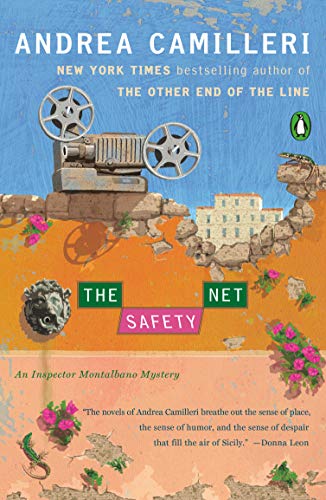
Inhaltsangabe
The new novel in the transporting New York Times bestselling Inspector Montalbano mystery series
Vigàta is bustling as the new filming location for a Swedish television series set in 1950. In the production frenzy, the director asks the locals to track down movies and vintage photos to faithfully recreate the air of Vigata in that time. Engineer Ernesto Sabatello, while rummaging in the attic of his house, finds some films shot by his father from 1958 to 1963, always on the same day, March 27 and always the same shot; the outside wall of a country house. Montalbano hears the story, and intrigued by the mystery of it, begins to investigate its meaning. Meanwhile, a middle school is threatened by a group of armed men, and a closer look at the situation finds Montalbano looking into the students themselves and finally delving into the world of social media.
Die Inhaltsangabe kann sich auf eine andere Ausgabe dieses Titels beziehen.
Über die Autorin bzw. den Autor
Andrea Camilleri, a mega-bestseller in Italy and Germany, is the author of the New York Times bestselling Inspector Montalbano mystery series as well as historical novels that take place in nineteenth-century Sicily. His books have been made into Italian TV shows and translated into thirty-two languages. His thirteenth Montalbano novel, The Potter's Field, won the Crime Writers' Association International Dagger Award and was longlisted for the IMPAC Dublin Literary Award.
Stephen Sartarelli is an award-winning translator and the author of three books of poetry.
Auszug. © Genehmigter Nachdruck. Alle Rechte vorbehalten.
1
The alarm clock started ringing wildly.
Eyes still closed, Montalbano reached out towards the nightstand with one hand and, feeling around, tried to turn it off, worried that the noise would wake up Livia, who was sleeping beside him.
But his fingers knocked into a glass that first tipped over and then fell to the floor.
He cursed the saints. Then he immediately heard Livia giggle. He turned towards her.
"Did the alarm-?"
"No, I'd been awake for a while."
"Really? What were you doing?"
"What do you mean what was I doing? I was waiting for daybreak and watching you."
Montalbano thought that the back of his head must constitute a rather boring landscape.
"Did you know that lately you sometimes whistle in your sleep?" asked Livia.
Upon hearing this revelation, Montalbano, for whatever reason, got irritated.
"How could I know that if I'm asleep? Anyway, be more specific. What do I whistle, pop songs, opera, or what?"
"Calm down! Are you offended or something? All right, to be more precise, you sometimes emit a kind of whistling sound."
"Through my nose?"
"I don't know."
"Next time, pay attention to whether I whistle through my nose or my mouth, and let me know."
"Why, does it make a difference?"
"Yes, it makes a huge difference. I remember reading something once about a guy whose nose made a whistling sound and it later turned out to be a symptom of a deadly disease."
"Oh, come on! And, by the way, I had a bad dream."
"Want to tell me about it?"
"I'm sitting and reading on a veranda exactly like ours, except that it gives onto the docks at the port. At some point I hear this big commotion of voices, and I see a man crying for help and being chased by another man ordering him to stop. The guy running away has a scarf around his head, a bandanna, something tied under his chin. The man giving chase is wearing a large belt with a lot of sharp knives tucked into it. At a certain point the man being chased finds himself up against the broadside of a barge. He has a moment of hesitation, and the pursuer takes advantage of this to throw one of his knives, which strikes the man in the nape of the neck, plunges all the way through, and comes out the front of his throat, nailing him to the wood of the barge. Just horrible. So the pursuer stops and starts throwing more knives at the victim, tracing the outline of his body against the boat. Then he suddenly turns and takes a step towards me. But luckily at that point I woke up."
"We sort of overdid it last night with the baby octopus!" was Montalbano's comment.
"And did you dream anything?" Livia asked.
At that moment the alarm went off. But how was that possible? It had rung just five minutes earlier!
Head still numb with sleep, the inspector opened his eyes and immediately realized he was in bed. There was no Livia. She was at home, in Boccadasse. He'd dreamt the whole thing, including Livia's dream.
He got up, went into the kitchen, prepared his customary mug of coffee, then got into the shower. Moments later, he was sitting on the veranda, smoking a cigarette while drinking his coffee. The day promised to be a fine one. Everything looked freshly painted, so bright were the colors.
He had no desire whatsoever to go into Vigˆta, or into what at least had been Vigˆta up until a few days earlier. Because in fact the town had put on a completely different face. It had been, well, thrown back in time, turned into the Vigˆta of the 1950s.
This irked Montalbano no end, because it all seemed so fake, as if he was attending a masked ball at Carnival.
The whole business had begun some four or five months earlier, when TeleVigˆta invited its viewers to search their homes for old Super 8 movies, which had been so popular around the middle of the previous century, and to send whatever they found to the studio offices. The television station would later integrate them into a program, a kind of "The Way We Were," about what the town was like in the 1950s.
For whatever reason, the initiative was a resounding success. Perhaps because the whole thing had become a kind of game for the townsfolk, who were having a ball seeing how time had transformed them or their children from toddlers who looked like beautiful little angels just descended from the heavens into toothless, hairless, sickly old geezers, and women who'd once been the light of the town into grannies good mostly for knitting socks.
Then they discovered that all this to-do actually had a specific purpose: All the material gathered was to serve as a visual aid for a production crew that was coming to town to film what is commonly known as a TV movie.
Without fail, a short while later the crew's technicians arrived, half of them Swedish, half of them Italian.
Now the strange thing about all this was that the group of Swedish technicians included some breathtakingly badass babes, who did a variety of odd jobs: as assistant set designers, sound technicians, stagehands, and so on . . . Which left the townsfolk a bit flabbergasted to see such beautiful women having to work, and wondering what the actresses would look like when they finally arrived.
And indeed, when they actually did arrive, work in Vigˆta came to a standstill.
With the flimsiest of excuses, people would drop whatever they were doing and run to the movie set. Things got so bad that law enforcement was asked to keep the rubberneckers away. And law enforcement, in this case, naturally took the form of one Mim“ Augello, who had been put in charge of the patrolmen protecting the film crew, with special attention given to the actresses.
This, in short, reduced the staff at the station house basically to three people: the inspector, Fazio, and Catarella. Luckily it was a period of calm and nothing was happening.
The Vigˆta townscape had changed. Gone were the TV antennas, the rubbish bins, the neon signs. And there was nothing remaining of the shops and stores Montalbano knew so well.
The inspector had had someone tell him the plot of the TV movie. The story was set, naturally, in the 1950s and involved a Swedish girl working as a bosun on a steamship from Kalmar who falls seriously ill during the sea journey and is admitted to the hospital in Montelusa.
Once she recovers her health she goes down to Vigˆta, to be near the port, and is taken in by a fisherman while she waits for her ship to return.
Due to a series of setbacks, the return of her steamship is delayed, and in the meantime the Swedish girl falls in love with a youth from Vigˆta and creates a life for herself in town, while nevertheless maintaining, deep in her heart, a secret hope that her ship will come back for her one day.
And she keeps on nourishing this hope even after she gets married and has a child.
Finally the day comes when the ship returns to harbor, and the young woman decides to board in secret, unbeknownst to her family. She arranges with a sailor to have him take her out to the ship in his boat, but at the last moment the Swedish girl changes her mind and turns back, to her home in Vigˆta.
When Montalbano heard this story, it sounded to him like a plagiarism of a beautiful story by Pirandello entitled "Far Away,"...
„Über diesen Titel“ kann sich auf eine andere Ausgabe dieses Titels beziehen.
Weitere beliebte Ausgaben desselben Titels

Suchergebnisse für The Safety Net (An Inspector Montalbano Mystery, Band...

Beispielbild für diese ISBN
The Safety Net An Inspector Mo
Anbieter: World of Books (was SecondSale), Montgomery, IL, USA
Verkäuferbewertung 5 von 5 Sternen

Zustand: Acceptable. Item in acceptable condition! Textbooks may not include supplemental items i.e. CDs, access codes etc. Artikel-Nr. 00100762844
Gebraucht kaufen
EUR 3,63
Versand gratis
Versand innerhalb von USA
Versand innerhalb von USA
Anzahl: 1 verfügbar
Beispielbild für diese ISBN
The Safety Net An Inspector Mo
Anbieter: World of Books (was SecondSale), Montgomery, IL, USA
Verkäuferbewertung 5 von 5 Sternen
Zustand: Good. Item in good condition. Textbooks may not include supplemental items i.e. CDs, access codes etc. Artikel-Nr. 00106268506
Gebraucht kaufen
EUR 3,63
Versand gratis
Versand innerhalb von USA
Versand innerhalb von USA
Anzahl: 1 verfügbar
Beispielbild für diese ISBN
The Safety Net
Verlag:
Penguin Publishing Group, 2020
ISBN 10: 0143134965
ISBN 13: 9780143134961
Gebraucht
Softcover
Anbieter: Better World Books, Mishawaka, IN, USA
Verkäuferbewertung 5 von 5 Sternen
Zustand: Good. Former library copy. Pages intact with minimal writing/highlighting. The binding may be loose and creased. Dust jackets/supplements are not included. Includes library markings. Stock photo provided. Product includes identifying sticker. Better World Books: Buy Books. Do Good. Artikel-Nr. 38642771-6
Gebraucht kaufen
EUR 6,37
Versand gratis
Versand innerhalb von USA
Versand innerhalb von USA
Anzahl: 2 verfügbar
Beispielbild für diese ISBN
The Safety Net (An Inspector Montalbano Mystery)
Anbieter: Wonder Book, Frederick, MD, USA
Verkäuferbewertung 5 von 5 Sternen
Zustand: Good. Good condition. A copy that has been read but remains intact. May contain markings such as bookplates, stamps, limited notes and highlighting, or a few light stains. Artikel-Nr. J07A-03050
Gebraucht kaufen
EUR 6,82
Versand gratis
Versand innerhalb von USA
Versand innerhalb von USA
Anzahl: 1 verfügbar
Beispielbild für diese ISBN
The Safety Net (An Inspector Montalbano Mystery)
Anbieter: Wonder Book, Frederick, MD, USA
Verkäuferbewertung 5 von 5 Sternen
Zustand: Very Good. Very Good condition. A copy that may have a few cosmetic defects. May also contain light spine creasing or a few markings such as an owner's name, short gifter's inscription or light stamp. Artikel-Nr. B08B-03242
Gebraucht kaufen
EUR 6,82
Versand gratis
Versand innerhalb von USA
Versand innerhalb von USA
Anzahl: 2 verfügbar
Beispielbild für diese ISBN
The Safety Net (An Inspector Montalbano Mystery, Bk. 25)
Anbieter: BookOutlet, Jefferson City, TN, USA
Verkäuferbewertung 5 von 5 Sternen
Paperback. Zustand: New. Paperback. Publisher overstock, may contain remainder mark on edge. Artikel-Nr. 9780143134961B
Beispielbild für diese ISBN
The Safety Net (Inspector Montalbano Mystery)
Anbieter: WorldofBooks, Goring-By-Sea, WS, Vereinigtes Königreich
Verkäuferbewertung 5 von 5 Sternen
Paperback. Zustand: Very Good. The book has been read, but is in excellent condition. Pages are intact and not marred by notes or highlighting. The spine remains undamaged. Artikel-Nr. GOR010844942
Gebraucht kaufen
EUR 5,78
EUR 6,53 Versand
Versand von Vereinigtes Königreich nach USA
Versand von Vereinigtes Königreich nach USA
Anzahl: 3 verfügbar
Beispielbild für diese ISBN
The Safety Net (Inspector Montalbano)
Anbieter: AwesomeBooks, Wallingford, Vereinigtes Königreich
Verkäuferbewertung 5 von 5 Sternen
Paperback. Zustand: Very Good. The Safety Net (Inspector Montalbano) This book is in very good condition and will be shipped within 24 hours of ordering. The cover may have some limited signs of wear but the pages are clean, intact and the spine remains undamaged. This book has clearly been well maintained and looked after thus far. Money back guarantee if you are not satisfied. See all our books here, order more than 1 book and get discounted shipping. Artikel-Nr. 7719-9780143134961
Gebraucht kaufen
EUR 7,79
EUR 4,80 Versand
Versand von Vereinigtes Königreich nach USA
Versand von Vereinigtes Königreich nach USA
Anzahl: 2 verfügbar
Beispielbild für diese ISBN
The Safety Net (Inspector Montalbano)
Anbieter: Bahamut Media, Reading, Vereinigtes Königreich
Verkäuferbewertung 5 von 5 Sternen
Paperback. Zustand: Very Good. This book is in very good condition and will be shipped within 24 hours of ordering. The cover may have some limited signs of wear but the pages are clean, intact and the spine remains undamaged. This book has clearly been well maintained and looked after thus far. Money back guarantee if you are not satisfied. See all our books here, order more than 1 book and get discounted shipping. Artikel-Nr. 6545-9780143134961
Gebraucht kaufen
EUR 7,69
EUR 8,13 Versand
Versand von Vereinigtes Königreich nach USA
Versand von Vereinigtes Königreich nach USA
Anzahl: 2 verfügbar
Beispielbild für diese ISBN
The Safety Net
Anbieter: Kennys Bookstore, Olney, MD, USA
Verkäuferbewertung 5 von 5 Sternen
Zustand: New. . . . . . . Books ship from the US and Ireland. Artikel-Nr. V9780143134961
Neu kaufen
EUR 20,95
EUR 9,09 Versand
Versand innerhalb von USA
Versand innerhalb von USA
Anzahl: 15 verfügbar