
Verwandte Artikel zu For the Ride (Penguin Poets)
Inhaltsangabe
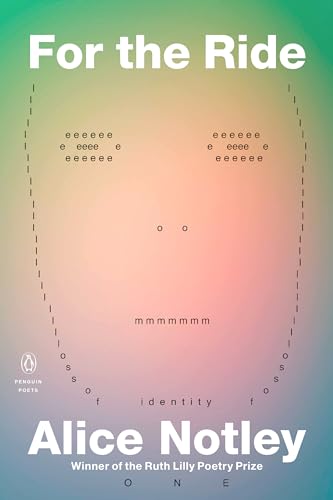
A major new book-length visionary poem from a writer "whose poems are among the major astonishments of contemporary poetry" (Robert Polito, the Poetry Foundation)
Alice Notley has become one of the most highly regarded figures in American poetry, a master of the visionary mode acclaimed for genre-bending, book-length poems of great ambition and adventurousness. Her newest book, For the Ride, is another such work. The protagonist, "One," is suddenly within the glyph, whose walls project scenes One can enter, and One does so. Other beings begin to materialize, and it seems like they (and One) are all survivors of a global disaster. They board a ship to flee to another dimension; they decide what they must save on this Ark are words, and they gather together as many as are deemed fit to save. They "sail" and meanwhile begin to change the language they are speaking, before disembarking at an abandoned future city.
Die Inhaltsangabe kann sich auf eine andere Ausgabe dieses Titels beziehen.
Über die Autorin bzw. den Autor
Alice Notley was born in Bisbee, Arizona, in 1945 and grew up in Needles, California. She is the author of more than thirty-five books of poetry, including Mysteries of Small Houses (Penguin, 1998, winner of the Los Angeles Times Book Prize and a finalist for the Pulitzer Prize); Disobedience (Penguin, 2001, winner of the Griffin Prize); and Grave of Light: New and Selected Poems 1970-2005, which received the Lenore Marshall Poetry Prize. Her honors also include an Academy Award in Literature from the American Academy of Arts and Letters and the Shelley Memorial Award from the Poetry Society of America. She lives and works in Paris.
Auszug. © Genehmigter Nachdruck. Alle Rechte vorbehalten.
Preface
There is a room of walls which come alive with images and words . . .
like a mind? in a beginning that’s first an ending—get it? You’ll have
to decipher what’s going on, as it happens. Just like I did. I started
out in the l’Orangerie in Paris with Monet’s Water Lilies, and their
pond, but then I, or someone, became One, on a journey to another
dimension to save Words from their demise, if there were really an
Apocalypse—I mean if there were and so all of language were lost.
“Save the Words” is the title of chapter II. This poem goes pretty far,
and terrifies me, but it should be read for pleasure. A story, with
characters, and illustrations, and qualities of humor and tender-
ness. Note further that on the ark that takes off from the pond, the
Survivors have with them an Anthology of poetry which is quoted
from: only poems can deal in the inexplicable—what really goes on.
And each of the poem’s characters finally becomes poems—
nothing else left to one. I mean I don’t know exactly what happened;
I might even have to tell this story again sometime. There are glyphs
or paint or matter or spirit everywhere, it keeps changing before
your eyes or whatever one has.
THE GLYPH OF CHAOS WITH WILLOWS
Back up and reenter glyph again, one. Wasn't one always there?
Yes but not consciously. First capitliize the name, One. Okay,
What about beauty? Oh the glyph's beautiful, mysterious,
possibly damning in the sense one can't go back on it, One.
One sees chaos, glyph's own background, rippled cloudy but grainy—
gradations of blue from navy to pale, shimmery, irregular...
One, oh One, hear tenses fall. Blanks about One of Unseen.
One doesn't know what's happening here! One shouts at no one. Brids fly,
aren't appearing, shadows flutter in, out of the grain, not in time—
Oh but One’s not in time, what’s One in? Chaos, beautiful chaos—
But, too, One’s in glyph and it’s hard; learning a new way to go,
that is, talk? proceeding on through . . . oh this might be round, rounded.
There are transversals, blurry poles—no they are lines One can’t think
talk correctamente ly. Mental. One can’t leave here forever?
Lines hold it up, why? Collapse isn’t logical either, One.
Who’s speaking to One? says the One. The foundational voice, One’s.
They are lines of words in some langue . . . Why can’t One read what’s within?
Oh but One can. That’s why One’s changing, having entered this star
neither civil nor unwelcoming in its peaceful disorder;
never proclaiming one color. One wanders letting blues fall
embuing One, embluing one, c’est jolie in here, pas laid—
doesn’t make one afraid of it, identityless mixages
of the more colors now, cerise, rose, and peach, then matte dark.
Oh what do the lines say to One? or to any one of the ones
sealed as ones are; senses are seals, unifying, at one’s wish,
the one into one like those; could see a lot more being here?
The voice says, When one enters here, the seals come off gradually.
For this is one’s parent chaos, timeless, shimmering, the old.
One seems not supposed to think, in what langue? One’s head’s opaque, alive—
opaque’s alive, is One? How does One know that One’s alive, conscious?
Stupid words, from any old language. Tints swirl in the word head;
One was born to be another’s creature, what is One doing here
in the first thought surrounded by word parts without a form, only
ripples of pigment ghosts? One likes the sudden shadow of greened black
containing a non-rose, red fist, mouth swell. One’s former other one,
mate or is it silky seal, gets up naked, from a bed to show—
in One’s imaging head—sheet of words with some replaced, edited,
meaning ignorance censoring ignorance. Seals can’t know much . . .
now One knows less, that’s good. Lost in glints, on the walls of the glyph—
walls? Ain’t walls or a thing. Should stay or go? Can’t go to the bathroom here,
senses have been cleaned out. Don’t have organs, aren’t in this new percept.
Cascade of white pink strokes. Trying to read. It’s just color, o dope.
One had to go to a bed by oneself. One became one’s own seal
past tense, isn’t it gone? Falls again, clunk. What tense is One in now?
One has the name of only personal pronoun here, in the tense too that’s one,
letting it all fall to pieces of aught. One’s so sick of the seals,
their feelings and their deaths. Now One has died, more or less, and that’s cool?—
tree hair blaze of a naught—is it something? Now let go of One’s words—
copper ripples in dark. Muffle, rien? Psst, croo-oo, ping, ba bah.
Then One’s sounds in torrent. As the binging proliferates One freaks . . .
Jump up and down, timing. No one’s around; there’s no time if unwatched.
Fa-ti-gué. Think in thoughts. Oh more like clots. Lovey dovey of isles,
One wants to do it oneself—one makes the glyph, doesn’t one? It’s tonal
not allegorical. Coping agent, laminate One’s rout, bout . . .
the coping agent’s dissolved. What if it’s hell? Just read it, stupid.
Ahem. Invite extinct obscura in. Quelle porte of this here glyph?
One used to say I and you, they and self. There was a shard-woman . . .
Go to pieces, one fool. One are the lost. Right in the breezy loss.
One likes it hereabouts, no arguments, puny thoughts like blippings;
chirp dream of lookalikes, chimes without verb. One drops a laugh, it’s weird.
Open mouth: squawk and then Li-sez. One wants to read some word strings.
But one don’t speaking right. Didn’t or can’t plafond of les nuages.
There was man in the store: what is a man? Goes to pieces. The door—
no one could find the door. Unless one’s damaged or almost dead . . .
Leave that for just a while. It is essential to gibber, wisely—
this is One’s coma, like. Man sold rational parts like marks on page.
Marks on page signify animal sounds. These marks came before sounds . . .
Prove it, One. Only One’s here: One makes the truth. One says what was the first:
Nothing no verb tenses, get it? A one in a coma finds out . . . matter is marks
reading strings of willowlike entwinings on the blue coma walls,
where the parts’ve fallen off of speech and time. Stand by the emeralds.
One finds one, other one. That’s one of the strands. One is a native one.
Tell one. The twigs writhing, les branches of parts. Gaskets and piston rings;
one is not, ones are not, separated. But only One is here.
One is composed of words like one makes in beginning, chaotically.
One makes them? One is making them, conscious. One knows it here, not chains,
posh garlands. Why? Why’s not valid here. Making oneself now, oh One.
One is made, already! Precisely, but is making one also—
prior, not even born. One’s reading, therefore, what’s written by who:
had painted a lovely clasp singing in the head. The voice knows all.
One wonders if one wants structure? Later, comes after...
„Über diesen Titel“ kann sich auf eine andere Ausgabe dieses Titels beziehen.
Suchergebnisse für For the Ride (Penguin Poets)

Beispielbild für diese ISBN
For the Ride
Anbieter: PBShop.store UK, Fairford, GLOS, Vereinigtes Königreich
Verkäuferbewertung 5 von 5 Sternen

PAP. Zustand: Used - Very Good. Used - Like New Book. Shipped from UK. Established seller since 2000. Artikel-Nr. P1-9780143134572
Gebraucht kaufen
EUR 14,44
EUR 4,90 Versand
Versand von Vereinigtes Königreich nach USA
Versand von Vereinigtes Königreich nach USA
Anzahl: 1 verfügbar
Beispielbild für diese ISBN
For the Ride
Anbieter: Revaluation Books, Exeter, Vereinigtes Königreich
Verkäuferbewertung 5 von 5 Sternen
Paperback. Zustand: Brand New. 160 pages. 9.00x6.00x0.43 inches. In Stock. Artikel-Nr. x-0143134574
Neu kaufen
EUR 31,78
EUR 11,78 Versand
Versand von Vereinigtes Königreich nach USA
Versand von Vereinigtes Königreich nach USA
Anzahl: 2 verfügbar
Foto des Verkäufers
For the Ride
Anbieter: moluna, Greven, Deutschland
Verkäuferbewertung 5 von 5 Sternen
Zustand: New. Alice Notley (1945 -2025) was born in Bisbee, Arizona, in 1945 and grew up in Needles, California. She is the author of more than forty books of poetry, including Mysteries of Small Houses (Penguin, 1998, winner of the Los Angeles Times Book P. Artikel-Nr. 298498004
Neu kaufen
EUR 19,63
EUR 48,99 Versand
Versand von Deutschland nach USA
Versand von Deutschland nach USA
Anzahl: 1 verfügbar