
Verwandte Artikel zu Getting Things Done for Teens: Take Control of Your...
Inhaltsangabe
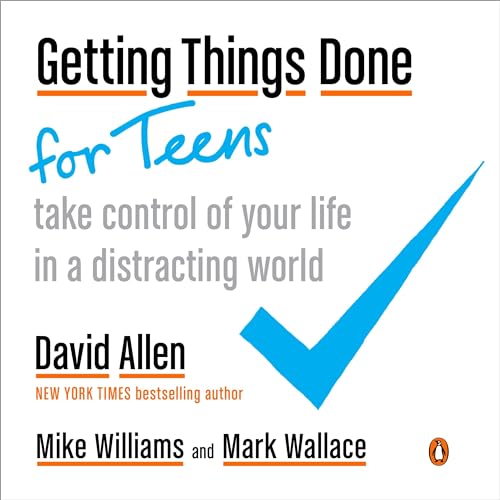
An adaptation of the business classic Getting Things Done for teenage readers
The most interconnected generation in history is navigating unimaginable amounts of social pressure, both in personal and online interactions. Very little time, focus, or education is being spent teaching and coaching this generation how to navigate this unprecedented amount of "stuff" entering their lives each day. How do we help the overloaded and distracted next generation deal with increasing complexity and help them not only survive, but thrive? How do we help them experience stress-free productivity and gain momentum and confidence? How do we help them achieve autonomy, so that they can confidently take on whatever comes their way?
Getting Things Done for Teens will train the next generation to overcome these obstacles and flourish by coaching them to use the internationally renowned Getting Things Done methodology. In its two editions, David Allen's classic has been translated into dozens of languages and sold over a million copies, establishing itself as one of the most influential business books of its era, and the ultimate book on personal organization. Getting Things Done for Teens will adapt its lessons by offering a fresh take on the GTD methodology, framing life as a game to play and GTD as the game pieces and strategies to play your most effective game. It presents GTD in a highly visual way and frames the methodology as not only as a system for being productive in school, but as a set of tools for everyday life.
Getting Things Done for Teens is the how-to manual for the next generation--a strategic guidebook for creating the conditions for a fruitful and effective future.
Die Inhaltsangabe kann sich auf eine andere Ausgabe dieses Titels beziehen.
Über die Autorin bzw. den Autor
David Allen is an internationally best-selling author who is widely recognized as the world’s leading expert on personal and organizational productivity. Time magazine called his flagship book, Getting Things Done “the definitive business self-help book of the decade.”
Mike Williams was President & CEO of The David Allen company from 2011 to 2016, is on the board of directors for the Association for Talent Development (td.org), and is the Getting Things Done Enterprise Architect at Zappos.com
Mark Wallace has taught in public schools in Minnesota for over 20 years and has won the TIES Distinguished Educator Award.
Auszug. © Genehmigter Nachdruck. Alle Rechte vorbehalten.
The Getting Things Done (GTD) Methodology
GTD is an acronym for Getting Things Done-a way of thinking that helps people gain better control and focus in their lives, no matter what they are doing. GTD is not really about getting things "done." It's about learning to become focused on and engaged with the present, being aware of what is next, finding stability when things feel out of control, and creatively anticipating whatever life has to offer, whether that involves school, work, relationships, sports, goals, dreams, or even video games. GTD is about being ready for it all.
We have seen people from all over the world benefit from the practice of GTD, ranging in ages from eight to eighty, plus or minus a few years on both ends of that spectrum. GTD can be used by anyone, of any background, any gender, any religion, any culture, at any time, in any situation. It is an approach that, once learned, can be developed, personalized, and used for the rest of your life. Much like music, dance, and sports, it is an art that involves learning, practicing, and integrating into your life.
GTD has three main parts:
1. Five Steps-to help you gain control
2. Levels of Focus-to help you gain perspective
3. A Planning Map-to help you gain both control and perspective for situations and projects that require deeper thinking
Explore each of these tools and strategies and decide what works best for you. Once you put the GTD way of thinking to the test, you'll find that it will help you succeed, and you'll want to learn more about how you can make these tools and strategies your own.
Some questions that might be preoccupying you:
"Why should I learn this?"
"Why have I not heard of this before from my parents or teachers?"
"Is this going to create more work for me?"
"Why can't I just do what I've always done, if it's worked for me so far?"
"What _________?"
"Why _________?"
These are all natural and good concerns, but let's look at why a new mind-set and skill set might be needed for your unique generation.
The Problem
Rising Complexity
Have you noticed how complicated the world is becoming? Have you noticed how complicated your world is becoming?
For example, can you remember a time, not so long ago, when you thought that you had a lot of homework? It probably seems laughable in comparison to the amount of homework you have now. What else in your life can you look back on that seems so much simpler, easier, or more straightforward compared to your life today?
Or, do you ever find yourself looking ahead and wishing you could fast-forward a bit to the next stage of your life? For example, do you wish you could have the freedom that comes with having a driver's license and a car? Or do you wish you could just hurry up and move on from middle school into high school, or from high school into college?
Do you notice anything here? Perhaps a pattern?
Life seems to find a way to get a bit more complicated every year. As this is happening, you also continue to change, grow, and respond to these added layers of complexity. Sometimes the complexity matches your ability to handle it quite well. Other times, it doesn't.
When complexities arrive at perfect times in your life, you are challenged in welcoming and exciting directions. You might experience the thrill of new levels of independence, new types of relationships, new learning, and new levels of competition. When this ideal timing happens, you might feel a positive sense of balance and growth. When have you felt this way? When was the last change in complexity that came just at the right time?
Sometimes, though, complexity comes faster than you are ready to handle. At these times, you might feel stressed and anxious, because there may be more change or more things to track than you currently know how to deal with or more homework or more activities or more work to manage than you feel capable of handling. Have you ever felt like this? How did you respond?
There are even times where you are desperate for new complexity-in any form. You might feel uninspired, even bored, in your current circumstances, and believe that you're more than ready for more. You may be hungry for a challenge.
At these times, you might experience a sense of unease until something changes, until there is something novel to explore-a new class, a new hobby, a new relationship, etc.
Have you ever felt that your current situations are stalled and that you're waiting for something unexpected, different, more, or bigger? How did you deal with it?
Managing the complexities of life is a dynamic process. Life continues to evolve, change, and shift-and so do you-sometimes at a comfortable rate, sometimes at an uncomfortable rate.
As you start the journey into this book, ask yourself, "How do I feel about the complexity of my life today?" Are you feeling overextended? Perhaps stressed? Underchallenged? Maybe you're currently bored out of your mind? Maybe you're stretched to the point of breaking in some areas of your life and bored in others.
Using the following complexity graph, place an "X" in the spot that best describes you today.
Most likely there have been points in your life when you've experienced some form of all these feelings. Whatever you think of the balance of today, the reality is that changes are coming and will continue to come. These shifts in complexity and the feelings that go with them are natural. Eventually, you will graduate high school and go on to college or get a job. You will decide where you will live, how you'll support yourself, and what kind of impact you want to make. You may decide to get married and raise a family. With each of these transitions, your life will become more complex, and that complexity will require new responses from you.
While everyone, including your parents and teachers, has experienced these shifts as they've made their way through life, your experience will be different, and it is important that you understand why.
The better you get, the better you better get.-David Allen
Connectivity and the Flood of Information
While it is true that every generation faces a world that is unlike the generation before it, your situation is different, because the world you're facing is vastly different. What worked in the past may not work for you, because something new appeared that has changed everything.
Do you know what it is? Massive digital connectivity. Massive.
We humans are more connected than we have ever been before. Our constant connectivity has transformed how we study, work, play, shop, travel, relate, and communicate. It has also transformed our brains themselves and even how we think.
Many young people are so immersed in this...
„Über diesen Titel“ kann sich auf eine andere Ausgabe dieses Titels beziehen.
Suchergebnisse für Getting Things Done for Teens: Take Control of Your...

Beispielbild für diese ISBN
Getting Things Done for Teens:
Anbieter: World of Books (was SecondSale), Montgomery, IL, USA
Verkäuferbewertung 5 von 5 Sternen

Zustand: Very Good. Item in very good condition! Textbooks may not include supplemental items i.e. CDs, access codes etc. Artikel-Nr. 00108547702
Gebraucht kaufen
EUR 4,50
Versand gratis
Versand innerhalb von USA
Versand innerhalb von USA
Anzahl: 3 verfügbar
Beispielbild für diese ISBN
Getting Things Done for Teens:
Anbieter: World of Books (was SecondSale), Montgomery, IL, USA
Verkäuferbewertung 5 von 5 Sternen
Zustand: Good. Item in good condition. Textbooks may not include supplemental items i.e. CDs, access codes etc. Artikel-Nr. 00093389127
Gebraucht kaufen
EUR 4,50
Versand gratis
Versand innerhalb von USA
Versand innerhalb von USA
Anzahl: Mehr als 20 verfügbar
Beispielbild für diese ISBN
Getting Things Done for Teens:
Anbieter: World of Books (was SecondSale), Montgomery, IL, USA
Verkäuferbewertung 5 von 5 Sternen
Zustand: Acceptable. Item in acceptable condition! Textbooks may not include supplemental items i.e. CDs, access codes etc. Artikel-Nr. 00088676727
Gebraucht kaufen
EUR 4,50
Versand gratis
Versand innerhalb von USA
Versand innerhalb von USA
Anzahl: 5 verfügbar
Beispielbild für diese ISBN
Getting Things Done for Teens: Take Control of Your Life in a Distracting World
Verlag:
Penguin Books (edition Illustrated), 2018
ISBN 10: 0143131931
ISBN 13: 9780143131939
Gebraucht
Paperback
Anbieter: BooksRun, Philadelphia, PA, USA
Verkäuferbewertung 5 von 5 Sternen
Paperback. Zustand: Very Good. Illustrated. It's a well-cared-for item that has seen limited use. The item may show minor signs of wear. All the text is legible, with all pages included. It may have slight markings and/or highlighting. Artikel-Nr. 0143131931-11-1
Gebraucht kaufen
EUR 5,41
Versand gratis
Versand innerhalb von USA
Versand innerhalb von USA
Anzahl: 2 verfügbar
Beispielbild für diese ISBN
Getting Things Done for Teens: Take Control of Your Life in a Distracting World
Anbieter: ThriftBooks-Reno, Reno, NV, USA
Verkäuferbewertung 5 von 5 Sternen
Paperback. Zustand: Good. No Jacket. Pages can have notes/highlighting. Spine may show signs of wear. ~ ThriftBooks: Read More, Spend Less. Artikel-Nr. G0143131931I3N00
Gebraucht kaufen
EUR 6,08
Versand gratis
Versand innerhalb von USA
Versand innerhalb von USA
Anzahl: 1 verfügbar
Beispielbild für diese ISBN
Getting Things Done for Teens: Take Control of Your Life in a Distracting World
Anbieter: ThriftBooks-Atlanta, AUSTELL, GA, USA
Verkäuferbewertung 5 von 5 Sternen
Paperback. Zustand: Fair. No Jacket. Readable copy. Pages may have considerable notes/highlighting. ~ ThriftBooks: Read More, Spend Less. Artikel-Nr. G0143131931I5N00
Gebraucht kaufen
EUR 6,08
Versand gratis
Versand innerhalb von USA
Versand innerhalb von USA
Anzahl: 1 verfügbar
Beispielbild für diese ISBN
Getting Things Done for Teens: Take Control of Your Life in a Distracting World
Anbieter: ThriftBooks-Dallas, Dallas, TX, USA
Verkäuferbewertung 5 von 5 Sternen
Paperback. Zustand: Good. No Jacket. Pages can have notes/highlighting. Spine may show signs of wear. ~ ThriftBooks: Read More, Spend Less. Artikel-Nr. G0143131931I3N00
Gebraucht kaufen
EUR 6,08
Versand gratis
Versand innerhalb von USA
Versand innerhalb von USA
Anzahl: 1 verfügbar
Beispielbild für diese ISBN
Getting Things Done for Teens: Take Control of Your Life in a Distracting World
Anbieter: ThriftBooks-Atlanta, AUSTELL, GA, USA
Verkäuferbewertung 5 von 5 Sternen
Paperback. Zustand: Good. No Jacket. Pages can have notes/highlighting. Spine may show signs of wear. ~ ThriftBooks: Read More, Spend Less. Artikel-Nr. G0143131931I3N00
Gebraucht kaufen
EUR 6,08
Versand gratis
Versand innerhalb von USA
Versand innerhalb von USA
Anzahl: 1 verfügbar
Beispielbild für diese ISBN
Getting Things Done for Teens : Take Control of Your Life in a Distracting World
Verlag:
Penguin Publishing Group, 2018
ISBN 10: 0143131931
ISBN 13: 9780143131939
Gebraucht
Softcover
Anbieter: Better World Books, Mishawaka, IN, USA
Verkäuferbewertung 5 von 5 Sternen
Zustand: Good. Pages intact with minimal writing/highlighting. The binding may be loose and creased. Dust jackets/supplements are not included. Stock photo provided. Product includes identifying sticker. Better World Books: Buy Books. Do Good. Artikel-Nr. 15500690-6
Gebraucht kaufen
EUR 6,09
Versand gratis
Versand innerhalb von USA
Versand innerhalb von USA
Anzahl: 2 verfügbar
Beispielbild für diese ISBN
Getting Things Done for Teens : Take Control of Your Life in a Distracting World
Verlag:
Penguin Publishing Group, 2018
ISBN 10: 0143131931
ISBN 13: 9780143131939
Gebraucht
Softcover
Anbieter: Better World Books, Mishawaka, IN, USA
Verkäuferbewertung 5 von 5 Sternen
Zustand: Good. Former library copy. Pages intact with minimal writing/highlighting. The binding may be loose and creased. Dust jackets/supplements are not included. Includes library markings. Stock photo provided. Product includes identifying sticker. Better World Books: Buy Books. Do Good. Artikel-Nr. 16946277-20
Gebraucht kaufen
EUR 6,09
Versand gratis
Versand innerhalb von USA
Versand innerhalb von USA
Anzahl: 13 verfügbar