
Verwandte Artikel zu Ignore It!: How Selectively Looking the Other Way Can...
Ignore It!: How Selectively Looking the Other Way Can Decrease Behavioral Problems and Increase Parenting Satisfaction - Softcover
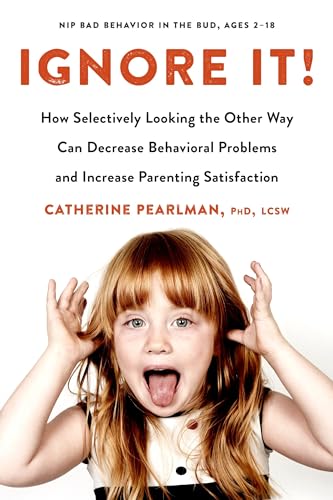
Inhaltsangabe
This book teaches frustrated, stressed-out parents that selectively ignoring certain behaviors can actually inspire positive changes in their kids.
With all the whining, complaining, begging, and negotiating, parenting can seem more like a chore than a pleasure. Dr. Catherine Pearlman, syndicated columnist and one of America’s leading parenting experts, has a simple yet revolutionary solution: Ignore It!
Dr. Pearlman’s four-step process returns the joy to child rearing. Combining highly effective strategies with time-tested approaches, she teaches parents when to selectively look the other way to withdraw reinforcement for undesirable behaviors. Too often we find ourselves bargaining, debating, arguing and pleading with kids. Instead of improved behavior parents are ensuring that the behavior will not only continue but often get worse. When children receive no attention or reward for misbehavior, they realize their ways of acting are ineffective and cease doing it. Using proven strategies supported by research, this book shows parents how to:
- Avoid engaging in a power struggle
- Stop using attention as a reward for misbehavior
- Use effective behavior modification techniques to diminish and often eliminate problem behaviors
Overflowing with wisdom, tips, scenarios, frequently asked questions, and a lot of encouragement, Ignore It! is the parenting program that promises to return bliss to the lives of exasperated parents.
Die Inhaltsangabe kann sich auf eine andere Ausgabe dieses Titels beziehen.
Über die Autorin bzw. den Autor
Dr. Catherine Pearlman is the founder of The Family Coach, a private practice specializing in helping families resolve everyday problems related to discipline, sleep, and sibling rivalry, among other issues. She is the proud parent of a son in elementary school and a daughter in middle school. Her syndicated Dear Family Coach column has appeared in The Wall Street Journal and many regional parenting magazines. She has appeared on Today and her advice has been featured in Parenting, Men's Health, CNN.com, and The Huffington Post. Dr. Pearlman is a licensed clinical social worker who has been working with children and families for more than twenty years. She is an assistant professor of social work at Brandman University and received a PhD in social welfare from Yeshiva University and a masters of social work from New York University.
Auszug. © Genehmigter Nachdruck. Alle Rechte vorbehalten.
IGNORE MY KIDS? ARE YOU CRAZY?
Whenever I counsel parents to ignore their children, I receive one of two responses. Roughly half look at me with a tilted head and an expression similar to the one my dog, Norma, makes when she isn’t sure what I am saying. They say something like, “Um, what do you mean, ignore them?” I repeat my thoughts about ignoring all of the annoying or testing behaviors, and the parents start to wonder if I am a bad family coach. Why on earth would they ignore their children? It feels counterintuitive. Bad behavior doesn’t just go away if you ignore it.
Well, actually, it does. After learning about Ignore it!, one dad told me he was scared to ignore his son’s inappropriate behavior because he worried the child would think he was okay with it. Dad wasn’t okay with it, and he wanted to be able to express that to his son. With Ignore it!, he still can convey that message—only not with words. His behavior will speak for him.
The other half of the parents are ecstatic to have permission to ignore their kids. They are exhausted from constant parenting. Managing children, careers, house payments and taxes, elderly parents, birthday parties, and school projects has mothers and fathers on the edge of checking out. Learning what one can and should ignore is often life-changing. One dad, relieved that he could at times ignore his only child, wrote me, “Thank you for this method. Now I can procreate again.” I’m pretty sure he was serious.
What isn’t disputed by these parents is that they are experiencing highly undesirable behavior from their children. Their kids whine. They cry and yell and scream and tantrum. The kids agitate them, often on purpose. And they push all of Mom and Dad’s buttons just because they can. Children are exploiting their parents’ vulnerabilities in every town, in every county, in every corner of every state. In response, parents spend more time disciplining than ever before. Time-outs and consequences are in perpetual rotation. Everything is a negotiation. But none of this is working. Not only is the unacceptable behavior not disappearing, it often gets worse.
As behavior gets worse parents yell more and punish more. They are angry and frustrated a lot more. Or, worst of all, they give up and give in. As a result, moms and dads enjoy parenting on a day‑to‑day basis a lot less. Something has to give. Parents usually choose to have children because while they imagined the hard work, they focused on the intense joy. However, they feel deflated when the balance is off so significantly. They experience considerably more frustration than elation.
Where did they go wrong?
WATCH ME, WATCH ME, WATCH ME
What is really at the heart of the two general parent responses to Ignore it! is that, in this age of relentless child observation, adulation, and adoration, ignoring children seems to be anathema to the predominate parenting style. Hyperparenting is an epidemic. I am not pointing fingers at helicopter parents because, quite honestly, we are all helicoptering to some degree. We never ignore our children. Ever. We take a heightened interest in everything they do, from their homework to their after-school activities to getting them into the best college.
Now, I can almost hear some of you saying, “That isn’t me.” Okay, maybe there are degrees to helicopter parenting. But read a few phrases most parents hear on a daily basis and ask yourself if you belong in the group:
“Mom, watch me do this dive again.”
“Mom, did you see the amazing car I made with my LEGOs?”
“Dad, watch this replay of my insane touchdown on the Xbox.”
“Pop, watch me climb this tree.”
“Watch me, watch me, watch me.” Kids aren’t satisfied pleasing themselves. They want to impress their parents and everyone around them, and they want to hear feedback on how (OMG!) awesome they are. Just observe any child playing any sport. A kid makes a great play in soccer and immediately looks to the parent for the thumbs‑up. Parents dictate self-worth in early childhood. By middle school, self-worth is decreed by an outside influence and measured in likes, shares, and popularity. Teens vigilantly craft their online images by posting only carefully curated selfies that have been approved by their best friends.
The need for attention is so great that children will go to extreme lengths to attain it. At first, most aim for the spotlight by being delightful. But sometimes that doesn’t work. Parents may have other children to divide their attention. Some parents work from home or are sick or even need a minute to make a call or send an e‑mail. This divided attention can lead kids to try to snag attention in less desirable ways. Enter: nudging, testing, needling, whining, yelling, and tantruming.
How and when did all of this attention-seeking and testing behavior start?
It began in infancy, and it was learned. Yup, we taught this behavior to our babies. We don’t just let kids watch a Baby Einstein video while we take a break from parenting for a half hour. No, we insist on sitting with them to teach them or support them or just keep them safe. Babies nowadays have a lot less self-directed play. In past generations, children didn’t have to be learning all the time. They just played without purpose. Those days are long gone.
Kids used to be left up to their own devices much more. They explored freely, rode their bikes around town, walked with their friends to the store for gum. When I was a kid, I’d spend long hours in the basement making “art” out of household products and laundry detergent. If I got bored, I’d walk myself over to the Schwartzes’ house to play Risk or Atari or hoops in the driveway. When it was time for my piano lesson, I’d ride my bike to the teacher’s house a mile away, all by myself. It was great. Times have changed.
This idea of constant parental supervision and instruction isn’t just self-imposed by parents. It is coming from all areas of society. For example, take a look at the description for a popular toy called Fisher-Price Brilliant Basics Baby’s First Blocks (notice the word “brilliant” in the name). The toy is a bucket containing shaped blocks and topped with a sorting grate. The online description of the toy reads, “Your baby will learn new concepts about colors and shapes (circle, star, triangle, and more) as the two of you sort the blocks through the shape-sorting lid before stacking up each group to knock them down.” This toy is for a six-month-old. Why would a parent need to sort the blocks with the baby? Why can’t the baby just play on her own? Answer: because society tells parents they need to constantly engage their attention on their children.
Of course, children require attention from their parents. And parents are usually devoted to providing it. But there is a healthy amount of attention that can turn problematic. More attention doesn’t necessarily produce better-adjusted and – behaved children. Once children come to expect endless attention, that attention can turn into a drug, and your kid into an addict. And just like the junkie seeking a fix, children continue attention-seeking behaviors despite undesirable consequences such as yelling and punishment.
THE INMATES ARE RUNNING THE ASYLUM
There is a natural call-and-response system set up to ensure babies thrive....
„Über diesen Titel“ kann sich auf eine andere Ausgabe dieses Titels beziehen.
Suchergebnisse für Ignore It!: How Selectively Looking the Other Way Can...

Beispielbild für diese ISBN
Ignore it!: How Selectively Looking the Other Way Can Decrease Behavioral Problems and Increase Parenting Satisfaction
Verlag:
Penguin Publishing Group, 2017
ISBN 10: 0143130331
ISBN 13: 9780143130338
Gebraucht
Paperback
Anbieter: World of Books (was SecondSale), Montgomery, IL, USA
Verkäuferbewertung 5 von 5 Sternen

Paperback. Zustand: Good. This book teaches frustrated, stressed-out parents that selectively ignoring certain behaviors can actually inspire positive changes in their kids. With all the whining, complaining, begging, and negotiating, parenting can seem more like a chore than a pleasure. Dr. Catherine Pearlman, syndicated columnist and one of America's leading parenting experts, has a simple yet revolutionary solution: Ignore It! Dr. Pearlman's four-step processreturns the joy to child rearing. Combining highly effective strategieswith time-tested approaches, she teaches parents when to selectively look the other way to withdraw reinforcement for undesirable behaviors. Too often we find ourselves bargaining, debating, arguing and pleading with kids. Instead of improved behavior parents are ensuring that the behavior will not only continue but often get worse. When children receive no attention or reward for misbehavior, they realize their ways of acting are ineffective and cease doing it.Using proven strategies supported by research, this book shows parents how to: - Avoid engaging in a power struggle - Stop using attention as a reward for misbehavior - Use effective behavior modification techniques to diminish and often eliminate problem behaviors Overflowing with wisdom, tips, scenarios, frequently asked questions, and a lot of encouragement,Ignore It! istheparenting program that promises to return bliss to the lives of exasperated parents. Artikel-Nr. 00099668380
Gebraucht kaufen
EUR 3,72
Versand gratis
Versand innerhalb von USA
Versand innerhalb von USA
Anzahl: 18 verfügbar
Beispielbild für diese ISBN
Ignore It How Selectively Look
Anbieter: World of Books (was SecondSale), Montgomery, IL, USA
Verkäuferbewertung 5 von 5 Sternen
Zustand: Very Good. Item in very good condition! Textbooks may not include supplemental items i.e. CDs, access codes etc. Artikel-Nr. 00107671688
Gebraucht kaufen
EUR 3,72
Versand gratis
Versand innerhalb von USA
Versand innerhalb von USA
Anzahl: 2 verfügbar
Beispielbild für diese ISBN
Ignore It!: How Selectively Looking the Other Way Can Decrease Behavioral Problems and Increase Parenting Satisfaction
Verlag:
Tarcher (edition Illustrated), 2017
ISBN 10: 0143130331
ISBN 13: 9780143130338
Gebraucht
Paperback
Anbieter: BooksRun, Philadelphia, PA, USA
Verkäuferbewertung 5 von 5 Sternen
Paperback. Zustand: Very Good. Illustrated. It's a well-cared-for item that has seen limited use. The item may show minor signs of wear. All the text is legible, with all pages included. It may have slight markings and/or highlighting. Artikel-Nr. 0143130331-11-1
Gebraucht kaufen
EUR 4,73
Versand gratis
Versand innerhalb von USA
Versand innerhalb von USA
Anzahl: 1 verfügbar
Beispielbild für diese ISBN
Ignore It!: How Selectively Looking the Other Way Can Decrease Behavioral Problems and Increase Parenting Satisfaction
Verlag:
Tarcher (edition Illustrated), 2017
ISBN 10: 0143130331
ISBN 13: 9780143130338
Gebraucht
Paperback
Anbieter: BooksRun, Philadelphia, PA, USA
Verkäuferbewertung 5 von 5 Sternen
Paperback. Zustand: Very Good. Illustrated. It's a well-cared-for item that has seen limited use. The item may show minor signs of wear. All the text is legible, with all pages included. It may have slight markings and/or highlighting. Artikel-Nr. 0143130331-8-1
Gebraucht kaufen
EUR 4,98
Versand gratis
Versand innerhalb von USA
Versand innerhalb von USA
Anzahl: 1 verfügbar
Beispielbild für diese ISBN
Ignore It! : How Selectively Looking the Other Way Can Decrease Behavioral Problems and Increase Parenting Satisfaction
Verlag:
Penguin Publishing Group, 2017
ISBN 10: 0143130331
ISBN 13: 9780143130338
Gebraucht
Softcover
Anbieter: Better World Books, Mishawaka, IN, USA
Verkäuferbewertung 5 von 5 Sternen
Zustand: Very Good. Former library copy. Pages intact with possible writing/highlighting. Binding strong with minor wear. Dust jackets/supplements may not be included. Includes library markings. Stock photo provided. Product includes identifying sticker. Better World Books: Buy Books. Do Good. Artikel-Nr. 16013062-6
Gebraucht kaufen
EUR 6,18
Versand gratis
Versand innerhalb von USA
Versand innerhalb von USA
Anzahl: 1 verfügbar
Beispielbild für diese ISBN
Ignore It! : How Selectively Looking the Other Way Can Decrease Behavioral Problems and Increase Parenting Satisfaction
Verlag:
Penguin Publishing Group, 2017
ISBN 10: 0143130331
ISBN 13: 9780143130338
Gebraucht
Softcover
Anbieter: Better World Books, Mishawaka, IN, USA
Verkäuferbewertung 5 von 5 Sternen
Zustand: Good. Pages intact with minimal writing/highlighting. The binding may be loose and creased. Dust jackets/supplements are not included. Stock photo provided. Product includes identifying sticker. Better World Books: Buy Books. Do Good. Artikel-Nr. 15344551-6
Gebraucht kaufen
EUR 6,18
Versand gratis
Versand innerhalb von USA
Versand innerhalb von USA
Anzahl: 3 verfügbar
Beispielbild für diese ISBN
Ignore It! : How Selectively Looking the Other Way Can Decrease Behavioral Problems and Increase Parenting Satisfaction
Verlag:
Penguin Publishing Group, 2017
ISBN 10: 0143130331
ISBN 13: 9780143130338
Gebraucht
Softcover
Anbieter: Better World Books, Mishawaka, IN, USA
Verkäuferbewertung 5 von 5 Sternen
Zustand: Good. Former library copy. Pages intact with minimal writing/highlighting. The binding may be loose and creased. Dust jackets/supplements are not included. Includes library markings. Stock photo provided. Product includes identifying sticker. Better World Books: Buy Books. Do Good. Artikel-Nr. 19169043-6
Gebraucht kaufen
EUR 6,18
Versand gratis
Versand innerhalb von USA
Versand innerhalb von USA
Anzahl: 2 verfügbar
Beispielbild für diese ISBN
Ignore It!: How Selectively Looking the Other Way Can Decrease Behavioral Problems and Increase Parenting Satisfaction
Anbieter: ThriftBooks-Atlanta, AUSTELL, GA, USA
Verkäuferbewertung 5 von 5 Sternen
Paperback. Zustand: Very Good. No Jacket. Former library book; May have limited writing in cover pages. Pages are unmarked. ~ ThriftBooks: Read More, Spend Less. Artikel-Nr. G0143130331I4N10
Gebraucht kaufen
EUR 6,34
Versand gratis
Versand innerhalb von USA
Versand innerhalb von USA
Anzahl: 1 verfügbar
Beispielbild für diese ISBN
Ignore It!: How Selectively Looking the Other Way Can Decrease Behavioral Problems and Increase Parenting Satisfaction
Anbieter: ThriftBooks-Dallas, Dallas, TX, USA
Verkäuferbewertung 5 von 5 Sternen
Paperback. Zustand: Very Good. No Jacket. May have limited writing in cover pages. Pages are unmarked. ~ ThriftBooks: Read More, Spend Less. Artikel-Nr. G0143130331I4N00
Gebraucht kaufen
EUR 6,34
Versand gratis
Versand innerhalb von USA
Versand innerhalb von USA
Anzahl: 1 verfügbar
Beispielbild für diese ISBN
Ignore It!: How Selectively Looking the Other Way Can Decrease Behavioral Problems and Increase Parenting Satisfaction
Anbieter: ThriftBooks-Atlanta, AUSTELL, GA, USA
Verkäuferbewertung 5 von 5 Sternen
Paperback. Zustand: Very Good. No Jacket. May have limited writing in cover pages. Pages are unmarked. ~ ThriftBooks: Read More, Spend Less. Artikel-Nr. G0143130331I4N00
Gebraucht kaufen
EUR 6,34
Versand gratis
Versand innerhalb von USA
Versand innerhalb von USA
Anzahl: 1 verfügbar