
Verwandte Artikel zu Ceremony: (Penguin Orange Collection)
Inhaltsangabe
The great Native American Novel of a battered veteran returning home to heal his mind and spirit, from celebrated author Leslie Marmon Silko
Decades after its original publication, Ceremony remains one of the most profound and moving works of Native American literature—a novel that is itself a ceremony of healing. Tayo, a World War II veteran of mixed ancestry, returns to the Laguna Pueblo Reservation. He is deeply scarred by his experience as a prisoner of the Japanese and further wounded by the rejection he encounters from his people. Only by immersing himself in the Indian past can he begin to regain the peace that was taken from him. Masterfully written, filled with the somber majesty of Pueblo myth, Ceremony is a work of enduring power. This Penguin Classics Deluxe Edition contains a new preface by the author and an introduction by Larry McMurtry.
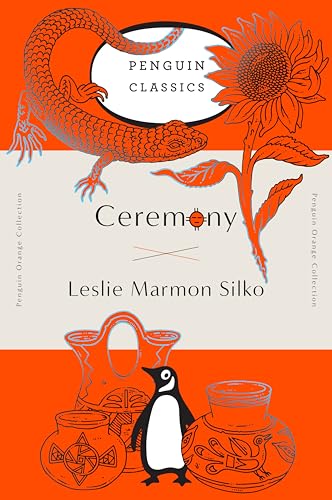
Part of the Penguin Orange Collection, a limited-run series of twelve influential and beloved American classics in a bold series design offering a modern take on the iconic Penguin paperback.
Winner of the 2016 AIGA + Design Observer 50 Books | 50 Covers competition
Die Inhaltsangabe kann sich auf eine andere Ausgabe dieses Titels beziehen.
Über die Autorin bzw. den Autor
Leslie Marmon Silko was born in New Mexico in 1948. She is the author of ten books of fiction, poetry, and memoir, including Ceremony, Storyteller, Almanac of the Dead, and The Turquoise Ledge. Considered by many as one of the most important contemporary Native American writers, Silko's honors include a MacArthur Foundation "Genius" fellowship, a National Endowment for the Arts grant, a Pushcart Prize for Poetry, and a Rosewater Foundation grant. She has been named a Living Cultural Treasure by the New Mexico Endowment for the Humanities Council, and has also received the Native Writers' Circle of the Americas Lifetime Achievement Award.
Von der hinteren Coverseite
Part of the Penguin Orange Collection, a limited-run series of twelve influential and beloved American classics in a bold series design offering a modern take on the iconic Penguin paperback
Winner of the 2016 AIGA + Design Observer 50 Books | 50 Covers competition
For the seventieth anniversary of Penguin Classics, the Penguin Orange Collection celebrates the heritage of Penguin's iconic book design with twelve influential American literary classics representing the breadth and diversity of the Penguin Classics library. These collectible editions are dressed in the iconic orange and white tri-band cover design, first created in 1935, while french flaps, high-quality paper, and striking cover illustrations provide the cutting-edge design treatment that is the signature of Penguin Classics Deluxe Editions today.
Ceremony
Almost forty years since its original publication, Ceremony remains one of the most profound and moving works of Native American literature-a novel that is itself a ceremony of healing. Masterfully written, filled with the somber majesty of Pueblo myth, Ceremony is a work of enduring power.
Auszug. © Genehmigter Nachdruck. Alle Rechte vorbehalten.
Table of Contents
About the Author
Title Page
Copyright Page
Dedication
Preface
Introduction
Ceremony
Sunrise.
About the Author
LESLIE MARMON SILKO was born in Albuquerque in 1948 of mixed ancestry—Laguna Pueblo, Mexican, and white. She grew up in the Laguna Pueblo Reservation, where she lives with her husband and two children. She is the author of the novel Almanac of the Dead, and her stories have appeared in many magazines and collections (including Writers of the Purple Sage). She is the recipient of a five-year MacArthur Foundation grant.
LARRY McMURTRY is the author of twenty-eight novels, including the Pulitzer Prize-winning Lonesome Dove. His other works include two collections of essays, three memoirs, and more than thirty screenplays, including the coauthorship of Brokeback Mountain, for which he received an Academy Award. He lives in Archer City, Texas.
PENGUIN BOOKS
Published by the Penguin Group
Penguin Group (USA) Inc., 375 Hudson Street, New York, New York 10014, U.S.A.
Penguin Group (Canada), 90 Eglinton Avenue East, Suite 700, Toronto,
Ontario, Canada M4P 2Y3 (a division of Pearson Penguin Canada Inc.)
Penguin Books Ltd, 80 Strand, London WC2R 0RL, England
Penguin Ireland, 25 St Stephen’s Green, Dublin 2, Ireland (a division of Penguin Books Ltd)
Penguin Group (Australia), 250 Camberwell Road, Camberwell,
Victoria 3124, Australia (a division of Pearson Australia Group Pty Ltd)
Penguin Books India Pvt Ltd, 11 Community Centre, Panchsheel Park, New Delhi - 110 017, India
Penguin Group (NZ), cnr Airborne and Rosedale Roads, Albany,
Auckland 1310, New Zealand (a division of Pearson New Zealand Ltd)
Penguin Books (South Africa) (Pty) Ltd, 24 Sturdee Avenue,
Rosebank, Johannesburg 2196, South Africa
Penguin Books Ltd, Registered Offices:
80 Strand, London WC2R 0RL, England
First published in the United States of America by The Viking Press 1977
Published by New American Library 1978
Published in Penguin Books 1986
This edition with a preface by the author and an introduction by Larry McMurtry published 2006
Introduction copyright © Larry McMurtry, 2006
All rights reserved
PUBLISHER’S NOTE
This is a work of fiction. Names, characters, places, and incidents either are the product
of the author’s imagination or are used fictitiously, and any resemblance to actual persons,
living or dead, business establishments, events, or locales is entirely coincidental.
THE LIBRARY OF CONGRESS CATALOGING-IN-PUBLICATION DATA
Silko, Leslie, 1943-
Ceremony / Leslie Marmon Silko ; introduction by Larry McMurtry.
p. cm.—(Penguin classics deluxe edition)
Originally published: New York : The Viking Press, 1977. With new preface by author.
ISBN: 9781440621826
1. World War, 1939-1945—Veterans—Fiction. 2. Laguna Indians—Fiction. I. Title.
PS3569.I44C4 2007
813'.54—dc22 2006050705
The scanning, uploading and distribution of this book via the Internet or via any other means without the permission of the publisher is illegal and punishable by law. Please purchase only authorized electronic editions, and do not participate in or encourage electronic piracy of copyrighted materials. Your support of the author’s rights is appreciated.
This book
is dedicated
to my grandmothers,
Jessie Goddard Leslie
and
Lillie Stagner Marmon,
and to my sons,
Robert William Chapman
and
Cazimir Silko
Thanks to the Rosewater Foundation-on-Ketchikan Creek,
Alaska, for the artist’s residence they generously provided.
Thanks also to the National Endowment for the Arts
and the 1974 Writing Fellowship.
John and Mei-Mei:
My love and my thanks to you
for keeping me going all the time.
Preface
We moved to Ketchikan, Alaska, from Chinle, Arizona, in the late spring of 1973. My elder son, Robert Chapman, was seven years old, and Cazimir was eighteen months. Ketchikan was John Silko’s hometown, and he’d taken a supervisory position in the legal services office in Ketchikan. I had a book contract with Viking Press because Richard Seaver, who was a Viking editor, saw my short stories in Ken Rosen’s anthology, The Man to Send Rain Clouds. At the time I thought it was odd that my book contract specified either a collection of short stories or a novel. I didn’t have a literary agent then to explain that publishers preferred novels. I had no intention of writing anything but short stories for Viking Press; I felt confident about the short story as a genre, but aside from being a voracious reader of novels from age ten, I neglected to take that course the English Department offered on The Novel. No way I was going to mess with success. Short stories, that’s what I’d write. I used my writer’s grant from the National Endowment for the Arts to pay for day care for Caz while Robert was in school.
Located on Revillagigedo Island, 750 miles north of Seattle, Ketchikan had a mild climate by Alaskan standards due in large part to a warm ocean current named the Japanese Current. The average year-round temperature was forty-eight degrees, and the average rainfall was 180 inches. In Chinle the annual rainfall was twelve inches in a good year. I was accustomed to the bright sunlight of the Southwest, where the weather permitted activity outdoors all year around. In southeastern Alaska the tall spruce trees, the heavy clouds, fogs and mist and the steep mountains enclosed the town. In the Southwest I was accustomed to gazing into distances of forty or fifty miles. I was accustomed to seeing the sky and the stars and moon.
The change in climate had a profound effect on me; I spent all of June, July, and August fighting off the terrible lethargy of a depression caused in large part by the absence of sunlight. I managed to write one short story during that time, about a woman who drowned herself; it wasn’t a good short story but a message to myself. In September after the boys were in day care and school, I tried to write at home but I found it difficult to concentrate: the dirty dishes and dirty laundry seemed to cry out for attention.
About this time Richard Whittaker came to my aid. Dick and his family lived across the street from my Silko in-laws. He practiced Indian law mostly for the local tribes, and he was a strong supporter of the Alaska Legal Services program, which employed my husband. Dick was a reader of novels and especially admired Kurt Vonnegut’s God Bless You, Mr. Rosewater. I talked about needing a place to write, and Dick Whittaker invited me to use the table and chair in his closet-sized law library. His law office was located on the second floor of the building that housed the offices of the legal services program. The building is still there overlooking Ketchikan Creek, next to the great Chief Johnson totem pole with Raven and Fog Woman at the corner of Mission Street and Stedman Street.
I worked on the library table with my Hermes portable typewriter and a fountain pen. Once I saw what I’d typed, I immediately edited with a fountain pen. Every day I read the previous day’s writing to get myself started again. Luckily I was in the early stages when I didn’t have much manuscript or many notes, because of course I could not leave my work spread out over the law library table: Dick Whittaker and...
„Über diesen Titel“ kann sich auf eine andere Ausgabe dieses Titels beziehen.
Suchergebnisse für Ceremony: (Penguin Orange Collection)

Beispielbild für diese ISBN
Ceremony: (Penguin Orange Collection)
Anbieter: World of Books (was SecondSale), Montgomery, IL, USA
Verkäuferbewertung 5 von 5 Sternen

Paperback. Zustand: Very Good. The great Native American Novel of a battered veteran returning home to heal his mind and spirit, from celebrated author Leslie Marmon Silko Decades after its original publication, Ceremony remains one of the most profound and moving works of Native American literature--a novel that is itself a ceremony of healing. Tayo, a World War II veteran of mixed ancestry, returns to the Laguna Pueblo Reservation. He is deeply scarred by his experience as a prisoner of the Japanese and further wounded by the rejection he encounters from his people. Only by immersing himself in the Indian past can he begin to regain the peace that was taken from him. Masterfully written, filled with the somber majesty of Pueblo myth, Ceremony is a work of enduring power. This Penguin Classics Deluxe Edition contains a new preface by the author and an introduction by Larry McMurtry. Part of the Penguin Orange Collection, a limited-run series of twelve influential and beloved American classics in a bold series design offering a modern take on the iconic Penguin paperback. Winner of the 2016 AIGA + Design Observer 50 Books | 50 Covers competition. Artikel-Nr. CIN0143129465VG
Gebraucht kaufen
EUR 5,61
Versand gratis
Versand innerhalb von USA
Versand innerhalb von USA
Anzahl: 1 verfügbar
Foto des Verkäufers
Ceremony: (Penguin Orange Collection)
Anbieter: Dream Books Co., Denver, CO, USA
Verkäuferbewertung 5 von 5 Sternen
Zustand: good. Gently used with minimal wear on the corners and cover. A few pages may contain light highlighting or writing, but the text remains fully legible. Dust jacket may be missing, and supplemental materials like CDs or codes may not be included. May be ex-library with library markings. Ships promptly! Artikel-Nr. DBV.0143129465.G
Gebraucht kaufen
EUR 5,62
Versand gratis
Versand innerhalb von USA
Versand innerhalb von USA
Anzahl: 1 verfügbar
Beispielbild für diese ISBN
Ceremony: (Penguin Orange Collection)
Anbieter: ThriftBooks-Dallas, Dallas, TX, USA
Verkäuferbewertung 5 von 5 Sternen
Paperback. Zustand: Very Good. No Jacket. May have limited writing in cover pages. Pages are unmarked. ~ ThriftBooks: Read More, Spend Less. Artikel-Nr. G0143129465I4N00
Gebraucht kaufen
EUR 6,05
Versand gratis
Versand innerhalb von USA
Versand innerhalb von USA
Anzahl: 1 verfügbar
Beispielbild für diese ISBN
Ceremony: (Penguin Orange Collection)
Anbieter: ThriftBooks-Atlanta, AUSTELL, GA, USA
Verkäuferbewertung 5 von 5 Sternen
Paperback. Zustand: Very Good. No Jacket. May have limited writing in cover pages. Pages are unmarked. ~ ThriftBooks: Read More, Spend Less. Artikel-Nr. G0143129465I4N00
Gebraucht kaufen
EUR 6,05
Versand gratis
Versand innerhalb von USA
Versand innerhalb von USA
Anzahl: 1 verfügbar
Beispielbild für diese ISBN
Ceremony: (Penguin Orange Collection)
Anbieter: ThriftBooks-Dallas, Dallas, TX, USA
Verkäuferbewertung 5 von 5 Sternen
Paperback. Zustand: Fair. No Jacket. Readable copy. Pages may have considerable notes/highlighting. ~ ThriftBooks: Read More, Spend Less. Artikel-Nr. G0143129465I5N00
Gebraucht kaufen
EUR 6,05
Versand gratis
Versand innerhalb von USA
Versand innerhalb von USA
Anzahl: 1 verfügbar
Beispielbild für diese ISBN
Ceremony: (Penguin Orange Collection)
Anbieter: ThriftBooks-Atlanta, AUSTELL, GA, USA
Verkäuferbewertung 5 von 5 Sternen
Paperback. Zustand: Good. No Jacket. Pages can have notes/highlighting. Spine may show signs of wear. ~ ThriftBooks: Read More, Spend Less. Artikel-Nr. G0143129465I3N00
Gebraucht kaufen
EUR 6,05
Versand gratis
Versand innerhalb von USA
Versand innerhalb von USA
Anzahl: 1 verfügbar
Beispielbild für diese ISBN
Ceremony: (Penguin Orange Collection)
Anbieter: ThriftBooks-Dallas, Dallas, TX, USA
Verkäuferbewertung 5 von 5 Sternen
Paperback. Zustand: Very Good. No Jacket. Former library book; May have limited writing in cover pages. Pages are unmarked. ~ ThriftBooks: Read More, Spend Less. Artikel-Nr. G0143129465I4N10
Gebraucht kaufen
EUR 6,05
Versand gratis
Versand innerhalb von USA
Versand innerhalb von USA
Anzahl: 1 verfügbar
Beispielbild für diese ISBN
Ceremony: (Penguin Orange Collection)
Anbieter: ThriftBooks-Atlanta, AUSTELL, GA, USA
Verkäuferbewertung 5 von 5 Sternen
Paperback. Zustand: Fair. No Jacket. Readable copy. Pages may have considerable notes/highlighting. ~ ThriftBooks: Read More, Spend Less. Artikel-Nr. G0143129465I5N00
Gebraucht kaufen
EUR 6,05
Versand gratis
Versand innerhalb von USA
Versand innerhalb von USA
Anzahl: 1 verfügbar
Beispielbild für diese ISBN
Ceremony: (Penguin Orange Collection)
Anbieter: ThriftBooks-Phoenix, Phoenix, AZ, USA
Verkäuferbewertung 5 von 5 Sternen
Paperback. Zustand: Very Good. No Jacket. May have limited writing in cover pages. Pages are unmarked. ~ ThriftBooks: Read More, Spend Less. Artikel-Nr. G0143129465I4N00
Gebraucht kaufen
EUR 6,05
Versand gratis
Versand innerhalb von USA
Versand innerhalb von USA
Anzahl: 1 verfügbar
Beispielbild für diese ISBN
Ceremony: (Penguin Orange Collection)
Anbieter: ThriftBooks-Reno, Reno, NV, USA
Verkäuferbewertung 5 von 5 Sternen
Paperback. Zustand: Very Good. No Jacket. May have limited writing in cover pages. Pages are unmarked. ~ ThriftBooks: Read More, Spend Less. Artikel-Nr. G0143129465I4N00
Gebraucht kaufen
EUR 6,05
Versand gratis
Versand innerhalb von USA
Versand innerhalb von USA
Anzahl: 1 verfügbar