
Verwandte Artikel zu Gods and Kings: The Rise and Fall of Alexander McQueen...
Inhaltsangabe
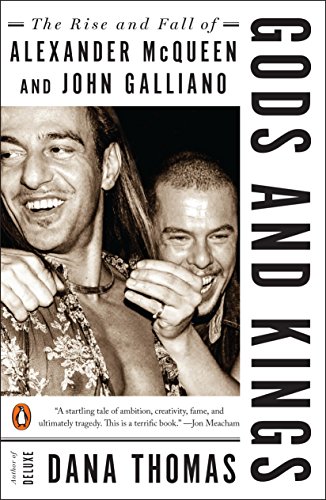
The New York Times–bestselling author of Deluxe and Fashionopolis: The Price of Fast Fasion and the Future of Clothes chronicles the making and unmaking of two of the greatest fashion designers of our time
In the mid-1990s, John Galliano and Alexander McQueen exploded onto a fashion scene that was in an artistic and economic rut. Their daring visions shook the establishment out of its bourgeois, minimalist stupor with vibrant, sexy designs and theatrical runway shows. By the end of the decade, each had been hired to run one of couture’s most storied houses, Galliano at Dior and McQueen at Givenchy. They were icons of a new generation of rock-star designers who headlined the transformation of luxury fashion from a small clutch of family-owned businesses into a global, multibillion-dollar corporate industry. But the pace was unsustainable. In 2010, McQueen took his own life. A year later, Galliano was fired in the wake of an alcohol-fueled, anti-Semitic diatribe.
In her groundbreaking work Gods and Kings, acclaimed fashion journalist Dana Thomas tells the true story of two unforgettable artists. In so doing, she pulls back the curtain on the revolution that has remade high fashion over the last two decades—and the price it demanded from the very ones who saved it.
Die Inhaltsangabe kann sich auf eine andere Ausgabe dieses Titels beziehen.
Über die Autorin bzw. den Autor
Dana Thomas is the author of Fashionopolis: The Price of Fast Fashion and the Future of Clothes, Gods and Kings and the New York Times bestseller Deluxe. She began her career writing for the Style section of The Washington Post, and she has served as a cultural and fashion correspondent for Newsweek in Paris. She is a regular contributor to The New York Times Style section and has written for The New York Times Magazine, The New Yorker, The Wall Street Journal, the Financial Times, Vogue, Harper’s Bazaar, T: The New York Times Style Magazine, and Architectural Digest. In 2016, the French Minister of Culture named Thomas a Chevalier of the Order of Arts and Letters. She lives in Paris.
Auszug. © Genehmigter Nachdruck. Alle Rechte vorbehalten.
Tangier is a city as ancient as the gods, the point where Europe and Africa meet, where the Atlantic and the Mediterranean kiss. It is a labyrinth of narrow streets “thronged with the phantoms of forgotten ages,” Mark Twain wrote in 1869, and “a basin that holds you,” Truman Capote observed, where “the days slide by less noticed than foam in a waterfall.”
In the early 1960s, a young boy from Gibraltar named John Charles Galliano passed through Tangier by ferry with his Spanish mother, Anita, on his way to and from school in Spain—an exotic commute made necessary by a long-standing diplomatic feud between his father’s homeland and his mother’s. Galliano delighted in their stopovers in this strange, curious place. “The souks, the markets, woven fabrics, the carpets, the smells, the herbs, the Mediterranean color,” he reflected years later. This, he mused, was “where my love of textiles comes from.”
Galliano was born on November 28, 1960, the middle child of three; sister Rose Marie was five years older, and Maria Inmaculada, three years younger. His father, John Joseph, was a plumber who “came from a long line of rather serious and practical men, such as tailors and carpenters, all of whom traditionally began to earn a living from the age of fourteen,” he said.
His mother, Ana Guillén Rueda—known as Anita—hailed from La Línea de la Concepción, the Spanish town across the border from Gibraltar. The Guillén family had long lived in the rural farming region next to the British territory. “They were renowned for their passion for flamenco and a temperament that was utterly fiery and wild,” Galliano said. She grew up under Spanish dictator General Franco’s totalitarian regime—a pro-nationalist and ultra-Catholic society where anti-Semitism flourished. After she married and moved to Gibraltar, she maintained close ties to her homeland, and made sure her young son was educated in the same culture as she had been.
The Galliano family resided at 13, Serfaty’s Passage, a small lane named for the local Jewish population, where the Esnoga Grande, Gibraltar’s principal synagogue, has been located since the early eighteenth century. Gibraltar has had an uneasy relationship with the Jewish community for centuries. Following their expulsion from Spain in 1492, much of the Spanish Jewish diaspora—known as the Sephardim, after the Hebrew word for Spain—passed through Gibraltar on their way to settlements in North Africa. They were given the right to a permanent settlement in 1749 and the population flourished quietly until World War II, when all its residents were evacuated from the two-and-a-half-square-mile territory.
The Gallianos were devout Catholics who attended mass regularly. Galliano was baptized at the Cathedral of St. Mary the Crowned, the baroque seat of the Roman Catholic diocese of Gibraltar, before the same altar where his parents wed. He adored growing up in Gibraltar, mesmerized, he said, by the “bright alleyways, sunshine, blue skies and a main street bustling with sailors.”
But John Joseph wanted more for his children: in 1967, he moved the family to South London, so six-year-old Galliano and his sisters could receive a better education. Galliano remembered thinking how brave his mother was “to depart with three young children to a completely foreign country where she did not speak a word of the language.” They eventually settled in the middle-class neighborhood of Peckham, where they lived in a tan brick Victorian row house at 128, Underhill Road.
London was in the throes of the Swinging Sixties, when the Beatles, the Rolling Stones, and other British Invasion bands were topping the pop music charts; fashion designer Mary Quant was liberating women with the miniskirt and hot pants; film directors Tony Richardson and Richard Lester were turning out cool, ironic comedies like The Knack . . . and How to Get It; and photographers David Bailey, Terence Donovan, and Harry Benson were capturing it all for Harper’s Bazaar, Vogue, and Life. “In a decade dominated by youth,” Time magazine pronounced in its landmark cover story on the city’s cultural renaissance, “London has burst into bloom. It swings; it is the scene.”
The Galliano family wanted no part of that London. Instead Anita, a striking redhead with an olive complexion and a good figure, did what she could to keep the scents, the colors, and the music of southern Spain alive in cold, gray, rainy England. She cooked traditional Mediterranean meals and encouraged her young son to sing—he had a lovely, pitch-perfect voice—and to dance the flamenco. “On tabletops,” he later explained, because “it makes more noise.”
“I knew pretty soon that I had inherited this whole Spanish pride thing from my mother—the way you look and the way you walk and dress,” he admitted. “I never knew anyone with more outfits than her. She was the sort of woman who would dress herself and her children up to the nines and scrub us all with baby perfume until we sparkled just to go out down the road for a coffee. I can still remember all the heads turning as she walked by.”
John Joseph—a fairly short and stocky, fair-skinned, balding man—ran his own plumbing business, and taught his son some of the basics, like how to use a blowtorch. “I would sometimes go out with him on jobs and I was struck by how he always had to have the most perfect finish and the cleanest joint, and how sad it was that all that craftsmanship would never be appreciated,” Galliano said. His father’s profession—which was very low on the English class scale—eventually became a sore spot for him: “People are always talking about how I am a plumber’s son,” he complained. “I am my father’s son primarily. What he chose to do as a career was his choice and he did it very, very well.” Galliano’s mother worked as “dinner lady” in a local school cafeteria. He never made mention of it publicly.
Throughout the home there were souvenirs of their pre-London life, such as a Spanish fan and pictures of Gibraltar. Galliano spoke Spanish with his mother and English with his father. “Other boys’ houses always seemed to smell of dogs and musty carpets,” he said, “whereas ours smelt of garlic and clean laundry and fresh flowers.”
As in Gibraltar, the Galliano family attended mass regularly. On some Sundays, Galliano would serve as an altar boy at the 9:30 service and play guitar for the Latin mass. He was particularly captivated by “all the pomp and ceremony, the clouds of incense, the Holy Communion outfits,” he recalled—an infatuation that would later surface in his fashion shows. For his first communion, he said, “I arrived in this dazzling white suit, bedecked with rosary beads and gold chains and ribbons with all the saints on.” The other boys were in their conservative school uniforms. “I knew I was different,” he admitted, “and I ended up being photographed with all the girls. But it didn’t bother me. I always liked being with the girls, and I also liked looking cool.”
Galliano readily allows that his parents instilled a strong set of values, “like the need for discipline and honesty, the notion that things were only worth doing if you did them to the best of your ability, and the importance of a...
„Über diesen Titel“ kann sich auf eine andere Ausgabe dieses Titels beziehen.
Suchergebnisse für Gods and Kings: The Rise and Fall of Alexander McQueen...

Beispielbild für diese ISBN
Gods and Kings: The Rise and Fall of Alexander McQueen and John Galliano
Anbieter: Books From California, Simi Valley, CA, USA
Verkäuferbewertung 4 von 5 Sternen

paperback. Zustand: Good. Book shows some shelf & handling wear, including minor edge wear and cover creasing. Pages are slightly worn. Interiors are intact with unmarked text/pictures. Good reading copy. Artikel-Nr. mon0004244803
Gebraucht kaufen
EUR 11,11
EUR 4,46 Versand
Versand innerhalb von USA
Versand innerhalb von USA
Anzahl: 1 verfügbar
Beispielbild für diese ISBN
Gods and Kings : The Rise and Fall of Alexander Mcqueen and John Galliano
Verlag:
Penguin Publishing Group, 2016
ISBN 10: 0143128396
ISBN 13: 9780143128397
Gebraucht
Softcover
Anbieter: Better World Books, Mishawaka, IN, USA
Verkäuferbewertung 5 von 5 Sternen

Zustand: Very Good. Pages intact with possible writing/highlighting. Binding strong with minor wear. Dust jackets/supplements may not be included. Stock photo provided. Product includes identifying sticker. Better World Books: Buy Books. Do Good. Artikel-Nr. 10041967-6
Gebraucht kaufen
EUR 16,16
Versand gratis
Versand innerhalb von USA
Versand innerhalb von USA
Anzahl: 1 verfügbar
Beispielbild für diese ISBN
Gods and Kings: The Rise and Fall of Alexander Mcqueen and John Galliano
Anbieter: Revaluation Books, Exeter, Vereinigtes Königreich
Verkäuferbewertung 5 von 5 Sternen
Paperback. Zustand: Brand New. reprint edition. 422 pages. 7.00x5.00x1.00 inches. In Stock. Artikel-Nr. __0143128396
Neu kaufen
EUR 19,99
EUR 11,80 Versand
Versand von Vereinigtes Königreich nach USA
Versand von Vereinigtes Königreich nach USA
Anzahl: 1 verfügbar
Beispielbild für diese ISBN
Gods and Kings: The Rise and Fall of Alexander Mcqueen and John Galliano
Anbieter: Revaluation Books, Exeter, Vereinigtes Königreich
Verkäuferbewertung 5 von 5 Sternen
Paperback. Zustand: Brand New. reprint edition. 422 pages. 7.00x5.00x1.00 inches. In Stock. Artikel-Nr. xr0143128396
Neu kaufen
EUR 23,41
EUR 11,80 Versand
Versand von Vereinigtes Königreich nach USA
Versand von Vereinigtes Königreich nach USA
Anzahl: 2 verfügbar
Beispielbild für diese ISBN
Gods and Kings: The Rise and Fall of Alexander McQueen and John Galliano
Anbieter: Kennys Bookstore, Olney, MD, USA
Verkäuferbewertung 5 von 5 Sternen
Zustand: New. 2016. Reprint. paperback. . . . . . Books ship from the US and Ireland. Artikel-Nr. V9780143128397
Neu kaufen
EUR 26,46
EUR 9,37 Versand
Versand innerhalb von USA
Versand innerhalb von USA
Anzahl: 15 verfügbar
Beispielbild für diese ISBN
Gods and Kings: The Rise and Fall of Alexander Mcqueen and John Galliano
Anbieter: Revaluation Books, Exeter, Vereinigtes Königreich
Verkäuferbewertung 5 von 5 Sternen
Paperback. Zustand: Brand New. reprint edition. 422 pages. 7.00x5.00x1.00 inches. In Stock. Artikel-Nr. 0143128396
Neu kaufen
EUR 34,14
EUR 11,80 Versand
Versand von Vereinigtes Königreich nach USA
Versand von Vereinigtes Königreich nach USA
Anzahl: 1 verfügbar
Beispielbild für diese ISBN
Gods and Kings: The Rise and Fall of Alexander McQueen and John Galliano
Anbieter: AwesomeBooks, Wallingford, Vereinigtes Königreich
Verkäuferbewertung 5 von 5 Sternen
Paperback. Zustand: Very Good. Gods and Kings: The Rise and Fall of Alexander McQueen and John Galliano This book is in very good condition and will be shipped within 24 hours of ordering. The cover may have some limited signs of wear but the pages are clean, intact and the spine remains undamaged. This book has clearly been well maintained and looked after thus far. Money back guarantee if you are not satisfied. See all our books here, order more than 1 book and get discounted shipping. Artikel-Nr. 7719-9780143128397
Gebraucht kaufen
EUR 55,96
EUR 4,86 Versand
Versand von Vereinigtes Königreich nach USA
Versand von Vereinigtes Königreich nach USA
Anzahl: 2 verfügbar
Foto des Verkäufers
Gods and Kings : The Rise and Fall of Alexander McQueen and John Galliano
Anbieter: AHA-BUCH GmbH, Einbeck, Deutschland
Verkäuferbewertung 5 von 5 Sternen
Taschenbuch. Zustand: Neu. Neuware - 'A startling tale of ambition, creativity, fame, and ultimately tragedy. This is a terrific book.' Jon MeachamThe New York Times bestselling author of Deluxe and Fashionopolis chronicles the making and unmaking of two of the greatest fashion designers of our timeIn the mid-1990s, John Galliano and Alexander McQueen exploded onto a fashion scene that was in an artistic and economic rut. Their daring visions shook the establishment out of its bourgeois, minimalist stupor with vibrant, sexy designs and theatrical runway shows. By the end of the decade, each had been hired to run one of couture's most storied houses, Galliano at Dior and McQueen at Givenchy. They were icons of a new generation of rock-star designers who headlined the transformation of luxury fashion from a small clutch of family-owned businesses into a global, multibillion-dollar corporate industry. But the pace was unsustainable. In 2010, McQueen took his own life. A year later, Galliano was fired in the wake of an alcohol-fueled, anti-Semitic diatribe.In her groundbreaking work Gods and Kings, acclaimed fashion journalist Dana Thomas tells the true story of two unforgettable artists. In so doing, she pulls back the curtain on the revolution that has remade high fashion over the last two decadesand the price it demanded from the very ones who saved it. Artikel-Nr. 9780143128397
Neu kaufen
EUR 27,49
EUR 35,00 Versand
Versand von Deutschland nach USA
Versand von Deutschland nach USA
Anzahl: 1 verfügbar
Beispielbild für diese ISBN
Gods and Kings: The Rise and Fall of Alexander McQueen and John Galliano
Anbieter: Bahamut Media, Reading, Vereinigtes Königreich
Verkäuferbewertung 4 von 5 Sternen
paperback. Zustand: Very Good. Shipped within 24 hours from our UK warehouse. Clean, undamaged book with no damage to pages and minimal wear to the cover. Spine still tight, in very good condition. Remember if you are not happy, you are covered by our 100% money back guarantee. Artikel-Nr. 6545-9780143128397
Gebraucht kaufen
EUR 55,38
EUR 8,23 Versand
Versand von Vereinigtes Königreich nach USA
Versand von Vereinigtes Königreich nach USA
Anzahl: 1 verfügbar
Foto des Verkäufers
Gods and Kings
Anbieter: moluna, Greven, Deutschland
Verkäuferbewertung 5 von 5 Sternen
Zustand: New. Dana Thomas is the author of Fashionopolis: The Price of Fast Fashion and the Future of Clothes, Gods and Kings and the New York Times bestseller Deluxe. She began her career writing for . Artikel-Nr. 897438751
Neu kaufen
EUR 23,48
EUR 48,99 Versand
Versand von Deutschland nach USA
Versand von Deutschland nach USA
Anzahl: Mehr als 20 verfügbar