
Verwandte Artikel zu The Lagoon: How Aristotle Invented Science
Inhaltsangabe
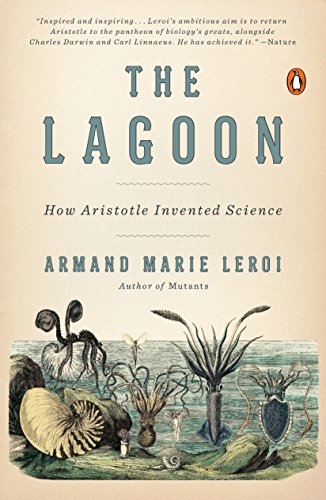
The remarkable but neglected story of Aristotle’s founding role in the scientific study of nature
Both a travelogue and a study of the origins of science, The Lagoon shows how an ancient thinker still has much to teach us today. Aristotle’s philosophy looms large over the history of Western thought, but the subject he most loved was biology. He wrote vast treatises on animals, dissecting them, classifying them, recording how they lived, fed, and bred. He founded a science. It can even be said that he founded science itself.
In this luminous book, acclaimed biologist Armand Marie Leroi recovers Aristotle’s science. He explores Aristotle’s observations, his deep ideas, his inspired guesses—and the things he got wildly wrong. Leroi visits the Aegean island where Aristotle plumbed the secrets of the living world in all its beauty. Modern science still bears the stamp of its founder. The Lagoon reveals that Aristotle was not only the first biologist, but also one of the greatest.
Die Inhaltsangabe kann sich auf eine andere Ausgabe dieses Titels beziehen.
Über die Autorin bzw. den Autor
Armand Marie Leroi is a professor of evolutionary developmental biology at Imperial College London. He is also a broadcaster and the author of Mutants: On Genetic Variety and the Human Body, which has been translated into nine languages and won the Guardian First Book Award. He lives in London.
Auszug. © Genehmigter Nachdruck. Alle Rechte vorbehalten.
THE LAGOON
LESBOS (MYTILENE)
Among the isles of Greece there is a certain island, insula nobilis et amoena, which Aristotle knew well. It lies on the Asian side, between the Troad and the Mysian coast, and far into its bosom, by the little town of Pyrrha, runs a broad and sheltered lagoon.
D’Arcy Wentworth Thompson,
On Aristotle as a biologist (1913)
AT
ERATO
I
THERE IS A bookshop in old Athens. It is the loveliest I know. It lies in an alley near the Agora, next to a shop that sells canaries and quails from cages strung on the façade. Wide louvres admit shafts of light that fall upon Japanese woodblock prints propped on a painter’s easel. Beyond, in the gloom, there are crates of lithographs and piles of topographical maps. Terracotta tiles and plaster busts of ancient philosophers and playwrights do duty as bookends. The scent is of warm, old paper and Turkish tobacco. The stillness is disturbed only by the muted trills of the songbirds next door.
I have returned so often, and the scene is so constant, that it is hard to remember when, exactly, I first walked into George Papadatos’ bookshop. But I do recall that it was the drachma’s last spring, when Greece was still poor and cheap and you landed at Ellinikon where the clacking flight boards listed Istanbul, Damascus, Beirut and Belgrade and you still felt as if you’d travelled east. George – lank grey hair, a bookman’s paunch – sat at his desk reading an old French political tract. Years ago, he told me, he had taught at Toronto – ‘But in Greece, they still had poets.’ He returned and named his store for the lyric muse.
Scanning his shelves, I saw Andrew Lang’s Odyssey and three volumes of Jowett’s Plato. They were the sort of books that might have belonged to an Englishman, a schoolmaster perhaps, who had retired to Athens, lived on his pension, and died there with some epigram of Callimachus on his lips. Whoever he was, he also left, in a row of Clarendon blue, the complete Works of Aristotle Translated into English, edited by J. S. Smith and W. D. Ross and published between 1910 and 1952. Ancient philosophy had never held much interest for me; I am a scientist. But I was idling and in no hurry to leave the calm of the shop. Besides, the title of the fourth volume in the series had caught my eye: Historia animalium.* I opened it and read about shells.
Again, in regard to the shells themselves, the testaceans present differences when compared to one another. Some are smooth-shelled, like the solen, the mussel and some clams, viz. those that are nicknamed ‘milk-shells’, while others are rough-shelled, such as the pool-oyster or edible oyster, the pinna and certain species of cockles, and the trumpet shells; and of these some are ribbed, such as the scallop and a certain kind of clam or cockle, and some are devoid of ribs, as the pinna and another species of clam.
The shell, for me it is always the shell, had sat in the sunlight of a bathroom windowsill, buried in sedimentary layers of my father’s shaving talc, seemingly for ever. My parents must have picked it up somewhere along the Italian littoral, though whether in Venice, Naples, Sorrento or Capri neither could recall. A summer souvenir, then, of when they were still young and newly married; but indifferent to such associations I coveted the thing for itself: the chocolate flames of its helical whorls, the deep orange of its mouth, the milk of its unreachable interior.
I can describe it so exactly for, although this was so many years ago, I have it before me now. It is a perfect specimen of Charonia variegata (Lamarck), the shell of Minoan frescos and Sandro Botticelli’s Venus and Mars. The trumpet of Aegean fishermen, weathered shells with a hole punched through the apex can still be found in Monastiraki stalls. Aristotle knew it as the kēryx, which means ‘herald’.
It was the first of many: shells, apparently infinitely various, yet possessed of a deep formal order of shapes and colours and textures that could be endlessly rearranged in shoeboxes until finally, seeing that the mania would not cease, my father had a cabinet built to house them all. A drawer for the luminous cowries, another for the thrillingly venomous cones, one for the filigree-sculptured murexes, others for the olives, marginellas, whelks, conchs, tuns, littorines, nerites, turbans and limpets, several for the bivalves and two, my pride, for the African land snails, gigantic creatures that no more resemble a common garden snail than an elephant does a rabbit. What pure delight. My mother’s heroic contribution was to type the catalogue and so become Conseil to my Aronnax, an expert in the Latinate hierarchy of Molluscan taxonomy, though her knowledge was entirely theoretical for she could scarcely tell one species from another.
At eighteen, convinced that my contribution to science would be vast malacological monographs that would be the last word for a hundred years (at least) on the Achatinidae of the African forests or, perhaps – for my attention tended to wander – the Buccindae of the Boreal Pacific, I went to learn marine biology at a research station perched on the edge of a small Canadian inlet. There, a marine ecologist, an awesome Blackbeard-like figure whose violent impatience was checked only by kindness to match, showed me how to peel away the layers of a gastropod’s tissues, more fragile than rice-paper, with forceps honed to a needle point and so reveal the severe functional logic that lies within. Another, a professorial cowboy-aesthete – the combination seems incongruous yet he was utterly of a piece – taught me how to think about evolution, which is to say about almost everything. I heard a legend speak, a scientist who had Laozi’s gaunt cheeks and wispy beard and who, blind from childhood, had discovered the one part of the empirical world that need not be seen and still can be known – shell form, of course – and had told its tales by touch alone. There was also a girl. She had wind-reddened skin and black hair and could pilot a RIB powered by twin Johnson 60s through two-metre surf and not flinch.
All this is, as I said, long ago. I did not, as it happens, ever write those taxonomic monographs. Science always sets you on entirely unpredictable paths and, by the time I walked into George Papadatos’ bookshop, I had long put my shells away. Still, it all came back to me when I read Aristotle on shells and when, reading further, I came across his description of the internal anatomy of the creatures that make them:
The stomach follows close upon the mouth and, by the way, this organ in the snail resembles a bird’s crop. Underneath come two white formations, mastoid or papillary in form; and similar formations are found in the cuttlefish also, only that they are of a firmer consistency [in snails] than in the cuttlefish. After the stomach comes the oesophagus, simple and long, extending to the poppy or quasi-liver, which is in the innermost recesses of the shell. All these statements may be verified in the case of the purple murex and the kēryx by observation within the whorl of the shell. What comes next . . .
You may wonder that such blunt words can carry beauty, but for me they did. It was not mere nostalgia, though certainly that played its part. No, it was that I understood, understood against all expectation and probability, what he meant. He had evidently walked down to the shore, picked up a snail, asked ‘what’s inside?’; had looked, and had...
„Über diesen Titel“ kann sich auf eine andere Ausgabe dieses Titels beziehen.
Suchergebnisse für The Lagoon: How Aristotle Invented Science

Beispielbild für diese ISBN
The Lagoon: How Aristotle Invented Science
Verlag:
Penguin Publishing Group (edition Reprint), 2015
ISBN 10: 0143127985
ISBN 13: 9780143127987
Gebraucht
Paperback
Anbieter: BooksRun, Philadelphia, PA, USA
Verkäuferbewertung 5 von 5 Sternen

Paperback. Zustand: Fair. Reprint. The item might be beaten up but readable. May contain markings or highlighting, as well as stains, bent corners, or any other major defect, but the text is not obscured in any way. Artikel-Nr. 0143127985-7-1-13
Gebraucht kaufen
EUR 4,78
Versand gratis
Versand innerhalb von USA
Versand innerhalb von USA
Anzahl: 1 verfügbar
Beispielbild für diese ISBN
The Lagoon: How Aristotle Invented Science
Verlag:
Penguin Publishing Group, 2015
ISBN 10: 0143127985
ISBN 13: 9780143127987
Gebraucht
Paperback
Anbieter: ThriftBooks-Atlanta, AUSTELL, GA, USA
Verkäuferbewertung 5 von 5 Sternen
Paperback. Zustand: Fair. No Jacket. Former library book; Readable copy. Pages may have considerable notes/highlighting. ~ ThriftBooks: Read More, Spend Less. Artikel-Nr. G0143127985I5N10
Gebraucht kaufen
EUR 6,75
Versand gratis
Versand innerhalb von USA
Versand innerhalb von USA
Anzahl: 1 verfügbar
Beispielbild für diese ISBN
The Lagoon: How Aristotle Invented Science
Anbieter: World of Books (was SecondSale), Montgomery, IL, USA
Verkäuferbewertung 5 von 5 Sternen
Paperback. Zustand: Good. The remarkable but neglected story of Aristotle's founding role in the scientific study of nature Both a travelogue and a study of the origins of science, The Lagoon shows how an ancient thinker still has much to teach us today. Aristotle's philosophy looms large over the history of Western thought, but the subject he most loved was biology. He wrote vast treatises on animals, dissecting them, classifying them, recording how they lived, fed, and bred. He founded a science. It can even be said that he founded science itself. In this luminous book, acclaimed biologist Armand Marie Leroi recovers Aristotle's science. He explores Aristotle's observations, his deep ideas, his inspired guesses--and the things he got wildly wrong. Leroi visits the Aegean island where Aristotle plumbed the secrets of the living world in all its beauty. Modern science still bears the stamp of its founder. The Lagoon reveals that Aristotle was not only the first biologist, but also one of the greatest. Artikel-Nr. 00109619923
Gebraucht kaufen
EUR 7,31
Versand gratis
Versand innerhalb von USA
Versand innerhalb von USA
Anzahl: 2 verfügbar
Beispielbild für diese ISBN
The Lagoon : How Aristotle Invented Science
Verlag:
Penguin Publishing Group, 2015
ISBN 10: 0143127985
ISBN 13: 9780143127987
Gebraucht
Softcover
Anbieter: Better World Books: West, Reno, NV, USA
Verkäuferbewertung 5 von 5 Sternen
Zustand: Very Good. Pages intact with possible writing/highlighting. Binding strong with minor wear. Dust jackets/supplements may not be included. Stock photo provided. Product includes identifying sticker. Better World Books: Buy Books. Do Good. Artikel-Nr. 6318884-75
Gebraucht kaufen
EUR 8,25
Versand gratis
Versand innerhalb von USA
Versand innerhalb von USA
Anzahl: 1 verfügbar
Beispielbild für diese ISBN
The Lagoon : How Aristotle Invented Science
Verlag:
Penguin Publishing Group, 2015
ISBN 10: 0143127985
ISBN 13: 9780143127987
Gebraucht
Softcover
Anbieter: Better World Books, Mishawaka, IN, USA
Verkäuferbewertung 5 von 5 Sternen
Zustand: Very Good. Pages intact with possible writing/highlighting. Binding strong with minor wear. Dust jackets/supplements may not be included. Stock photo provided. Product includes identifying sticker. Better World Books: Buy Books. Do Good. Artikel-Nr. 6318884-75
Gebraucht kaufen
EUR 8,25
Versand gratis
Versand innerhalb von USA
Versand innerhalb von USA
Anzahl: 2 verfügbar
Beispielbild für diese ISBN
The Lagoon : How Aristotle Invented Science
Verlag:
Penguin Publishing Group, 2015
ISBN 10: 0143127985
ISBN 13: 9780143127987
Gebraucht
Softcover
Anbieter: Better World Books, Mishawaka, IN, USA
Verkäuferbewertung 5 von 5 Sternen
Zustand: Good. Pages intact with minimal writing/highlighting. The binding may be loose and creased. Dust jackets/supplements are not included. Stock photo provided. Product includes identifying sticker. Better World Books: Buy Books. Do Good. Artikel-Nr. 18571656-6
Gebraucht kaufen
EUR 8,25
Versand gratis
Versand innerhalb von USA
Versand innerhalb von USA
Anzahl: 1 verfügbar
Foto des Verkäufers
The Lagoon: How Aristotle Invented Science
Anbieter: WeBuyBooks, Rossendale, LANCS, Vereinigtes Königreich
Verkäuferbewertung 5 von 5 Sternen
paperback. Zustand: Good. Most items will be dispatched the same or the next working day. A copy that has been read but remains in clean condition. All of the pages are intact and the cover is intact and the spine may show signs of wear. The book may have minor markings which are not specifically mentioned. Artikel-Nr. rev5045496564
Gebraucht kaufen
EUR 12,67
EUR 7,55 Versand
Versand von Vereinigtes Königreich nach USA
Versand von Vereinigtes Königreich nach USA
Anzahl: 1 verfügbar
Beispielbild für diese ISBN
The Lagoon: How Aristotle Invented Science
Anbieter: Revaluation Books, Exeter, Vereinigtes Königreich
Verkäuferbewertung 5 von 5 Sternen
Paperback. Zustand: Brand New. reprint edition. 501 pages. 8.50x5.50x1.25 inches. In Stock. Artikel-Nr. x-0143127985
Neu kaufen
EUR 32,73
EUR 14,64 Versand
Versand von Vereinigtes Königreich nach USA
Versand von Vereinigtes Königreich nach USA
Anzahl: 2 verfügbar