
Verwandte Artikel zu Victoria: A Life
Inhaltsangabe
“[A] shimmering and rather wonderful biography.” —The Guardian
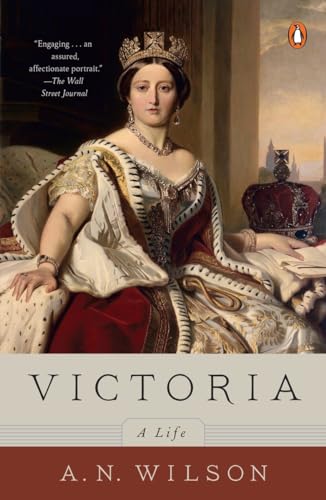
When Queen Victoria died in 1901, she had ruled for nearly sixty-four years. She was the mother of nine and grandmother of forty-two and the matriarch of royal Europe through her children’s marriages. To many, Queen Victoria is a ruler shrouded in myth and mystique, an aging, stiff widow paraded as the figurehead to an all-male imperial enterprise. But in truth, Britain’s longest-reigning monarch was one of the most passionate, expressive, humorous, and unconventional women who ever lived, and the story of her life continues to fascinate.
A. N. Wilson’s exhaustively researched and definitive biography includes a wealth of new material from previously unseen sources to show us Queen Victoria as she’s never been seen before. Wilson explores the curious set of circumstances that led to Victoria’s coronation, her strange and isolated childhood, her passionate marriage to Prince Albert and his pivotal influence even after death, and her widowhood and subsequent intimate friendship with her Highland servant John Brown, all set against the backdrop of this momentous epoch in Britain’s history—and the world’s.
Born at the very moment of the expansion of British political and commercial power across the globe, Victoria went on to chart a unique course for her country even as she became the matriarch of nearly every great dynasty of Europe. Her destiny was thus interwoven with those of millions of people—not just in Europe but in the ever-expanding empire that Britain was becoming throughout the nineteenth century. The famed queen had a face that adorned postage stamps, banners, statues, and busts all over the known world.
Wilson’s Victoria is a towering achievement, a masterpiece of biography by a writer at the height of his powers.
Die Inhaltsangabe kann sich auf eine andere Ausgabe dieses Titels beziehen.
Über die Autorin bzw. den Autor
A. N. Wilson is the author of biographies on Jesus, Milton, Tolstoy, C. S. Lewis, and Dante. His acclaimed histories The Victorians and God’s Funeral have made him an authority on Victorian-era Great Britain. A contributor to a number of British newspapers, he lives in London.
Auszug. © Genehmigter Nachdruck. Alle Rechte vorbehalten.
Part One
1
Authors
One gusty April day in 1838, Thomas Carlyle was walking in Green Park, near Buckingham Palace in London. Forty-two years old, the Scotsman had been living in the English capital for a little over three years, and he had lately soared to literary fame. His study of The French Revolution had been published in the previous year – the year in which Victoria was crowned the Queen of England – and the popularity of the two events were not disconnected. Carlyle had made what his first biographer, Froude, called a “vast phantasmagoria”culminating in the French people getting rid of their monarchy.
The English were not minded, in any very organized sense, to do the same, but Victoria became Queen in hungry times. The monarchy had not been popular in the first decades of the nineteenth century. J.A.Froude noted that “the hungry and injured millions will rise up and bring to justice their guilty rulers, themselves little better than those whom they throw down”.
Britain in those days was very far from being a democracy. It was governed by an oligarchy of aristocratic, landowning families. Its stability, as a state depended upon the functioning of the Law, the workings of two Houses of Parliament, the efficiency of the army and navy, the balance of trade. Parliament was representative, not democratic. That is, the members of the Commons were not elected by the People, but by a small number of men of property. In the reign previous to Victoria’s, that of her uncle William IV, the Reform Bill of 1832 had done a little to extend the franchise, and to abolish the more grotesque of the electoral anomalies – the so-called Rotten Boroughs, in which there were only a handful of electors. But the members of the Commons were not elected by more than a tiny handful of those whom they represented. Checking and approving the deliberations of the Commons was the function of the Upper House, the Lords, some hundred or so rich men who owned most of the land, and exercised most of the power, in Britain.
There had, as yet, been no French-style Revolution to overthrow these arrangements. And it was to be the care and concern of the British Governing classes to make sure that no such revolution occurred. The previous old King, William IV, having had a dissolute life, and fathered ten children out of wedlock, died legitimately married and reconciled to God, murmuring the words, “The Church, the Church”.
The twin institutions, of the Church of England, and the Monarchy, clearly played a vital role in the delicate balance of the British Constitution. The Victorians liked to tell one another that the monarch was simply a figurehead, kept in place by the Whig landowners, a figure who signed state papers and gave the nod to the deliberations of the House of Lords. This was not really the case. The monarch still occupied a position of real power in Britain, and if that power were to be exercised recklessly, or if the monarchy were hated by a hungry populace, there was no knowing what anarchy would ensue. The monarch depended upon the peerage; the peerage depended upon economic prosperity, and upon the rising commercial classes who could provide it; the shared powers of Trade, Land, the Law and the Church were all delicately, and not always obviously, interwoven in the destinies of that young woman glimpsed in the park by the historian. It was essential for her future that the other institutions should continue to support her; it was essential for all of them, that she should maintain the status quo, that she should not fail.
Victoria’s grandfather, King George III, a monarch who was politically active, and who had played a pivotal role in the shaping of British political history, was blind for the last ten years of his life, and at sporadic intervals in the last twenty years of his long reign (1760-1820) he had been raving mad. The fear that the royal madness was hereditary was ever-present in the British governing class, and the young Queen’s ministers watched every one of her tantrums, each emotional display, every instance of irrational behaviour, with anxiety.
George III’s son, who ruled as Regent during the times of blindness and madness, had been extremely unpopular, not least because of the sordid and cruel way in which he had divorced his queen, Caroline of Brunswick. By the time he was succeeded by his brother the Duke of Clarence (William IV) in 1830, it had looked very much as if the supply of possible heirs to the throne had all but dwindled. It was mere luck that William had not, in turn, been succeeded by his extremely unpopular brother Ernest, Duke of Cumberland, a scar-faced brute who was widely believed to have murdered his valet and married a woman who had killed her previous two husbands, and whose extreme Toryism made him hated by the masses. Had the young Victoria not existed, Ernest would have been the King of England, and Britain might well have made a second decision to become a Republic.
Carlyle himself, the historian who saw Victoria in her carriage on that April day, was by way of being a republican, certainly one deeply read in the era of the first Republic in the seventeenth century, and a hero-worshipping biographer of Oliver Cromwell. Carlyle was a sardonic and amusing man, whose stock in trade was a refusal to be impressed – by the English, who to his Scottish soul were ever alien, by the Establishment, which he found laughable, by the class hierarchy, very near the bottom of which he had been born. His hero was the German poet Goethe, and Carlyle sought, in the confused state of modern England, with its great social injustices, its teeming poor, its disease-ridden industrial cities, its Philistinism, some means of returning, with that poet, a positive attitude, to life, an Everlasting Yea. Carlyle on that breezy April day, was passed by a carriage: the Queen, taking, as he said in his Scottish way, “her bit departure for Windsor. I had seen her another day at Hyde Park Corner, coming in from the daily ride. She is decidedly a pretty-looking little creature: health, clearness, graceful timidity, looking out from her young face....One could not help some interest in her, situated as mortal seldom was...”
Carlyle, who went on to write one of the most magisterial royal biographies in the literature of the world – the Life of Frederick the Great – was peculiarly well-placed to see the strangeness of Victoria’s position as she swept past him in the carriage. (They would not meet until years later, when, both widowed and old, they exchanged small talk at the Deanery of Westminster Abbey).
She was indeed situated as mortal seldom was. This makes her story of abiding fascination. Her father and mother might so easily not have had a child at all. Once born, Victoria’s often solitary childhood was the strangest of preparations for what she was to become: not merely the mother of nine and the grandmother of forty-two children, but the matriarch of Royal Europe. She was either the actual ancestor of, or she was connected by marriage to, nearly all the great dynasties of Europe, and in almost each of those crowned or coroneted figureheads, there was bound up a political story. Her destiny was thus interwoven with that of millions of peoples – not just in Europe, but in the ever-expanding Empire which Britain was becoming throughout the nineteenth century. One day to be named the Empress of India, the “pretty-looking little creature” had a face which would adorn postage-stamps, banners, statues and busts all over the known world. And this came about, as the Germanophile Thomas Carlyle would have been the first to recognize, because of the combination of two...
„Über diesen Titel“ kann sich auf eine andere Ausgabe dieses Titels beziehen.
Suchergebnisse für Victoria: A Life

Beispielbild für diese ISBN
Victoria: A Life
Anbieter: World of Books (was SecondSale), Montgomery, IL, USA
Verkäuferbewertung 5 von 5 Sternen

Paperback. Zustand: Fair. "[A] shimmering and rather wonderful biography." --The Guardian When Queen Victoria died in 1901, she had ruled for nearly sixty-four years. She was the mother of nine and grandmother of forty-two and the matriarch of royal Europe through her children's marriages. To many, Queen Victoria is a ruler shrouded in myth and mystique, an aging, stiff widow paraded as the figurehead to an all-male imperial enterprise. But in truth, Britain's longest-reigning monarch was one of the most passionate, expressive, humorous, and unconventional women who ever lived, and the story of her life continues to fascinate. A. N. Wilson's exhaustively researched and definitive biography includes a wealth of new material from previously unseen sources to show us Queen Victoria as she's never been seen before. Wilson explores the curious set of circumstances that led to Victoria's coronation, her strange and isolated childhood, her passionate marriage to Prince Albert and his pivotal influence even after death, and her widowhood and subsequent intimate friendship with her Highland servant John Brown, all set against the backdrop of this momentous epoch in Britain's history--and the world's. Born at the very moment of the expansion of British political and commercial power across the globe, Victoria went on to chart a unique course for her country even as she became the matriarch of nearly every great dynasty of Europe. Her destiny was thus interwoven with those of millions of people--not just in Europe but in the ever-expanding empire that Britain was becoming throughout the nineteenth century. The famed queen had a face that adorned postage stamps, banners, statues, and busts all over the known world. Wilson's Victoria is a towering achievement, a masterpiece of biography by a writer at the height of his powers. Artikel-Nr. 00098023102
Gebraucht kaufen
EUR 4,05
Versand gratis
Versand innerhalb von USA
Versand innerhalb von USA
Anzahl: 3 verfügbar
Beispielbild für diese ISBN
Victoria: A Life
Anbieter: World of Books (was SecondSale), Montgomery, IL, USA
Verkäuferbewertung 5 von 5 Sternen
Paperback. Zustand: Good. "[A] shimmering and rather wonderful biography." --The Guardian When Queen Victoria died in 1901, she had ruled for nearly sixty-four years. She was the mother of nine and grandmother of forty-two and the matriarch of royal Europe through her children's marriages. To many, Queen Victoria is a ruler shrouded in myth and mystique, an aging, stiff widow paraded as the figurehead to an all-male imperial enterprise. But in truth, Britain's longest-reigning monarch was one of the most passionate, expressive, humorous, and unconventional women who ever lived, and the story of her life continues to fascinate. A. N. Wilson's exhaustively researched and definitive biography includes a wealth of new material from previously unseen sources to show us Queen Victoria as she's never been seen before. Wilson explores the curious set of circumstances that led to Victoria's coronation, her strange and isolated childhood, her passionate marriage to Prince Albert and his pivotal influence even after death, and her widowhood and subsequent intimate friendship with her Highland servant John Brown, all set against the backdrop of this momentous epoch in Britain's history--and the world's. Born at the very moment of the expansion of British political and commercial power across the globe, Victoria went on to chart a unique course for her country even as she became the matriarch of nearly every great dynasty of Europe. Her destiny was thus interwoven with those of millions of people--not just in Europe but in the ever-expanding empire that Britain was becoming throughout the nineteenth century. The famed queen had a face that adorned postage stamps, banners, statues, and busts all over the known world. Wilson's Victoria is a towering achievement, a masterpiece of biography by a writer at the height of his powers. Artikel-Nr. 00094671694
Gebraucht kaufen
EUR 4,05
Versand gratis
Versand innerhalb von USA
Versand innerhalb von USA
Anzahl: 8 verfügbar
Beispielbild für diese ISBN
Victoria: A Life
Verlag:
Penguin Books (edition Reprint), 2015
ISBN 10: 014312787X
ISBN 13: 9780143127871
Gebraucht
Paperback
Anbieter: BooksRun, Philadelphia, PA, USA
Verkäuferbewertung 5 von 5 Sternen
Paperback. Zustand: Very Good. Reprint. It's a well-cared-for item that has seen limited use. The item may show minor signs of wear. All the text is legible, with all pages included. It may have slight markings and/or highlighting. Artikel-Nr. 014312787X-11-1
Gebraucht kaufen
EUR 4,97
Versand gratis
Versand innerhalb von USA
Versand innerhalb von USA
Anzahl: 2 verfügbar
Beispielbild für diese ISBN
Victoria : A Life
Verlag:
Penguin Publishing Group, 2015
ISBN 10: 014312787X
ISBN 13: 9780143127871
Gebraucht
Softcover
Anbieter: Better World Books, Mishawaka, IN, USA
Verkäuferbewertung 5 von 5 Sternen
Zustand: Good. Reprint. Pages intact with minimal writing/highlighting. The binding may be loose and creased. Dust jackets/supplements are not included. Stock photo provided. Product includes identifying sticker. Better World Books: Buy Books. Do Good. Artikel-Nr. 8855553-6
Gebraucht kaufen
EUR 6,35
Versand gratis
Versand innerhalb von USA
Versand innerhalb von USA
Anzahl: 2 verfügbar
Beispielbild für diese ISBN
Victoria : A Life
Verlag:
Penguin Publishing Group, 2015
ISBN 10: 014312787X
ISBN 13: 9780143127871
Gebraucht
Softcover
Anbieter: Better World Books: West, Reno, NV, USA
Verkäuferbewertung 5 von 5 Sternen
Zustand: Good. Reprint. Pages intact with minimal writing/highlighting. The binding may be loose and creased. Dust jackets/supplements are not included. Stock photo provided. Product includes identifying sticker. Better World Books: Buy Books. Do Good. Artikel-Nr. 8855553-6
Gebraucht kaufen
EUR 6,35
Versand gratis
Versand innerhalb von USA
Versand innerhalb von USA
Anzahl: 1 verfügbar
Beispielbild für diese ISBN
Victoria: A Life
Anbieter: ThriftBooks-Atlanta, AUSTELL, GA, USA
Verkäuferbewertung 5 von 5 Sternen
Paperback. Zustand: Very Good. No Jacket. May have limited writing in cover pages. Pages are unmarked. ~ ThriftBooks: Read More, Spend Less. Artikel-Nr. G014312787XI4N00
Gebraucht kaufen
EUR 6,38
Versand gratis
Versand innerhalb von USA
Versand innerhalb von USA
Anzahl: 1 verfügbar
Beispielbild für diese ISBN
Victoria: A Life
Anbieter: ThriftBooks-Phoenix, Phoenix, AZ, USA
Verkäuferbewertung 5 von 5 Sternen
Paperback. Zustand: Very Good. No Jacket. May have limited writing in cover pages. Pages are unmarked. ~ ThriftBooks: Read More, Spend Less. Artikel-Nr. G014312787XI4N00
Gebraucht kaufen
EUR 6,38
Versand gratis
Versand innerhalb von USA
Versand innerhalb von USA
Anzahl: 1 verfügbar
Beispielbild für diese ISBN
Victoria: A Life
Anbieter: Wonder Book, Frederick, MD, USA
Verkäuferbewertung 5 von 5 Sternen
Zustand: Good. Good condition. A copy that has been read but remains intact. May contain markings such as bookplates, stamps, limited notes and highlighting, or a few light stains. Artikel-Nr. Q11D-00997
Gebraucht kaufen
EUR 6,42
Versand gratis
Versand innerhalb von USA
Versand innerhalb von USA
Anzahl: 2 verfügbar
Beispielbild für diese ISBN
Victoria: A Life
Anbieter: Heisenbooks, Fairless Hills, PA, USA
Verkäuferbewertung 2 von 5 Sternen

paperback. Zustand: Good. Artikel-Nr. PNJ-XBX-g-149847
Gebraucht kaufen
EUR 4,49
EUR 3,55 Versand
Versand innerhalb von USA
Versand innerhalb von USA
Anzahl: 1 verfügbar
Beispielbild für diese ISBN
Victoria: A Life
Verlag:
Penguin Putnam Inc, United States, 2015
ISBN 10: 014312787X
ISBN 13: 9780143127871
Gebraucht
Paperback
Anbieter: WorldofBooks, Goring-By-Sea, WS, Vereinigtes Königreich
Verkäuferbewertung 5 von 5 Sternen
Paperback. Zustand: Very Good. The book has been read, but is in excellent condition. Pages are intact and not marred by notes or highlighting. The spine remains undamaged. Artikel-Nr. GOR014795069
Gebraucht kaufen
EUR 3,40
EUR 6,61 Versand
Versand von Vereinigtes Königreich nach USA
Versand von Vereinigtes Königreich nach USA
Anzahl: 1 verfügbar